
Another Bullish Bear
We last looked at the Bullish Bears? back on October 21. Now, we have another Ursine to add to the bull camp: Steve Leuthold, Chairman, The Leuthold Group.
He is the subject of this week’s Barron’s interview:
Barron’s: What is your assessment of the market’s big selloff this fall?
Leuthold: There were two stages, the first being what we thought was a normal cyclical bear market. We thought the economy had peaked in last year’s fourth quarter. And then, about six weeks ago, after the market had come down about 25%, it looked to us as though the market had discounted a recession. By that time, the recession was eight or nine months old. So we thought that, as normally happens, the market tends to turn up in the middle of a recession.
Then came the liquidity freeze, which was the second stage, and that took us down over the past six weeks and really hurt us. We were doing pretty well up until that point because we were defensive, but we turned bullish too early.
In a recent research note, you wrote: “I remain bullish and wrong.” Is that still your sentiment?
Yes, it is. I was just looking at an interview I did with Barron’s in December 1980, and I was called a super bull. And then we got prematurely bearish in 1998, and people started calling me a perma-bear. Right now, though, I am not a super bull, but I am a very convinced and optimistic bull.
What underscores your case?
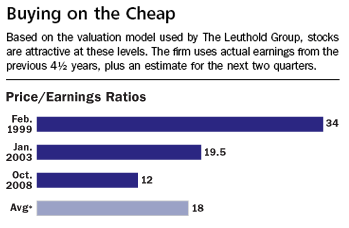
Certainly, the intrinsic value of stocks. In terms of our valuation model, it’s the most positive we have seen since 1984. We look at 28 different factors, including price-to-earnings and price-to-sales, and they are quite decidedly positive. Because we look at normalized earnings, we smooth them out over a business cycle. We have always done it that way, and we are at about 12 times earnings now.
Is that on forward earnings?
No. What we do is we take the last 4½ years of historical earnings, and then we project forward only six months. Then we divide the whole thing by 20, or the number of quarters. We have found over the years that it is almost imperative that you do that — that is, smoothing out the business cycle to get the underlying level of earnings.
How does that 12 times P/E ratio compare to other periods?
Looking back 55 years, we are in the 15th percentile, well into the bottom quartile, and this is where markets very often have bottomed out. So on a valuation basis, this is a really cheap market. At these levels, we are really down in bull-market territory. From here, on a one-year basis — and this goes back to 1926 — the market has been up about 18%, on average, in the next year.
There’s more at Barron’s, and their interviews often show up at Marketwatch of Yahoo finance.
>
Source:
INTERVIEW: A “Perma-Bear” Warms to Stocks Steve Leuthold, Chairman, The Leuthold Group
LAWRENCE C. STRAUSS
Barron’s, NOVEMBER 3, 2008
http://online.barrons.com/article/SB122549293587789385.html



November 1st, 2008 at 9:59 am
Thanks for the heads up. Leuthold is a hometown hero here on the frozen tundra for the yeoman work he does on the markets. His grizzly fund has served me well over the last year and for real market wonks his green book perspectives for the professional is akin to Proust, every month. Another spot where Barrons interviews sometimes turn up is the canadian site beearly.com.
November 1st, 2008 at 10:12 am
I think he’s a couple years early on this one, as well. We’ll see a nice bounce but the the bottom is not in for this bear market.
November 1st, 2008 at 10:32 am
“Steve Leuthold” Who?
November 1st, 2008 at 10:38 am
I think he’s deceived by the unusually, and probably unsustainably, high earnings most companies enjoyed during much of the past bubble. They were way above historical norms and their reverting to the mean is plenty of explanation for a much lower bottom than many expect.
November 1st, 2008 at 10:52 am
Let’s say it is the “bottom”. How far “up” can this ultimately go over the next 2-3 years with consumer tanking, credit cards defaulting and contracting, job losses, etc? Roubini is predicting now a 24-month recession beginning Jan 08 through 09, with stagnation considerably longer. Isn’t it more likely this will be “sideways” for a long time with tradable rallies and declines along the way?
November 1st, 2008 at 11:14 am
Barry, registration and login to your site both happen over an unsecure link? If so, that sucks!
~~~
BR: I’m just getting to know Word Press. If you have any suggestions, or if anyone knows how to adjsut this, please let me know!
(How secure does your comment name and pw have to be?)
November 1st, 2008 at 11:28 am
The Value of Forecasting
I admit upfront that I am an old man who probably can’t change his ways or even understand the modern trading world. But I have managed to survive decades as a market trader without ever making a market forecast or prediction. Most traders I have known who base their trading on forecasts — whether long or short-term — are no longer traders. Therefore, I am fascinated with the discussions on this blog that argue remarkably precise price AND time predictions. When I was far younger I also tried such folly. It became crystal clear early on that my predictions could not claim even 50-50 status. In the case of Steve Leuthold: he too is old; I know him; he does NOT base his investment strategy on market predictions; and like me has survived a long time.
November 1st, 2008 at 11:30 am
I have no clue right now. I’m up for the year, 401k is doing great and I’ve had a fairly good feeling for the market over the last few years but right now I couldn’t be more unsure. I’m only 10% invested currently.
The Fed has expanded its balance sheet by a TRILLION dollars but asset deflation still seems inevitable.
The consumer is finally rolling over but historical valuations make some things look cheap.
Commodities are being repriced but that is more to demand destruction than anything.
Pension funds still haven’t been bailed out…that alone could add another half a TRILLION.
The deficit will be over a TRILLION next year…
The WORLD is slowing down, just look at the Baltic Dry Index, how much is priced in?
Have we adjusted our outlook enough? Are we pricing in enough of a correction? Did we over shoot? It sure looks like the wrong time to turn bullish but maybe that is why it is right.
I just don’t know…go half in?
————————————————————————
Barry, love the new look but the fact of the matter is we all come for the content. You’ve done us all a great service over the years. Keep up the good work and thank you for your level headed, commonsense approach.
November 1st, 2008 at 11:54 am
All one has to do is read Mauldin’s newsletter today and see the surge in credit card spending, and understand the second biggest vendor is McDonalds, and then understand that the liquidity problem is the symptom of a much bigger solvency problem, which the government cannot under any circumstance fix without dramatically raising the wages of most workers in this country. Ever wonder how the guy making 10 bucks an hour at Home Depot can pay his bills? Guess what? I have no mortgage and I fix my cars, plumbing, electric myself. I have children in public school. And ten bucks an hour would barely get me through the food bills. Basic tenet of capitalism that stupid capitalist don’t understand. If a person works, he needs to be compensated enough to survive, even if he’s not in a union. It’s that radical idea of a living wage, which companies in the late eighteen hundreds would have been shamed out of town if they did not provide. Bust the unions in order to screw the worker and you will eventually screw the system because the system is composed of people. That is exactly what has happened here and abroad. The system is completely unbalanced. The stock market will go up for a while and then come crashing down until gradually this problem fixes itself. Globalization and massive credit expansion (and don’t believe for one minute that credit card companies aren’t just as foolish as the investment bankers who developed their phony vehicles for creating wealth out of thin air) allowed the capitalist clowns who compensated themselves beyond any dreams and screwed the rest of their company mightily to carry out the charade. My investing suggestion: SRS as it approaches 100. The models Leuthold speaks about are going to blow up in his face, just like technical support levels have in the last two months. Just as this problem is ultimately based on the lack of real wages in this country and some others, so will the stock market problem be based on earnings. You cannot continue to earn money when your workers do not receive money. Credit card debt expansion is a symptom of a massive debt disease.
November 1st, 2008 at 11:55 am
It baffles me how ordinarily sane individuals use PE, based on historical earnings (or historically-based visions of future earnings) as a measure of valuation, when the economy is CLEARLY running over a cliff, with earnings poised to contract at a furious rate. PE is a reasonable tool to use ONLY when a trend has been established and offers some reason to expect that the future will be similar to the recent past. Historical extremes only apply as limits when they are not being reset to wider limits.
The leverage that has been used to de-rail the global economy shows that in the late 1920’s, they had no imagination when it came to using leverage on a large scale. How does one even go about figuring the leverage employed in the CDS market, anyway? If I figure it by dividing the effective capital by the backing assets … well, dividing $60T by zero doesn’t give me any useful results.
Are not sales still required to generate earnings? Is this a supposition of exports supporting our dismal economy, and if that is the case, exports to where?
Perhaps the ginormous injection of credit is sufficient to turn things around, and the effects will be seen in the first quarter of 2009, but from my perspective, the forces driving the destruction of credit are still hale and hardy, and chewing away at us. All that the Fed+Treasury have done thus far is to make sure that the process of economic destruction is well-lubricated, and that the economy shrinks in a smooth and effortless manner — oh, and to ensure that top management has money to pay the bonuses and deferred compensation to the cretins at the top, while letting the cretins at the bottom take the full impact.
Maybe all this is just a tempest in a teapot, a case of differing time horizons. Perhaps we will have a couple of thousand point run-up over the next 3 weeks, following by a five-to-six thousand point drop. I’m not a day trader, so those kind of moves hold only danger for me.
Now Steve Leuthold is a experienced investor who’s been around for a number of years, so how can he be bullish at this point? Is this a case of premature estimation, like his 1998 performance, when he was 2-3 years early with his timing call, and missed out on a HUGE run-up? Will he look back a decade from now, and say, “Sure the market dropped another 50% in the first half of 2009, but by 2010 it had begun to recover — just as I predicted”. And then the next wave of ARM resets hit in 2011.
How well have the Leuthold Group’s portfolios done against the indices over the long haul? Can he dance fast enough?
November 1st, 2008 at 11:59 am
BARRON used to be reputable now it’s shill paper. another bear turned bull LOL ,out of the woodwork they come. using 4 1/2 years average past historical earnings is worthless. earnings were credit and debt bubble infused most of them coming from the financial service sector shuffling worhtless paper around. profit margins are still way to high and will revert well below the mean. we are following the roadmap of the japanese (the road we have chosen but criticized the japanese for) anyone who thinks our stock market or casino can’t replicate the japanese casino has a screw loose. welcome to deflation japanese style s+p 650 and below
November 1st, 2008 at 12:21 pm
Barry,
Apologies, the tone of my earlier comment was out of line. I do appreciate the new site and the work that has gone into it. However, I think that registration/login over an unsecure link is something you should remedy.
November 1st, 2008 at 12:36 pm
I hope you guys know know what you are talking about. Last time you all went bullish on Oct 13th I caved in after holding my shorts for over a year and got out at dow 9700ish only to watch the market turn and slam down. I am so bummed in a moment of weakness after holding out and ignoring CNBC for over a year I sold out my shorts on that day only to see the market go to 8500 the next day. I lost a lot of confidence in this site and its commenter’s..
Don’t get me wrong.. I am not a victim .. I made the decision but mostly due to the overwhelming bullishness on this board..
This time around I am extremely skeptical.
~~~
BR: Really? The “overwhelming bullishness of this board”? There was a Bull call on Oct 10, at 7900. But you would be hard pressed to describe most commenters here as bullish…
November 1st, 2008 at 1:00 pm
@Triplec – I don’t feel an “overwhelming sense of bullishness” on this board – the most common expectation I see is short term bounce followed by a retest of the low which may or may not hold, with the wildcard being Obama and this holiday season consumer.
Personally I feel we’re building ourselves up for an even bigger commodity/industrial bubble a few years out – we’ve shown billions of people in developing countries how their lives can be better and they’re not just going to give up and say “ok then, back to how things were”. Barry’s comment that gold may see 3,000 but pass through 300 on the way fits pretty much exactly how I feel about the whole commodity market.
In the meantime, rigs and mines are starting to close, drillers are laying off crews and all the investment in energy alternatives is slowing. When the demand comes back, the supply won’t be there.
November 1st, 2008 at 1:03 pm
triplec
The lesson you have learned is the lesson all traders have learned sooner or later. Remember the first three rules of successful trading:
1) NEVER, NEVER, NEVER take any advice or let anyone else influence your trading decisions. To do so merely reveals that you do NOT have a systematic and disciplined approach to investing. A surprisingly large and varied number of displined investment approaches can be successful over time. Stick with one and ignore all others.
2) See Rule #1 — repeat it often.
3) NEVER, NEVER, NEVER base your investment strategy on market forecasts.
November 1st, 2008 at 2:10 pm
On the subject of Leuthold’s bullishness.
If one predicts, on 11/1/08, that a diversified portfolio is likely to be higher in value at some unspecified point in the future, that prediction is going to be vindicated sooner or later.
Of course, making a bullish forecast in November of 2008 is worth far less to anyone than making a clear cut bearish forecast in October of 2007.
November 1st, 2008 at 2:20 pm
We’re in uncharted waters so relying on any amount of historical data seems somewhat foolhardy.
November 1st, 2008 at 4:22 pm
So he smooths his P/Es over an arbitrarily chosen 5 year business cycle? Why 5?
November 1st, 2008 at 6:20 pm
Mac E.:
What system do you generally use? I can’t see how any long term profitable system cannot include some type of expectation of what’s going to happen, at least in the very short term.
I don’t mind getting ideas from others on this board. I think them out myself to see if I think they are worthwhile. For example, leftback’s advice to buy SRS looked very promising, although it took until Sept. to pan out. My only problem with it was my stupid execution so I only made about 25% instead of doubling my investment.
On triplesec’s misadventure, I felt sort of the same way. I had independently come to the conclusion that there would be a bounce and jumped in whole hog too early as I tend to, and got overleveraged with some calls. But, I made it all back and then some this past week. And, I can’t blame Barry for that: his advice was “dipping your toe in” with stop orders in place, which is what I should have done. As for jumping too early, Rothschild said when asked how he made so much: “Because I never buy at the bottom and always sell too soon.”
November 1st, 2008 at 7:29 pm
Mike in Nola
I would be pleased to share with you or anyone else how I trade the market. However, I am sure that I would bore hell out of the participants on this blog with an explanatio0n of my “system” as it were. Let me offer a few, hopefully brief, comments.
THE DARK SIDE
You will probably not want to read more after I explain the downside to my approach. As soon as I lose money on a trade, I exit the market totally. For example, from August 1996 through July 2000 I did not make a trade. Greenspan called it “irrational exuberance,” but I called it “irresponsible idiocy.” I also did not make a trade from August 2006 through August 2007. (I did have a day job that paid the bills.) I did not “miss opportunities,” I happily missed losses because even in retrospect I have no way to explain or trade those markets. I was well aware that both periods were bubbles leading to disaster, but I could not forecast the end.
THE BRIGHTER SIDE
In the vernacular of Wall Street my approach is that of a “quant.” I let Mother Market take me into and out of the market. There are no forecasts. The system has five basic principles:
(a) It is a probabalistic world: I use some relatively simple models to calculate the probability of a trend continuing or reversing — I don’t forecast the trend.
`
(b) The only certain forecast of Mother Market is that “the market reverts to the mean.” But what is the “mean?” People use trend lines, regression lines and moving averages. Instead, I use the New York composite, the Mother of all indexes. More precisely, I use the 21 day MA of the NYSE.
(c) The NYSE always leads in defining the market trend. I don’t trade the NYSE but I do trade the NDX and S&P in terms of their divergence from the NYSE.
(c) I am almost always both long and short, the ratios differ over time, depending on the probabilities of trend change.
(d) I scale into long and short positions. 5, 10, 15 and 20% market reversals lead to 25%, 50%, 75% and 100% positions either long or short depending on market direction. In other words, a low probability (at least once upon a time) 20% uninterrupted market move up will leave me 100% short and vice versa.
Given this oversimplified description, many will find the holes. It ain’t that simple but, as confessed above, uninterrupted up moves take me out of the market.
November 1st, 2008 at 8:27 pm
Hard pressed indeed. Many here are clearly bearish because of what they fear will happen to the economy. Yes, home prices will continue to decline and there will be more foreclosures. Yes, unemployment will continue to increase. Yes, consumers are maxed out and will have to start saving. But we know all that.
In fact, we know all that with some precision. Just look at the monthly data. If you plot year-over-year rates of change in home prices, sales of existing and new homes, and initial and continuing unemployment claims, you’ll see that (a) the rate of change of existing home sales bottomed in January, (b) new home sales bottomed in April, (c) home prices are now in the process of bottoming, (d) personal saving flipped from negative to positive in May, and, given the level of unemployment claims in December 2007, (e) unemployment claims are going to bottom next month. “Bottoming” meaning that the declines or increases have started to slow down rather than continue to speed up. Real personal consumption expenditures peaked in May and so the rate of change should bottom in the second quarter of 2009. We also know that foreclosures related to sub-prime adjustable rate resets are peaking in the current quarter, etc.
Note that these trends, particularly evident in the employment data, are remarkably similar to trends in previous recessions. That is, so far this recession has been more or less vanilla. This point was made by Stratfor in their commentary yesterday:
“The crisis is routinizing itself. We mean by this that the economic pattern — as opposed to the financial — is taking a recognizable form. We have slowed somewhat more rapidly than normal, but commodity prices have plunged early in the piece. We would expect bad numbers in the last quarter, but possibly not as bad as some have said. The problems will persist through the spring, but we should see recovery in the summer. We are in recession, and it looks pretty much like what we saw in the past two recessions. It certainly doesn’t look anything like the 1970s. Interest rates aren’t through the roof, and we don’t have double-digit unemployment and inflation. So in trying to benchmark this process, the United States is behaving better than most expected, and in line with what we have seen in the past.”
Yes, this is going to be longer than your average recession, but, assuming it started in January, it has already been longer than your average recession. That is, we are a long way into this recession and we are now getting more visibility regarding how and when it will terminate.
The economy is going to get worse before it gets better, but, as Buffett says, “if you wait for the robins, spring will be over”.
November 1st, 2008 at 10:38 pm
Mac E: You’re right; it is boring
Not. It sounds pretty reasonable from what I can gather from the explanation. I just don’t think I can be that disciplined. I have not really traded before this year. But, the overwhelming evidence of a coming crash and the discovery of the ultrashorts I could use in my IRA persuaded me.
I stayed out in the late 1990’s also. As someone with a lot of tech knowledge, it seemed like a complete fraud.
November 1st, 2008 at 11:48 pm
Mike in Nola
For some new to the trading (as opposed to investing) game, I think the most compelling lessons of the current cataclysm are revealed by the disasters apparently wrought on the once mighty. From the Icahns to the John Henrys (even his Red Sox lost) to a countless number of hedge funds — even I’ve heard to the likes of Paul Tudor Jones — people with extraordinary trading histories have taken huge — if not fatal — hits.
As the song says, “know when to fold em.” Its why my best rule is that which says I get out altogether with the first loss. The first loss is the best loss. In any case, always have an exit strategy.
November 2nd, 2008 at 8:29 am
One has to respect Leuthold’s prior record BUT this time around IS different. The psychology of the markets, and confidence therein, has changed, similar to the late Nixon/Vietnam era when trust in government evaporated and has questionably yet to return. Investors and traders alike now realize what the current band aids created by Washington are: a combination of Humpty Dumpty and the Emperor Has No Clothes. We are on a long, long, slow spiral downward, and the few predictable bounces will offer an opportunity to avoid greater future fiscal pain. This is preserve capital time. What’s safe? Not much, and inflation and the dollar’s coming enema will effect all, for a while.