Just How Bad Was October 2008 ?
Not too shabby a week — plus 11% across the major indices, with some areas even stronger. Of course, that comes from deeply oversold levels, with stocks peak trough down 27% within October. The key question going forward is whether or not this past week’s snapback rally has legs. But rather than guess about that, let’s look at some of the more intriguing data points from October 2008.
Gee, I picked a bad month to stop sniffing glue:
>
EQUITIES:
• October was the worst month for the Standard & Poor’s index of 500 stocks in 21 years — since the 1987 stock market crash. (NYT)
• The Dow dropped 14% drop over the past four weeks — the biggest October decline since 1987, when the crash sent markets down 23% for the month. The S&P 500 was down 17%, and Nasdaq fell 18%. This ranked as the 15th worst monthly decline for the Dow Industrials since 1900.
• Global equities in October shed $9.5 trillion. (Barron’s)
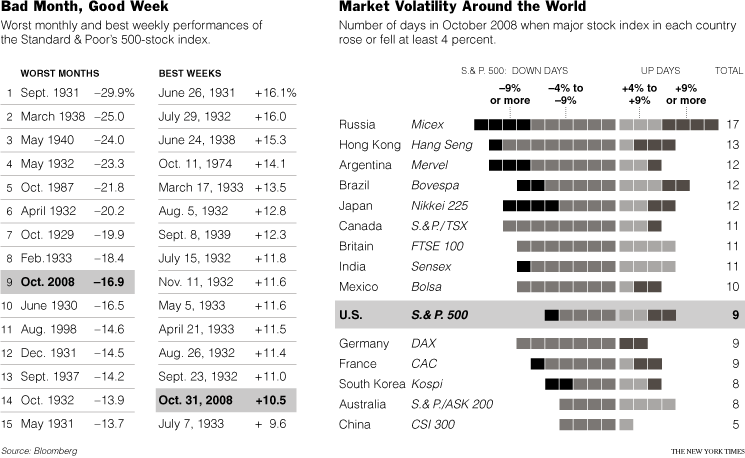
• October 2008 was the most volatile in the 80-year history of the S.& P. 500. (see NYT chart, at right)
• We had the most down days in a single month since August 1973. (Marketwatch)
• Compare 3 recent SPX Bear Markets: -46% from October 2007; Compare that with 1973-74 down 48% over 23 months. The 2000-03 bear was 49 percent over nearly 3 years.
• The S&P 500 had the most volatile month since November 1929 (1% moves higher or lower).
• October had two days where the indices were up more than 9% — the 10th time this has occurred over the past 80 years. (NYT)
• During an eight-day losing streak at the beginning of the month, the Dow lost 2,396 points.
• Consider days with 4% moves up or down: None from 2003 through 2007; Three throughout the 1950s and two in the 1960s. October 2008? 9 days with four percent plus or minus. That edges out September 1932’s record of 8. (NYT)
• The Dow had its second-biggest point drop on record, of 733 points. The Dow posted two of it biggest point gains, climbing by 936 points (October 13th) and 889 (October 28th)
CURRENCY:
• US dollar gained 14.3% against the euro, 22.3% against the Canadian dollar, and 31.8% against the Australian dollar. This is the fourth best month on record (using data going back to 1967). March ‘91, November ‘78, and October ‘82 are the only three months where the US Dollar saw bigger gains. (Marketwatch)
BONDS:
• Perhaps the credit crisis is finally easing: Overnight Libor dropped to its lowest levels in 6 years, falling to 0.73125%, down from 5.09% on October 9th. (Bespoke)
COMMODITIES:
• Copper and Crude oil had their worst one-month losses ever (Barron’s)
• Crude-oil futures lost one third of their value, falling 33% during the month. This was their biggest monthly percentage drop since trading began in 1983. Average retail price for gasoline fell 31%, ($2.504 a gallon), down 14% from a year ago.
• Gold lost 18% for the month — its worst monthly drop since 1980.
• Wheat had its largest monthly decline in 22 years; Copper and Aluminum had their largest drop in more than 20 years; Sugar for its biggest monthly fall in a decade. (WSJ)
GLOBAL BOURSES:
• Emerging-market bonds popped 8% over Treasurys — a six-year high.
• Market cap losses: Standard & Poor’s global indexes lost $6.79 trillion (September’s 2008 lost $3.4 trillion)
• European stocks rose 12% (Dow Jones Stoxx 600 Index) — their biggest weekly gain since 2001. (Bloomberg)
• MSCI Emerging Markets Index fell nearly 30% — the worst month since August 1998. Thats a loss of about ~ $900 billion. (Marketwatch)
• Japan’s Nikkei 225 hit a 26-year low.
• Iceland’s exchange crashed 81% for the month. (Marketwatch)
• Russia had the world’s most volatile index, with 17 days with of more than four percent moves in the Micex index. For the month, the Micex lost 28.8%, but had a weekly gain of 42.5%. (NYT)
• Argentina’s Merval and Brazil’s Bovespa indexes were set to make their biggest one-month percentage losses since August 1998, with the Merval falling 37% and the Bovespa losing 25%.
>
>
>
Source:
So how bad was October? One for the history books
Laura Mandaro & Nick Godt
MarketWatch, Oct. 31, 2008
http://tinyurl.com/5p7mdl
OVERNIGHT LIBOR AT LOWEST LEVEL IN YEARS
Bespoke Investments, October 30, 2008
http://bespokeinvest.typepad.com/bespoke/2008/10/overnight-libor-at-lowest-level-in-years.html
A Monthlong Walk on the Wildest Side of the Stock Market
FLOYD NORRIS
NYT, October 31, 2008
http://www.nytimes.com/2008/11/01/business/01chart.html
European Stocks Post Biggest Weekly Rally Since 2001
Michael Patterson
Bloomberg, November 1 2008
http://www.bloomberg.com/apps/news?pid=20601087&sid=a.QaMNs7UGxk&
Commodities Take Hit in Month
TOM SELLEN
WSJ, NOVEMBER 1, 2008
http://online.wsj.com/article/SB122544101179287615.html
MONTHLY PERFORMANCE FOR OIL, DOLLAR, DOW
Bespoke Investments, October 31, 2008
http://bespokeinvest.typepad.com/bespoke/2008/10/monthly-performance-for-oil-dollar-dow.html
Deflated Expectations
DEBBIE CARLSON
Barron’s COMMODITIES CORNER NOVEMBER 3, 2008
http://online.barrons.com/article/SB122549287954389335.html
Stocks Gain as Brutal Month Ends
Michael S. Derby and Howard Packowitz
WSJ, OCTOBER 31, 2008, 10:36 P.M.
http://online.wsj.com/article/SB122544813555487665.html



November 1st, 2008 at 11:58 am
The fundamental issue for traders in reciting these events is the choice between two interpretations:
(1) bad public policy coupled with bad behavior by financial institutions produced a cataclysmic, but still short term, market outcome THAT WILL BE CORRECTED. Therefore, we can use the history of past October Surprises to guess/forecast subseqnt rallies. That is to say, the System hasn’t been broken and past is prologue.
Or
(2) The System is broken. History is no reliable guide (neither for public policymakers nor market traders). This is not necessarily gloom and doom. A new system will be created but it will take time and there will be many periods of turmoil along the way.
Personally, I stand committed with the second view. Indeed, to me, much of the action that led to the bubbles post 2002 were (desperate) efforts to avoid confronting systemic change. Given what has transpired already, we are in the hurricane of systemic change.
November 1st, 2008 at 12:50 pm
This being the most volatile period in the 80 year history of the S&P 500 is curious. Seems stocks might be quite vulnerable to the “VW Bug.”
November 1st, 2008 at 1:20 pm
As a commenter earlier this week said, 10% moves like the market has had in October are not the signs of healthy markets.
November 1st, 2008 at 3:05 pm
“The Dow posted two of it biggest point gains, climbing by 936 points (October 13th) and 889 (October 28th)”
I seem to remember someone timestamping Long calls on the 10th and 24th, but the name is escaping me..
Nice BR.
though, as Mac E. delineates, above, I’d be found in Camp #2, as well..we’ll have to Hope that doesn’t change to Stalag 13, or, worse, FEMA’s Rex-84
http://clusty.com/search?input-form=clusty-simple&v%3Asources=webplus&query=Rex-84
November 1st, 2008 at 3:07 pm
O, that’s where those ‘emoticons’ come from…
auto-estilio out of WP.
can those things be tamped down?
November 1st, 2008 at 3:12 pm
“Compare that with 1973-74 down 48% over 23 months.”
While it is true that the official start finish of the 73-74 bear is commonly held to be 23 months I would note that the market did sell off almost 20% from Jan 73 to July 73 where upon it then rallied over three months to just 5% of the old highs during Oct from which it then sold off 45% reaching a low in Oct 74 followed by a retest in Dec 74.
I point this out to continue to make the case that Oct 73-74 is still the best overlay to Oct 07-08. Time will tell. A lot of the world ending depressionary talk was also in vogue which would make sense. When price charts run similar, generally speaking, so will the fundamental excuse making. Price vs time equals psychology, every time.
November 1st, 2008 at 4:59 pm
THE END OF HISTORY?
P Neid argues for the congruence of 1973-74. My systemic change argument says that history is not relevant. The fact that this decline has happened in half the time without a 20% retracement either is the smallest part of the story.
What’s similar 1973 vs 2008?
1) Precursors: Nixon took dollar off gold standard and dollar swooned; Arthur Burns as Fed Chief, slavishly followed Nixon’s orders and undertook very easy monetary policy to ensure 1972 election outcome; Kissinger married the Shah and effectively backed the insane British policy in Suez leading to the first Holy War and rapidly rising oil prices; and we were led by a functionally insane President abetted by reluctant criminals many of whom spent jail time. (On the latter we can only hope that similar outcomes obtain.)
2) Economic Conditions: There simply are few relevnt similarities between then and now. Then the dominant issue was inflation not depression (read deflation). I stll have my WIN button (Whip Inflation Now). The major banks were not threatened by imminent extinction — Citicorp was just beginning what became a huge move toward global banking). The dollar, though cheaper, was still the dominant, ne the only, reserve currency; in fact the nascent Eurodollar market was juft beginning to blossom hugely. General Motors was reaching its peak of world auto sales; IBM was becoming dominant in world IT spending and so on; and the apparent softness in labor statistics can be totally explained by a massive infusion of females into the workforce.
The 1973-74 period, I would (and have) argued was the end of the post WWII, global economic system. It was the end of a union-based, industrial manufacturing economy holding near-monopoly status in the global economy. This systemic change took at least 17 years to clear — from 1966 through 1982. Remember that 1973-74 was only the bloody middle of a very long Bear Market.
November 1st, 2008 at 4:59 pm
Patrick,
1973 has been my preferred comparo for some time . . . it works very well on several levels
See this
http://www.ritholtz.com/blog/2006/05/comparos-with-the-1987-crash/
and this
http://www.ritholtz.com/blog/2007/04/1987-versus-2007/
November 1st, 2008 at 6:30 pm
Sorry folks…stop trying to fit this current problem into history…in 1973, Total credit was 150% of GDP…as of 6/30/08, it was 357%. Face it…we are screwed. This problem has no precedent and indicates that a new financial system is called for. One where capital is allocated properly, without central bank meddling.
November 1st, 2008 at 6:48 pm
I’m still with you, Steve Barry. I don’t think this problem has a close enough precedent for an accurate comparison. I think we’re all in deep, deep trouble. I know that random anecdotes are hardly reliable, but the more I hear from people I know (who are some of the most responsible people I know) about the challenges each and every one of them are facing (e.g. lost jobs, business, unable to sell/hold onto homes, etc.), the more I believe this to be true.
I’ll be biding time and adding to my shorts if this market continues to creep up. Just hope I don’t run out of free capital in the process.
November 1st, 2008 at 7:20 pm
It goes without saying that I’m a chartist. I won’t bore you with my bona fides going back to the late seventies, honorable mention chartist of the year crap etc as a commodity broker/trader. With that out of the way I further concede that I won’t argue fundamentals with anyone. That is not to say I don’t follow them–I do very closely. It is a must with any serious attempt at bubble analysis.
As one of the early practitioners of chart overlays, too many melted plastic sheets in EFHutton office Xerox’s to count, the very important lesson I learned, I mentioned above–Price vs Time = Psychology.
That said, similar charts, not the distorted price compacted 1987 vs 2007 chart that Barry debunked in his link, will always have similar outcomes until they don’t. That is not a cop out. What I am saying is that we are all in the prediction business with some us as traders putting our portfolios at risk in said analysis.
So, I hear today’s fundamental story but I’m still left with constructing a trade. What I know from the charts and history is that 45-60% declines are generally incredible investment opportunities. The 1929-32 bear being the exception. Even then in the depths of the greatest depression the market rallied from 41 to 200 from 1932-38. I can make money in that. But back to today. It always returns to price vs time = psychology. If past is prologue we will get a retest and hopefully a new low under 2002 lows confirming the breaking of the 1970 lows confirming today’s depressionary talk and I will be a buyer, a significant buyer especially having liquidated everything a couple of months ago. (If the low is in I’ll have to be happy with my small airline position.)
If I’m wrong I’ll take a hit and start anew in my research this time focusing on 1930-32 because as I said price vs time blah, blah, blah. The important thing is I’ll will have planned my trade and traded my plan. I don’t care what the news is. It has to be bad, almost world ending, to buy stocks 50% off the highs.
As to the suggestion that we are in a long term trading range I have no problem with that, in fact that is what I hope. John Templeton said as much years ago. I won’t argue with him.
November 1st, 2008 at 8:00 pm
For trading purposes, I would like to see a follow-through day in the next 6 sessions.
From a different perspective, I consider that bad debt was the basis for the past expansion. In truth, a significant portion of all gains since 2003 have been phantom, based on Ponzi financing – not only can that credit expansion not be relied upon to continue to raise prices, but vast phantom gains are still being wiped from the books. Have the markets priced all this in, overshot to the downside, or do we still have a ways to go? I keep remembering the 75+% fall in value of the Nikkei – an unwind of a similar yet smaller bubble.
I do not see how an L-shaped recession can be avoided – debt has become a stigma rather than status symbol, And that is a radical change in perceptions.
November 1st, 2008 at 8:26 pm
Reason 1 why this has no precedent was the one I outlined above…the Total Credit per GDP is now 357%. The economy is addicted to debt…in fact all we have seen so far is a slowdown in the growth of debt. Official Fed releases have not even shown a contraction yet. Credit/GDP relates to the degree to which the economy can service its debt. If a homeowner can’t service his debt, he gets foreclosed.
Reason 2 is that we are at the precipice of a major demographic shift, as baby boomers retire. As they do, they will stop contributing to 401k’s and will have to reduce equity allocation.
November 1st, 2008 at 9:26 pm
S Barry
As usual, I quite agree with your cae but will you allow me to expand on it?
(1) the credit/GDP ratios are far worse in Europe and I have always believed that the “end game” decline would start in Europe.
(2) For 25 years we have depended on foreign sources to fund our debt. Game’s up. Over the next few months the US must peddle Trillions of dollars (yes with a T) of new debt. Who will buy it?
(3) Checking the recent GDP numbers reveals that government expenditures were about all holding us afloat. The largest share of those expenditures are state and local government. Trust me on this one, state and local governments are going under. That is the next shoe to drop.
(4) Much has been done and will be done to save dead and dying industries and companies. Sadly, it ain’t going to work. Autos, auto parts and retailers, small retailers and large, construction, brokers, and on and on. Presumably the government will assume the retirement and other benefit programs as well as “systemicaaly threatening” debt obligations. What will this do to your credit/GDP ratios?
November 1st, 2008 at 10:15 pm
“I keep remembering the 75+% fall in value of the Nikkei – an unwind of a similar yet smaller bubble.”
Winston,
Until this current situation plays itself out a little more, the Nikkei/Japan real estate bubble has still be considered the greatest bubble of the last 100 years.
Consider that the Nikkei which used to be called the Nikkei Dow Jones, calculated the same as the Dow constituting the 225 largest companies, in less than 20 years went from 2,000 to 40,000 while its real estate market had dramatic gains such that the value of Tokyo real estate alone doubled from 1987 to 1989 reaching a value that exceeded the entire value of the state of California. Nothing here even comes close. The internet bubble had some of the same feel. The Nikkei after suffering a 14% plunge on Oct 20, 1987 to 21000 then turned around and almost doubled in two years. All this from the world’s second largest economy. The intertwining of corporations, banks and real estate trusts is still being worked out.
While our current mess may in fact surpass the Japanese benchmark I’ll have to see it to believe it.
November 2nd, 2008 at 2:24 am
Mac,
By all means…love your expansion. If you look at the Depression starting in 1929, it started when credit/GDP was estimated to be about 160%. That figure spiked to a high of 260%, not because credit was a bubble, but because GDP collapsed. In the present case, if GDP falls faster than total credit, we could see a super spike in credit/GDP to 500%.
November 2nd, 2008 at 4:08 am
Does anyone know what it means when overnight LIBOR is lower than the T-bill rate? Is there an expectation of more short-term rate cuts?
November 2nd, 2008 at 6:20 am
jd:
I’m trying to figure that out myself…the overnight LIBOR has jumped around a lot lately. Just as it wasn’t a good thing that the rate was high and banks didn’t want to lend, now it is so low, it indicates there is no demand for the money…or maybe banks can get all they need from the Chinese Menu of Fed facilities.
November 2nd, 2008 at 9:26 am
S Barry
Why should we assume that LIBOR is relevant anylonger? Seems like the FED and the Bank of England have become the “interbank.”
On your credit/GDP ratio argument: what is the way out?
In my simple mind there are only three ways to significantly reduce debt:
1) renegotiate terms — but with whom, how and would it matter?
2) outright default — right now there is a growing global competition for capital to finance bailouts but it is highly unlikely to have positive long-term effects. There used to be competitions in currency devaluations in such circumstances but could this not become competitions in debt default?
3) inflate your way out — this is the implicit if not the explicit objective of the FED. It would take a whopping inflation; it would severely injure the elderly and the poor generally; but, then, we wouldn’t have to raise taxes on the rich to pay down debt.
November 2nd, 2008 at 9:29 am
Help!
Where on the new ww.ritholtz.com site does one go to manage one’s account, as in change one’s password from a string of random characters assigned by ???? to some mnemonic combination I can remember?
Believe dead_hobo has had same issue?
November 2nd, 2008 at 10:32 am
Bbatmando:
When you go to the “Leave Reply” box, your user ID will be a link…click on “batmando” in your case and you will go to your account profile.
Mac: Only way out I see is massive defaults and a deflationary Depression.
I now have 3 major reasons why we are screwed vs. any other past recession:
1) Credit/GDP much higher than ever before.
2) Demographic shift of baby boomer retirements.
3) This time it is GLOBAL in scope.
November 2nd, 2008 at 10:52 am
Regarding baby boomer retirees, I wish I had more info on the demographics of this, because there seems like a number of possible “silver linings”:
1. Many more boomers retire than new people entering the job market = Unemployment doesn’t increase. Wage inflation could be a problem though.
2. Many of the boomers retiring still have old style pensions. New people entering the market place will need to use 401ks or similar to plan for retirement = no huge sucking black hole in the market.
The worse scenario seems to be if boomers don’t retire:
3. They all stay on 5 more years because they feel they can’t afford to retire, people new to the job market can’t find work = high unemployment. Even worse if they move their funds out of the market in the meantime (can you say “missed the boat?”)
Pure speculation and could be way off. Interested to hear why if so…
November 2nd, 2008 at 11:21 am
DP:
You raise interesting things to consider. Even boomers with pesions likely have 401k’s as well…and pension plans invest in stocks also, so as the boomers come off payroll, there is less to invest in stocks for pension plans. New workers will earn much less to start than retirees did, so even as they replace the older workers, the amount of money to be invested will shrink.
November 2nd, 2008 at 12:03 pm
S Barry and DP
RETIREMENT INCENTIVES.
Two points on retirees vs. investors:
1) In the longer run it is not the unemployment rate that is critical but, rather, the total labor force participation rate. If at some point we are going to grow our way back out of this mess, then labor force participation must increase — for 18 to 67 year olds it has been flat to declining for some time. Retirees (like me) consume wealth, we don’t create it.
2) DP suggestes people will work longer because they “can’t afford to retire.” If S Barry is right about deflation and depression the INCENTIVES TO RETIRE INCREASE. Inflation kills fixed incomers, while deflation advantages fixed incomers. In a high unemployment, low wage environment, the prospect of even meager Social Security benefits may be strongly preferred to low or no income..
November 2nd, 2008 at 1:08 pm
Thanks for the feedback all. Wish we had the forum up, discussions in blog comments tend to lose steam as the blog post itself ages, which is a shame – there is so much incredible value from the posters here.
November 2nd, 2008 at 8:38 pm
Steve Barry:
I think you’re right. Why bother with the Interbank market at all when the Central Banks of the world are throwing money around?
But does this mean that the Fed is actually screwing up the Interbank market by doing this, and thereby hurting banks since now they can’t offload their excess liquidity at a reasonable rate?