Crude Oil = $57

Email this post Print this post
By Barry Ritholtz - November 12th, 2008, 10:19AM

OPEC keeps cutting production, and Oil prices keep falling anyway . . .

December Crude Oil Futures

click for updated chart:
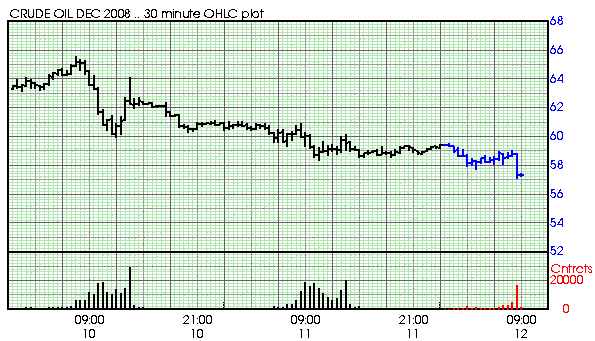
Chart via Barcharts

23 Responses to “Crude Oil = $57”

  1. Mannwich Says:

    At this rate, soon I’ll be able to buy gas with spare change again, just like the “old days” when prices are below $1.00/gallon. Let the good times roll, baby!

    Sadly, spare change is all I might have if things continue to deteroriate.

  2. jmborchers Says:

    If it wasn’t clear in the beginning it is now. Paulson is an idiot, LOL.

    People will realize it’s better than he’s making it out to be.

    I love oil down here, BTW. Looking for oil to go back to $20.

  3. tenaciousd Says:

    I guess this puts an end to “drill here, drill now” at least for the short-term.

  4. Bob the unemployed Says:

    It appears that the higher price of oil over the summer, coupled with the sound of crashing economies around the world, is having an effect upon demand for crude.

  5. leftback Says:

    $ is not going to go up for ever… just when things are bad, oil prices will rise again and things will get worse. There are a number of energy, mining and shipping stocks presently pricing in end of the world scenarios. I submit that the sun will still rise in the morning, and Sarah Palin will still have Larry Kudlow obsessed with drilling…

  6. slimsam Says:

    Wait… I thought $147 Oil was due to Peak Oil concerns?!?

  7. jbruso Says:

    WTF?! Paulson says troubled assets will not be purchased http://news.yahoo.com/s/ap/20081112/ap_on_bi_ge/financial_meltdown;_ylt=AnNNTCg7F6728UIbDCsvKFes0NUE

  8. rww Says:

    Dollar showing some weakness today against the euro and swiss franc

  9. rww Says:

    and holy shit against the yen

  10. Dr. Kenneth Noisewater Says:

    We Can Solve the Financial Crisis by Destroying OPEC
    “Consider: This year, with OPEC-rigged oil prices averaging near $110/barrel, Americans will pay $900 billion for their oil supply, and the world as a whole will pay $3.6 trillion. These petroleum costs are up a factor of ten from what they were in 1999, and represent a huge, highly regressive tax on the world economy. For Americans, the $900 billion oil levy (up from $80 billion in 1999) is equivalent to a 33% increase in income taxes across the board — with sixty percent of the sum being paid over in tribute to foreign governments.”

  11. Mark E Hoffer Says:

    yeah, but KN, who’ll buy our Treasuries?

    I’m thinkin’ lb has a good read on this..

    Take advantage of the gift of a , temporarily, higher U$D, by the time the G-20 is done with it, it’ll be a whole different story..

  12. Greg0658 Says:

    We need a leveled out cost for fuel. If the oil spike and fall is / was :
    a. manipulation by the marketeers looking for the new MEW
    b. pay for the war
    c. Chinas buildup to the Olympics
    d. break green energys back
    e. financial game play of some sort ( King of the hill )

    Repeat “We need a leveled out cost for fuel.” So central planners get with it. I will be very angry if green energy starts going belly up – repossesions bought at dimes on the dollar by oil men with my driving monies of the past year.

  13. Chuck Ponzi Says:

    Commodities were a mania, just like real estate, and stocks, and real estate, and precious metals, and stocks, and stocks, and land, and tulips, and fiat currency, and trading companies, and exploration companies, and every mania before it.

    I highly recommend Manias, Panics, and Crashes as a good read. Noone should have missed this one. Economics 101 says that in the long run, people shift consumption when alternatives are cheaper than the good. Alternative energy is still profitable at these oil levels.

    I hear people clamoring still that oil is cheaper than in 2004… yes, well in 2004 we had a massive, incomprehensible housing bubble at our backs supporting consumption. Now, it’s a headwind. Consumption falls fast and hard when much of our oil consumption is discretionary.

    Chuck Ponzi

  14. cp_oo7@yahoo.com Says:

    crude going 52area. at 1st.

  15. Dr. Kenneth Noisewater Says:

    Repeat “We need a leveled out cost for fuel.” So central planners get with it. I will be very angry if green energy starts going belly up – repossesions bought at dimes on the dollar by oil men with my driving monies of the past year.

    I vote for slapping federal taxes on gasoline, removing CAFE restrictions, and letting the market and Rational Actors do the work of economizing the fleet, bankrupting OPEC, etc.. Use that $$$ to pay off debt, offset defense spending to protect access to oil and freedom of the seas, rebuilding highway infrastructure (redeploying all those idle housing contractors and engineers), or even foot the bill for zero-interest loans to restructure Detroit (though they’ve already been slammed hard on fuel-economy).. Call it $3/gal phased in over 4 years at 75c per year.. That’s still ridiculously low compared to the rest of the industrialized world..

    I’d even say add minimum liability insurance to the price of gasoline as well! You only pay for the insurance you use as you drive, no more uninsured motorists, yet another impetus for economic cars to “save the planet” and bankrupt the arab SOBs… Leaving diesel alone of course, as increasing its price adds cost thru the industrial economy (commercial transportation), so those of us with diesel vehicles would continue to purchase insurance as is done now..

  16. dead hobo Says:

    $57 going on $49.

    The RBOB futures indicate a potential price collapse, assuming 40 gallons of gas per barrel of oil. This means the pump price in a moderate tax state should fall to maybe $1.50 or less in a couple of weeks. Since credit is not going to burst out of control soon, this means the price of oil should approach the price in a competitive model, and stay there for a long while. OPEC has no power to do anything other than make basic production decisions that affect inventory and storage. They will whine like babies, but that’s about all they can do.

    Do GM a favor and buy a new big car at a gigantic savings. It’s safe to cruise around in the SUV again. OPEC is an empty threat.

    Also, do yourself a favor and think about putting some cash to work in Energy Services. The price of oil may be falling, but it still costs a lot to drill new wells, and demand is not anywhere close to being destroyed. Only the price. I have some cash there and plan to put more in as the sheep sell into the commodity price drop.

  17. Mr Beefy Says:

    This shouldn’t be an issue for the OPEC countries. They used their profits to build infrastructure and new industries. Oh wait. :) .

  18. Bruce N Tennessee Says:

    Leftback:

    If you are out there, I will wager you a Whopper that initial claims are above 510k Thursday.

    Bet?

    Bruce in Tennessee

  19. gregh Says:

    DeadHobo, i’m looking forward to more road-trips.

    PS, you can now afford carbon offsets to hedge the footprint of that SUV ;)
    http://www.edf.org/page.cfm?tagID=23994

  20. goldeneye Says:

    IEA out with report executive summary at http://www.iea.org/Textbase/npsum/WEO2008SUM.pdf

    (pages 5/6)

    These projections are based on the assumption that the IEA crude oil import price
    averages $100 per barrel (in real year-2007 dollars) over the period 2008-2015,
    rising to over $120 in 2030. This represents a major upward adjustment from last
    year’s Outlook, reflecting the higher prices for near-term physical delivery and for
    futures contracts, as well as a reassessment of the prospects for the cost of oil supply
    and the outlook for demand. In nominal terms, prices double to just over $200 per
    barrel in 2030. However, pronounced short-term swings in prices are likely to remain
    the norm and temporary price spikes or sharp falls cannot be ruled out. Prices are
    likely to remain highly volatile, especially in the next year or two. A worsening of the
    current financial crisis would most likely depress economic activity and, therefore, oil
    demand, exerting downward pressure on prices. Beyond 2015, we assume that rising
    marginal costs of supply exert upward pressure on prices through to the end of the
    projection period.
    Combined with our oil-demand projections, these assumptions point to persistently
    high levels of consumer spending on oil in both OECD and non-OECD countries. As a
    share of world GDP at market exchange rates, spending soared from 1% in 1998 to around
    4% in 2007, with serious adverse implications for the economies of consuming countries.
    That share is projected to stabilise at more than 5% over much of the Outlook period. For
    non-OECD countries, the share averages 6% to 7%. The only time the world has ever spent
    so much of its income on oil was in the early 1980s, when it exceeded 6%. On the other
    hand, OPEC oil and gas export revenues jump from under $700 billion in 2006 to over
    $2 trillion in 2030, with their share of world GDP rising from 1.2% to 2%.

    Most incremental oil and gas will come from OPEC – if they invest
    enough
    World oil supply is projected to rise from 84 mb/d in 2007 to 106 mb/d in 2030 in
    the Reference Scenario. Netting out processing gains in refining, global production
    reaches 104 mb/d. Although global oil production in total is not expected to peak
    before 2030, production of conventional oil — crude oil, natural gas liquids (NGLs)
    and enhanced oil recovery (EOR) — is projected to level off towards the end of the
    projection period. Conventional crude oil production alone increases only modestly
    over 2007-2030 — by 5 mb/d — as almost all the additional capacity from new oilfields
    is offset by declines in output at existing fields. The bulk of the net increase in total
    oil production comes from NGLs (driven by the relatively rapid expansion in gas supply)
    and from non-conventional resources and technologies, including Canadian oil sands.
    The bulk of the increase in world oil output is expected to come from OPEC countries,
    their collective share rising from 44% in 2007 to 51% in 2030. Their reserves are, in
    principle, large enough (and development costs low enough) for output to grow faster
    than this. But investment by these countries is assumed to be constrained by several
    factors, including conservative depletion policies and geopolitics. Saudi Arabia remains
    the world’s largest producer throughout the projection period, its output climbing

    from 10.2 mb/d in 2007 to 15.6 mb/d in 2030. Non-OPEC conventional oil production is
    already at plateau and is projected to start to decline by around the middle of the next
    decade, accelerating through to the end of the projection period. Production has already
    peaked in most non-OPEC countries and will peak in most others before 2030.

  21. Downtown Vancouver Realtor Says:

    Low oil prices are soooo good for America. An economist here in Canada basically said it was the high oil price that pushed the US into recession. What we are experiencing now is the market righting itself by allowing commodities prices to fall to give respite to the consumers of these (most of America) so their businesses can get profitable again. I am a Downtown Vancouver Realtor and our market is beginning to see big price declines and I would put out there that this is caused in part by falling prices for our natural resources (particularly oil). The banking crisis certainly undermined confidence, but Western Canada’s Provincial governments have been racking in huge amounts of money from Oil royalties and thats just a fraction of what business has been taking in. Projections are for big declines in these royalties.

  22. cp_oo7@yahoo.com Says:

    gold tgt 640-590$ area 440 in 2009.

  23. Downtown Vancouver Realtor Says:

    It’d be great to see Oil down even more. The US and world economies need it.
