
Discussing Unemployment Rate and Job Loss on NPR

Email this post Print this post
By Barry Ritholtz - November 7th, 2008, 10:30AM

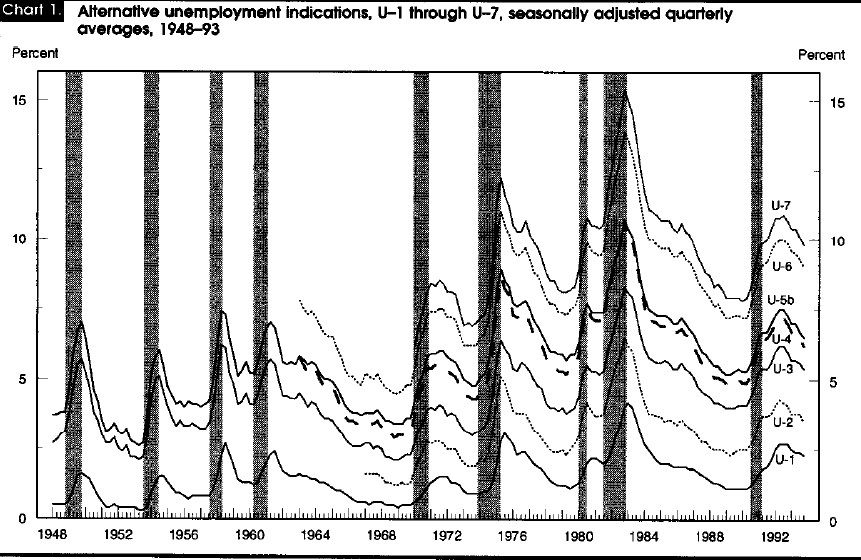
I am off to NPR to talk about how the various measures of employment — Birth Death adjustment, Unemployment rates, total Employment — have changed over the years.

This has been a pet peeve of mine for years.

A few charts and data sources follow . . .

>

Birth Death Adjustment

via Jake at Econompic

U1- U7 (1995)
>

Sources:
BLS introduces new range of alternative unemployment measures
John E. Bregger and Steven E. Haugen
October 1995, Vol. 118, No. 10

http://www.bls.gov/opub/mlr/1995/10/art3exc.htm

Table A-12. Alternative measures of labor underutilization

http://www.bls.gov/news.release/empsit.t12.htm

BLS introduces new range of alternative unemployment measures (PDF)

http://www.bls.gov/opub/mlr/1995/10/art3full.pdf

Additional Reading:
Hard numbers: The economy is worse than you know
Kevin Phillips, Harper’s Magazine
Tampa Bay Times, Sunday, April 27, 2008

http://www.tampabay.com/news/article473596.ece

The 20-Hour Workweek
The unemployment rate seems low. That’s because it’s not counting all those underemployed workers.
Daniel Gross
Wednesday, Oct. 22, 2008, at 3:59 PM ET

http://www.slate.com/id/2202879/

14 Responses to “Discussing Unemployment Rate and Job Loss on NPR”

  1. OkieLawyer Says:

    Could someone please explain a quandary to me? The stock market is soaring based on the news of steep job losses. I have seen this in the past, but I don’t understand it. I would think that steep job losses would be an indication of declining sales / revenue. I would think that it would be logical then for stock values to go down, not up.

    What data set am I missing?

    Or is this just a bear market rally?

  2. Mind Says:

    The bad news was priced in earlier in the week.

  3. albnyc Says:

    Reading these and other charts, it seems that unemployment peaks as the recession ends…? I don’t see a deviation from that connection? Are we peaking?

  4. babycondor Says:

    Sell the rumor, buy the [bad] news?

  5. jrnbj Says:

    This frustrated U-6er just heard you on NPR. Nice succinct spot, thanks.
    All hail the next Krugman….

  6. leftback Says:

    @ Okie Lawyer: This is a technical bounce off intermediate support after a 50% reversal of the post-crash bear market rally. The world already ended earlier in the week, and it will not end again for a few weeks. Seriously, can you imagine a worse week of news than this one?

  7. DL Says:

    When are those idiots at the NBER going to admit that we’re in a recession?

  8. DL Says:

    OkieLawyer @ 10:38

    There are probably a lot of people who have access to the employment data before it’s released to “J6P”. Maybe there are limitations on the trading that they can do in their own accounts, but if so, they can just sell the information to money managers.

  9. Winston Munn Says:

    This market has had difficulty dismissing the Goldilocks scenario. It still seems to want to believe that this recession will be short and mild – that “prosperity is right around the corner”.

    I do not agree. The alteration of perception has already occured – debt is now the enemy. Excessive credit expansion cannot be forced upon frightened, unwilling borrowers.

    Without debt creation, how does a debt-based economy expand?

  10. Bob A Says:

    Expand or not. The cows still need milking. There will be traders and they will trade.

  11. Henry1807 Says:

    There’s something odd about the second chart:

    It’s showing U3 as topping out at about 8% in the early-1980’s recession. If memory serves, the max unemployment rate then was over 10%. And I’m pretty sure the sources were using U3.

    Am I missing something?

    As an aside, if we’re at 6.5% now on U3, with all the “adjustments” that Government statisticians have been able to muster (Birth/Death, etc), and unemployment is almost certainly going to get much worse next year and possibly in 2010, then we’re very likely to go well over 8% on U3. Roubini predicted 9%. So does that mean that we’re going to face an unemployment problem worse than the early-1980’s recession (which was the worst since the 1930’s)?

  12. Laurent GUERBY Says:

    Some bits about “unemployment”, being U1 or U9999999 (as I added it a while ago on wikipedia):

    In 2004 according to OECD, normalized unemployment for men aged 25 to 54 was 4.6% in the USA and 7.4% in France. At the same time and for the same population the employment rate (number of workers divided by population) was 86.3% in the USA and 86.7% in France.

    This example shows that the unemployment rate is 60% higher in France than in the USA, yet more people in this demographic are working in France than in the USA, which is counterintuitive if it is expected that the unemployment rate reflects the health of the labor market

    Even across time in the USA for a given level of “unemployment” you’ll get very different employment rate, which is coherent with unemployment being a fake and useless measure.

  13. 49er Says:

    Unemployment is a lagging indicator, when a true rebound occurs (bottom), subsequent unemployment will continue for months before showing improvement. In a depression the lag could be years.

  14. 49er Says:

    Programs like WPA can distort the real unemployment in the form of underemployment. So bring your shovels and let’s meet at Tony’s Sushi and Taco Bar.