
Is the U.S. market “cheap”?

Email this post Print this post
By Barry Ritholtz - November 14th, 2008, 1:30PM

Maybe not, if this (updated) graph of the trailing 12-month P/E ratio is anything to go by…
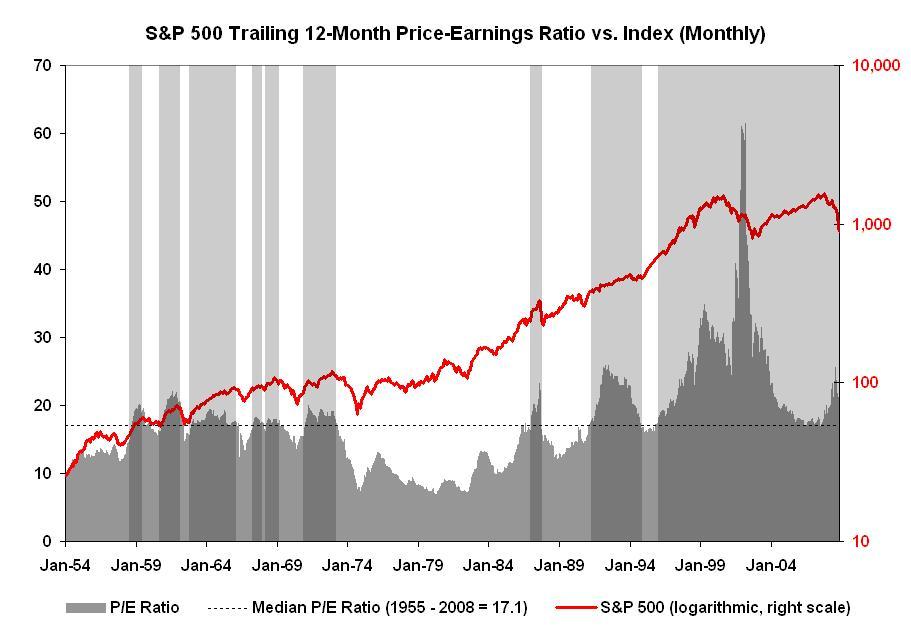
chart via Mike Panzner

Note: This is an update of a P/E Expansion and Contraction chart we first showed back in 2006 — and since so many of you have asked to see this chart updated . . .

28 Responses to “Is the U.S. market “cheap”?”

  1. HyperEcstasy Says:

    Which earnings number are you using?

    You should always specify which one you are using, especially now because reported earnings and operating earnings have diverged significantly. See the charts here:

    http://stocks.daytodaydata.net/SP-500-PE-Ratio-Historical.aspx

    Currently (2008-11-14 13:49 ET) the S&P P/E ratio using reported earnings for 2009 (which is 49.15 as of 2008-11-12) is 17.91. You can check the real-time S&P P/E ratio using various earnings numbers on this page on that same web site: http://stocks.daytodaydata.net/SP-500-PE-Ratio.aspx

    17.91 is not cheap, especially whilst entering deeper into a recession.

  2. Mike C Says:

    http://www.hussman.net/wmc/wmc081110.htm

    “It will help to be careful about the analysis of valuations, because there are a lot of bad arguments being thrown around. Among the most misleading are calculations about potential risk and fair value based on current earnings, without normalizing them in some way. Some analysts are talking about how low earnings might go in a deep recession, and what P/E multiple might be applied to them at the trough, based on P/E multiples at other bear troughs. That sort of analysis strikes me as coarse and unhelpful, since the extent of the earnings contraction varies dramatically from one bear market to the next. There’s no such object as a “P/E on trough earnings” – at least nothing well-behaved. Stock valuations should only be based on measures that are somehow representative of the long-term stream of cash flows that can be expected from that point onward. Trough earnings are not helpful in that regard.

    Much better to base valuations and potential risk calculations on normalized earnings – some smooth and well-behaved measure like peak-earnings, earnings at a fixed profit margin (essentially proportional to sales), mid-channel earnings, etc.

    …………..

    To adjust for that noise, **********we have to form our valuation multiples based on some smooth fundamental rather than a noisy, cyclical, mean-reverting one. This is essential, because stocks aren’t a claim on next year’s earnings – they are a claim on a very long-term stream of cash flows, and short-term variations in earnings have very little effect on the value of that long-term stream.************”

    Just recently, the market looked “cheap” based on earnings that were temporarily elevated way beyond trend. It would be the exact opposite mistake to conclude valuations look “expensive” based on earnings that are *temporarily* depressed way below trend. The trailing P/E in 2002 was 40+. In 2000, it was 30. Was the market more overvalued in 2002 then 2o00?

  3. jmborchers Says:

    Importnant fact to consider is the number of stocks now in the S&P which trade at 18 P/E instead of the more historical 10 P/E.

  4. Mike M Says:

    It’s always great to see earnings numbers used on trailing or forward figures when normalized is the only honest way to go. A fair, objective figure for normalized reported earnings is about $60. With rates at these levels, the index is a good value at or below 1000. The risk free rate needs to be much higher to warrant a P/E of 10. The neat thing about that chart is that it shows low P/E’s in 70’s and 80’s, a very high interest rate period.

  5. Byno Says:

    Cheap, as in you bet your ass I’ll rent JCVD from Netflix when it comes out on DVD? Oh Yeah.

    Cheap, as in I’ll pay eleven bucks to see JCVD this weekend? Meh.

    Jean Claude Van Damme FTW

  6. Winston Munn Says:

    How do you project future earnings when you have this kind of information with which to work?

    http://www.usnews.com/blogs/the-ticker/2008/11/14/citigroup-troubles-grow.html

    The story claims Citigroup is cutting 60,000 more jobs (23K already gone) by next year and raising interest rates on credit cards.

    And untold billions in level 3 assets are still on books….

    Before there is a P/E, there needs to be some E

  7. gregh Says:

    is that P/E expansion inflation adjusted?

  8. going broke Says:

    @ Winston

    Couldn’t agree more.
    Also, the market trend is still down, down, down while so many necessary consumer products are up, up, up. The amount of $$$ going into mutual funds are declining and until this turns around, markets ain’t going anywhere… even if the P/E “might” get better.

  9. noels Says:

    P/E’s are a bad indicator of “cheapness”. Earnings are low or negative in a trough, making PE’s explode.

    Furthermore, there is more than current earnings. 95% of a company’s value is made of future earnings. Anyone a chart on bookvalue over the long run ?

  10. Mike M Says:

    Winston Munn Says:

    “Before there is a P/E, there needs to be some E”

    This is why the market rallies before the economy recovers. The P/E ratio at major market bottoms is often sky high because they are trough earnings. Earnings are often misleading low. This is the main reason investors should normalize earnings when making assumptions and not assume the worst will continue indefinitely. Likewise, normalizing earnings always gives investors reasons to be cautious at market peaks.

  11. leftback Says:

    This market is an interesting mixture of stocks with attractive P/E ratios and those that have yet to be taken out and beaten with a stick. GOOG, AAPL… not to mention those with mystery earnings.

  12. Winston Munn Says:

    The question for this market is: “How can you have any pudding if you don’t eat your meat?”

    @Mike M,
    Good info Mike and thanks.

    I believe one of the problems inherent in this market is that risk cannot be priced if it is an unknown. This was a problem with which Japan and its banks dealt poorly during their Lost Generation. During lean times, opaqueness breeds doubt about the business framework - the basic business model needs to be viewed as profitable in order to encourage growth. How can you know if the basic model is flawed if you cannot see all its components?

    During the run up to collapse, the drunkards are blind to risk anyway- party on - so why bother with transparency?

    But when the bubble pops, transparency becomes king….hence, the need for real E in P/E.

  13. constantnormal Says:

    leftback — if you subtract the $27.55 per share in cash that AAPL is carrying from the share price, the PE looks a bit different. The big question is how low are their earnings going to go in the coming year?

    Of course, that is the Big Question for EVERY company.

  14. spencer Says:

    His data is incorrect.

    Go here:
    http://www2.standardandpoors.com/portal/site/sp/en/us/page.topic/indices_500/2,3,2,2,0,0,0,0,0,1,5,0,0,0,0,0.html

  15. constantnormal Says:

    It is a pity that those charts of index PE’s exclude the negative PE’s from consideration. At least I think that’s the case. For a proper consideration of what is happening with earnings in a group of companies, I would think one would want to average the losses in with the earnings, and I don’t think that happens. I think that the companies with losses (i.e., “negative” PEs) are excluded from the average PE calculation.

    Somebody gimme a dope slap if I’m wildly and ignorantly incorrect here.

  16. KJ Foehr Says:

    I think over the next decade or longer, it is going to look more like the left half of the chart than the right half.

  17. I-Man Says:

    That was obviously redemption selling ahead of the 11-15 deadline, no?

  18. E Says:

    I don’t know if the US market is cheap, but it got a lot cheaper in the last 45 minutes.

  19. I-Man Says:

    http://www.reuters.com/article/americasDealsNews/idUSTRE4AD04220081114

    If interested.

  20. DP Says:

    Either I have misunderstood the 11-15 deadline, or some others are.

    Isn’t 11-15 significant only because that is the date by which investors in a number of hedge funds have to give 45 days notice that they would like to withdraw their funds at the end of the year?

    A lot of the selling is a rush by hedge funds to get in front of that in case other hedge funds under-estimate their redemptions and there is mass selling between 11-15 and year end? There is potential for that and there is also potential that they all overshot and have more cash than they need? I guess we won’t know for sure until end of year.

    In the meantime, I’m starting to develop all kinds of conspiracy theories about this all being a huge shake-out so they can load up again, at their own leisure (which may or may not be a big rush of cash back into the market). Is this a real change in consumer behaviour, or a stock market driven “system shock” similar to after 9/11 that people gradually come out of?

  21. RonN Says:

    Stocks are “cheaper”, but not “cheap”.

    When “irrational exuberance” subsides, fundamentals like PE ratios come back in vogue. See the 2 links below, one on Nuriel Roubini’s RGE website and the other on SeekingAlpha, which support this view

    They also show the use 10 year earning averages to “smooth out the bumps” in earnings — an issue pointed out by Mike C and Mike M above. Note that Robert Shiller, Ben Graham, and many others recommend using this 10 year average.

    1st link is authored by James Hamilton (UCSD Econ Prof)
    http://www.rgemonitor.com/globalmacro-monitor/254404/investment_advice_for_a_wild_market

    second link is an article of mine on SeekingAlpha over a month ago.
    http://seekingalpha.com/article/99347-too-late-to-short-spy-an-historical-perspective

  22. cpwestcoast Says:

    just a casual observation - i have been reading this site for about 6 months, generally i have agreed with your bearishness/straightforwardness, but….the real reasons to be bullish would be (1) street numbers have gone from too high to too low, as in the street isnt surprised by the amount the BBY/INTC/NOK has taken numbers down by (unlikely) (2) stocks are so cheap that even if they are trading at 12 times next year and next year has to come down 10% it is still worth owning stocks because stocks are not going to trade at 10.8 times next year and 12 times is trough valuation (quick aside, stocks arent going to 10 times, sure they did 30 years ago, but look at interest rates then vs now)…..but the reasons to be bullish that have been posted here are a technical look at the SSO, and a chart showing spx valuations using trailing 12 months….it is just too easy to shoot holes in these…technicals are a tool in the toolbox, and can help for a trade, yes things can get overly bearish, but shorting these rallies is easier than trying to use technicals to call a bottom…and trailing 12 months, plse, 09 is going to be radically different that 08 based on the whole recession/depression, not to mention the stock mkt is fwd looking, trailing 12 month eps is worthless/dubious in general and specifically now…i dont really have a point to this post, and I am certainly not trying to call you out barry, but if you are going to highlight reasons to be bullish (even if its for a bounce only) i guess i would expect more, it seems like you are just throwing anything up that you come across or see that confirms your view, which is a selectivity bias that i would guess is hard to avoid as it is human nature to defend one’s view

  23. RonN Says:

    cpwestcoast says:
    “….stocks arent going to 10 times, sure they did 30 years ago, but look at interest rates then vs now…”

    Not true, PE’s DO go to 10 in times of low interest. Using Robert Shiller’s PE10 database and ignoring months when long term interest rates are above 4.5%, my analysis shows that 15-18% of the time PE’s are 10 or below (see footnote in my post on SeekingAlpha
    http://seekingalpha.com/article/101934-how-low-are-pe-ratios-a-comment-on-mark-hulberts-take ).

    One could argue that our present problems (known and unknown) are not as bad as they were in those 15-18% of past times, but then again, one could argue that the other way too….

  24. RonN Says:

    Here’s a link from an econ prof at Johns Hopkins on the interesting story of how Robert Shiller’s arguments back in 1996 led Greenspan to give his “irrational exhuberance” speech. Too bad Alan didn’t take appropriate actions, but it didn’t fit his “worldview”.

    Note that an updated analysis of Shiller’s “Graham Chart” in this link prompts the author to say:

    “Some market commentators argue that the recent stock price declines reflect a degree of irrational pessimism or panic that is the inverse of the irrational exuberance of the 1990s. The Campbell and Shiller figure provides no support for that view…”

    http://www.rgemonitor.com/financemarkets-monitor/254416/recent_stock_declines__panic_or_just_the_end_of_irrational_exuberance

  25. harold hecuba Says:

    ok here it goes. we are experiencing massive deflation on a global scale. SOME credit markets have eased but remain well elevated others such as corporates to treasuries are at RECORD levels. corporate default rates are still very low and only to increase somewhat maybe dramatically. housing has not come anywhere near levels where current incomes can support prices. overcapacity is everywhere and unemployment will continue to rise. AIG was responsible for 1% of all CDS (there is a monster lurking out there) currency volatility has gone balistic and will wreak havoc on balance sheets globally. the economy is on complete life support. please tell me what happens when the gov lets off the gas pedal. how can anyone have any idea about cash flow when the gov has intervened to such an extent. analyst estimates are absurd. people are WAY UNDER ESTIMATING the magnitude of this mess. rally here rally there on hopes and dreams. the bear will continue its decline on the slope of hope. I’ll call for a depression. s+p 650 and well below

  26. jakester Says:

    the amount of bulls out there buying up every failed rally tells me that the main course is ready to be served..

  27. eternitus Says:

    Dow PE is around 10 and the numbers above include enormous writedowns that skew the result. I have to doubt the helpfulness of comparing the numbers across periods unless you normalize earnings. Current writedowns obfuscate the true earnings power of the market… relying on the headline number without examining what is behind it is just lazy.

    What we do have is a Dow yielding more than treasuries. That is not sustainable… either treasuries will have to get murdered or the dow will have to rise. Dow’s div coverage is good, so I wouldn’t expext a meaningful fall in the yield going forward.

  28. HyperEcstasy Says:

    I can’t see how Hussman’s price to peak earnings makes much sense.

    If a business’ profits had peaked 6 months ago and have been falling since then, would you value the company based on its earnings 6 months ago or its earnings now?