
A financial firm borrows billions of dollars to make big bets on esoteric securities. Markets turn and the bets go sour. Overnight, the firm loses most of its money, and Wall Street suddenly shuns it. Fearing that its collapse could set off a full-scale market meltdown, the government intervenes and encourages private interests to bail it out.
The firm isn’t Bear Stearns — it was Long-Term Capital Management, the hedge fund based in Greenwich, Conn., and the rescue occurred 10 years ago.
–ROGER LOWENSTEIN, NYT
>
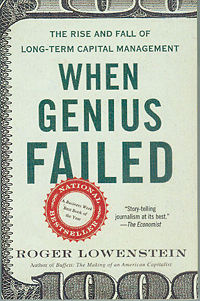 If you haven’t read When Genius Failed, you are missing out on the best narrative about the credit crisis — not the 1998 version, but the current situation.
The parallels are astounding. I reread the book this past summer, and found it amazingly similar: Over-leveraged firm, which ultimately has too little capital, buys lots of thinly traded, hard to analyze, difficult to value paper.
When the market for some of this paper seizes up, the firm goes bust.The book deservedly was named one of the “Best Business Books of 2000.”
Lowenstein wrote an extensive essay on the 10th year anniversary of the collapse of LTCM. You should definitely read the book, but if you don’t get to it, you should read the essay:
>
In the wake of Long-Term Capital’s failure, Wall Street professed to have learned that even models designed by “geniuses” were subject to error and to the uncertainties that inevitably afflict human forecasts. It also professed a newfound respect for the perils of borrowing. Whether this wisdom endured may be judged by events of the past year, when not only Bear Stearns but also scores of banks and financial institutions have written off hundreds of billions of dollars — a result of blithe faith in models of the housing industry, not to mention a voracious hunger to do business on credit.
Regulators, too, have seemed to replay the past without gaining from the experience. What of the warning that obscure derivatives needed to be better regulated and understood? What of the evident risk that intervention from Washington would foster yet more speculative behavior — and possibly lead to a string of bailouts?>
>
Source:
Long-Term Capital: It’s a Short-Term Memory
ROGER LOWENSTEIN
NYT, September 6, 2008
http://www.nytimes.com/2008/09/07/business/07ltcm.html

What's been said:
Discussions found on the web: