
The Most Volatile Market Ever

Email this post Print this post
By Barry Ritholtz - November 25th, 2008, 12:00PM

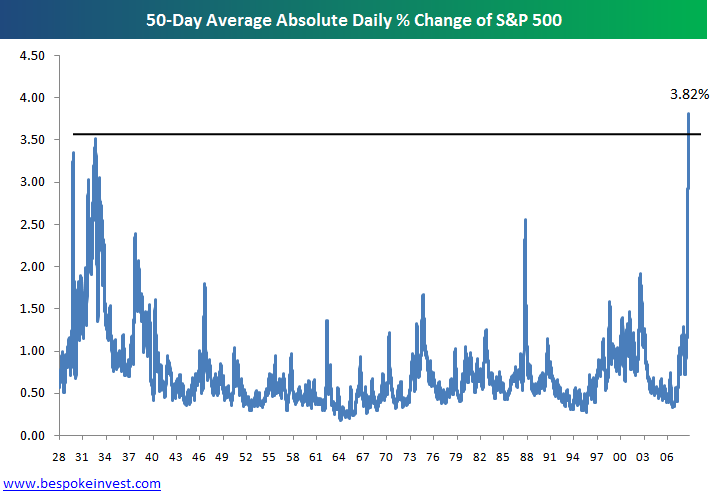
The Bespoke Boys point out that “over the last 50 trading days, the average absolute daily percentage change of the S&P 500 has been . . . wait for it . . . 3.82%!”

In the history of the S&P 500, there has never been a more volatile period.

>
>

Source:
The Most Volatile Market Ever
November 24, 2008

http://bespokeinvest.typepad.com/bespoke/2008/11/the-most-volatile-market-ever.html

23 Responses to “The Most Volatile Market Ever”

  1. Archiphage Says:

    And a quick glance suggests all those spikes seem to correspond to bear markets.

  2. Prieur du Plessis Says:

    The Oxford Dictionary defines “volatility” as “liable to change rapidly and unpredictably, especially for the worse”. How appropriate!

    Another way of illustrating the extreme volatility is simply to look at the one-day percentage change in the S&P 500 Index. See graph: http://tinyurl.com/67a28q

  3. leftback Says:

    And a quick glance suggests all those spikes seem to correspond to bear markets.

    ….and it won’t be over until the VIX is back in the teens…
    until then, Trader Heaven continues.

    a heartfelt vote of thanks to the panic birds who sold me RTP this morning….
    i am looking at nice gains in COP, GDX, PAAS and F since last week.
    trying to add to my miners and materials here and there.

    big test of the 840-850 area going on. i think we will survive.
    with consumer confidence holding on i suspect the malls will not be empty on Friday.

  4. Unscripted Thoughts Says:

    And I have to wonder how much of that increased volatility is due to 1) day traders using the Internet and 2) robo sell/buy programs? Gotta be enough that really ratchet up things and we are seeing the culmination now.

  5. Mannwich Says:

    In this “market” –

    “long term” = 1-2 hours.

  6. DKTrader Says:

    So do we hold 840 today? That is the question! If so, I think we continue to rally tomorrow and Friday. otherwise, I see it going back below 800. interesting times!

  7. greenie Says:

    DKTrader, we will probably do all of the above….that’s volatility

  8. JohnnyVee Says:

    And the Citi bailout rally looks to be over. The word on the street is that the stats strongly point to a 13 to 15 year bear market like 1929 to 1944 or 1968 to 1982. Anyone have a different opinion?

  9. roncfp Says:

    Sure, there are some really nice years in those time frames. The total market returns:

    1933-36 – 137%
    1975-76 – 66%
    1978-80 – 63%

  10. RiskAverseAlert Says:

    @roncfp… We probably have some weeks more to endure in a bottoming process before the kind of returns you allude to probably begin coming to fruition.

    Two things I would add…

    First, the market’s bottom in 1932 occurred well-before the banking system went into its death spiral.

    Second, this time around probably is different. The leverage built into the system is profoundly greater. Thus, there might be every reason to perceive opportunity building here, yet some months from now it probably will all end in disaster. (Personally, I suspect we are being purposely bankrupted … particularly the Treasury. Historically speaking, it’s a big deal.)

  11. scorpio Says:

    it must mean we’ve bottomed and are preparing for the next giant leg up, Dow 36,000 here we come

  12. Andy Tabbo Says:

    Do the traders who made money in the last several months get some kind of award?

    - AT

  13. roncfp Says:

    @ Risk Averse Alert – no bottoms have been called in my message. I’m just stating the facts and I’m not saying we’ll get those returns in the future. I merely stated that there have been some very strong markets within those timeframes above.

    Do I sense a bubble of fear? Hmmmm. :-)

  14. I-Man Says:

    AT:

    I award you as “TBP Chief Elliot Wave BadAss”

  15. Mannwich Says:

    @AT: Yes, unlike many, you get to keep your money and then some…….at least for now. Isn’t that “reward” enough?

  16. TrickStar Says:

    The bottom was last Thursday. Anticlimactic, I know.

  17. thefinancedude Says:

    http://www.minyanville.com/articles/C-citigroup-STOCKS-volatility-bailout-liquidity/index/a/20123

    According to Mr Practical: The stock indexes have moved more in the last 50 days than they have for the last 50 years.

  18. jmborchers Says:

    Tomorrow should be a relatively big up day for positive consumer speculation going into Black Friday. How hard could it be to beat 50% of last year’s sales?

    Friday I expect will be then down.

  19. leftback Says:

    John, I have it played the other way around, I think tomorrow will be down after durable goods and the deteriorating credit news, plus a safety trade ahead of the holiday. Friday and/or Monday will be the up day/s.

    Either way I think 840 holds and the trading range between 840-980 is back in play.

  20. Mannwich Says:

    I have to admit that I have no clue which way things are going the rest of the week. Will likely sit tight in my positions (unless we swing wildly in one direction) and watch most of it from the sidelines. Very cautious right now. Nothing suprises me anymore.

  21. DL Says:

    leftback @ 4:21

    “Either way I think 840 holds and the trading range between 840-980 is back in play”

    SPX got to 741 on 11/21/08. I don’t think we necessarily have to retest that before the end of December, but I have to think that we get at least as far down as 800 before the end of the year, and certainly before inauguration day.

  22. Simon Says:

    The chart posted by Prieur du Plessis looks like the seismigraphic output of a very large earthquake. Financial storms seem to superficially have interesting parallels to some physical systems like earthquakes.

    They are extremely difficult to predict

    The normal low level cyclical graph (small wiggly line) suddenly becomes greatly amplified (big wiggly line)

    Lots of damage ocures to brittle structures, (think leveraged institutions)

    Ductile structures suffer less damage, (think primary productive enterprises that have a cash buffer)

    Failure in one area can lead to a progressive failure in the entire system.

    For example a falling crane strikes the corner of a concrete car parking building causing punching failure in the corner column. The force of the top deck landing on the next deck down is sufficient to set of a similar failure in adjacent columns resulting in a progressive failure until either the entire building is flattened or a discontinuity in the system is reached and the progression stops. (think banks lending to each other and using the loans as equity). Actually the twin tower failures were similar also.

    A kind of measure that would help mitigate or eliminate the risks of large progressive failures would be deliberate discontinuities in the system, like a fire break or a seismic gap.

    Another measure would be having a professional body charged with maintaining the stability of the system. Such peoples education and primary concern would be, like engineers creating stable durable structures. Not the enrichment of themselves or their clients. Reward would be like any other profession based on recognition of achievement in design and technical excellence.

  23. Patrick Neid Says:

    Enjoy it while it lasts. You will miss it when it is gone.