8th Bear Market Rally Since October 2007
Merrill Lynch’s David Rosenberg notes that last week’s pop was the eighth bear market rally since October 2007.
As the chart below shows, they have ranged in strength from ~8% to over 24%.
Each one was treated (“enthusiastically”) as if a bottom had been made. Each one saw a subsequent lower low, excepting the most recent one that ended Friday.
These included:
- The TAF (S&P 500 at 1500)
- January 75 bp rate cut (1325)
- The Bear Stearns deal in March (1270)
- The fiscal package in April (1200)
- The GSE conservatory in July (1200)
- The TARP in October (1180)
- Pre-election Rally (840)
- The Citi bailout in November (750)
Rosenberg added late Sunday:
This is now a five-day rally that has seen the S&P 500 surge 19%. Then again, we did see a 7-day rally tally up to 18.5% from late October to early November. And before that a 4-day rally in mid-October that netted equity traders an 8.5% spike. What is happening is that the bear market rallies are getting shorter and more flashy – but they are still bear market rallies. The ones we have seen thus far in this bear market have seen the S&P 500 rise nearly 10% and last 18 days on average. These are rallies, in our opinion, that investors should using as an opportunity to sell into.
>
Bear Market Rallies, October 2007 to November 2008
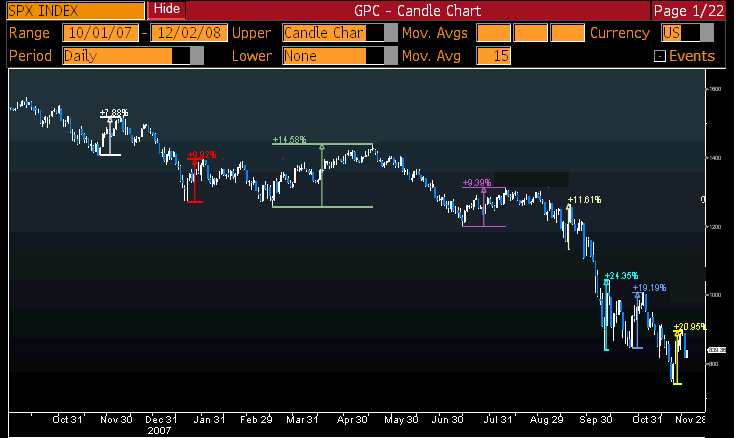
chart courtesy of FusionIQ, Bloomberg



December 2nd, 2008 at 11:54 am
Rosenberg has been pretty spot-on in his calls, if memory serves. Don’t see any reason to be fighting this tape.
December 2nd, 2008 at 12:21 pm
That’s it. No more shorting for me. Just got out of meeting. Everything is going right for me the last 2 weeks. We’ve probably seen the bottom. Recession already 1 year old.
December 2nd, 2008 at 12:25 pm
Borchers – what meeting, pray tell.
December 2nd, 2008 at 12:31 pm
engineering, my side job, lol. This is going to be a fierce ralley. All that cash on the sidelines will come back. The Fed buying the long rate to move the interest rate down is the right thing. Remember ole Greenspan’s plea before Congress about losing control of the long rate? Once this is under control all else shall fall into place.
December 2nd, 2008 at 12:38 pm
We’re still 33% below the 200 day moving average. I would think it’d be a bit risky to bet on anything but up from here. I’m a bit curious what his definition of a “rally” is. I would define a rally is a period of at least one month where stocks go up. I say it’s time up that is the determinant, not percentage gain. If it’s based on percentage, than every single up day we’ve had over the last 2 months would be considered a rally. I’m betting on a “real” rally…one of those multi-month, 40+% gains…and VIX dropping below 20.
December 2nd, 2008 at 12:39 pm
Long QLD through last rally, was going to sell Monday, didnt get out. Back to net zero yesterday on the longs. QLD net up 2.9% after this AM. Added UYG at close yesterday, up 12.7% so far today. Just love those Matterhorn looking SKF peaks. Mind you, I’m not a bull on financials, just trying not to fall in love with one-sided trades.
December 2nd, 2008 at 12:47 pm
bradp, i was going to remark that if you like uyg, you’ll love fas. but it seems uyg is outperforming fas today.
fas up 9-10% vs. uyg up 11.5%
December 2nd, 2008 at 12:59 pm
Borchers – Ah, I see. I thought maybe you were deciding the fate of the markets in that meeting!
Unfortunately, I’m not so sure about a fierce bear market in the near-term. I think that investors will be selling into these rallies for tax reasons which should temper things. In addition, the flight of money from stocks to bonds typically suggests a flight to quality, but these days it’s not really about quality, but safety. So I’m thinking that Bernie going long may not have the gravitas that move would typically carry.
December 2nd, 2008 at 1:08 pm
I’m with John.
Unfortunately, I called my own bottom at Dow 7500.
BTW, don’t take investment advice from me, or anyone else on the internet. Continue to leave your cash in the checking/savings/cd until I’m all in, ok?
Chuck Ponzi
December 2nd, 2008 at 1:25 pm
The bottom is found only in hindsight. I’d rather be late than early to the “confirmed” trend change.
December 2nd, 2008 at 2:05 pm
I think rally will continue and surprise to the upside, lasting 2-3 months. If we brake back below the lows in the near term look for an airpocket to 600.
December 2nd, 2008 at 3:00 pm
It seems to me the line in the sand is 750 0n the spx. If we crash through that the downtrend will continue. However, I think it is hard to go short when we are so far below the 200 day. It’s kind of like buying oil at 147. I must agree with AmenRa: The bottom is found only in hindsight. I’d rather be late than early to the “confirmed” trend change.
Barry, what do you think?
December 2nd, 2008 at 3:18 pm
the reliance of an asset based finance economy is over. this ridiculous period spanning over 20 years culminated in the bursting of enormous bubbles in housing , debt and credit all at once. still no one seems to be able to comprehend the magnitude of this mess. asset prices will continue to fall for YEARS. bear rallies will of course occur but they should be in no way be mistaken for a new bull market. i
December 2nd, 2008 at 5:03 pm
I agree with H. Hecuba (a mess for years), but also agree with mudpuppy that shorting so far below the 200 day MA is too much. I think it’s one of those times to do nothing, for the moment.
December 2nd, 2008 at 5:28 pm
Thank-you, harold hecuba. Well said.
Is it just me, but why would you give GM $18 billion in new money (their latest proposal) when you could buy the whole company for about $2.8 billion?
Ford wants $9 billion. It’s only worth about $7 billion.
I guess a smaller loss is better than a bigger loss, but why not just buy them? Then the Federal government could more efficiently manage them, like its doing w/, say, Fannie and Freddie.
If this all weren’t so tragic it would be quite humorous.
December 2nd, 2008 at 5:50 pm
I don’t understand what Harold Hecuba means:
“the reliance of an asset based finance economy is over.”
Is that actually a sentence?
And I don’t know what he’s reading, but it seems like most people/banks/gov’t/companies are scared Shiteless – which might explain:
1) the freezing of the credit markets
a return of the USD strength
2) the huge selloff of all asset classes
3) the tightening of consumer purse strings across the WORLD
4) multibillion dollar bailouts
5) multinational coordination from central banks
6) massive layoffs and drastic reductions in revenue forecasts
7) incredible VIX numbers
9) anything else I missed.
So, Harold, here’s to your profound grasp of the obvious. Welcome to the party.
December 2nd, 2008 at 7:23 pm
stay short until next Friday.
December 2nd, 2008 at 8:53 pm
trickstar
and your point is? and sorry i don’t look over to correct grammatical errors as i could care less. i guess it should have read the reliance on an asset based economy is over.
December 2nd, 2008 at 11:39 pm
sorry harold. the grammatical thing was me just being a grammar nerd.
I poorly attempted to make a few points: i don’t understand your main point – what does “the reliance on an asset based economy” actually mean? I’m inclined to think I completely disagree
First, the whole world (financial markets included) is based on valuing tangible and intangible assets. Status, boobs, Mercedes, education, water, and animal crackers can be and are viewed as assets upon which different people place different values.
Second, the list of things I put above suggests that people do comprehend the gravity of the situation. No once claims to know where all the bodies are buried, but most (including dumb old me) recognizes that there’s lots of carnage to come.
As for asset prices falling for YEARS, well, as noted, there are lots of asset classes out there. And for many of them, the fundamentals haven’t changed. US housing, metals, rice, coffee, soybeans, livestock, and more aren’t going to fall for years. Some of them will fall for months, some will trade sideways for months, but not years.
Which assets do you believe will fall for years and why?
December 3rd, 2008 at 12:19 am
Perhaps the best way to think of which asset classes might fall for years is to consider them by ‘quantity extant’ against ‘liquidity needs’.
Furthermore, the only difference between months and years is a divisor of 12.
And finally, there is no more “sideline cash” today than there was in 1931.
December 3rd, 2008 at 6:35 am
my apologies trickstar. what i meant were assets that individuals have come to rely on as the illusion of wealth took hold. when we mutated to a consumption based society during the early 1990’s savings rates continued to fall and were placed on the illusion that stocks would go up forever. alan greespan and robert rubin fostered this environment with the targetting of asset prices. i believe most felt that stocks would go up forever and everyone believed retirement was going to be utopia. when this illusion of wealth cratered it was replaced by the even bigger bubble in housing. no need to worry alan was on the job and my retirement was safe, my house will continue to gain in value and i can continue to pull equity from it. retirement will be a utopia no need to save. now that stocks and housing have come down in value the illusion of wealth has been shattered. i believe the prices of homes will continue to fall for years. they are still overpriced relative to incomes and i don’t see inccreases in wages in this deflationary environment. i also don’t believe stocks are at the bottom of the cycle and will fall further in the next 1 to 2 years as earnings will continue to get hit and pe multiples will contract to bear market levles. we are in a period of MASSIVE deflation that only the destruction of debt will solve. gov is simply making things worse or dragging the process out.
December 3rd, 2008 at 11:29 am
harold hecuba you make some valid points. However I must quetion you on deflation. There are those who believe, and I am one of them, that the massive money printing we are now seeing will cause inflation. Some think hyper inflation.
When you say housing prices will fall for years because they are still overpriced relative to income, what metric are you using. Should ones monthly payment be 20% of earnings? 25%? 30%? 35? What?
And what is the current ratio between housing prices and incomes?
And finally, how do you know what earnings will be one to two years out.
China’s not going to grow? India’s not going to grow? Brazil? Russia?
December 3rd, 2008 at 9:17 pm
Don’t worry shorts. Reality will be setting in soon. Mass layoffs starting after the holidays, and once Obama’s face is on the tele for a few weeks, the hope rally will start to fade too. And if appetite for U.K. or U.S. debt should diminish … lookout. The question is when really, not if, but U.K.. will get hit before U.S. and will be the canary in the coal mine for U.S. equities.
http://globaleconomicanalysis.blogspot.com/2008/12/prepare-for-depression-level.html
December 4th, 2008 at 10:02 am
It’s hard to believe most of the bad news is not priced in. That said I’m expecting some more volatility as we head to the year end and and books are closed out. The bottom which has been tested frequently as this piece suggests is surely around 8000 on the Dow. Clearly this recession is only half over, there’s lots more bad employment news. GDP revised was down 0.5 in third quarter, fourth is probably going to be much much worse and I’m expecting substantial further contractions in at least the first two quarters of next year. We’re probably trading in the bottom ranges but surely there’s plenty of time take advantage of this situation.
December 4th, 2008 at 10:13 am
ChickenDinner Says:
December 3rd, 2008 at 9:17 pm
Actually I think you’re wrong about the Obama effect. It’s partly political but mainly economic. The govt has clearly chosen to become the spender of last resort and they’ll bail out the auto companies. There’s still a huge appetite for US debt, it’s premature to bet against it as anyone who bet against the dollar a year ago will tell you. What you’re losing sight of is that all things are relative so that while the US economy and the British one for that matter have huge problems, relative to a lot of the emerging economies they are still perceived as safer. Would you rather own US/British debt or Indonesian/ Chinese/Malaysian/South Korean. In the land of the blind the one eyed man is king.