Bailout Open Thread

Email this post Print this post
By Barry Ritholtz - December 8th, 2008, 10:05PM

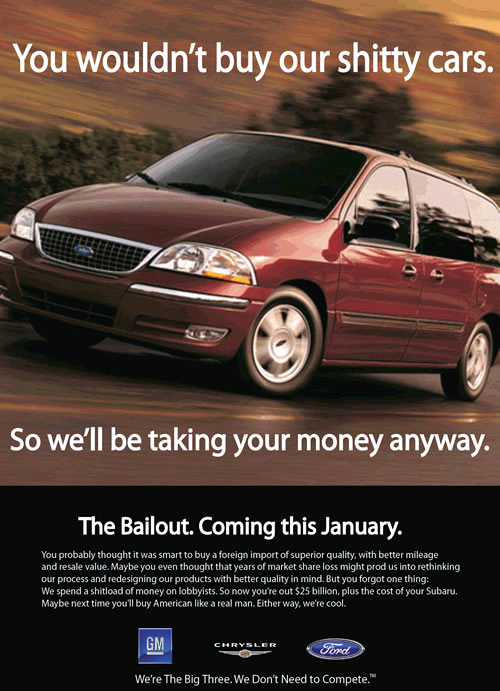
Nice:

50 Responses to “Bailout Open Thread”

  1. CNBC Sucks Says:

    Internet Explorer blew up in my face. I guess MSFT will be asking for a bailout in 2028. Can’t America make a product that doesn’t suck?

    I was going to say, Ritholtz, as a registered Republican, I totally applaud your pointing out that your interview was the most viewed and emailed article at Barron’s. Narcissus.com is unavailable, but you might want to register narcissus.me. Totally appropriate.

    Just busting your chops a bit, buddy. But I will say if you are a leading bear, this crash still sucks.

  2. Steve Barry Says:

    I’ll take a Bailout Sedan in Tuxedo Black with leather seats.

    Actually this bailout is a scheme to keep the employees from being laid off. I have a suggestion…do the bailout, but STOP MAKING THE CARS. It’ll save us taxpayers a fortune. Then get the workers jobs building roads to nowhere under Obama’s new infrastructure plan. To position for the future, let’s finally design a Jetson’s flying car that folds up into a briefcase. Take advance deposits on that car from all over the world…then outsource it to China. Problem solved.

  3. Lee_in_DC Says:

    AAA = Auto Affirmative Action. After all, the asians aren’t getting any help.

  4. Mark E Hoffer Says:

    yep, ’tis be, too much, like that, SB.

    lends isight into why the American People are lukewarm, at best, in support of this ‘Bailout’..

    The Big 3, in happy concordance with their Keeper, the USGov’t, has been screwing their customers every which way from (NASCAR) Sunday..
    http://www.thefreedictionary.com/concordance

    To think that those bumbling Bureaucrats, yes, the ones running the Big 3, couldn’t produce a Quality vehicle, if their lives depended on it, is to be Ignorant of much more than simple Facts..

  5. KJ Foehr Says:

    Paul Volcker for Car Czar!

  6. marka Says:

    The big three aren’t car companies - they are sports truck/suv companies. If you want to get a truck for the family you go and see these guys, for a car you go somewhere else.

  7. EorrFU Says:

    NY Times has the draft legislation http://graphics8.nytimes.com/packages/pdf/business/autobilldraft.pdf

    My favorite passage so far:

    ” During the period in which any financial assistance provided under this Act to any eligible automobile manufacturer is outstanding, the eligible automobile manufacturer may not own or lease any private passenger aircraft, or any interest in any such aircraft.”

  8. DL Says:

    No reason to get worked up over a measly $15B. Obama’s going to be the one doling out the real money next year.

  9. EorrFU Says:

    Why is this necessary??? Obama invests in rail travel and they force GM trains on them???

    IN GENERAL.—Each eligible automobile manufacturer which receives financial assistance under this Act shall conduct an analysis of potential uses of any excess production capacity (especially those of former sport utility vehicle producers) to make vehicles for sale to publictransit agencies, including—

    (1) the current and projected demand for busand rail cars by American public transit agencies;

    (2) the potential growth for both sales and supplies to such agencies in the short, medium, and long term;

    (3) a description of existing ‘‘Buy America’’ provisions, and data provided by the Federal Transit Administration regarding the use or request of waivers from such provisions; and

    (4) any recommendations as to whether such actions would result in a business line that makes sense for the automobile manufacturer.

  10. Gene Says:

    @Steve Barry - You are partially correct. Quit making the cars for a while.

    However, most assembly line workers are not trained in construction skills: building concrete forms or operating heavy earth moving equipment or welding, etc. Let the workers stay home. It will be cheaper than the year to two years of retraining, plus the equivalent union benefits for job protection, limited work functionality (one man, one job, if you work sheet metal, you better not plug in an extension cord without a shop steward’s sign off, etc.). I think for the most part you’ll find the biggest chunk of the Big 3 work force is in their fifties.

    Part of me says it will take years to crank up the public works projects (unless we decide to allow immigrant guest workers). Plus, I’m not really in the mood to go live in tents in Appalachia or Louisiana while I am building new roads, are you?

  11. EorrFU Says:

    I don’t speak legalese (run-on passive sentences make my head ache) but where is the provision for the designee to void the agreements with the UAW?

  12. Steve Barry Says:

    @ Gene “Plus, I’m not really in the mood to go live in tents in Appalachia or Louisiana while I am building new roads, are you?”

    Who said anything about me doing it? I already changed careers and protected all my assets…but now that you mention it, it may be easier than teaching.

  13. Theodore D. Says:

    I want to take advantage of this open thread to ask a question. I am not as knowledgeable as many of the readers in this blogosphere, but I have been pouring over every post and trying to learn as much as humanly possible about this whole mess. I want to reiterate the point of that Boston Globe (or Herald) post saying how informative all the blogs have been (I had most of those Bookmarked already). That said I want to write a note on relating to the bailout for my last semester in law school. I am very excited about writing this because this will give me a chance to lay out the root causes of this mess. I think I want to right about how to regulate a CDS market.

    This will give me a great opportunity to write about the 1. the root economic causes; 2. the banking structure; 3. rating agencies; 4a. hedges & options contracts; 4b. Chicago mercantile exchange; 5. swaps and other derivatives; 6. my recommendation for how to regulate this. I would love to hear some general feedback if anyone thinks this is a good idea for a legal note and how I would tentatively approach it. Also is this good topic for a legal note in general? I have played with the idea of how to regulate the rating agencies as well. I do not pretend to have many great suggestions right now (as to either topic), but hopefully through research I can come up with some sort of a plan. My goal is to come up with a plan instead of just a critique of whatever is in the work now.

    I have really enjoyed reading all the posts and everyones comments over the last few month and now want to do some scholarly work of my own. If you have any thoughts or suggestions, please respond or feel free to shoot my an email. I would love to hear from everyone: tmd20@case.edu

    - BR I hope this type of comment doesn’t upset you, I’m just trying to build off of what I have learned from your site.

    Ted

  14. Steve Barry Says:

    @Ted

    For me it all begins and ends here. Almost every problem I can think of feeds to this larger root cause…too much debt. Housing, with its mortgage mess, is a subset of debt. Anybody with a good sense of math and economics can easily conclude from this chart that this ain’t going to be pretty.

  15. Steve Barry Says:

    anytime a metric greatly exceeds what was seen during the Great Depression, you must come to your senses fast.

  16. TrickStar Says:

    Let’s write the checks and be done with it. I don’t even care if there are conditions. The only hope I have is that the Big 3 will stay in business for the next 12 months. Restructuring? Whatever. Push restart. But for now, keep them afloat until the rest of the economy gets its lets. 12 months should do it. The Big 3 is a cancer on the global auto industry, and it certainly hasn’t done anything for Michigan or Detroit in 25 years except provide high-class welfare. Back in 1983, my mom moved us out of there in ‘83 ’cause she saw it as a dead-end place. Gee, if only she’d have shorted those stocks as we drove outta town.

    As for Ted’s homework - pick one of those sections and really do it up right. If you were to cover all of those topics, you’d be a mile wide and an inch deep and it’s not clear you’d get a whole lot of insight from that.

    Section 2 offers a really sexy topic right now. Banking / banking supervision. To understand the role of banks in our economy is the most fundamental thing you could address.

  17. Winston Munn Says:

    I’m torn between the GM Bailout for its rugged durability or that sporty Ford Bailout for its styling.

  18. Theodore D. Says:

    @ S. Barry,

    I guess commenting on either topics I thought about writing on would not be dealing with the real issue. I guess both would still be viable topics but the it seems like the two issues I suggested might just be what helped bring down the house of cards rather than stack them up. Would this mean a note on requiring a much lower leverage ratio for firms is more on point to the root problem? This is something that could be regulated, and although not necessarily the whole cause it is demonstrative of the root problem (if I understand this right). Thanks for the insight.

    Ted

  19. RiskAverseAlert Says:

    If only the F-150 could tow the Wall Street line with such ease…

    $8.5 trillion versus $15 billion. Holy jackboots, that UAW is robbing us blind.

  20. skardin Says:

    The audacity of our lame-duck Congress/Bush and now Obama to proclaim we need to keep our manufacturing jobs is at least 2 decades t o late. Were they hiding in a cave during those times? Oh now, we need to save manufacturing jobs?

    As an independent, I voted for Obama and Democrats this year. I’m not saying these trying times is easy but if you can’t handle the heat and make the right decisions on cut spending/national debt then stay out of the kitchen. If Obama continues this typical Democrats path, he is no better than Bush and NeoCons.

    I’m gonna get heat for this, NeoCon’s idea of solving problems is to start wars around the globe. Democrats’ idea is to throw more money at problems they don’t understand. One thing both have in common is how well spoken they are in front of cameras every Sunday. American leadership is in a sad state right now.

  21. Patrick Neid Says:

    With printed articles soon to be flooding the MSM, blogs etc touting the merits of Nationalization done right, I say let’s get Chavez for auto czar. With the Financials and autos, health-care and energy still to come we need an experienced hand at the controls.

  22. DP Says:

    We keep hearing “nobody will buy a car from a bankrupt manufacturer”. Strange that nobody is asking the question “Who will buy a car from a manufacturer that was already effectively bankrupt and could easily be again in 6 months time?”. I’d quite like a Charger, but no way in hell I’m buying a car from any of these 3 until we see at least a couple of years of stability.

  23. Steve Barry Says:

    Ted…that’s a good start, but misses the key takeaway…the root cause of the meltdown is too much debt in all aspects of society…the American consumer is addicted to debt…the government is addicted to debt and the Federal Reserve, with Greenspan greatly responsible, printed all the money and fostered the moral hazard for the debt to be created. Wall Street was more than willing to help out by leveraging up 40 to one and collecting all those fees for selling the debt to the world.

  24. BustaMove Says:

    Thanking the stars that my father got out of GM in the late ’90s to jumpstart a new career.

    To DP - Durable Goods decreased 14.1% last quarter…

  25. danm Says:

    I guess both would still be viable topics but the it seems like the two issues I suggested might just be what helped bring down the house of cards rather than stack them up
    ———————————-
    2 issues? You see, IMO the biggest problem with our system is our lack of intelligence. Human beings have trouble putting more than 2 variables together. You will notice that most economic theories focus on 1 or 2 variables when in fact our real economy is very complex, it’s like spaghetti.

    There is no 1 or 2 reasons why we are here. Try these:

    1. Economic model based on growth when North America is mature. We went to produce in emerging markets to cut costs to keep the growth game going but now we need to sell to them but do we really want them to get richer and take over our power?

    2. If emerging markets grow, they will consume more energy. Our Western economies are energy centric, we currently can’t afford to share. The model was not based on sharing, it was based on slavery. But emerging markets now hold a huge amount of US treasuries and thanks to financial warfare, America will be forced to negotiate.

    3. Economic model based on growth but for the first time since the 1930s we are entering an era where the most productive segment of our working population will be shrinking relative to the number of dependants.

    4. America using its superpower position earned after 2 wars basis to stop conversion of money into gold. Overvaluation of US dollar permitted US to overspend.

    5. Focusing on only 1 or 2 variables at a time: interest rates, tax cuts. When you ar playing with these 2 variables you are impacting all the other ones but we are just now starting to look at the other ones that are being impacted: trade deficit, value of US dollar, fiscal deficit and future liabilities, etc.

    6. Exporting pollution and deforestation. A world system that does not account for the cost of externalities. Americans don’t see and realize the true extent of the environmental destruction they are generating with their consumerism. If they were producing their dollar store crap on their own land, they’d probably be more careful.

    7. Americans are not accounting for the real number of barrels they are burning. Chinese oil consumption to produce dollar store crap is really American consumption of energy.

    8. Over the decades we have been taking tearing down the pillars (s&l, insurance, brokerage, banking, trust…) that were put in place to protect us from finance. Financial firms just got too big to fail.

    9. Point 3 led to a finance based economy which has led to an explosion of debt.

    10. Rates came crashing down, leaving boomers and retirees with little yield. A thirst for yield led investors to buy crappy assets to boost returns.

    11. Because of the high earnings in finance, there’s been a huge fight for talent. Many firms felt compelled to ditch their old business models to generate more revenue in order to retain their top talent.

    12. Our system is so complex that not many individals have the capacity to understand and fix it.

    13. A lack of respect for social sciences in North America. The focus has been on money, money, money and stuff and oh yeah, major league sports (proxy for war). Who cares about history, sociology, arts? All the subjects that deal with quality of life were essentially disregarded.

    If you ask me, regualtion is futile until our leaders actually get a clue.

  26. rww Says:

    SB, that’s a great chart.

  27. Amos Satterlee Says:

    @danm: great job. I’d add the exporting of manufacturing to fuel the dollar stores — a twin of your #9.

  28. danm Says:

    An I could easily argue that we are where we are today because of the Great Depression…

    1. Great Depression Creates Turmoil in Germany
    2. Germany’s depression makes it easy for Hitler to get to power
    3. America helps allies win war
    4. World owes America
    5. Soldiers come home and grow the economy
    6. America becomes mature
    7. Nixon freezes currency conversion
    8. US dollar reserve currency.
    9. America takes advantage of reserve currency status and credit binge starts.
    9. Credit based economy grows
    10. Policies twisted to keep credit binge going.
    11. ROW wants to spend like us but we can’t let go. Our stuff is badly made and falling apart so we need to fix and replace before ROW uses up commodities and energy.

  29. skardin Says:

    Indeed a nice list danm.

    Can’t say it’s a complete lack of intelligence because they at least do acknowledge there are problems now. It’s rather a fear if they choose “inaction” and let things run it’s natural course, they will go down in history as another Hoover. So instead of letting the free market adjust, filter out the bad players, the Fed is throwing taxpayer’s money at it and watch it burn. At the same time, ignoring the 10 trillion national debt that is still growing, 2 war fronts, unstable Middle East and now troublesome Pakistan and India.

    Fear to fail is why we won’t learn a thing from this financial crisis or 8-yrs of bad Bush policies. Fear to fail is why all the intellects in Washington will act only to cover up mistakes and reward the bad. Good thing is when this economy recovers, good companies will only emerge even stronger… sadly, Walmart will be one of them and this says a lot about American politics.

  30. The Curmudgeon Says:

    @Ted:

    Narrow your focus. Like Steve Barry says, the whole thing is predicated on debt. For financial companies, that means borrowing short to lend long. Works well until the short stuff dries up because short-term lenders finally realize the long stuff is secured by crap. But that’s just a symptom.

    The essence of the problem is as danm pointed out–the addiction to growth. The entire model of the United States, and even before with the colonies, is continued growth. The empire has to grow to survive. The need for growth is not confined to the domestic economy. The empire also needs to grow militarily and politically. When growth of the empire appeared poised to stall during the early years of this decade, we found a nice little war to prosecute. Along with that, Greenspan reduced real interest rates below zero to ward off the gathering deflationary forces that would have otherwise sent economic growth at home tumbling. He created the illusion of growth through massive increases in money’s supply and velocity that only barely prevented prices from falling as they would have otherwise. The illusion has now been unmasked. Growth was over in 2003, but its effects are only now being felt.

    But even more fundamentally, demography is destiny. The native population of the US, like the rest of the developed world, has ceased growing and in some cases (e.g., Japan and South Korea) is in rapid decline. Without population growth, economic growth is near impossible. Growth through immigration is the only thing keeping the American empire from collapsing. It remains to be seen how much longer such growth will continue.

    None of this is particularly evident when viewed through the prism of the law. I’m a lawyer by training and my experience has been that the law rarely illuminates, but more commonly obfuscates, truth. Remember when looking at history through a legal prism that law always follows human behavior, instead of compelling it, and you may be able to divine how this all got going.

  31. Greg0658 Says:

    your pic at the top reminds me I’m seeing alot of ads on tv

    how far out have they bought up ads? probably the Super Bowl? would canceling those contracts add money to the solvency coffers or be riddled with lawyer fees making it a draw?

    Contracts … reminds me of that joke if you owe the bank a $100,000 its your problem - if its $1 Million its the banks problem.

    on other matters but related:
    I’m blown away at corruption at all levels - I swear you don’t know anymore which Mob to trust.
    ie: Seems we in Illinois can’t find a clean govenor candidate able to play the game within the rules of the game. Don’t threaten BoA. Again its just an allegation and off to the interogation room. Paper pushers get ready for a payday. More at 5. Now watching Greece and the world over (didn’t see much play on the UN Afganistan motor pool car bombings) … tell me soothsayers and marketeers … should I board up my picture windows before its to late?

  32. mudpuppy Says:

    danm, awesome post.
    I recently read an article on the post carbon institute site: http://www.postcarbon.org/economists_without_clue
    Where the author Richard Heinberg basically argues that both Keynes and von Hayek’s schools of economic theory are both wrong intheir belief there is no limit to growth. Heinberg says: ” In the months and perhaps years ahead we will see a titanic battle to the finish between the free marketers and the state controllers over who is right about the economy, and about who is capable of restoring the beatific condition of perpetual growth. Sadly, neither camp has the answer this time around. Humanity has reached a significant physical limit to growth—Peak Oil—that will spell ruin to all economic philosophies that fail to take such limits into account.”

  33. constantnormal Says:

    I say let’s pull a switcheroo — let the bankers build cars and the auto workers manage money.

    How bad could it be?

  34. constantnormal Says:

    @ DP — We keep hearing “nobody will buy a car from a bankrupt manufacturer”.

    Yes, but nobody mentions that ALL GM’s output is produced using parts made by Delphi, which has been operating under bankruptcy for several years now.

    So people have already been buying SUVs and pickups made by a bankrupt company, and have been doing so for quite a while.

  35. constantnormal Says:

    How much do people think will be committed to bailing out New York and Michigan? I suspect that their income has been severely curtailed for many years to come, and I don’t see them shutting down infrastructure to trim their sails …

  36. Greg0658 Says:

    http://en.wikiquote.org/wiki/List_of_misquotations
    “Money is the root of all evil”
    In context: “For the love of money is the root of all evil: which while some coveted after, they have erred from the faith, and pierced themselves through with many sorrows.”
    (1 Timothy 6:10) KJV (The King James Bible)
    Many translations render what the KJV renders as “the root” (originally ???a) as “a root” or “at the root” and “all evil” (p?? ?a???) as “all sorts of evil” or “all kinds of evil”.

    me now - Tim gets the gravy … but I wonder who of his friends gave him the quote … or how many centuries it was dinner table talk before it was written down?

    Larry Kudlow loves the “Gov sells the IL Senate seat story”. I wonder if we get to hear the unedited tapes anytime soon? Remember the Joe the Plumber interview on Fox. It helped railroad John McCain imo. Pick and choose out of context comments put a whole different spin on the discussion. Thanks Keith Olbermann for the whole piece.

  37. constantnormal Says:

    @ The Curmudgeon — “The essence of the problem is as danm pointed out–the addiction to growth.”

    Kinda like Easter Island, huh? At one point they had an island with generous resources, and in boom times consumed everything — in the ensuing collapse (from which they have never completely recovered), they used up all the trees, over-populated, and finally fell into cannibalism, until their numbers were reduced sufficiently to permit a stable society to form again (albeit at a much lower economic level).

    Looking at this from a global perspective, all one has to do is step back and examine global population growth:
    http://en.wikipedia.org/wiki/Image:Population_curve.svg

    Yikes!

  38. willid3 Says:

    for folks who think the domestics just don’t produce cars consumers buy, there is this question. do you know what the top 20 cars by sales were in November? You will be surprised by the answer to that question. I don’t like the need for these loans, but then again, if we don’t this would be worse than Lehman’s bankruptcy. and we see how well that’s worked out. can these companies come back? well the big 2 seem to be on their way, with small 1 being in trouble for lack of investment more than any thing else. i don’t see a lot of comments about the problem foreign car companies parking their cars at the ports. seems they are running out room to park them. and the rest of the countries are working on investments in their companies. mostly this seems to be about the lack of growth. and lack of income growth. and if we don;t grow, we need to stop having kids. and make is so you can only have one kid (the one to replace you) and no more than that.

  39. Greg0658 Says:

    danm those lists are an interesting drilldown … drill drill drill

    Steve Barry that Credit Debt to GDP chart and relating the previous depression with this time period. I’m in the perception that GDP is not what it used to be … ie: paper pushing jobs heavy

  40. The Curmudgeon Says:

    @constantnormal–

    Good example, Easter Island.

    The long-term growth rate of any living organism (including human organisms, whether individually or collectively) has to be zero. It’s simple math. If it weren’t zero, then eventually the universe wouldn’t be able to fit them all. Kinda shows how stupid we humans are–worship the god of growth when a back of envelope calculation reveals that it can’t go on forever.

  41. A. Bailor of Calif Says:

    Someone Earlier said that Detroit Cars are for Trucks and SUV’s, and Cars are for imports. I own a 04 Toyota Sequoia 4×4 and would not sell it for what I paid for it now. This is the best car I have ever owned. Does everything except get good gas milage. I however dont give a crap about good gas milage when I need a dependable vehicle getting me through the snow, off-highway, or where ever. Detroit vehicles suck.

  42. Theodore D. Says:

    Thanks everyone for all the valuable insights with this. I might try to switch gears to do an econ note with this. I copied and pasted all these comment and put them in a word file to peruse later. I really appreciate everyones contribution.

    Ted

  43. TrickStar Says:

    @ Ted once more : )

    The driver of Steve Barry’s chart is the AVAILABILITY OF CREDIT. That relates to banks who lend, credit bureaus and creditors that rate consumer borrowers, and rating agencies who rate companies.

    Lots of debt isn’t a bad thing if the borrowers can repay it. It is the ability to determine the probability of default that is at the heart of the matter.

    As it currently stands, there are too many conflicts of interest and not enough oversight over the various assessment functions.

    Things are fine if the regulators regulate the private sector responsibly.

    (When the regulator becomes the borrower, well, that’s a whole different ball of wax - and not particularly pertinent to the current crisis. A rising USD is testament to that fact.)

  44. Mark E Hoffer Says:

    this: Steve Barry Says:

    December 9th, 2008 at 8:01 am
    Ted…that’s a good start, but misses the key takeaway…the root cause of the meltdown is too much debt in all aspects of society…the American consumer is addicted to debt…the government is addicted to debt and the Federal Reserve, with Greenspan greatly responsible, printed all the money and fostered the moral hazard for the debt to be created. Wall Street was more than willing to help out by leveraging up 40 to one and collecting all those fees for selling the debt to the world.

    needs to be used, as a lever, against this: “Sadly, neither camp has the answer this time around. Humanity has reached a significant physical limit to growth—Peak Oil—that will spell ruin to all economic philosophies that fail to take such limits into account.”

    LSS: There is a Grand difference between Finance and Economics. Steve Barry, above, properly alludes to the Financial basis–that demands exponential Growth(it’s in the Math)–that is the, current, foundation of our Economy. As has been pointed out, above, Nature abhors exponential growth–of anything.

    Economics, simply defined, is, merely, the study of Man’s rationalization of limited resources, in the face of unlimited desires..

    to borrow from someone else: “We didn’t leave The Stone Age b/c We ran out of Rocks.”

    It is Human Action, spurred by our Imaginations–the Product of our greatest Asset–our Minds, that will tell of our future limits–not, hardly, Malthusian ‘Resource Depletion’..or, lack of Fictious units of Account produced behind some curtain..

    And, to bring this up again, for all the talk of ‘Natural Limits’, I’m, really, surprised that there’sso little interest in Economic Fractalism..
    http://www.icerocket.com/search?tab=web&fr=h&q=Economic+Fractalism&x=27&y=3

    Adjustment, guess what? Here We come..

  45. jrhyno Says:

    I posted this on another thread, but it probably belongs here too….

    Well, of course most of us reading this has asked the very question that Barry has posed:

    “Here is the question I cannot figure out: Why are the automakers treated so differently than the banks?”

    I think that the whole scale of the difference is mind-boggling as well. Barry has noted several times the true cost of the whole financial system bailout (several trillion always ratchetting upwards), vs. a petty 15 $ billion (or 35, but who cares, it’s a tiny number in comparision) for the auto companies.

    I’ll weigh in with 2 quick observations:

    1) Congress seems to be dictating that one of the changes that the automakers must address is the milage that their fleets get, and a move towards hybrids. I find this humorous on several levels.

    With gas at a “reasonable” $1.65 per gallon, the public appetite for paying a premium for a hybrid seems to have waned. I fully expect that gas and oil prices will again rise, timeframe unknown, and that hybrids or electrics are the way to go. Obama has been given a gift of low oil prices, the time to really encourage vehicles that get great milage is here.

    Didn’t the congress for years never mandate an increase in the CAFE standards? Wouldn’t this have been a way to “encourage” the automakers to do what they should have been doing all along, IN a climate of higher gas prices?

    Lastly, the latest sales figures of the big 3 are all WAY down. They need to build cars that we’ll buy!! But wait, if you look at sales figures from Toyota and Honda, they are down a comparable amount. Apparently Americans aren’t buying their cars either. Could it be that at this point in time, it’s not the type of car out there, but perhaps that either the consumer has pulled way back, or that he/she can’t get financing?

    2) I’m in favor of the auto bailout, if for no other reason that the big 3 actually make something in the country. It’s one of the few products that is still indeed made here. And according to JD Powers, initial quality is comparable or superior to Toyota and Honda.

    Anyway, there are my .20c (yes, .20 vs. .02) worth of insight.

    Disclosure, Long Honda (2003 Civic Hybrid), Long Subaru (2007 Forrester), Long Volkswagon (95 Cabrio), Long GM (67 Camaro Conv., in dire need of restoration).

  46. mainstreet Says:

    I am just a novice here:

    We have bailed out the financial system to prevent a systemic melt-down. I get it!!!! We the tax payer may get it back out of whatever earnings or scams they can come up with. I hope!!!!! The auto guys want a bail out to help them. They will pay us back in the future from the profits received from future sales. I get it !!!! We the tax payer may get it back if they survive. I hope!!!!! This with all freshly printed money. I get it !!!!

    Now, the local politicians , major city mayor’s, and state goverments are posturing for thier’s. Last I checked the local and state goverments could not print money. That means we the tax payer have to pay it back. We can’t!!!!! The end game won’t work!!!!!

    Do we really believe that a infastructure stimulus package to rebuild roads, bridges, tunnel to NYC, build schools, and hospitals is what we need ? We may need all those projects but do we really believe that this is the type of work the estimated 150,000 Wall Street unemployed types or the estimated 243,000 service industry types can or would do. I think not.

    We are in deep do0do0!!!!

  47. Greg0658 Says:

    which is worse?
    Nationalization or Foreignization

    I saw this line on another thread by Mark Hoffer
    “if your Goal is De-Industrialization, then it makes Perfect Sense”

    today we have an announcement locally - Mittal steel rolling mill to shutdown - sounds permanent, but won’t be, seen this before as LTV

    maybe this is a grand plan to strip foreigners - shame on this system if so

  48. Greg0658 Says:

    another shamefull scheme possibility - my beaver dam therory

    withdrawl industry and jobs - wreck the economy - swoop in and buy the devalues -
    return the industry with taxpayer TIF assistance - sell reinvigorted devalued to the thriving economy

    forgot the interum step - sell the CDSs on territory and regional areas

  49. Theodore D. Says:

    @ Trickstar,

    I have been running what you said through my computer (head) a bunch and I don’t see how the story you told me fits the chart. Please fill me in where wrong: If the credit crisis is based on banks lending with insufficient collateral, chopping it up and shipping it out (MBS), then shouldn’t the massive amount of debt start around 2002(ish)? It seems like around 82 we really fell in love with debt. I always thought this whole mess revolved around MBS/CDS/non-regulation/bad rating agencies/moral hazard to name a few. But the chart Steve Barry showed makes the problem seem much much deeper than all of that.

    Could it be that even without the recent MBS/CDS/non-regulation/bad rating agencies/moral hazard problems we would have got here eventually? Could all of the newest problems just be symptomatic of a deeper issue starting in 82?

    Thanks for the time, I know this is out of my pay grade but I’m applying to conservative (legal) think tanks in D.C. (mostly social matters) but I would really like to have some understanding of what is going on. Also its impossible (or rather pretentious) to attempt to write a note about something that I don’t understand well enough.

    Ted

  50. Mark E Hoffer Says:

    Theodore D. (and Greg0658 )

    see: “When the first triennium of the Trilateral Commission was launched in 1973, the most immediate purpose was to draw together—at a time of considerable friction among governments—the highest level unofficial group possible to look together at the key common problems facing our three areas. At a deeper level, there was a sense that the United States was no longer in such a singular leadership position as it had been in earlier post-World War II years, and that a more shared form of leadership—including Europe and Japan in particular—would be needed for the international system to navigate successfully the major challenges of the coming years.

    Two strong convictions guide our thinking for the 2006-2009 triennium. First, the Trilateral Commission remains as important as ever in helping our countries fulfill their shared leadership responsibilities in the wider international system and, second, its framework needs to be widened to reflect broader changes in the world. Thus, the Japan Group has become a Pacific Asian Group, and Mexican members have been added to the North American Group. The European Group continues to widen in line with the enlargement of the EU. We are also continuing in this triennium our practice of inviting a number of participants from other key areas.

    The “growing interdependence” that so impressed the founders of the Trilateral Commission in the early 1970s is deepening into “globalization.” The need for shared thinking and leadership by the Trilateral countries, who (along with the principal international organizations) remain the primary anchors of the wider international system, has not diminished but, if anything, intensified. At the same time, their leadership must change to take into account the dramatic transformation of the international system. As relations with other countries become more mature—and power more diffuse—the leadership tasks of the original Trilateral countries need to be carried out with others to an increasing extent….”
    http://www.trilateral.org/about.htm

    and, for further: http://www.icerocket.com/search?tab=web&fr=h&q=trilateral+commission&x=24&y=14

    Could all of the newest problems just be symptomatic of a deeper issue starting in 82?
    ‘82 was just when we started running out of ’seed-corn’..