
Home Prices Fall to 2004 Levels; 18% Record Drop
Data through October 2008 shows continued broad based declines in the prices of existing single family homes across the United States, with 14 of the 20 metro areas showing record 10% versus October 2007.
The overall 20 city composite index fell 18% year over year, up from a drop of 17.4% y/o/y in September. The usual culprits led the decline, Vegas, Phoenix, San Francisco, LA, San Diego and Miami. The smallest y/o/y decline was in Charlotte which fell just 4.45%.
>
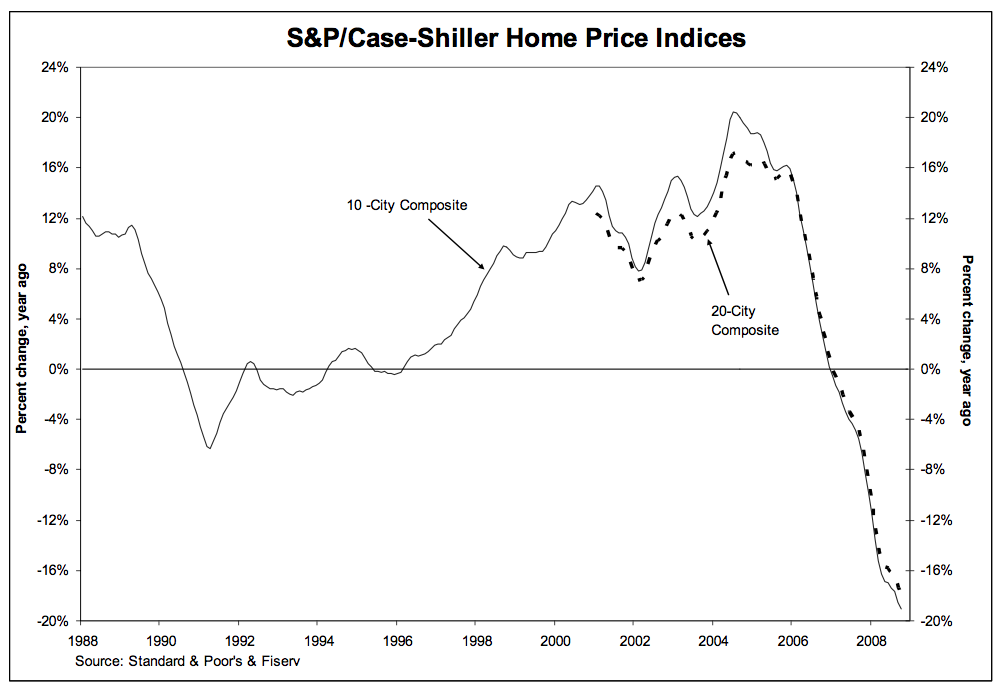
>
Peter Boockvar notes that “While weak but not unexpected, the more interesting data will be seen beginning with the Nov #’s as that is when mortgage rates started its sharp drop. Today in fact, according to Bankrate.com, the average 30 yr mortgage rate reached its lowest level since Sept ‘05 at 5.22%. To this point, the only big reaction to the drop in rates has been in refi’s but it’s purchases that need to be revived and we’ll see hopefully soon if it’s price or cost of money that will drive the buying decision.”
>
See also:


December 30th, 2008 at 9:54 am
Updating my Shiller History of Home Values chart with today’s number…I see…good news…housing is indeed nearer to a bottom!!! The bad news…it should be back in its normal historic range around 2015 if you extrapolate on the chart.
Think about it this way…we are at 2004 levels, which was about 7 years into the boom…it will likely take another 7 years to return to that starting point…it looks quite symmetrical. If it falls faster, the effective pain will be even worse.
Of course, it may overshoot to the downside given how far up we went…that will push the bottom out way past the end of the Mayan calendar.
December 30th, 2008 at 9:59 am
Update the chart yourself…it topped at 220 (I adjusted for inflatio) in 2006…update every month with the 20 city composite, currently at 158
http://graphics8.nytimes.com/images/2006/08/26/weekinreview/27leon_graph2.large.gif
December 30th, 2008 at 10:01 am
I mark the boom really happening in terms of volume in 2002-03.
In terms of price, 1989-96 was pretty slack. Flat to slightly negative. In ‘96, it began to pick up, improving all the way thru to 2002. My pet theory is that some of the big 1990s stock market gains were taken off the table and rotated into real estate by many people.
The Real Estate market went from hot to red hot in 2002 thanks to ultra low rates. Add in an absence of lending standards from 2003 forward, and you get a white hot market.
December 30th, 2008 at 10:05 am
Barry,
If you go by Shiller’s History, 89-96 was slack, but off a record boom number…see my link above.
December 30th, 2008 at 10:17 am
I believe Shiller thinks 1997 was the last year prices were historically correct.
Also, as with pretty much every bubble that has ever happened, we will probably overshoot the return to mean and bottom out well bellow. I see a long drop and then stagnation in home prices.
I have said this before, there are those who bought in 2004-2006 who will never see their home worth that again in their lifetime.
December 30th, 2008 at 10:24 am
Steepest drop since February
The Case Shiller home price index declined by 2.2% MoM in October, the largest
decline since last February, worse than ML expectation but in line with the
consensus forecast. Home price declines have deepened since September when
the credit crunch truly started impacting mortgage lending. November may
produce a similar price concession but new initiatives from the Fed to bolster
lending and drive down mortgage rates may help slow the pace of real estate
deflation beyond that point. The year-on-year pace came in at -18%, yet a new
record yearly decline. This decline brings the correction from the peak to -23.7%;
though we believe there is still another 15% price decline to come.
Deflation across the nation
As in September, all 20 major cities in the index posted monthly declines and all
remained in the red on a yearly comp basis as well. Detroit and San Francisco
saw the largest monthly declines at -4.5% and -4.2% respectively.
December 30th, 2008 at 10:32 am
This is a sensational number, but still has a craplike quality. I’m sure it is defensible, but it is also still deceitful. I didn’t build in Crazytown. My home did not appreciate in value by stupefying amounts and it has not fallen by 18%. If I used fair value accounting and treated it as a mark-to-market asset, then it might only be worth a fraction of it’s worth. Nor do I anticipate a distressed sale at any time. At worst, time on the market would undoubtedly be longer and my price would still provide a long term capital gain.
If some California moron paid 3 times too much for a home on property once inhabited by rattlesnakes, too bad. Ditto for some Floridian who got scammed on some land and then overbuilt overpriced junk on swampland or a sand bar.Cry me a river for those people.
This number is as disingenuous ae the 8% drop in retail sales in December. Factor out the lowered cost of energy and the drop was about 2%. But wait! Various sectors fell by double digit percentages, some very high. This proves my point. If sales were that bad,the large number of double digit sector losses would have creates a double digit loss in retail sales overall. Liars. You can’t have a long list of double digit losers, make it look like everybody is close to ruin, and then state the overall decline was significantly less than the average of the the sectors in the article. Either the bad news was a lie or some sectors did amazingly well to offset the bad numbers.
December 30th, 2008 at 10:34 am
This chart can be misleading because it does not reflect cumulative value change. The drop looks awful but its only 2 years compared with the CUM appreciation over the good years. What it really needs is a barchart overlay showing the inflation adjusted median home price or median home price as a ratio to median income. I suspect there is still quite a long way to go to revert to the mean with the usual overshoot. Why does nobody seem to produce such data?
December 30th, 2008 at 10:36 am
It is possible that the Fed printing money will attenuate the fall in housing so that we don’t reach undershoot levels. Still, when you look around at some of the high-end homes in the US and ask: “who can afford to buy that now?”, you realize that in some parts of the country and some parts of the market, the fall has only just begun.
No more $1M studios in SoHo. Those people will default or eat Ramen noodles for the rest of their lives.
December 30th, 2008 at 10:42 am
This is a nightmare to banking/finance industry. Most of the big firms assumed that the HPI Y-of-Y bottomed in Q2 or Q3 2008. Then a “recovery” (means improved Y-of-Y %HPI) phase was added. If NOT, as the latest numbers show, all of the loss estimations has to be recalibrated. This has a big effect on the financial guarantee business and the structure products valuation.
Modelers must be very busy in the coming days to adjust their models.
December 30th, 2008 at 10:49 am
@philipat
Check the chart I posted above…update it yourself as I described…that gives a nice snapshot of the problem.
December 30th, 2008 at 10:50 am
“Modelers must be very busy in the coming days to adjust their models.”
I guess that’s why the beginning of the end will only arrive with end of the fall in home prices. Conversely, there’s not much more to be made by shorting the ABX?
December 30th, 2008 at 10:57 am
Come on Dead Hobo , you’re better than that. Your logic is akin to “how can one in five people be Chinese? I know hundreds of people and only one is from China.”
When I submitted that Detroit house to Barry, I shared with him the following story:
My wife and I move to Tampa in April. Right now, we’re looking to rent a 2100 sf house with an indoor pool (pool is not considered part of the sf) 30-40 minutes up a toll road from dead center downtown for only $900/mo. Oh, and there’s a lease to own feature that lets us apply our rent towards the principal. If we walk, we walk, if we stay and buy, we have the price reduced by a corresponding amount. And this isn’t a house in the exurbs. Relatively new? Yes. Large tract housing? No: when we lived in Charlotte, the same house would have cost at least $250-300k and in NoVA, *slightly* more; in Tampa, they’re selling them for less than $150k right now, and in some cases the prices are down 50% (granted, that’s out in the large tract swaths of town, but still). We’re used to paying much more for housing, but at those prices, we can divert resources to the 529 and retirement accounts (maybe I can retire before I die! Yay!)
Something else: IMHO, Case-Shiller doesn’t weight the home values correctly, tending to skew towards the higher end of the spectrum. Other sites that using a median price have seen much larger declines in value in the last few months/years; we’re talking differences of as much as 5%, which is pretty damn large.
December 30th, 2008 at 10:57 am
@Steve Barry
“Check the chart I posted above…update it yourself as I described…that gives a nice snapshot of the problem.”
Thanks Steve, hadn’t read the complete thread and, yes, that shows the data in a much more meaningful way.
My excuse is is it’s late here and I probably shouldn’t have opened that second bottle of red!!
December 30th, 2008 at 11:15 am
Sorry for being blatantly OT, but this snippet jumped out at me yesterday. I guess the “sports is recession-proof” meme is beginning to crumble….and this is supposed to be a big football (and hockey) town. I went to the Vikings’ site yesterday and hundreds/thousands of tickets can be had at EVERY price level.
http://www.twincities.com/news/ci_11330650?source=rss
December 30th, 2008 at 11:17 am
Let’s work some numbers and see how bad things really are.
Assume a modest home in the heartland worth $100,000 on 1/1/2000, but it is valued like those in Crazytown since Y2K.
2000 gain = 12% End of year value = $112,000.
2001 gain = 14%. End of Year value = $127,680
2002 gain = 8%. End of year value = $137,894
2003 gain = 15%. End of Year value = $158,579
2004 gain = 16%. End of year value = $183,951
2005 gain = 18%. End of year value = $217,062
2006 gain = 13%. End of year value = $245,280
2007 gain = 0%. End of year value = $245,280
2008 loss = 18%. End of Year value = $201,130.
Qualifier: I took my percentages from the chart. Thus, they might be off a little. But the point is still clear.
If you bought in Crazytown in 2000, you are still up about 100%. If you Bought in Crazytown in 2005, you are at about break even. After that, you are down but will probably make it back if you wait a couple of years.
OOOOHHH. Scary!
December 30th, 2008 at 11:24 am
@dead hobo: Good point, but you’re not “up” or “even” if you used your house as an ATM during that time……
December 30th, 2008 at 11:28 am
I just took Shiller’s 100 year chart, updated using powerpoint and sent to Barry. Hope he will post it.
December 30th, 2008 at 11:31 am
Mannwich Said:
December 30th, 2008 at 11:24 am
@dead hobo: Good point, but you’re not “up” or “even” if you used your house as an ATM during that time……
reply:
Not really. Your implication would be severe only if the idiot was highly leveraged and the house ATM crapped out. Otherwise, waiting a couple of years will bring the equity back to positive levels.
December 30th, 2008 at 11:33 am
@Mannwich:
“@dead hobo: Good point, but you’re not “up” or “even” if you used your house as an ATM during that time……”
The other chart I really like is the one which adjusts GDP growth 2000-2007 with and without MEW. Bottom line: What growth? Kind of restates the problem that we not only have to catch up with the present but a long ways back also. I still think that the average US person is still in denial and truly hasn’t got a clue of how bad things are and how much suffering there is to come? Of course, suffering means being denied going to the MAll for TWO weekens and spending nothing. Good Morning America.
December 30th, 2008 at 11:52 am
@ philipat said: “I still think that the average US person is still in denial and truly hasn’t got a clue of how bad things are and how much suffering there is to come?”
especially when they see that we will be stuck in a long phase of high unemployment and steady inflation….
Perhaps in no longer going to the mall to buy crappy plastic things, America will awake to new possibilities. There are an awful lot of new technologies and scientific/engineering projects that went on hold during BushWorld, just waiting for new investment, both in terms of capital and manpower. It’s all about intelligent allocation from here.
December 30th, 2008 at 11:56 am
Nice rally going here. Bruce in Tennessee may have to fire up the grill if we get to SPX 905…
December 30th, 2008 at 11:59 am
Keep this rally going…tomorrow, when my QID distribution hits my accounts, I will re-invest it at a nice price.
December 30th, 2008 at 12:06 pm
leftback Said:
December 30th, 2008 at 11:52 am
…. Perhaps in no longer going to the mall to buy crappy plastic things, America will awake to new possibilities.
philipat Says:
December 30th, 2008 at 11:33 am
… Of course, suffering means being denied going to the MAll for TWO weekens and spending nothing. Good Morning America.
reply:
——-
The economy is 2/3 Consumer. Are you two communists or robe wearing flagellation enthusiasts? The media profits by writing scare stories that make people also want to also advertisements placed near the scare stories. I’d rather think and be wrong, then be gullible and easily manipulated by scary stories in the news. Suckers.
December 30th, 2008 at 12:18 pm
Dead hobo: If your hypothetical house dropped from $245k to $200k this year; and if, as is typical, your hypothetical owner has little in the way of other savings, then even if he has no other liens on the property, he lost a third of his net worth this year. People can’t and don’t continue consuming mass quantities of crap after losing a third of their net worth. Hence the downward spiral in the so-called “service” sector of the economy
December 30th, 2008 at 12:20 pm
Now Dead Hobo is being disingeuous. The scenario in which a homeowner buys a home in 2000 and her home is worth twice as much DOES NOT exist in the 20 city survey. In fact, the area with the most apprecation – DC/NoVA – is now below June of ‘04, with more downside to come. Trust me: if you bought a condo across the river in the last few years, you are up shit creek at the moment.
Oh, and the geometric return for the 20 city average is 5.2%/yr since 2000, and that’s probably high given CS’s penchant for skewing price weightings to the upside and the fact that there are still two months left to report for the year. Inflation with inflation (as opposed to ex), you’re return is zero – in line with the historical actual “return” on homes after the greatest bubble in history and only a year into this recession. It will get worse, and those home prices will come down summore. Maybe a lot more.
December 30th, 2008 at 12:21 pm
@ rww: And if you subtract the service sector from the American economy, you get the sound of one hand clapping in a forest.
December 30th, 2008 at 12:41 pm
Can’t believe Vince Farrell has the balls to keep appearing on CNBC after he did a radio spot promoting Bloomberg Radio…oh oh…there goes the rally I wanted.
December 30th, 2008 at 12:48 pm
dead hobo is 100% correct in this statement, “If you bought in Crazytown in 2000, you are still up about 100%. If you Bought in Crazytown in 2005, you are at about break even.” i live in crazytown (orange county, california) and this is where we are right now…
barry ritholtz is also spot on with his pet theory “that some of the big 1990s stock market gains were taken off the table and rotated into real estate by many people.” 1000s of multi-millionaires and 100s of billionaires were minted in dot-c0m boom.
i have followed this, actually lived this, first-hand since the late 1990’s.
the caveat is that those that bought in 2000 or before kept adding to the collection of homes on incomes they may no longer have.
December 30th, 2008 at 12:49 pm
@ dead hobo:
I am not quite sure about your flagellation comments, but knock yourself out.
Look, dude – the “service” economy wasn’t very real, and the garage is already full of crap that no-one needs.
Added to that, the “FIRE” economy will not be back – at least for a while.
But I am not really all that bearish, this is actually the start of better things: it’s time to make stuff, America.
How about trains that are fast, clean and run on time? (Japan, Germany) modern nuclear power plants(France). Energy-saving products (Scandinavia) and a whole host of other innovations that the rest of the world is already using? The era of Americocentricity is over unless you are Larry Kudlow.
Take away Silicon Valley and this country is mired in the 1950s. You can’t just sit around selling houses to each other and going to the nail salon. Wake up, dummies !!
December 30th, 2008 at 12:52 pm
There’s a good chance that, in NOMINAL terms, median house prices (national average) will hit bottom within 18 months. But in inflation-adjusted terms, the decline could go on for another 10 years after that. (And of course, there’s always the debate as to how best to measure inflation).
December 30th, 2008 at 12:55 pm
@lb: It’s all about the WILL to think AND, more importantly, ACT big (and maybe defer some gratification) and I’m just not sure that Americans have that will anymore because of the idea that quick, painless riches are always around the corner…..
December 30th, 2008 at 1:00 pm
@karen: Perhaps it’s implied, but I’ll add – and those who bought in Crazytown in 2000 and used that home equity to purchase additional homes (while many have suffered lost jobs/reduced incomes) is in a whole world of obvious pain.
December 30th, 2008 at 1:33 pm
mannwich, leftback, byno:
And if pigs could fly we would all regularly step in pig sh*t.
In other words, take any situation and wrap terrible exogenous crap around it and you have terrible exogenous crap.
Byno, you can pick your girlfriend but you can’t pick your facts and expect others to say they’re as pretty as your girlfriend. My facts came from the CS graph, which is an average of lots of locations. By implication, you are saying the CS is not accurate because one of your pet locations is not spot on average. You make the rocks in my head rattle.
December 30th, 2008 at 1:37 pm
Karen. The problem is that you can’t refinance your home unless you have, at least, 20% equity–note some areas require 25% equity these days. Under deadhobo’s chart, only those that bought–and did not pull cash out– in 2003 @ $158k can refi. ($201k x .8 = $160k). A few more % points down and the refi market is dead too. Bottom line, no/little equity = no refi.
December 30th, 2008 at 1:44 pm
Check out Barry’s new Digital Media entry…my updated Shiller Chart appears.
December 30th, 2008 at 1:44 pm
Johnny, no argument from me on your point other than refinancing may not be necessary if your rate is re-setting lower… got zirp?
Anyway, i came late to the party and may have misunderstood some of the discussion points.
December 30th, 2008 at 2:12 pm
Steve Barry said:
December 30th, 2008 at 1:44 pm
Check out Barry’s new Digital Media entry…my updated Shiller Chart appears.
addendum:
—————
Don’t forget to read my critique of this very flawed graph.
December 30th, 2008 at 2:17 pm
@Dead Hobo:
Take off your rose colored glasses for a second and look at your own data the other way. It shows that indeed, prices may still have a long way to fall. Income didn’t double between 2000 and 2008, so why should have home prices?
What we did get over that time period is a tremendous amount of supply growth and lots of people bought at the top, and lots of people did use their home value as an ATM. You may not have, and your friends may not have, but lots of people did. Housing still has a way to go before it is truly affordable again. This isn’t even taking into account all the wealth that was created over this time period was funneled somehow back into the economy. That effect is now gone.
So yes, to me, that is sort of scary.
But hey, maybe it was the naked shorts that took down housing too?
December 30th, 2008 at 2:33 pm
cfischer Says:
December 30th, 2008 at 2:17 pm
… Housing still has a way to go before it is truly affordable again. This isn’t even taking into account all the wealth that was created over this time period was funneled somehow back into the economy. That effect is now gone.
reply:
———–
No argument that housing is high priced. If incomes continue to fall in the Obama terms, such as they did during the Republican era, then bad times are a comin’. I think Obama will try to reverse the dumbing down of America and the mindless exporting of jobs. I think he will again try to establish a comparative advantage in what the USA has to offer and let the foreigners do whatever they do best.
Credit and garbage credit based financial products will probably cease to be our largest export. Whiners will, of course, decry the fact they have to do more than pass hot potato credit paper around to earn high incomes. Some might even have to go back to school and study something useful … then actually do it. (Although nobody will whine as loudly as naked shorts taken off the crack)
So incomes will probably rise because the value of what the American worker will do will be higher. Thus, homes will become more affordable. Low interest rates will also goose up the price of homes since many people will buy as much as they can afford to pay for monthly. You may not like that but if you get an education, apply yourself, and stay off the Ripple you too may afford to move out of your doublewide.
December 30th, 2008 at 2:53 pm
“Don’t forget to read my critique of this very flawed graph.”
Don’t forget to read my critique of your critique.
December 30th, 2008 at 3:22 pm
“It is possible that the Fed printing money will attenuate the fall in housing so that we don’t reach undershoot levels.
That cannot happen – the money they are printing is not going to people who will buy houses. It is going to defend an economic upper class against catastrophic loss caused by their disastrous investment choices. There is no current ‘trickle down’ mechanism… and may have never been one. The government printing has had no effect whatsoever on the general economy; in spite of dropping rates and invented money every measured sector has declined for about a year.
December 30th, 2008 at 3:56 pm
@ wally:
I actually hope you are right. I think affordable housing would be a great result.
Of course I have to defend myself against the possibility of Fed success in stabilizing the upper class catastrophe and runing the lives of the populace by debasing the currency and causing food and fuel inflation.
December 30th, 2008 at 5:35 pm
Edhopper is right.
And then there is deflation.
How much is your house worth?
The answer is not two and half times congressional salaries.
The answer is MEDIAN WAGES times 2.5.
In case you haven’t noticed, wages are going down.
And then there’s deflation.
Don’t worry about it. If you’ve got plenty of cash and a good income, you never have to sell your white elephant (I mean house). Enjoy your 3,500 square feet. Add a movie theater or a pool ar maybe another tennis court. Hey, oil is cheap so make it a heated tennis court. Don’t forget the 300 speaker installment so you can play tennis or swim to the music. Life is wonderful. There are no problems and nobody is going to bomb your house. Have a nice day.
December 30th, 2008 at 6:40 pm
Check out the chart on page 1 comparing the US housing bubble to Japan’s bubble of the 80’s/90’s:
http://www.csis.org/media/csis/events/081029_japan_koo.pdf
This is from a lecture by Richard Koo (chief economist of Nomura Research Institute) discussing the lessons that can be learned by Japan’s lost decade. Of course, you can take what he says with a grain of salt. It may be a good prediction of what to expect in US fiscal policy. The lecture and slides can be found here:
http://www.csis.org/component/option,com_csis_events/task,view/id,1828/
PS – I have become an avid reader of this blog due in part to the many excellent insights and perspectives of the comments. Thanks, everyone!
December 30th, 2008 at 7:49 pm
cbosco76,
nice links~ always helpful to pay attention to what the CSIS is hanging out for circulation..
LSS:
on p.11/26 –his box: Government procures funds at low rates due to lack of other borrowers
on p. 21/26 –under risks: Weaker U$D/ loss of Petro$-status/ U$D collapse
if every ‘Western’ Nation is attempting the same scheme, who’s buying all of the newly created ‘debt’?
who’ll be buying ‘ours’?
who’ll ‘Rollover’?
also: his use of ‘29-’54 I-rates comparo, is fatuous.. USA’29 and Japan’89 had more in common, Macroeconomically, than Japan’89 and USA’008..by a long shot..
and, fromp.17/26 Ex.16
seems like one could make the case that Japan’s ‘private-sector’ has been in Gov’t receivership–wonder how that’d play at the WTO?
in Sum, his whole POV is predicated on the continuing existance, and belief therein, of Fictional units of account–popularized by our favorite Poli-Sci-Fi novelist, JMK..
as an aside, I thought it funny that he’s, still, referring to this interlude as ‘Subprime crisis’, as opposed to ‘ProCrime’, but, I’ll hazard, some transparencies won’t be seen..
