
How to become Ultrabroke
Mark McHugh is a financial professional and former associate of a large investment firm.
He provides fee-based financial planning and tax preparation services in the Philadelphia area.
Editor’s Warning: Although Mark McHugh shares a surname with a respected contributor to The Big Picture Café, we’d like to state for the record, that Mark doesn’t know Jack.
~~~
Are You getting ETF’d?
Objective: UltraShort Blah-Blah ProShares seeks daily investment results, before fees and expenses, that correspond to twice (200%) the inverse (opposite) of the daily performance of the Blah-Blah Index.
Remember when you first heard about these leveraged ETF’s? That little part of your brain that actually wants you to survive started flailing its’ arms saying, Hold on there, Chief…. Double the gains?…How does this work?…How much fees and expenses?…Can this possibly work?…Remember? And you said, “Shut-up brain, I know what I’m doing.” Double your pleasure, double your fun, double your risk of cardiac arrest while just sitting in front of a computer. Now look at you, after a handful of “Plaxico” incidents, trying to externalize the whole thing.
Real men don’t read prospectuses, I always say. So when the eggheads at ProShares (and others) offered to warp time and space just for me, I was excited. Now, thanks to the recent performance of the SRS (ProShares Ultra-short Real Estate) and URE (ultra-long), I believe I’ve discovered a wormhole to a whole new dimension of excitement.
Take this past Monday, for instance:
While not able to understand to understand the Theory of Relativity, I can multiply by 2 (and subtract). Is a couple percent off target anything to be concerned about? The difference amounts to about $0.13 for URE holders and about $4.35 for SRS longs. I’d multiply that by the number of shares outstanding, but the only data I can find (MSN) says there are 8m shares of SRS outstanding (it traded over 15m today). And Yahoo says the expense ratio is 0.95% (sometimes the jokes just write themselves).
It’s not fair to rush to judgement based on one anomaly, right? So, how do you like your anomalies?
Intraday:

Perhaps it is noteworthy that these price deviations vs. IYR (Barclays DJUSRE tracking ETF) observed on 12/03/08 at 2:36 were indicative of the direction the index would move in by the close.
The Eight week long anomaly:
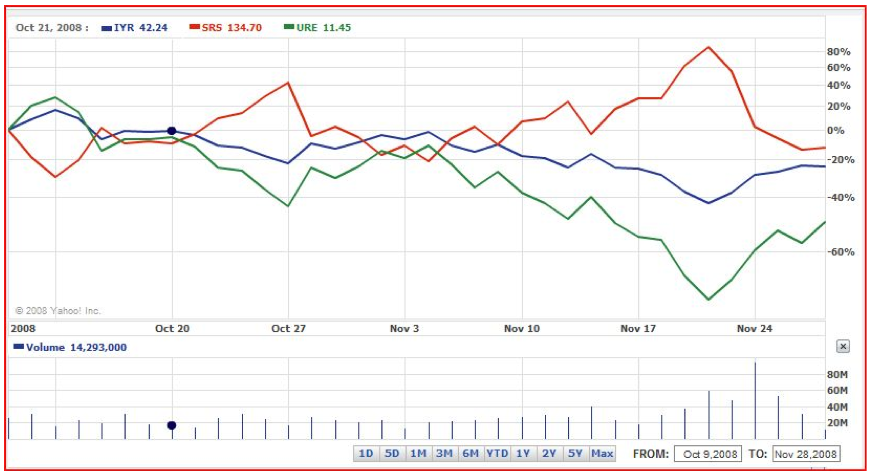
The Final Anomaly:
As of 12/03/08, the DJUSRE index is down 52.7% YTD, meanwhile SRS has returned a measly 3.6% (not 105.4%). Ironically, shorting the URE (which is essentially the same trade) has netted better than 85%. Sickeningly Ironic, is the idea that shorting equal dollar amounts of both URE and SRS (a neutral trade) would have produced a gain of almost 41%.
Conclusions:
I believe that these weapons of financial self-destruction (leveraged ETF’s) are as structurally flawed as all the other “innovative” financial products that flew in under the regulators radar in recent years. The URE/SRS pair is just the first to reach critical mass. SKF/UYG should be next to crack (it may have already, I don’t follow it in detail). It certainly seems that shorting them is far safer than buying them. And the next time that little voice says, How does this work?….maybe I’ll listen.
I hope that I’m wrong about the nature and sustainability of these funds, because there has been a deluge of them recently (“3x”, “Ultra-commodities”, etc.). I’ve just got a bad feeling that this is where unintended consequences come from.
I’ve heard several pundits say that they are looking to see the markets go through an “apathy” stage. I just can’t see that happening with these babies around. Too exciting. Oh, I almost forgot to mention that a lot of these things trade options too? Might as well just douse myself with gasoline and have somebody hand me a lit sparkler.
~~~
Sources:
http://finance.yahoo.com
http://moneycentral.msn.com



December 5th, 2008 at 9:16 am
BR, perfect timing….. I have a position in SRS on for the Jobs Report and I click over and spot “Ultrabroke” and SRS as exhibit A. While I am surprised a -533,000 number hasn’t sent the futures down to Hades, I decided not to stick around. SRS sold for a tiny profit. Can hardly wait for the newspaper headlines to come tomorrow. With a Sunday “reading” day to digest the headlines, Monday could be quite interesting on Wall St., save for some more government “hocus pocus” in between.
One thing’s for sure, today’s Jobs Report and headline cycle is the LAST thing retailers want to hear.
December 5th, 2008 at 9:18 am
To borrow from the recent paper towel commercial run a few months back, Monday could well be a “three sheeter”….
December 5th, 2008 at 9:31 am
You are displaying one of the most common misconceptions about these ETFs:
They are not designed to track the underlying index 2x on any period other than 1 day
On any period greater than one day, there is inherent compounding errors.
This is a statistical phenomenon is similar to the fact that if you lose 50% you need to gain 100% to break even.
Proshares covers this in the 1st section of the prospectus:
http://www.proshares.com/funds/performance/UnderstandingProSharesLongTermPerformance.html
Very few people understand this properly. (Among the imacts of it is that it makes doing traditional TA on the ultras a questionable practice)
December 5th, 2008 at 9:53 am
> Ironically, shorting the URE (which is essentially the same trade)
Also, these are *not* the same trade. They compound in opposite directions.
December 5th, 2008 at 9:57 am
Here’s the thing. I bought 200 shares of SDS this morning at 96.75. I just sold it at 98.75. Not bad for 15 minutes. This is not an investment It is a trading vehicle. I have repeated the same process over and over this year and I am not ultrabroke. I am up 22% YTD. Thanks for the concern. I know I’m playing with fire.
December 5th, 2008 at 10:04 am
“Mark doesn’t know Jack.”
Pun (not) intended I hope?
December 5th, 2008 at 11:29 am
i subscribe to a trading newsletter with several strategies including a daily trading one. the ultra short ETF’s are a nice way to make money on the way down instead of just going to cash for a day or so
but they are just like any other stock, the price fluctuates and isn’t always in exact sync with the index. it’s interesting that when the index goes below some trendline the price of the ETF goes crazy and spikes above what the fair value is. Say the NDX is down 1% when it breaks some support. QID should be up 2% but will probably jump to + 2.25% or + 2.5% and then settle down to it’s fair value
December 5th, 2008 at 11:38 am
Not to call anyone out here but hasn’t BR posted in the past that he has used the vehicles for clients managed accounts as a way to get market exposure while being 50% cash????
December 5th, 2008 at 11:42 am
I don’t know what your problem is here Mark. Why don’t you just buy two
December 5th, 2008 at 12:01 pm
i think those ETF is dependent on how good the manager is, not sure how this person would play a role… (yes, yes, I read all that stuff about how volatility changes the number game) but if you look at
QQQQ vs. QID: YTD, QQQQ -46.75%, QID +113.68%
FXI vs. FXP: YTD, FXI -53.49%, FXP -35.67%
that’s just incredible. I lost a lot on FXP, and vowed to never play that again… SKF or QID would be a lot better -_-
December 5th, 2008 at 12:09 pm
I just want to add after doing some quick comparisons with these vs their benchmark indexes, the returns are all over the place but the SPX based ones seem to track the best. Hmmm
December 5th, 2008 at 12:21 pm
No. No. No. No.
These have noting to do with the manager and they (for the most part) track their NAV fairly well.
(Most of them have decent divvys, but thats not the issue either)
THESE ARE NOT DESIGNED TO TRACK 2x FOR PERIODS LONGER THAN 1 DAY
Pull up a spreadsheet and work it out yourself.
Say you start with an index and its ultra ETF both worth $100.
On day 1 the index drops $10. The ultra track perfectly and drops 2×10% to $80.
On day 2 the index gains the $10 back. This is an 11% move. The ultra then gains 2×11% * 80 = 97.6
You’ve now lost ~2.5% against the underlying index with no tracking errors or mismanagment.
As noted in the prospectus, this “slippage” increases with the volatility of the index. (It can even cause the ultra to “outperform” with a cascading unidirecional move)
Basically these ETFs automatically increase your leverage as they gain in value and decrease your leverage as they lose value.
December 5th, 2008 at 1:37 pm
jfeddak explains it.
I like shorting SSO over long SDS since I think the market will trend down, but with occasional sharp rallys (which bleed off SDS gains as per jfeddak comments). On the other hand, SDS often works better on a day you “know” will trend down. Same with the other ULTRA twins.
Warning: these ULTRA twins develop occasional correlated biases. For example, S&P index = -2%, SDS = 3.5%, SSO = -3.5%. A rather large tracking error.
Haven’t tried shorting both sides of an ULTRA twin. Interesting.
December 5th, 2008 at 1:48 pm
> Haven’t tried shorting both sides of an ULTRA twin. Interesting.
I looked into this a bit. In general they’re hard to borrow and the gains aren’t particularly stellar unless you’re seeing the once-in-a-lifetime volatility that we’ve been seeing. (Don’t forget the divs/distributions when doing long term comparisons on these). And there’s the unknown of counterparty risk and the goofy stuff that happened to the financial ultras during the shorting ban.
It makes more sense to do with the 3x inverses as they have more leverage.
Note that if you catch a move in your direction, the short ultralong will underperform the long ultrashort. (and vice versa)
These basically are short to medium term day and swing trading vehicles. They are absolutely cannot be used as long term buy and hold investments.
December 5th, 2008 at 2:31 pm
jfeddak:
I’ve made about 23% off the Ultra shorts since August. Some trading, but never completely out. I will be completely out if S&P breaks 700 or March, whichever comes first.
I don’t know if you consider this trading or buy-and-hold. I do know that the Ultrashorts deliver a lot less than 2X, probably better off with 1X shorts and less bother.
December 5th, 2008 at 3:40 pm
Broken, as long as you’re aware of the issues.
Most people trading these have no idea how they work.
They are definanetly not a “free lunch” replacement for the underlying index.
If anything, they’re sort of like ITM leaps where you are eating a slight time decay over time.
I don’t like to hold them through more than one swing cycle. but to each his own.
The other thing I see all over the place is people doing traditional technical analysis on the ultras withough accounting for the slippage. This is somewhat like doing TA on an option and declaring you’ve hit support because you’ve time decayed back down to a prior level.
Because of the slippage, the price level you hit back 2-3 months ago is *not* the same as that same price level 2 months later. Unless you believe that the ultra is driving the underlying index, you are far better off doing the TA on the underlying index even if you are trading the ultra. (For an example of this, go look at that 760 resistance on RUT from earlier this year. Now look at the chart of UWM or TWM and see what the slippage does to that nice clean technical level)
December 6th, 2008 at 3:37 pm
Cut to the chase… ETFs ARE “weapons” to — money managers. They want your money so they will discredit the competition any way they can. Anomalies are just that… the derivative models they use to match performance of an index are not an exact science. Don’t make a big deal out of it.
December 6th, 2008 at 10:33 pm
Thanks to everyone who has commented (especially jfedak). You articulate the point very well that we are getting what we paid for, whether we understood it or not. I wanted to make the point that you have to be a superior market timer to get great returns from these leveraged ETF. If market timing is not your forte, you need to understand the risks involved.
I had kind of hoped that some people would comment about some other aspects of the ultra’s, like how frustrating the “drift” can be when you’re trying to open or close a position (and if anyone has observed any patterns). Or how much of the price action takes place outside of trading hours. Or, how unbalanced the dollar amounts traded on the SRS/URE pair have become (and what implications that might have).
The driving force behind the article was a vacuum of discussion critical of leveraged ETFs, perhaps because they buy advertising on most of the big financial websites. I hope somebody out there has thought this all through, because this looks like the fastest growing segment of the investment world right now.
Most of all, thanks to Barry for publishing it.