
Subscribe                   
Get The Big Picture
by Email


More Bailout Comparisons

Email this post Print this post
By Barry Ritholtz - December 3rd, 2008, 10:30AM

Last week’s discussion on the size of the bailout expenditures generated some interesting buzz. A few others picked up on the size, and created a few different ways to depict the amount of money involved.

These have been my favorites:
>

Bailout Pie Chart
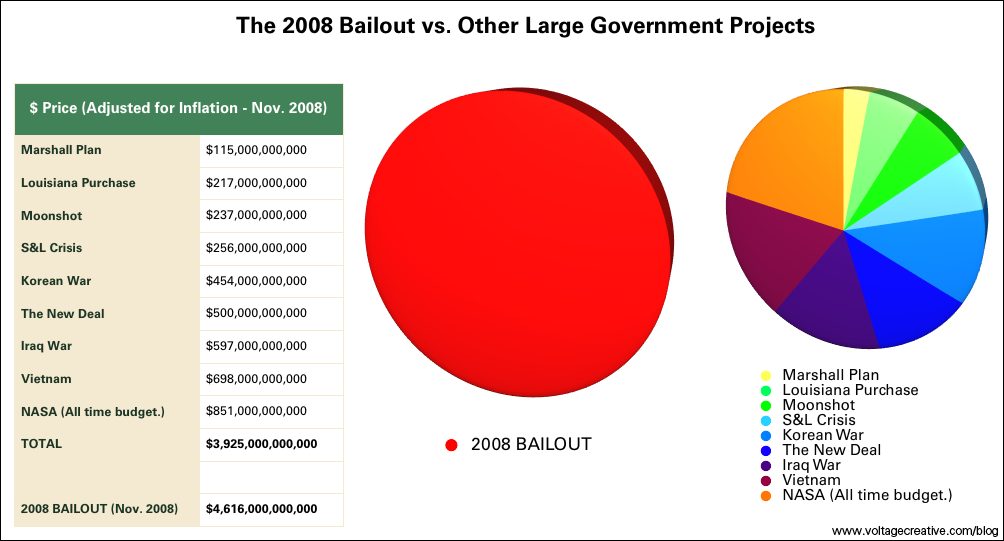
chart courtesy of voltagecreative

>

Prior Bailouts as a % of US GDP
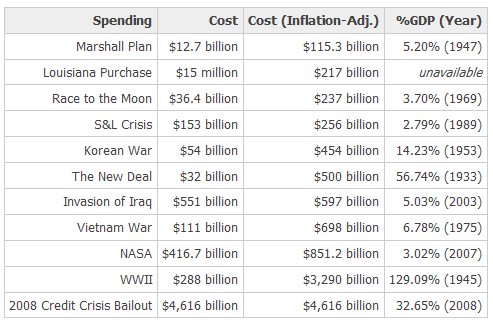
via mindtangle (note that this data is already old!)

>

Global Bailouts per National GDP
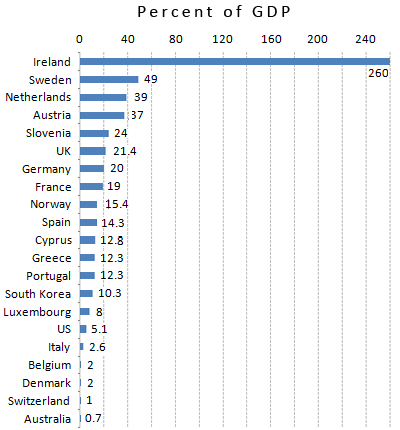
chart courtesy of Portfolio

>
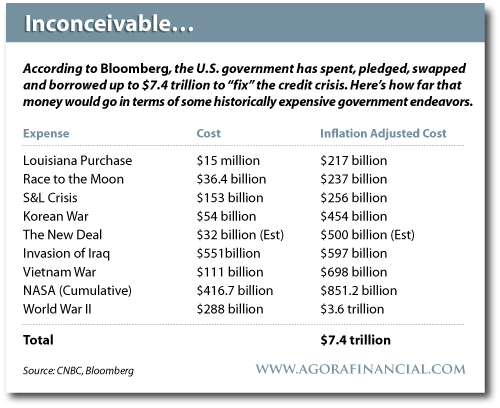
via Agora Financial

>

Previously:
Calculating the Total Bailout Costs (December 2008)
http://www.ritholtz.com/blog/2008/12/calculating-the-total-bailout-costs/

Big Bailouts, Bigger Bucks (November 2008)
http://www.ritholtz.com/blog/2008/11/big-bailouts-bigger-bucks/

32 Responses to “More Bailout Comparisons”

  1. Barry Ritholtz Says:

    Did I miss any other cool ones?

  2. jb01411 Says:

    While the Federal Government has certainly put itself on the hook for a great sum of money, you are not comparing apples to apples. Most of the announced government plans involve the Fed or Treasury using the US govt balance sheet to fund private enterprise, either through investments in prefs, the CP market, exposure to Citi’s assets. Whereas WWII, the Iraq war, NASA et al represent expenditure. The ultimate cost of the Bailout will not be calculable until the economy recovers and the final losses are tallied. To the extent that the Fed or Treasury take losses on their exposure, that will be the comparable number to the expenditures listed. While this may indeed prove to be significant, comparing exposure to expenditure is intellectually dishonest.

    ~~~

    BR: It is still a government expenditure, and as such crowds out other uses for the moeny.

    Further, we have no idea how much of this is going to come back to the taxpayer — but my best guess is it will cost trillions when everything is said and done.

    Not counting the potential inflation impact of running all those printing presses helicopters 24/7.

  3. BKM Says:

    Aside from the carry wind down, the above is a very tells the story of the USD and Treasury market.

  4. daveNYC Says:

    Shouldn’t Ireland be Iceland?

  5. doug Says:

    Ok, they are neat, but leave me confused. according to my semi disfunctional brain, one indicates %gdp for US is quite different from the other. 32 vs 5. I don’t get it

  6. Transor Z Says:

    Is the moonshot expense double-counted since the cumulative NASA budget is also included?

  7. Rightline Says:

    Gasbag on CNBS facing off with Liesmanat 11:33 am est just before (yet another) Obama news conference. Referring to Paulson and more TARP money….. it’s “Bailout Nation” !!

  8. jrhyno Says:

    I know that this probably isn’t the correct thread to post this in, but is there a place on the blog where your readers (including myself!!) post current trading ideas and such. I see those threads, but they always appear to be in response to one of Barry’s posts on the subject.

    Would it be useful to have a constantly updating thread, say, on trading?

    Thanks, just a thought,

    Jeff

  9. DL Says:

    How about the Alaska purchase (in 1867) for seven million dollars, equivalent to 100 million or so today.

    http://en.wikipedia.org/wiki/Alaska_purchase

  10. VennData Says:

    This is total overkill. Let the bailouts continue, I’ve got no problem with them, why… look at the “Smart Money” Goldman Sachs guys. They’re going to start an Internet bank. What a novel concept. I’ll bet they get more than their fare share… sorry… fair share of the chunk of the nearly $ four T accumulating in money markets.

    Forget the merger with Citibank. GS needs to team up with Starbucks and offer Sears/Dean Witter-like banking to the swillers… er… a… suckers… er.. a… savers …well potential savers, who buy those four dollar grande soy lattes. Call ‘em GoldenBucks.. or StarSachs, whatever, marketing… the name… that’s the easy part. Anyone who pays that kind of money for coffee is sure to love low.. low rates on checking in the hopes of helping America’s financial system, and saving the venerable marketing geniuses at GS.

    I can see Blankfein and Schultz teaming up in an ad, Iacocca-like: If you’re going to buy coffee, at least buy American.

  11. KidDynamite Says:

    ditto Doug above - the 5% of GDP figure for the US Bailout is way out of line with the other estimates.

  12. dinosaurtrader Says:

    Thanks, this is great.

    -DT

  13. RW Says:

    Well, hyperinflation and the recession of 1980-82 was no picnic, worse than 1972-73 even if the market didn’t crash as deep, and the cost of getting out of all that during Reagan’s two terms of office was the real beginning of the Republican commitment to borrowing over revenue collection (increased deficit spending) so a lot of cost should be associated with that; not sure how to total it up or what label it deserves but it was certainly a definable program through Reagan, Bush I & II.

    In any case I can’t see much alternative to a full bailout now, no matter what the cost. While my neo-Calvinist side would like to believe folks get what they deserve and that painful correction is a good thing (for other people) if only from an educational standpoint, there are a sufficient number of innocents being smashed these days to say nothing of the risk that our country could become competitively impaired that I am willing to forgo the self-righteous pleasure this time around in favor of cash helicopters. FWIW

    I seriously doubt we will have any clear idea what the actual cost of this crisis is until long after it is over and accounts are settled but inflation, or debt monetization as I hear it politely referred to, is certainly waiting in the wings. The only reason I’m inclined to doubt it will be hyperinflation is because the velocity of money can fall so low during depressed economic times that even running the printing presses at top speed may barely budge the base needle.

    PS: I don’t understand the argument that government expenditure crowds out other uses of money during a liquidity trap: How can this be seen as anything other than a replacement for private investment that is no longer occurring because the only ‘other use’ that money is being put to is mattress stuffing; wasn’t that Keynes’ great insight?

  14. DL Says:

    Two more:

    Hoover dam

    Original Cost: $49 million
    Inflation Adjusted Cost: $782 million

    * * *

    Panama canal

    Original Cost: $375 million
    Inflation Adjusted Cost: $7.9 billion

  15. batmando Says:

    @daveNYC Says at 11:31 am

    “Shouldn’t Ireland be Iceland?”

    The Icelandic gov’t was unable to bail-out the Icelandic banks whose bad debt was something like 10:1 the Icelandic GDP.

    Whereas Ireland early on said it would guarantee the debt of all Irish banks who apparently were very much into the toxic debt trade

  16. RW Says:

    Addendum: Now that I think of it Bush II was not really pursuing a Reagonomics kind of program, it was more like free-style looting, but certainly Reagan’s first term could be interpreted as a bailout even if the total economic policy arc of Reagan + Bush I went beyond that.

  17. AnalyseThis Says:

    The Irish banks were NOT “very much into the toxic debt trade”. They are run of the mill lenders (granted with a big property related exposure) and relied probably too much on non-deposit funding. The Irish government has not put 1 cent into the Irish banks, but has guaranteed all debt (ex upper Tier 2), interbank funding and deposits until Sep 2010. The guarantee covers liabililities amounting to €400-500bn. There is possible 1 small bank that may not have sufficent equity to cover its losses, which may require the government to make up the loss (would be a small % of GDP, if that). At worst it may have to underwrite equity issuance of 1 or 2 of the banks, which may lead to it taking a short to medium term stake in those banks.

  18. markam Says:

    It looks like the 5% figure is based on the widely circulated $700B bailout estimate whereas the 32% figure is based on an estimate of $4.6T (which still seems a bit light)

  19. Bruce N Tennessee Says:

    RW:

    How can this be seen as anything other than a replacement for private investment that is no longer occurring because the only ‘other use’ that money is being put to is mattress stuffing; wasn’t that Keynes’ great insight?

    The problem is, there IS no replacement for private investment…and I do appreciate your point. My thought is that if this doesn’t work, then you are then saddled with recession/depression AND one of two choices…very heavy tax increases or debt default…

  20. AGG Says:

    And now this:
    Dec. 3 (Bloomberg) — Yields on speculative-grade bonds imply a U.S. default rate of 21 percent, higher than the record set during the Great Depression in 1933, according to John Lonski, chief economist at Moody’s Investors Service.

    The extra yield investors demand to own U.S. high-yield bonds was 19.19 percentage points on Dec. 1, according to Moody’s. Assuming a 20 percent recovery rate, the spread implies a default rate of 20.9 percent, Lonski said yesterday in a market commentary. That compares with a rate of 11 percent in January 2001, 12.1 percent in June 1991 and 15.4 percent in 1933.

    Hunker down, folks. The storm is here.

  21. RW Says:

    Bruce in TN, there is an alternative to default of course, inflation (monetization of debt) but otherwise can’t disagree, could be out of the frying pan and into the fire. But I frankly don’t see any chance of getting out of the pan in the first place in the absence of stimulus so I feel we are obliged to try.

    I’m not unsympathetic to those who argue we should avoid the risk but have yet to see a really cogent argument to that effect; e.g., so far those who argue a direct stimulus policy is outright wrong tend to either be arguing that: We can’t afford it (didn’t hear much about that while gross deficit spending was ballooning to 10 trillion buck while benefiting the upper classes but, okay, it’s a point), or
    they are the kind of idiot who thinks more tax cuts is the only necessary and, in some cases, sufficient answer to any problem (we don’t need no stinking capital gains; now what was the question?), or
    they are true believers in the church of markets-are-god and will guide us to Nirvana (or was that Soma?), or
    they are historical revisionists particularly vis-a-vis the Great Depression and its lessons (I don’t know economics particularly well but am very familiar with data analysis and logic and can recognize when someone is cherry picking or assuming the conclusion in their premises — folks like Amity Schlaes do both).

    It’s a classic zugzwang; there are no good moves, only less bad ones. It seems to me that if we can not succeed in getting out of this liquidity trap then depression becomes something close to inevitable and defaulting on our debts more likely regardless, for citizens and the country as a whole alike; i.e, the dollar will either be worth more in which case debt burden becomes too great or economic growth will be so stagnant that debt can not be supported and even inflation won’t buy our way out, it will just result in a growing number of countries refusing our currency and refusing our assets and debt along with it.

  22. constantnormal Says:

    Two things —

    1) this has been bothering me ever since these lists started showing up — Is not the “Race to the Moon” also included within the cumulative NASA budgets? Shame, shame, double counting, not allowed. Where are the eagle-eyed pencil-necked bean counters among us?

    2) I see a lot of this bubble formation as excess money production that has been squirted from one asset class to the next — from Greenspan’s eager pumping into the mortgage industry, fleeing into the short end of the Treasury debt pool when the mortgage derivatives industry collapsed, and that pooling of money along with the money fleeing from deflation-ravaged commodities and cratering equities is now expanding out into longer-term Treasuries. When that bubble also explodes, where will the money go?

    Wouldn’t it be prudent to mop up this excess cash — which is clearly more than is required to maintain liquidity in the shrunken global economy — instead of continuing to pump more and more money into places where it is simply puddling with zero velocity, not moving, not serving any productive use?

    What is Bernanke thinking? Surely he sees that continuing to inflate (in the pressurized sense, not the monetary sense) these corpse-like institutions with mountains of dollars will not re-animate them? Just let the zombies die — for we cannot bring them back to life. Surely Ben sees this as well, doesn’t he? DOESN’T HE??!! What is he hoping to achieve by this?

    What possible sense is there in any of the government’s actions? What don’t I see?

  23. Transor Z Says:

    @ constantnormal: Yeah, I posted about the NASA numbers being double counted also. And my “quant” skills end after I run out of toes…

  24. rogerdaily Says:

    Most of these comparisons are simply silly.

    There’s a world of difference between SPENDING money on a war versus INVESTING in preferred securities.

  25. RW Says:

    Addendum: One of the stronger arguments I’ve seen against a large-scale stimulus in the US is here at http://tinyurl.com/5cnpcq

    Based on this logic it would be better to convince surplus countries such as China that they should run a large scale Keynesian style stimulus to increase their domestic demand while the US and other deficit countries cure themselves of the over-consumption and debt habit; my problem is I don’t believe either would happen so I wind up a square one again, the need to generate jobs while repairing/improving infrastructure matches the economic need (if only we hadn’t already spent so much money!).

  26. flipspiceland Says:

    re: Venndata, Buying american.

    The best reason to buy American, (from an avid former free-trader who woke up one morning and saw the light) why a national onslaught of a ” Buy American” campaign would be in everyone’s best interests is a simple reflection on our past behavior of buying from China and other third world countries:

    Every cent we have saved in doing so, every sneaker we bought for $49.99, every TV, that would sell here for 2 or three times as much is now going to cost us 10X what we thought we saved in lost GDP, wages, pensions, and every other asset, including now, our homes and economic stagnation.

    Absolutely buy American where you can but much more is needed to wean the American consumer off of the myth of low prices. To get them for once to look at the damage this has done to our country’s balance sheet, our personal wealth, and growth opportunities for the young and now ten million unemployed. In consuming at Wal-mart, et al at the lowest prices , we inadvertently have been eating and swallowing our own tails.

  27. Hulkster Says:

    I have to come down on the side of viewing exposure the same as expenditure as not being accurate. If the bank is exposed $250k for my mortgage on my $1 million home, are they really exposed at all? And if the Fed takes a pledge of that mortgage as security so the bank can take back some fressh cash, has the Fed now ’spent’ $250k?

    Looking at gross amounts is the same fallacy that surrounded dot-coms revenue sharing agreements. You advertise on my site and I’ll advertise on yours and we’ll both book a billion in advertising revenue and amortize the expense over the many years we expect to derive a benefit from the expenditure.

    Neither situation is steeped in the real economics of what is happening.

  28. Transor Z Says:

    @Hulkster:

    Your logic (which would be basically sound under normal conditions) is akin to the accounting practices at banks that started this whole mess. How do you account for an asset class hopelessly entwined with complex/poorly understood risk on your balance sheet?

    In the case of a bailout response to catastrophic global financial turmoil of unprecedented complexity, I can see the argument for equating exposure with expenditure. Too many unknowns, the money has been earmarked.

    100,000 soldiers are about to hit the beaches to fight an enemy whose strength we can only estimate. Our soldiers are untested. Better to assume that 50,000 of our troops will survive unscathed or more prudent to assume the whole army is going to be tied up for a while?

  29. JustinTheSkeptic Says:

    Just my opinion, but I just finished driving several thousand miles of interstate and they are dead. Trucks come at you in three or four, instead of six to ten, like last year… Oh, say it aint still so Joe, but I do believe it is going to get even worse from here. What was the S&P 500 back in “81?

  30. rexn Says:

    Barry: I gotta agree with the first post. You can’t really count all $8.5 trillion as a government expense.

    I know, it’s a really big number!!! and it sounds really scary!!! And we can all cluck to ourselves that the real situation is so much worse than the government claims! Aren’t we special!!!

    For one thing, you’re counting trillions that haven’t been spent, swapped, lent or invested. Those are theoretical bailouts. I’d like to tell you that I made love to 357 beautiful women today, because that’s how many I fantasized about as I passed them on the street today. Wow! I am some kind of lover — theoretically…

    Out of the trillions that have been actually spent or committed, some of it is pure swaps: Yen for dollars. Some is swapped cash for Treasuries, or Treasuries for agencies. Or guarantees against commercial paper. Almost all of it is either loans or direct investments. The Fed has lent out $2 trillion, and it has collateral that it has valued at $2.2 trillion or so. Maybe some of the collateral is worthless, but all of it?? 100%??

    And since this money is being pumped directly into the financial system, it’s hard to claim that it’s completely crowding out private-sector borrowing or investment. If the banks ever do lend it out, the economy will get $10 for every $1 provided by the Fed.

    Anyway, you don’t have the right number anyway. According to the FDIC, banks and thrifts had deposits of $7.025 trillion as of June 30. Clearly, you need to assume that all 8,441 banks will fail and that the government will be on the hook for 100% of the losses. You’ve only got down $1.8 trillion for FDIC. So now we are at $13 or $14 trillion ($8.5 trillion plus $5.2 trillion extra for FDIC). And you should assume that all $5 trillion in Fannie and Freddie bonds will turn into fairy dust, because you should assume that every mortgage in the United States will default with 100% losses. So now we are at $19 trillion. Dig around some more and I’m sure you can make it an even $20 trillion. I’ve got it!!!! If we just assume that all 30,000 defined pension plans fail, then the PGBC will be on the hook for a few trillion or so….

    $20 trillion is a much better number!! If you put $20 trillion on your book cover, you’ll get all of Lyndon LaRouche’s readers, plus all of Paul Farrell’s!!

  31. John Pozzi Says:

    Let’s start a New World Order - http://www.grb.net

  32. beezer Says:

    Short term the real danger is to keep the credit lines and commercial paper markets functioning. If they fail then even solid companies, even solid large companies, would downsize dramatically or fail. That would put us into Depression very quickly.

    The bailout money totals are hyperinflated.

    As for why aren’t people investing, they aren’t because there’s obviously very few productive investments available in a deflation where, if you simply wait, everything’s going to get cheaper. Right now the only productive investments available, and needed, are infrastructure ones and they are traditionally the domain of government, not private markets.

    Obama’s fiscal stimulus will help, but it’s only at $150 billion. After 30 years of neglect, it will take much more than that to return our infrastructure(s) to health.

    Bush has checked out, as he should. Why spend all the $700 billion if there’s going to be a new sheriff in town in a month? Obama is already our President. And he appears to be our President. Congress, and the current President, are both following his lead.

    As for our underlying problem, it’s summed up in that we have a consumer economy. Sorry folks, that’s an oxymoron.

Leave a Reply

You must be logged in to post a comment.