
Priced Out of College
Does it make much sense that CPI inflation is less than education, medical care and income? I guess food, energy and housing costs must have been pretty soft over that same period.
Oh, wait a minute . . .
>
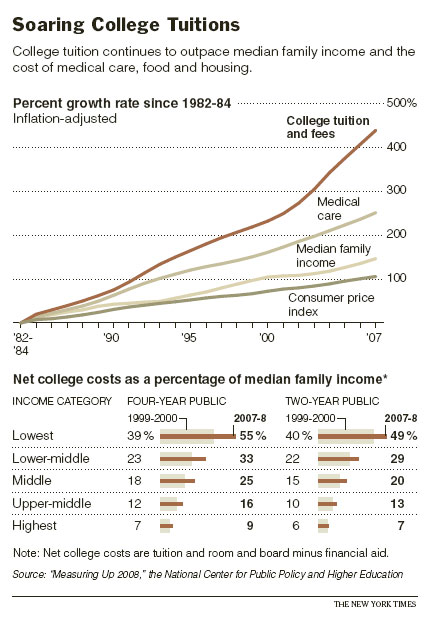
courtesy of the NYT
Thank goodness there hasn’t been much inflation over the past few years!
>
Source:
College May Become Unaffordable for Most in U.S.
TAMAR LEWIN
NYT, December 3, 2008
http://www.nytimes.com/2008/12/03/education/03college.html



December 3rd, 2008 at 2:44 pm
My guess is we may see some deflation in this arena as well. Given the excess supply of MBAs, one might expect demand for the money-shuffling degrees to decline, except we could use some good forensic accountants at the FBI. It is really long past time for America (and its education system) to cease the clueless and sophomoric denigration of scientists, technologists and engineers. Sweat and brains built this country in the 20th century and 8 years of greed and shallowness have almost pissed it all away. We are going to need ideas, creativity and hard work to put the train back on the rails.
December 3rd, 2008 at 2:51 pm
“If a change is made that is sufficiently large to alter permanently a long-term historical trend, then it will alter the society as a whole. In other words, a society is a system in which all parts are interrelated, and you can’t permanently change any important part without changing all the other parts as well.” - Ted Kaczynski AKA The Unabomber.
Believe it or not.
December 3rd, 2008 at 2:54 pm
What cannot be tracked is the 5 year degree versus the 4 year degree. This is done via the controlling of required class availability. If you change your major you are toast, even with summer school. The inflati0n rate is therefore much higher.
December 3rd, 2008 at 3:04 pm
on the topic of inflation, take a look at this from self-evident:
One month ago, the Cleveland Fed stopped publishing their inflation expectations derived from the TIPS spread.
https://self-evident.org/?p=374
December 3rd, 2008 at 3:10 pm
Man am happy I got the three kids (8 and younger) all paid up in there pre-paid (not savings) college fund. It’s like a bond earning 10%.
December 3rd, 2008 at 3:12 pm
My daughter is at Penn. The estimated total cost there for 2008 including a dorm and meal plan was about $47K. I wouldn’t be surprised to see it over $50K in 2009.
BTW, what are all those Wharton grads going to do now? It appears the Goldman Goose is dead.
All that tuition may be money down the drain for a few years.
As Jim Rogers (I think it was) said recently, “All those financial engineers should learn how to grow food. That’s what is going to be important now.”
What’s it cost to go to farming school?
December 3rd, 2008 at 3:18 pm
“Man am happy I got the three kids (8 and younger) all paid up in there pre-paid (not savings) college fund. It’s like a bond earning 10%.”
good luck to us.
Mine is backed by the full faith and credit of the state of Illinois, hope yours is a more credit worthy state.
December 3rd, 2008 at 3:20 pm
Color me stupid, but if you adjust CPI (the index of inflation) for inflation over that range, shouldn’t it be flat???? Doesn’t make any sense to me. It says it is inflation adjusted, but if it was then the CPI should be flat.
December 3rd, 2008 at 3:22 pm
If it helps, the combination of financial aid (government subsidies) and cheap credit (student loans) are the primary enablers of higher tuition costs for college students. Yes, it very likely qualifies as a bubble.
If you want a better, more affordable system, consider what happens when you eliminate the subsidized financial aid part of it.
December 3rd, 2008 at 3:25 pm
@AndrewShaw
Sadly I’m in IL also…. we can only hope!
I just know if I would of had it in a savings plan I most likely would have been 100% long the market.
December 3rd, 2008 at 3:26 pm
I work at a research university and I can assure you faculty salaries are not keeping up with inflation. What is driving up the college cost is the relentless expansion of administration. There used to be just 2 Deans on campus in the 70s, now there’s more than a dozen. Colleges and universities are becoming big business with well paid managers. Intellectual content of the curriculum, sadly, has declined.
December 3rd, 2008 at 3:39 pm
There was an article in August in the WSJ by Charles Murray (of the “Bell Curve” infamy) entitled, “For Most People, College is a Waste of Time” copy here http://www.studentsfirstpinellas.org/WSJ.pdf
December 3rd, 2008 at 3:40 pm
Barry,
This is a classic example in economics of what happens when a third party (the government, whether state and/or federal) intermediates and thus disrupts the pricing mechanism between the buyer and seller of a product or service with subsidies / grants / aid, etc. (The same situation exists in health care.) This and numerous other pathologies that have infected the entire American educational system from top to bottom have caused the current mess.
By the way, college has been “Unaffordable for Most in U.S.” for many years, not “May Become Unaffordable for Most in U.S.”. This is why government financial assistance occurred in the first place.
December 3rd, 2008 at 3:55 pm
I agree with ironman (@ 3:22)
I don’t see any end in sight, either. The government is going to keep pumping up the housing bubble and the college tuition bubble.
And Obama wants to set up a whole new mechanism to pump up the healthcare bubble at an even faster rate.
December 3rd, 2008 at 4:09 pm
Round here (and everyone knows this is nowhere) a first class high school education can cost 20k a year and there is precious little financial help available. One solution, move to NYC, test into Science or Stuyvesant, and get it for free! Goddam socialists.
December 3rd, 2008 at 4:10 pm
Well, there is always the Judge Smails college plan:
http://www.youtube.com/watch?v=9dbLfD5Vjq4
December 3rd, 2008 at 4:10 pm
When I went to a state u in the 1960s the state directly subsidized the university system and tutition was so low that it was easy for middle class students to graduate with no debt.
In the 1980s this system changed to one of removing the direct subsidy, allowing prices to rise sharply and subsidize loans.
Now, the typical middle class student leaves college with very large debts that will consume a significant share of the student’s income for years.
Yet, ironman tells us switching from an essentially free tuition system to one where the student takes on massive debt removes the price elasticity of demand form the system.
Ironman, I have some stock in a New York bridge I would like to talk to you about.
December 3rd, 2008 at 4:15 pm
Before the credit crises really took flight and the market was still down only 15% or so there were some interesting discussions about education and learning in the context of the internet age.
I can happily say, that since about August 07 when I found the website for a guy, Brain Shannon, who was posting really useful trading videos on You Tube under How To and DIY, linking to this website, that I now know all about VIX, TED, Libor, CDS, ABX, SIV, TARP, QLD, QID, Fuld, Jim, Marc, Ben, Roubini, Krugman, Galbraith, Dick, Tom and Barry.
And I’ve never been any where near a business school.
Actually all I know is that I have a lot more reading to do before I will really know anything. But I do know who I’m going to read.
OK it cost me some time cause I’m a working man but it sure hasn’t come close to an ivy league business school fee. Yet.
December 3rd, 2008 at 4:18 pm
when there are huge political reasons to understate CPI so as to minimize COLA increases - does anyone really think that the CPI numbers are credible?
December 3rd, 2008 at 4:36 pm
Those 529 plans aren’t looking too hot this year either.
December 3rd, 2008 at 4:37 pm
Simon,
add Taleb and Mandelbrot and you’ll be able to trade against MBA’s for the rest of your life.
Curiosity/ humility crushes biz school.
cheers,
bri
MBA (mostly nonsense)
JD 1 yr (learned speed reading which is useful)
December 3rd, 2008 at 5:00 pm
Purly anecdotal, but in my sample of one (a top ten NE private liberal arts college), the biggest change from 20yrs ago has been the build out of luxuries. By that I mean amenities that could only belong to country clubs that most of the students would never be able to afford once they graduate. The silly non-core “x” studies programs that have grown over the years add to the total faculty count as well.
December 3rd, 2008 at 5:00 pm
There’s an opinion piece in the Guardian calling for monetary authorities to deliberately induce inflation:
http://www.guardian.co.uk/commentisfree/cifamerica/2008/dec/02/global-economic-recession-inflation
I suspect that there are a lot of people who agree with him.
The problem with “a little inflation” is that it’s too much like being “a little bit pregnant”.
December 3rd, 2008 at 5:26 pm
DL,
I fear the monetarists are arriving armed with a knife in the midst of a gunfight. Japan learned this lesson; we may well, too - there is no way to force borrowers to borrow nor lenders to lend. The problems are perceptual and these are the driving questions: do I want to be in additional debt right now? and do I want to risk lending to any but the most creditworthy right now?
All you accomplish with monetarist intervention is to sow the seeds of the next bubble-collapse ferris wheel.
December 3rd, 2008 at 5:41 pm
Tuition is a problem, but textbooks are the biggest scam. I’m a recent graduate of a large, public, southern university, and it is insane how much I spent on textbooks in 5 years. Publishers, retailers, and our professors are running this scheme together. Publishers pay professors handsomely to issue new editions every few semesters. The “new editions” have nothing but a few different paragraphs, and the textbook retailers then force you students to buy a new edition for, say, $200, instead of a used one for $75. Multiply this scam across 4 or 5 courses per semester, and then across 8 or 10 semesters, and pretty soon you’re talking some real money.
December 3rd, 2008 at 5:45 pm
Sorry to be blatantly off-topic, but I just got back from my annual visit to the mall for some light holiday shopping. I can report that there was a downcast, gloomy vibe to the mall (Southdale Mall in Edina, MN) and that most stores were half-empty to entirely empty, meaning not a sole person in them. I don’t shop much but I’ve never seen the stores this empty and quiet during the holiday season in my lifetime.
The two stores that I saw somewhat busy/busy were Marshall’s (not crazy busy but there were people in there buying stuff, although we didn’t stand in a line to check out) and the Apple store, which is admittedly small, but was packed to the gills with people. Not sure anyone was buying anything (we didn’t go in) but there were a lot of people at least browsing.
December 3rd, 2008 at 5:54 pm
I think this is a red herring in some ways.
If school X goes from a tuition of $10 to a tuition of $20, but its aid to everyone who cannot afford it goes from $0 to $10, then the cost of going to school for “normal” folks stays the same, while the cost for the wealthy doubles.
Now if school X goes from $10 to $50, it can use the proceeds to fund 100% need-based grants, and keep the leftovers. So the lower income students pay less even while tuition rises.
It’s a highly lucrative progressive tax on wealthy parents, with no penalties for the school or lower income students, so long as all the peer institutions do the same.
Looking at it that way, the STATED tuition costs cease to matter as an inflation measure — only the MEDIAN cost. I’m not sure how many of these studies take the time to look those figures up.
December 3rd, 2008 at 5:55 pm
spencer said:
So, you actually believe the current tuition system is “essentially free”? I think State U. might need to issue a recall on that degree of yours….
Let’s address your point. First, it’s the universities’ “price discrimination” policies that ought to be modified. “Price elasticity” is a quite different concept from what I’ve discussed and is not particularly relevant to this situation.
Second, the current system in place at most universities is simply not transparent - nobody knows how much their college education is really going to cost them out of pocket until they’ve gone through the process of enrolling, acquiring scholarships, financial aid (as applicable), etc. The universities maintain this system as a way to maximize their revenues from individual students through price discrimination. The same way airlines do, especially if you consider the example of airline passengers sitting next to each other on a plane who almost certainly paid very different prices for their seats.
The larger point you’ve missed is that the subsidies have enabled the higher costs of college. Here’s the simple math you missed at “State U” back in the 60s. (My alma mater from another decade, by the way. College Financing 101 was very much part of the curriculum in my day.):
(1) College cost with Subsidies = Cost paid by students + Subsidies
Here, we confirm that subsidies don’t make college free. Now, let’s increase those subsidies over time:
(2) College cost with Higher Subsidies = Cost paid by students + Higher Subsidies
Note that the cost paid by students didn’t go up in this example. Not very realistic, but it does show how subsidies can mask the true cost of higher education from students. Let’s fix that to better reflect reality at today’s academic institutions of higher learning:
(3) Higher College Cost with Higher Subsidies = Higher Cost paid by students + Higher Subsidies
Let me assure you that (3) > (2) > (1)! And that (3) puts the most dollars in the pockets of the universities, which is why the system is designed to work that way.
What Eureka’s experiment demonstrated is that eliminating the subsidies can result in both lowering the total cost of college and lowering the cost paid by its students. That doing so resulted in higher revenues for the college was a surprising bonus.
December 3rd, 2008 at 6:07 pm
It is like health care. All of the the government money increases demand, which does increase supply eventually, but since it is all through government bureaucracy there is the graft multiplier of 0.33. If you increase the money coming in via government by 100% you increase the supply by 33% If the government really wanted to do something about education or health care they would either stay out of it, or do something more aimed at the supply side. Also, a large percent of the universities are of poor quality. They have little choice since so many students are of such poor quality. They are little more than BA mills churning out history majors so that kids can avoid getting a real job. Or even worse they are AA and dropout mills. If people were paying their own money for education they’d make sure they got a degree that was worth something. I know that when I started paying was the same time I became serious as a student.
December 3rd, 2008 at 6:18 pm
ddk:
“aid to everyone who cannot afford it” == debt
And too much debt is part of the problem, right? So the solution is to lower costs, which universities are not accomplishing.
December 3rd, 2008 at 6:36 pm
leftback @ 2:44
“It is really long past time for America … to cease the clueless and sophomoric denigration of scientists, technologists and engineers”.
Given that I’m a member of the category (scientists, technologists and engineers), I completely agree.
However, I have faith that it won’t be long before we again have 30 year-olds making a million dollars a year on Wall Street by peddling dubious financial products to investors.
And the exploits of the parasitic trial lawyers will only continue to increase.
December 3rd, 2008 at 7:24 pm
Of course China has distorted the CPI downwards during that timeline. And the 80’s originated the above trend growth in debt which gave us student loans such as they are now.
December 3rd, 2008 at 7:37 pm
Education (like healthcare) is mostly non-tradable. Wages and prices in the broad economy have been held down by arbitrage with the low-wage “emerging” economies. It’s less an issue of education soaring it’s more about the rest of the economy stagnating. Absent globalization the rest of the economy would be showing more comparable price increases (for good and for ill).
December 3rd, 2008 at 7:45 pm
A couple of points from a current professor, son of retired professor:
1) By any objective measure faculty salaries have been declining in real terms for the past 30 years.
2) Higher Ed administration, which used to follow a peer management philosophy (faculty rise through the ranks, serve for a while then often return to the faculty) now follows a corporate model with corporate pay. Our current president has never served as a faculty member, never published research, never taught a class, never mentored a graduate student etc… He moved from high ed consulting directly into admin. He is paid close to $1million/year with lots of perks.
3) State support for higher ed has declined dramatically in real $ terms over the past 30 years. So rising public university tuition is largely a cost shift from general state taxes to individual students. This shift may have allowed private universities to raise tuition and still remain competitive.
December 3rd, 2008 at 8:10 pm
i suspect the biggest thing that may control this is that students are going to have trouble justifying the money if the jobs they qualify for after school aren’t stable, don’t pay much to begin with or in the end. we have sent to many of the jobs that require a degree off shore to make it where the ROI on this is becoming a moot point. which will really hurt later when (and if) the economy picks back up. of course if the standard of living starts to match the rest of the world, either there will be few in schools or they reduce the price.
December 3rd, 2008 at 8:14 pm
A few people above have suggested that those business degrees suddenly are not as prestigious as they once were. I beg to differ. If there is one thing that the dislocation in the economy has shown, it is that the financial services industry will be protected AT ALL COSTS. In the United States, we have business models that are epic failures–ones that could never be mentioned in the context of a going concern; chapter 7 shoe-ins–and the government just throws hundreds of billions of dollars at these companies. I can’t imagine anyone wanting to be a scientist in the United States when they could go into a more lucrative business profession with a guaranteed government subsidy.
December 3rd, 2008 at 8:47 pm
United States when they could go into a more lucrative business profession with a guaranteed government subsidy.
—————-
Wow! That’ encouraging… A bunch of graduates who don’t care about their contribution to the world.
If that feeling is not there at 20, imagine at 30, 40 ,50… Good prospects for the US of A!
December 3rd, 2008 at 9:02 pm
@John
Thanks for saying what the media or politicians won’t. Tuition inflation is a direct result of government price interference.
Don’t hold your breath waiting for a congressional inquisition of college deans. As the cost of college goes up, the politicians respond with more grants, subsidies, tax credits, etc. If the cost of gas goes up, the politicians respond with talk of price controls, windfall profits taxes, and investigations.
Most Americans are too stupid to see the double standard.
December 3rd, 2008 at 9:20 pm
this is an interesting post
@larster
good point.you also can’t track a student that transfers schools but the credits don’t transfer. and then that same student enrolls in a new 5 year program.
@DP
look for a 529 where you can control the investments. It’s not the 529 that does poorly, that is just a holding tank. Many would have allowed you to go to cash to avoid the pounding this would have been especially important if you needed to money short term. to those of you who think the pre-paids are safe, well, people thought money markets were safe up until a few months ago. something tells me that state budgets having problems might be in the news … you know here and there in 2009.
December 3rd, 2008 at 11:02 pm
I can see those prices not affecting CPI for a few years but after the first decade or so you have to start wondering.
On the positive side, just think what great money managers the kids will be by the time they are 35. They won’t have a choice. Given the mess they’ve inherited we will be handing out graduate degrees in money management courtesy of the school of hard knocks. This will be the most money astute generation in decades. It is that or die in the process. Sometimes the natural world forces hard learning on the young.
December 3rd, 2008 at 11:37 pm
College tuition should go up more. Once nobody can afford it, it will drop just like house price did. I’ve been to a private university. The tenured professor was stupid as hell. Parents pay high tuition just to give their kids diploma. There is not much useful skill being taught. I learned most through my working experience. I am glad that I took out everything from my 529 plan in summer. WTF is this 529? The more I save, the higher the tuition goes. 529 administrator will make free money off me. I advise everyone get out of this 529 scam. The same thing goes to 401K. Both of them have such limited options and don’t allow you to trade in and out. Hedgies make free money off middle class. It is time to wake up. Zero government aid to higher ed, please. Bankrupt incompetent colleges.
December 3rd, 2008 at 11:52 pm
@ben22 - Thanks. I’ve been putting a few hundred a month into a state 529 plan since the day my daughter was born (now 5). I need to do some research on what the situation is with capital losses in a 529 and either transfer it to a brokerage acct or just take the loss and start over in a plan I have more control over. I guess I could also just leave it there and stop adding to it, then start a new acct elsewhere. Who knows, maybe by 2021 we’ll see DOW 14k again.
Complacence sure is costly.
December 4th, 2008 at 3:59 am
Instead of having this ideological flame war about the evils of subsidies/non-subsidies, “the go-vermin is bad…because it is bad!” kinda rhetoric, how about an audited breakdown of college COSTS over time. Not costs to the consumer, but total expenses incurred by colleges?
As for should the go-vermin should even be in the college financial support business, how come India has been able to built the world-class Indian Institute of Technology where students pay a maximum of 700 USD/year covering all expenses? Oh! And low-income students don’t pay a cent.
How do they do that?
1) Their acceptance rate is <2%. The best only please, and don’t call us, we’ll call you.
2) The comittees accepting students are completely anonymous.
3) Deans are academics only, with track records to prove it.
4) You want to make a million dollars donation? Nice of you and much appreciated! Call the Ministry of Education and they’ll talk, since we can’t accept this money directly. (So your money can’t buy a spot foryour son who, BTW, does not have awesome grades, but I digress.
5) Central governement subsidize the whole system.
Result? A sizeable number of IIT students consider institutions like MIT or Carnegie-Mellon, or Urbana-Champain a second choice.
That is how you create leaders in a field. The best and the brightest only, REGARDLESS of socio-economic status, heaavy support from the rest of society is bound to give back a lot. how do you think India became a tech powerhouse in its own right? With football teams, MBAs and donations from the zillionaires?
December 4th, 2008 at 6:17 am
Francois,
nice point. in that one example you’ve well-explained the total Antithesis of the Education-Industrial Complex that has been crafted, here, in the North American Union.
December 4th, 2008 at 11:08 am
Financial aid for college means loans for nearly all but the low income families. I am in a middle class family (accountant at a Fortune 500 company, wife works in a elementry school) with 3 kids in college. The aid formula says I should contribute $17k per year per kid toward their schooling. The only aid offered was loans. The public university in town costs $20k per year tuition, fees, books, room & board.
You need college for most white collar jobs. My company will not even hire admin asst if they don’t have college. The college system is broken and not affordable to any but the well off and poor. Unsubsidized prices would have to fall because few could afford it.
December 4th, 2008 at 11:15 am
Does anyone have a break-down showing what’s behind the cost increases? Is it professor salaries? Technology upgrades? Other infrastructure?
I graduated from a large public university approx 10 years ago and anytime I’m on the campus today, I’m amazed at the facilities (gyms etc) that are available today vs. when I was there.
Seems to me that the schools are spending a lot of money on things that are not part of their core mission: to provide a high-quality education. If it’s the case that luxurious amenities are required in order to attract students to enroll (which is BS in the case of my alma mater as they have gotten more applicants than they can handle for many decades) then the (potential) students and their parents clearly need to reconsider their priorities.
December 4th, 2008 at 12:15 pm
I am not sure why anyone would want to go to college. Harvard Business School just validated Alan Blinder’s study that most of our jobs can be done off shore.: law, finance, radiology, computers, finance. If you connect to a wire, so do cheap Indians. College is a money losing investment these days.
December 4th, 2008 at 1:04 pm
@DP
No problem. A couple other things to consider:
1. Remember that many colleges will accept stock “gifts” to pay tuition and as a result you would avoid paying capital gains on that stock, this would end up giving you the same tax benefit of the 529, you just have to be careful as not all schools will do this. In the end, you would most likely pay less in fees on stock you manage yourself as opposed to a 529 and the mutual fund and administrative costs.
2. I’m not sure if you have any other children but I’d be careful about oversaving into a 529. Your daughter is still very young and might not go to school or might get a scholarship, she may do a 2 year program, she may join the military or go right to work after high school etc. if the money in a 529 is not used for education you pay a 10% penalty to get funds back out. You can always name someone else the beneficiary but why take the risk if you could use stock, gift it, and if you don’t use it for college there is no penalty to use it for yourself.
3. In the same way you could also look at some muni’s right now as possible decent buys which would also provide you with much tax relief and no risk of having to use the money for college. This strategy might be better if cap gains do indeed jump to 30 something percent. Just watch if you are going to use muni funds as some will be subject to AMT.
4. I don’t know what state you live in but many states now offer a tax credit for contributions to 529 plans so that is also something to consider if using the other strategies I mention above. While this is a nice benefit it might not outweigh the other risks of having funds in the 529.
529 plans are o.k. if used properly but if you really know the rules often times it makes sense to use something different. To me they are best suited for grandparents trying to gift away the estate that have several grandchildren, or for wealthy families with no shot at aid with a short term need for the funds or in other words a relative certainty that they will be used for school and thus not subject to a penalty.
there are no capital losses on a 529 that you can claim on taxes, that said, most 529’s allow you to roll-over your funds to a different 529 plan. Many will allow you to do this for free, just make sure if you own funds you don’t have Class B share funds b/c you will get hit with a fee to sell if you bought less than 3-7 years ago. I guess if the funds really suck you should sell them anyway even if you have to pay a fee. I don’t want to say any specific companies on here b/c this doesn’t seem like the place to do it but there are some big firms that offer very low cost plans that allow you to control the investments and have lots of investment options. They aren’t all bad you just need to find the right one.
Hope this helps.
December 4th, 2008 at 1:07 pm
“I graduated from a large public university approx 10 years ago and anytime I’m on the campus today, I’m amazed at the facilities (gyms etc) that are available today vs. when I was there.”
You could check the Chronicle of Higher Education for details, but there have been a lot of articles documenting an increasing in expenditure for (1) nicer dorms; (2) nicer student unions; and (3) nicer recreational facilities or gyms. As part of the “student is the customer” model, colleges have been actively marketing the lifestyle aspect of college living. So yes, a substantial amount of money has been spent on non-academic aspects of university life. Apparently, according to marketing surveys, this is what students and their parents want???
The bottom line is that colleges and universities have become an extension of high school… a place to babysit kids for another 4-5 years before releasing them into the real world. We seem determined to delay maturation as long as possible. Sending millions of kids to college who have no ability or interest to college is part of that grand plan. As a nation, we would be MUCH better off with a more diverse array of educational opportunities: (1) vocational training of all types and degrees of rigor to fill computer science to auto mechanic positions; (2) on-line training for continual skill upgrading in the existing workforce; (3) college reserved for those who are truly academically inclined. There is a place for colleges and universities, but as a college professor I agree with the earlier commentators that this is NOT the place for everyone.
December 4th, 2008 at 1:30 pm
groundhogday:
Well said. I’m sad to say that college for me was fun but classes were dull, not exactly challenging, they didn’t make me think critically. The delay in maturity that you speak about makes me think of how kids don’t know how to ask questions because they don’t know how to question anything. I learned more in the last 18 months on this site than I did in 4years at b school. More important, places like this help me understand how to apply the knowledge as opposed to learning from a book with no application to real life.
I’m very grateful that I had an opportunity to go to college but today I find myself to be more grateful for people like BR and many of the commentors on this site.
December 4th, 2008 at 10:56 pm
paid education for everyone at http://www.grb.net