Regression to the Mean

Email this post Print this post
By Barry Ritholtz - December 10th, 2008, 1:43PM

Another interesting chart from Doug Short over at dshort.com
>
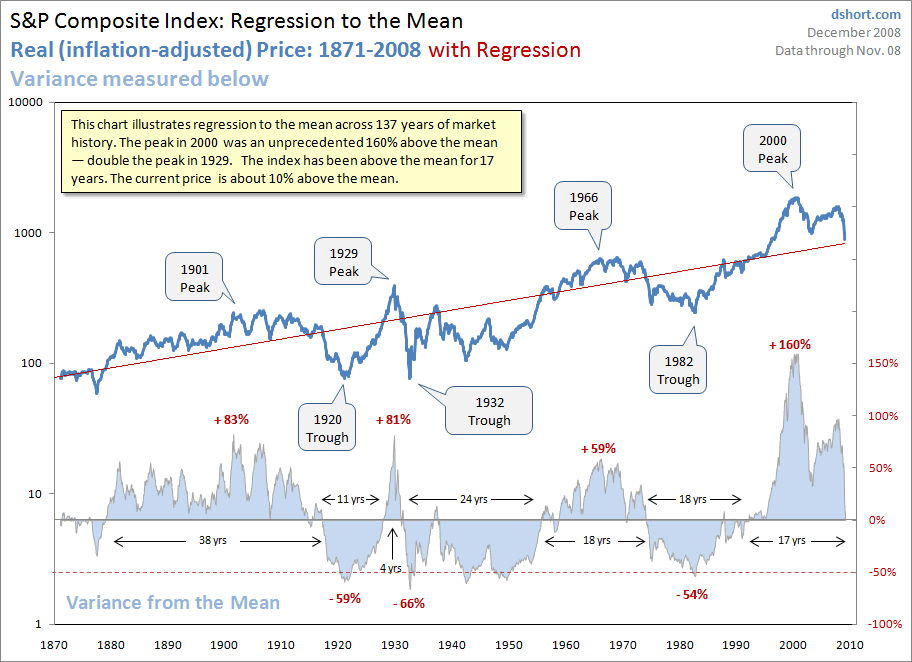
>

Here’s Doug’s commentary:
http://dshort.com/articles/regression-to-the-mean.html

36 Responses to “Regression to the Mean”

  1. Amos Satterlee Says:

    Question: if the S&P were to the 1982 trough, what would the index hit? If the current value (say 900) is 10% above the mean, then the current mean is 810. Based on a simple visual analysis of the chart, the current value at the level of the 1982 trough would be 373 (810 - 54%). Is this correct thinking?

  2. albnyc Says:

    Short answer: who the hell knows!

  3. karen Says:

    Must read is the commentary! There is a second $spx chart using shadowstats alternate CPI data…

  4. DaveM Says:

    This would be an even better chart if it were log scaled showing percentages to better account for the way we see data.

  5. DL Says:

    If you split the difference between the two models (official CPI versus the “shadowstats” CPI), you come up with a bear market low of about 600-650, or some “inflation adjusted” version thereof. What an inflation-adjusted level of 600 might mean in NOMINAL terms, and how quickly it would get there, is another question.

  6. menglish Says:

    If you follow the link to the commentary there is an interesting version of this same analysis done with “real” inflation numbers. Given how much we all trust the official numbers since 1982, it’s worth noting that the S&P 500 doesn’t look _nearly_ as bad when you use more accurate inflation numbers. It in fact places us near a “-%50 from the regression” potential trough.

    Also, it’s not a mean, its a regression, and it’s certainly not clear that the slope of that regression should remain constant throughout history.

  7. DL Says:

    Another point to note about the long-term chart. After hitting the peak in 1901, investors had to wait 19 years before the bull market got going; after the ’29 peak, they had to wait about 20 years to get a good bull market; similarly after the 1966 peak, one had to wait 16 years. By contrast, we’re only eight years into this secular market.

    The “buy and hold” folks are likely to be in for a disappointment.

  8. RW Says:

    Interesting chart: Wonder how much we’ll overshoot this time, assuming the line remains straight.

    I’m not aware of any evidence that economic trends are linear or that regression to the mean is anything other than a common outcome in any system of imprecise measurement (price seeking in this case) but human nature is sufficiently constant that a review of history never hurts (we do tend to overshoot when feelings are strong but where will the new pivot be set …ah, now if I knew that!)

  9. Theodore D. Says:

    What do you mean by “secular market?” My Finance prof. uses that word all the time, I asked him what he meant by it and he didn’t have an answer. A Theology interested guy wants to know.

  10. Kent @ The Financial Philosopher Says:

    @ DL:

    I certainly do not mean to pick you out of the crowd or put words in your mouth, but I’ve heard many people say that “buy and hold” is dead. How does one define “buy and hold?” Certainly if a person buys at a peak and sells 10 years later at a lower price that would qualify as a “buy and hold” disappointment.

    The most notorious person that is arguably the classic “buy and hold” investor is Warren Buffett. Do you think he is “disappointed” with his long-term returns?

    In my view (and investment practice), “buy and hold” means that a prudent long-term investor is a net buyer in incredibly bearish environments (ala 2002 and today) and a net seller in incredibly bullish environments (ala 1999 and 2007).

    It’s not market timing — it’s simply the timeless virtues of simplicity, patience and moderation… and, of course, avoiding the temptation of following extreme herd behavior…

    “I tell you that virtue does not come by money but that from virtue comes money…” ~ Socrates

  11. Bob_in_MA Says:

    If the second chart shows anything, I would say it shows that the shadowstats inflation calculations are probably the ones that are way off. It would imply the super-bulls are right and we are in an era of unusually high p/e ratios.

    The idea that a guy with an MBA has figured out a gross flaw in government stats, yet has failed to convince any serious economists ought to give pause to anyone quoting him.

    I’ve looked on the site to find where exactly his formula differs from the BLS’s and all I found was this:
    http://www.shadowstats.com/article/56
    …part diatribe, part conspiracy theory…

    Either there is a conspiracy involving hundreds, if not thousands, of government and academic economists, or, this guy is wrong.

  12. constantnormal Says:

    If you guesstimate when the under-the-line bottom might occur, you come up with something approximately in the 2014 time frame, which is curiously when James Tobin guesstimates (using his Q ratio) that we will bottom on a valuation basis.

    http://www.bloomberg.com/apps/news?pid=20601087&sid=as0OqKgfd70c&refer=home

  13. StatArber Says:

    I’m not sure that there is any robust conclusion to draw from this chart (or other charts of similar style). Notice that if you had done a similar study in 1900 (using data from 1871 to 1900) that you could have concluded that stocks were “cheap” relative to history throughout the 1920s. Similarly, the same study in 1950 would have led you to conclude that stocks were “rich” for the next decade or two.

    By construction, a regression _must_ have mean zero errors. This means that if you fit using the full time series, and then examine historical deviations from the model (also assuming some niceness about the distribution of the data), you end up with something that appears mean reverting that doesn’t actually provide predictive power. By construction, a linear model will have this reversal built in. It makes for a pretty chart, but it doesn’t mean anything significant going forward.

  14. constantnormal Says:

    And one can almost see (certainly imagine seeing) the bump up from the 2000-2003 downturn when Greenspan had his foot on the monetary accelerator for too long — one wonders if he had backed off and mopped up the excess liquidity, whether we could have avoided the worst of the overshoot that is coming now.

    If wishes were wings …

  15. deltaverde Says:

    Kent@TheFinancialPhilosopher - I think DL was probably referring to investment advisers like mine, who when I expressed my concerns about weak fundamentals and the looming impact of the housing bust last fall, told me that if I wanted to practice “market timing” I should find another adviser. In other words, all she knew how to do was take my money, put it in mutual funds and collect her fees. Anything outside of buying into a vehicle and waiting for it to go up was in her mind risky and imprudent. You might think I just had a particularly bad adviser, but talking to friends I haven’t heard many significantly different stories.

  16. karen Says:

    The Coppock Curve, another chart representation:

    http://www.tradersnarrative.com/coppock-curve-deeply-negative-no-signal-yet-859.html

  17. DL Says:

    Kent @ 3:01

    “In my view… “buy and hold” means that a prudent long-term investor is a net buyer in incredibly bearish environments (ala 2002 and today) and a net seller in incredibly bullish environments (ala 1999 and 2007)”.

    Sure, buy in 2002, sell in 2007 was good advice. But I don’t really classify that as “buy and hold”. And did you really go 100% in cash in October 2007…? What advice would you have given to someone in the early 1970’s…?

    As for myself, I’m just trying to be an opportunistic market participant. (But that’s different from buy and hold).

  18. Bob_in_MA Says:

    deltaverde,

    The mere fact you asked the question shows you probably would be better off getting an account at Schwab and just investing in broad index funds/ETFs, moving money around gradually based on your own perceptions.

    I sold a business and came into some money and went and talked to some financial advisors, but was completely unimpressed. Plus there’s the danger they are investing your money based on whatever incentives they receive.

  19. Douglas Watts Says:

    Either there is a conspiracy involving hundreds, if not thousands, of government and academic economists, or, this guy is wrong. — Bob in Mass.

    Hmm …

  20. Mark E Hoffer Says:

    “when I expressed my concerns about weak fundamentals and the looming impact of the housing bust last fall, told me that if I wanted to practice “market timing” I should find another adviser. In other words, all she knew how to do was take my money, put it in mutual funds and collect her fees. Anything outside of buying into a vehicle and waiting for it to go up was in her mind risky and imprudent. You might think I just had a particularly bad adviser, but talking to friends I haven’t heard many significantly different stories.”

    U$D 50 000 x 2%= U$D 1 000

    U$D 40 x 12= ~U$D 500

    150 lb Quarter of Beef x U$D 3/lb.= ~U$D 500

    LSS: Roll your Own.

    BR,

    re: FusionIQ, though, sometimes it’s easier to buy’m by the Box..

  21. Mind Says:

    Met a financial adviser at Thanksgiving and he got to talking about how people had taken hits of 40 or 50% and were just going to have to work longer before retirement. He said “you can’t time the market”. His jaw about dropped when I told him I had mostly gone into cash a year ago (based on info from TBP and others) with some peripheral attempts at knife-catching since then and was basically even for the year.

  22. DP Says:

    Interesting that on the day of the first October “crash”, the S&P closed at 899.22 - today it closed at 899.24

    Does it mean anything? More than likely not, but if you know what your brokerage acct was on that date then today is a great way to compare how you’ve done during the two months of insanity.

  23. KC Says:

    ??? I looked at the second chart, and it shows the S&P being flat from October 2002-October 2007. This would mean inflation has averaged 15% a year between 1982-2008, because the S&P went up 15% a year from 2002-2007. I have a hard time believing that chart. Perhaps I’m reading it wrong.

  24. Mark E Hoffer Says:

    karen,

    re: link, see: Right now we are at -243, which is almost at the same level at which the market turned around in March 2003 (corresponding Coppock guide level at that time was -246).

    The deepest level we’ve seen this indicator fall was in 1932, when it plumbed -643 for the S&P 500 index. That shouldn’t be that surprising when you consider that it was the most brutal bear market for US stocks.
    ~

    For me, I think it’s a safe bet that we see somekind of # betwwen the 306 in ‘74, and the 643 of ‘32..

    tho, of course: “Differin’ opines, make’m run the Equuines.”

    nice link, haven’t seen a Coppock chart in a while..

  25. VoiceFromTheWilderness Says:

    Since the stock market isn’t a statiscal process, ‘the mean’ is a meaningless variable. As is ‘the variance’. They may be useful at some times but their predictive value is always subject to … reality.

  26. Steve Barry Says:

    We were so far above the mean, we obviously borrowed from the future…since this is the greatest crisis since the depression (and it could eventually beat it), we will surely now have hell to pay for it.

  27. Kent @ The Financial Philosopher Says:

    Thanks for the various comments:

    @DL: No, I did not move to 100% cash in October 2007. I had been slowly building cash since January 2007 (for myself and for my clients). At the time, most of my clients were unsure of my logic in the face of a healthy bull market but trusted the direction. Also, all new clients I have picked up since late 2007 and early 2008 were moved 100% to cash (depending on location and tax consequences) and set on a 12 month DCA schedule. That was not “timing the market” — it was simply logic, patience, simplicity and moderation.

    @ Deltaverde: It sounds as if your “adviser” does not practice “risk management.” You can see my comment to DL for an example.

    @ Bob in MA: “Fee-only” advisers are only paid by their clients and do not receive commissions; therefore, they are unbiased to products and the most client-centered adviser out there. If one was to seek an adviser, I recommend “fee-only.”

    Most people can do as good or better investing on their own than with the vast majority of advisers. The problem is that our brains get in the way and the “average” investor often sells at low points and buys at high points.

    With that said, however, commenters on this blog are leagues ahead of the “average” investor…

  28. Steve Barry Says:

    Intersting about the “bullish” alternative…what if we use the bullish alternative, but now assume rapid deflation going forward? The S&P would deflate as well, no?

  29. TrickStar Says:

    1) Gee, those charts are great.
    2) Buy and hold isn’t dead. If you look at the left side of either chart, you’ll see a little blue squiggly line start in the bottom left hand corner and make its squiggly way up to the upper right hand side of the chart. That upward squiggly movement represent avg. returns of about 10% per year for a long, long time. Ain’t too many folks who have shown they can beat that consistently.
    3) Let’s be honest here. What really matters is which chart (of the two) the mutual fund and pension fund managers would use. Grantham likes the 10 year to determine fair values and mean reversions; I’m guessing he’d think the 135 years of data might distort things. If he’s using the 10-year, and you’re using the 135-year, you miss the train.

  30. Mark E Hoffer Says:

    TS,

    this: “That upward squiggly movement represent avg. returns of about 10% per year for a long, long time. Ain’t too many folks who have shown they can beat that consistently.”

    is b/c ‘Cained Peep would rather be Wrong in groups, than Right alone..

    any 7th-Grader could learn to do ‘Buy-Writes’ on:
    http://finance.yahoo.com/q/bc?s=PM&t=1y
    http://finance.yahoo.com/q/op?s=PM&m=2009-01

    and walk home +10% per annum, with their eyes closed..

    and, worse, that’s not even the best ex. (PM)

    for some intro.. http://www.onn.tv/HomePage#close

  31. JohnnyVee Says:

    The chart appears to show that in bad economic times that that bottom is about 50-80% under the mean. So we are no where near a bottom. If the mean would equal 850 today-by eye balling the chart- then only when the S&P is under 500, at the very least, should one start buying for the long term.

  32. CC_in_Georgia Says:

    @StatArb:

    Well said, sir. 100% correct.

    The position of the regression line is solely dependent on the time series used. Therefore, the relationship (above or below trendline) between one particular data point and the regression line can vary wildly depending on what time period used.

  33. TrickStar Says:

    @ Mark - That’s a fair point. I was excluding options from my example. Thanks for the link!

  34. Lance Says:

    I wrote about this at my place, but the most interesting thing about the second chart is that it does not imply that stocks are actually cheap. As I said there:

    “if John Williams’ numbers are correct then stocks should be as low as they are because GDP and earnings have been horrible in inflation adjusted terms for a very long time. We have been in a recession for two decades similar to Japan. I don’t think that is true, but if so then stocks deserve every bit of the undervaluation they have experienced.”

    My own opinion is that inflation is off, by by nowhere close to what Shadow Stats implies. Thus, the market is reasonably, but not spectacularly undervalued. That is pretty much what Jeremy Grantham says as well, and a minor adjustment to the first graph puts trend where he puts it as well.

  35. Mark E Hoffer Says:

    TrickStar Says:

    December 10th, 2008 at 8:59 pm

    TS,

    Seriously, de nada, anytime.

  36. dead hobo Says:

    Great chart, but it has one fatal flaw. It ignores fluctuations in the process mean. While it appears from this chart the market is a process that is in control and, overall, subject to random variation, the time period covered is too long for meaningful analysis.

    I would submit that each crossing over or under the center line is in actuality a shift in the process mean and that each period should stand alone for analysis. This would aid the analysis substantially.

    Now, the question of the day: Will the market cross the line and shift the mean to a lower point? Or will it jump upwards and continue above the line for a few more years? If it crosses the line and a recalculation of the line confirms the jump, kiss your sweet assets goodbye. If it remains above the line, then buy buy buy.
