Recession Will Last Through Most of 2009
Live! From World Economic Forum in Davos, Switzerland: Interview with Harvard University Professor Ken Rogoff
Bloomberg, January 31, 2009
Live! From World Economic Forum in Davos, Switzerland: Interview with Harvard University Professor Ken Rogoff
Bloomberg, January 31, 2009
David Leonhardt has a huge piece in the Sunday NYT magazine section, titled, The Big Fix.
ONE GOOD WAY TO UNDERSTAND the current growth slowdown is to think of the debt-fueled consumer-spending spree of the past 20 years as a symbol of an even larger problem. As a country we have been spending too much on the present and not enough on the future. We have been co”nsuming rather than investing. We’re suffering from investment-deficit disorder.
You can find examples of this disorder in just about any realm of American life. Walk into a doctor’s office and you will be asked to fill out a long form with the most basic kinds of information that you have provided dozens of times before. Walk into a doctor’s office in many other rich countries and that information — as well as your medical history — will be stored in computers. These electronic records not only reduce hassle; they also reduce medical errors. Americans cannot avail themselves of this innovation despite the fact that the United States spends far more on health care, per person, than any other country. We are spending our money to consume medical treatments, many of which have only marginal health benefits, rather than to invest it in ways that would eventually have far broader benefits.
Along similar lines, Americans are indefatigable buyers of consumer electronics, yet a smaller share of households in the United States has broadband Internet service than in Canada, Japan, Britain, South Korea and about a dozen other countries. Then there’s education: this country once led the world in educational attainment by a wide margin. It no longer does. And transportation: a trip from Boston to Washington, on the fastest train in this country, takes six-and-a-half hours. A trip from Paris to Marseilles, roughly the same distance, takes three hours — a result of the French government’s commitment to infrastructure.
These are only a few examples. Tucked away in the many statistical tables at the Commerce Department are numbers on how much the government and the private sector spend on investment and research — on highways, software, medical research and other things likely to yield future benefits. Spending by the private sector hasn’t changed much over time. It was equal to 17 percent of G.D.P. 50 years ago, and it is about 17 percent now. But spending by the government — federal, state and local — has changed. It has dropped from about 7 percent of G.D.P. in the 1950s to about 4 percent now.”
Wow, major R&D is almost half as much as a percent of GDP as it was.
No wonder most of our recent progress has been incremental in nature — No major R&D breakthroughs.
Our energy mostly comes from burning the same fuels we did a century ago; The propulsion system of the cars we drive have been around for well over a century; Our batteries are marginally better than they were decades ago, as are our solar cells.
What major breakthroughs have taken place recently that have changed society? The PC is about 25 years old, the internet is 15 years old.
Technology: What have you done for us lately?
>
Source:
The Big Fix
DAVID LEONHARDT
NYT, January 27, 2009
http://www.nytimes.com/2009/02/01/magazine/01Economy-t.html
WSJ economics reporter Kelly Evans tells colleague Phil Izzo the economy’s 3.8% drop in the fourth quarter was better than what was expected, but only because U.S. counts an unwanted buildup of goods on store shelves as growth.
1/30/2009
via NYT
>
Source:
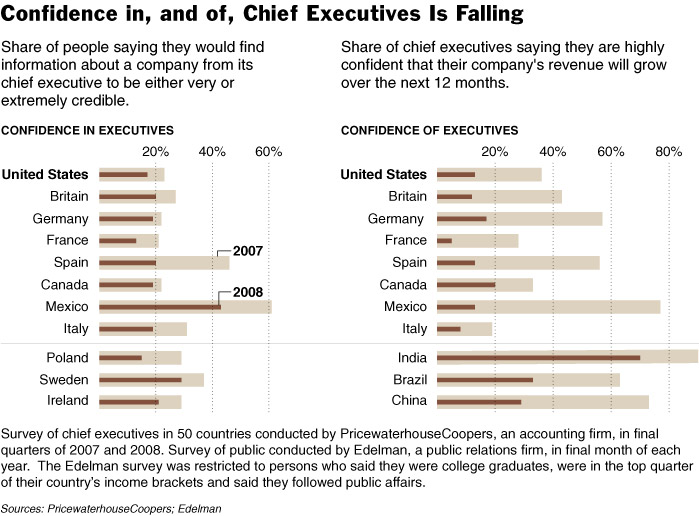
A Rise in Pessimism in the Corner Office
FLOYD NORRIS
NYT, January 30, 2009
http://www.nytimes.com/2009/01/31/business/economy/31charts.html
Yesterday, I was busy dealing with two big projects: John Mauldin’s newsletter, and interviewing new publishers for the next book (no, it ain’t gonna be McGraw Hill again).
This kept me away from my favorite wonk activity, dissecting the latest government data dump. Or as it is known on college campuses across the land, Intro to Creative Writing & Poetry.
Barron’s Randall Forsyth takes a swipe at the numbers:
“The litany of woes was capped by the government’s first stab at estimating the fourth quarter’s gross domestic product, which was shown to have contracted at a 3.8% annual rate, after the usual adjustment for inflation and seasonal factors. Though much worse than the 0.5% decline in the third quarter, it was less severe than the 5%-6% drop forecast by economists, if that offers any solace.
The skid was tempered by an unexpected rise in inventories, which added some 1.3 percentage points to the headline GDP number, according to Steven Wieting, economist at Citigroup. Excluding inventories, real final sales shrank at a sharp 5.1% annual pace, about as expected and much more severe than the 1.3% contraction in the preceding quarter. That points to destocking in this quarter and the quarters ahead as production is cut to bring it in line with demand.
But falling prices also made the real decline appear less severe than it was. Nominal GDP collapsed at a 4.1% annual rate in the latest quarter, the sharpest drop in a half a century. And it would have been worse were it not for Uncle Sam’s spending; private final sales plunged by 6.5% while government spending expanded at a 1.9% pace despite contracting state and local expenditures.
“Once again, real GDP growth appears to be a poor metric of the recession,” write John Ryding and Conrad DeQuadros, economists at RDQ Economics. Consumer spending plunged at a 3.5% annual rate in the current quarter, residential investment collapsed at a 23.6% rate and real business spending plummeted 19.1%. “There was no demand from the private sector in the fourth quarter,” they conclude. And the same was true globally. Exports fell at a 20% annual rate as the recession spread abroad.
While real GDP was the weakest since 1982, nominal GDP was the worst since 1958. The difference is falling prices, which makes the real measure seem less dire. But Ryding and De Quadros contend that the unemployment rate is a better indicator of the economy than GDP. As the tally of the layoffs rises, that paints a still-drearier picture. (emphasis added)
I’ve had a pretty reliable gut on the real economy versus official economic data — its not fat, its actually filled with proprietary economic sensors — and this is only part of the story. My Spidey-sense tells me there is much more to this number than the usual soon-to-be-revised downwards preliminary data.
I’ll hunt about to see if there is anything beyond the usual funny stuff going on . . .
>
Source:
What’s So Super?
RANDALL W. FORSYTH
Barron’s JANUARY 31, 2009
http://online.barrons.com/article/SB123335939695435159.html
Gross Domestic Product (GDP)
8:30 A.M. EST, FRIDAY, JANUARY 30, 2009
http://www.bea.gov/newsreleases/national/gdp/gdpnewsrelease.htm
http://www.bea.gov/national/index.htm#gdp
Trading With the Big Boys
January 30, 2009
By John Mauldin
This week we are going to do something a little different. I am in Bermuda taking a little weekend R&R after a speech, as well as working on my book. There is not the time for the usual letter this week, but I have asked Barry Ritholtz to write about his new trading program, FusionIQ, for reasons I will talk about below.
But first, and quickly, if you are planning on attending my Strategic Investment Conference this April 2-4 you need to act soon. You can get more details at the end of the letter. And the first of the “Conversations with John Mauldin” is up. We recorded it this week, with Ed Easterling and Dr. Lacy Hunt. I thought it went very well for an inaugural talk. The transcript is there already. For those who have subscribed, you should have received an email and be able to log in and listen or read the transcript. And I welcome feedback as we launch this new service. And I want to thank Tiffani, Ryan, and Anne in my office, who have worked long hours getting this ready. There is a lot of back-room work that has to be done to make something like this available, and I am happy to have their support.
Warning: This e-letter is about a new trading platform that I think is interesting. While not trying to be promotional, it will offer you a product at the end. As I write below, there is reason to think about what tools other are using when you are trading against them; but for those of you who are looking for economic analysis, skip this and wait till next week, when I am back in the office. For the rest of us, let’s jump right in.
Tough market!
That’s something I hear in the office every day — from professional traders, money managers, and hedge funds. These markets have been brutal, and the competition has been relentless.
For the individual investor, it is important to understand who your opponents are on the field of battle. Sports and war metaphors abound, because they are consistent with what you are going up against each day. In addition to always battling Mr. Market, as tough an opponent as there is, your rivals are also anyone else buying or selling stocks. They, too, are looking for ways to produce positive returns.
Consider what Charles Ellis, who helps oversee the $15-billion endowment fund at Yale University, said:
“Watch a pro football game, and it’s obvious the guys on the field are far faster, stronger and more willing to bear and inflict pain than you are. Surely you would say, ‘I don’t want to play against those guys!’
Well, 90% of stock market volume is done by institutions, and half of that is done by the world’s 50 largest investment firms, deeply committed, vastly well prepared — the smartest sons of bitches in the world working their tails off all day long. You know what? I don’t want to play against those guys either.”
That’s a brutal and very honest observation. The institutions Ellis refers to are mutual funds, hedge funds, and program traders — and all of their professional staff, mathematicians, and researchers. The pros are deploying every possible tool to give them whatever edge they can get. And even they can have a hard time, as most of them will testify to the difficulty of trading in 2008.
Despite this daunting opposition, many individuals unhesitatingly step onto the playing field with the pros. To carry the sports metaphor further, they end up receiving season-ending injuries to their investment and retirement accounts.
My “day job” is finding money managers for clients. It is fair to say I have looked at many hundreds of managers and funds over the last 20 years. I have also talked with countless people who want to break into the investment management business. I must admit I am not always the most encouraging, as my experience says it is a tough world. But there are those who do indeed make it. Some very successful traders are small shops, while others grow into large management businesses.
But they do have one thing in common. They have an edge. Somewhere, somehow, they have developed an edge which gives them the ability to eke out profits, whether from trading stocks or commodities or currencies.
That’s why it is so important to be prepared — mentally, physically, and with the right equipment. It’s not just guns and ammo, but intel and recon tools as well. The explosion of cheap PC power and web-based market data may have given everyone similar technology, but it did not grant them an equal ability to use them. Just as picking up a 5 iron doesn’t make you Tiger Woods, sitting in front of a PC doesn’t make you Jim Simons (Renaissance Technologies). There is a huge difference between accessing data and the knowledge of how to use it.
I have asked Barry Ritholtz (you may know him through his blog The Big Picture and appearances on CNBC) to write today about his new trading and statistical platform, FusionIQ. Barry is a successful, no-nonsense, take-no-prisoners type of trader. His rather blunt manner that you see on TV is what you get in real life. We have become good friends. I have watched him develop this software for the last few years, and I like it, as it marries fundamental and technical analysis. This is what Barron’s had to say about the software:
“FUSIONIQ’S MODELS blend fundamental and technical metrics to determine the strength of some 8,000 publicly traded equities. They identify the most tradable issues and sectors with the lowest component of risk.
FusionIQ also finds issues with unusual short-term strength or weakness, issuing Buy and Sell signals accordingly. In general, FusionIQ recommends subscribers hold a rolling portfolio of 15 to 20 issues for the intermediate term.
“Beyond that, it identifies trading opportunities. FusionIQ models pinpoint highly ranked issues whose prices suddenly gap up 5% or more on high volume (and other conditions). They also issue alerts when analysts with good track records offer earnings forecasts outside peer estimates, and when short squeezes are in the offing — that is, when a highly shorted issue exhibits enough relative strength to force short sellers to cover their positions and boost the price further.”
There are three reasons I am bringing this to your attention today. First, there are tens of thousands of investment professionals out there who have lost their jobs in recent months. I was told last month that the number of people sitting for the CFA exams is the highest on record. The explosion of young people coming out of school looking for a job in the financial world is at an all-time high. I get calls and letters from them all the time asking for advice.
I feel somewhat uncomfortable with myself when asked what to do. I know the odds, as the financial world is down-sizing, and there are some really capable and experienced people on the street today. There are just going to be fewer jobs. That is the reality. But I also know that if you can make it, it can be a very rewarding and fascinating career, with some of the most exciting and switched-on people anywhere. I am literally having more fun than I ever have. And telling someone not to chase his dream? I don’t want to do that, but I do want to be honest.
So, if you want to be a trader, listen up to what Barry is talking about, and know that you are dealing with people who AT A MINIMUM are armed with technology like this. I have been on some of the largest trading floors in the world. The tech at their disposal, the data they can call up, the research they can marshal, is impressive. Barry and his partners have spent literally millions. The big trading houses have spent tens of millions. It is not as easy as those commercials on TV make it sound. These pros spend hours learning their systems in front of a screen.
When the Madoff story first broke, we noted that it “smelled funny” that Bernie was working alone.
Now, CBS News suggests that the Madoff family made estate moves which suggest they were anticipating property forfeiture. (Video is here)
Excerpt:
CBS News has learned that Madoff and his brother, along with their wives, took steps two years ago — around the time that federal regulators started probing Madoff’s business activities — that could help prevent their Florida homes from being taken away from them, something possible under Florida state law.
“Florida has very unique laws and has been described by some as a debtor’s haven,” said John Pankauski, a Florida estate attorney. “People who may want to protect their property will seek the protection of Florida laws.”
Florida’s “homestead” laws, which are unlike what any other state has, in part allow homeowners facing legal judgments (or other financial issues) to protect their primary residence fully – keeping it out of the hands of potential creditors. One of the key steps in qualifying for the home-protection is seeking “homestead exemption,” which provides homeowners with a tax break.
On May 10, 2001, Peter Madoff bought the home at 200 Algoma Road in Palm Beach, Fla., along with his wife Marion. Both were listed as owners at the time. Five years later, on Nov. 8, 2006, Peter transferred the title to Marion making her the sole legal owner of the home. A month later, on Dec. 28, 2006, Marion applied for, and soon after received, homestead exemption.
According to federal documents, during this time the Securities and Exchange Commission was in the middle of what turned out to be a two year investigation into Madoff’s company, Bernard L. Madoff Investment Securities LLC, for “fraudulent activities.” The investigation began on Jan. 6, 2006.
“Why are you transferring assets to your spouse? What caused that transfer? If you are transferring assets for estate planning purposes why wasn’t it done before?” said Pankauski.
While its not conclusive, it certainly is somewhat suspicious in its timing . . .
>
Source:
Double Trouble for Madoffs?
Armen Keteyian
CBS, January 30, 2009
http://www.cbsnews.com/stories/2009/01/30/cbsnews_investigates/main4765109.shtml?source=RSSattr=HOME_4765109
Wow, what are the odds of that?
8,000 on the nose!
Its the weekend — how about an open thread!