Comparing Unemployment Rates Across Eras
Is the economy better or worse than it was in the early 70s? How about early 80s? What about Unemployment?
I suspect that most people think both the Recession and Unemployment are worse now than it was during either of those prior periods.
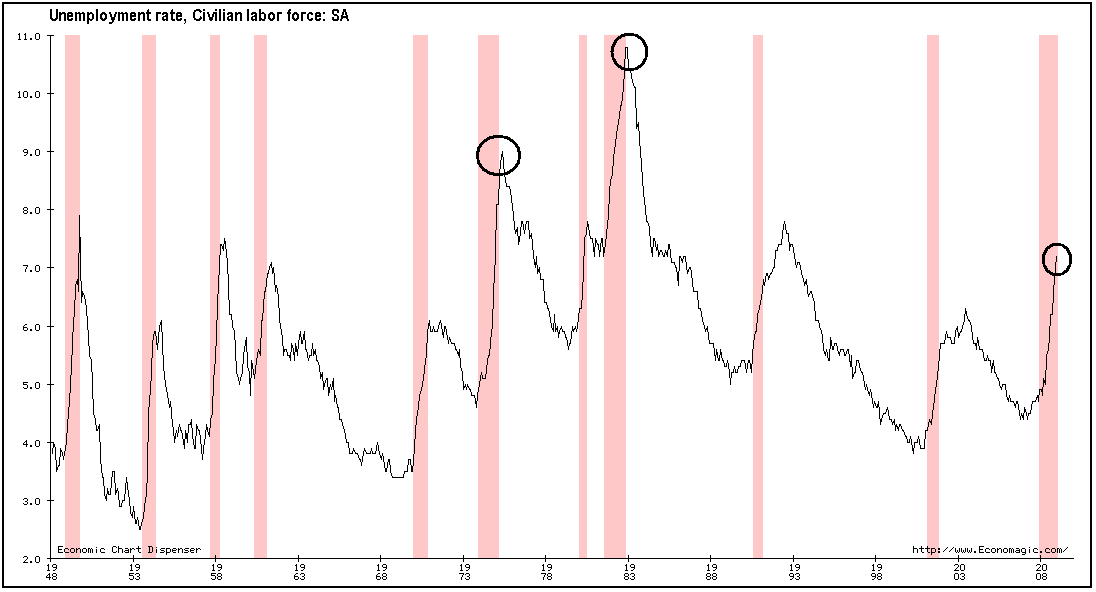
If that is the case, than what are we to make of the following chart below? It shows Unemployment peaking (after) the ‘74 recession at ~9%, and unemployment peaking (after) the ‘82 recession at 11%. Here we are 12 months into this recession, with Unemployment just over 7%.
I can think of several explanations for this anomaly: 1) The data is off; 2) this recession is not as bad as those were; 3) structural changes in the economy mean less layoffs; 4) demographics are impacting people leaving the labor force, helping to keep UR lower; 5) we have a lot further to run in terms of job losses. Perhaps some combination of all 5 of these factors are involved.
via economagic


January 12th, 2009 at 12:01 pm
I’m guessing #5
January 12th, 2009 at 12:05 pm
Average unemployment rates for the last eight years were not substantially different than the prior eight years under Clinton. This is in spite of the fact that only 3 million jobs were created versus 23 million jobs in the prior eight years. Unemployment rates are a leading indicator at best. BLS Non-farm employment is a better number for absolute comparisons with prior periods, once you factor out the “Birth-Death” bullshit.
January 12th, 2009 at 12:11 pm
Debt burdens are also much higher today than those other time periods, hence the uneasiness. People are now finally starting to realize that accumulating stuff while burying themselves in debt that they have to repay with interest is not real “wealth”.
January 12th, 2009 at 12:17 pm
I’d argue for #5. I’m also wondering if this chart take into consideration changes in the way unemployment is calculated.
January 12th, 2009 at 12:21 pm
Jeff makes a good, additional, point, that + point 5.) is, to me, what describes this current scene..
as an aside, all of this ‘talk’ about “things looking better in 2H ‘009″ has all the Hallmarks of a significant trap for those “holding for the loong term”..
those with, unhedged, Long, “diversified”, exposure are fixin’ to be fuel for the Brush Fire that ‘009 will turn out to be..
IOW, The Future is Now, plan accordingly..
January 12th, 2009 at 12:22 pm
The methodology to calculate the unemployment rate in the prior periods, is it the same as current?
January 12th, 2009 at 12:29 pm
I’d als0 add that people are scared sh$tless about having no health insurance (or ridiculously high premiums for coverage) if/when they get laid off from their jobs.
January 12th, 2009 at 12:29 pm
I think its number 5. Back in those earlier periods, we had much lower debt loads per family, and did not have the dual busting of housing and stock market bubbles. Inflation was a problem, but salaries were increasing to compensate.
January 12th, 2009 at 12:30 pm
I’ll pick #4 as my fundamental, and suggest that this implies #5 (for now). Could be that we are just starting to see the downside of the boomer demographic wave start to wash over us. There is a school of thought that most of the last 30 years ‘great moderation’ has been mostly a result of the boomer upswing. Now maybe it’s time for the downside.
Looking at the demographics picture worldwide over the next 20-30 years paints a pretty bleak picture of demand destruction in ageing populations across europe and asia. China and rest of developed asia will be an ageing society by about 2020 I think. Currently +ve US pop growth projections could easily turn sour if fertility rates and immigration dip as a result of economic hardship just as it did in the great depression. Either way it’s a greying demographic in the US and elsewhere.
I think that demographics are playing a much bigger part as a cause of the current problems, and will play an even larger part in the aftermath than people realise.
January 12th, 2009 at 12:31 pm
Screw that muddled and cooked stats…here’s a real vignette that puts into perspective how bad and high the unemployment rate is today…
Last weekend from the Columbian in Washington. “A call center business that plans to open a Vancouver operation this month took in more than 800 applications during a Tuesday job fair. The event was held…to fill between 20 to 30 positions. Call center job wages are between $10 and $12 per hour.”
January 12th, 2009 at 12:32 pm
@km4: Pretty stark indeed. I would bet that many of those people need a job not only for some or any income but they’re looking for health bene’s to stave off any current/future bankruptcy due to a health issue.
January 12th, 2009 at 12:40 pm
Number 5, with a bullet!
(Sorry if you aren’t old enough to have heard the term…)
January 12th, 2009 at 12:40 pm
Mark E. Hoffer said, “those with, unhedged, Long, “diversified”, exposure are fixin’ to be fuel for the Brush Fire that ‘009 will turn out to be..”
Hi Mark, hopefully you’ll forgive my naivete, but would this include everyone with long, diversified retirement plans? My assumption is that, at least within a given plan, you can’t really hedge (which I’m thinking is done by shorting). If that is correct, how are those plans fuel for the fire? I would expect those long term positions to be no worse than anything else at this point. Or am I confused beyond help
?
Thanks in advance… – Gregg
January 12th, 2009 at 12:45 pm
i am thinking its #1 with a helping of sliced and diced data to make it look better? about the only way to try and compare the numbers is to use the same methodology on both sets of numbers using the raw data (and software). otherwise you get numbers that aren’t really comparable.
January 12th, 2009 at 12:50 pm
I would say not #1, since the methodology has not changed; #5 definitely, we’re just getting started; and a bit of #4, though I’m not sure how to tease it out. Two things I checked out: involuntary part-time workers are much higher now than in the 1975 downturn, but not as high as the peak of 1982. And labor force participation was pretty steady through the 1980-82 downturn, while it’s dropped somewhat in the last couple of months. If it hadn’t dropped, we’d be at 7.8 instead of 7.2, so that’s something to watch.
Another factor you didn’t mention: globalization. Some of our job losses have been exported to China et al.
Scott
January 12th, 2009 at 12:55 pm
I think it is in no small part because they have changed the way they define unemployment. Isn’t there something about that the new 7 is similar to the old 11? It may also, in part, be that a lot more people are older and close to retirement now, so they retire early rather than try to find a new job.
January 12th, 2009 at 1:03 pm
Another vote for #5.
January 12th, 2009 at 1:04 pm
In case anyone couldn’t predict, I’m voting #5 as well.
January 12th, 2009 at 1:07 pm
I say that being layed off now is harder because of inflation? Just a thought.
January 12th, 2009 at 1:11 pm
@GB: It’s harder now because most people can’t afford/get health insurance on their own, they have crushing debt obligations, and usually find another LOWER paying job only after several months of looking.
January 12th, 2009 at 1:11 pm
Dedude is right they did tinker with the numbers in the 90’s. But like Barry I don’t buy John Williams’ 17.5 SGS number. I’m in the multi residential dev industry and I would say its closer to 11%. We’re based in DFW/San Diego and if its bad here I can only imagine how it is elsewhere. Puts us at about 1982 numbers but with deflation. I’d be interested in Barry’s opinion.
January 12th, 2009 at 1:11 pm
GreggT,
as you know, this: “.. at least within a given plan, you can’t really hedge ..” is, more often than not, correct.
it is a ‘feature’ of those plans, that makes them, part of “The Font of the Eternal Bid”..
LSS: we well know how that turned out for Peoples in ‘008..
and “long, diversified retirement plans” are “Assets”, that can be “Insured”, much like Home, Auto, Life, etc.
rather than “shorting”, “Put”-buying is more akin to the “Insurance” analogy..
as always, the above is, merely, one opinion. gain others, and reflect them through your Self..
key to the Hypothesis, though, is that “non-linearity” is afoot..
January 12th, 2009 at 1:16 pm
I’d say mostly 5 with and a pinch of some of the others thrown in. But now, there are probably more unemployed that have or are going to lose their homes.
@Trick(Star)(Starr)(Style)
I think Barry is trying to hand you your pick slip
January 12th, 2009 at 1:56 pm
You need to add a #6: a very high percentage of people around today weren’t around during the 70s and therefore can’t relate to how really bad it was (add to this the fact that people always think their problems are worse than anything anyone else has endured).
January 12th, 2009 at 1:58 pm
Scepticus says:
“I think that demographics are playing a much bigger part as a cause of the current problems, and will play an even larger part in the aftermath than people realise.”
Indeed. Demography is destiny. The real reason for Japan’s inability to grow it economy is its inability/lack of desire to grow (or even maintain) its population.
Something much bigger than just a secular recession is afoot here. Demand is dying because people are too, notwithstanding the shrill cries of the modern-day Malthusians.
January 12th, 2009 at 1:58 pm
@TrickStyle For Firefox goto Tools>Options>Privacy on the private data use the clear data. It will reset your cached information and let you log in.
January 12th, 2009 at 2:13 pm
Dedude and callistenes: BLS tinkered with their definition of discouraged worker in 1990s, but not in the numbers that go into calculating the unemployment rate. To be counted as unemployed, you have to be looking for work, which leaves discouraged workers out (both before 1994 and after).
Scott
January 12th, 2009 at 2:14 pm
fyi from Wiki (a visual graph)
US Labor Force Participation Rate:
1974 – 61%
1983 – 63.75%
2003 – 66.5% (more women working & more 2 income households)
http://en.wikipedia.org/wiki/Labor_force
Pop = total population
LF = labor force = U + E
LFpop = labor force population
p = participation rate = LF / LFpop
E = number employed
e = rate of employment = E / LF
U = number of unemployed
u = rate of unemployment = U / LF
US Population
1970 – 203,211,926
1980 – 226,545,805
2000 – 281,421,906
http://en.wikipedia.org/wiki/Us_population
US Unemployment (from above)
1974 – 9%
1983 – 11%
2008 – 7%
I went looking for # of people wanting a job in each time period. Not a percent. This isn’t my job and I might mess this up but here goes:
1974 = 11,156,335
1983 = 15,948,825
2008 = 13,198,687
and anytime I present an unemployment figure using a gov figure that is primarily fabricated to make Presidents look good and get consumers to consume – I question whether the disenfranchised (no longer looking) are included
beyond that where did I hear today (it was MSNBC on MorningJoe) pollsters asking someone what they do for a living – more and more its a paragraph of a response. And last week the father whos kid was kidnapped and left at a rest area in his pajamas and his mom was murdered – dad admitted on the air he was holding down 3 jobs … theres a story MSM
January 12th, 2009 at 2:50 pm
Born in the last few months of the so-called baby boom, I have been hearing about and awaiting the great baby boom retirement my entire working life – only to discover that most boomers continue to work or want to work or have to work – forever! On population pyramids, it is true about the overall aging but it it’s not as extreme as media portrays it. Depsite the one-child policy, China and USA have very similar profiles. In 2050, yes China will have about hundreds of millions over 50 but also 292 million 15 and under!
January 12th, 2009 at 2:54 pm
Go to http://www.shadowstats.com
If you use the U6 figures and add back the discouraged workers for over a year, you get unemployment of 17.8% today.
January 12th, 2009 at 3:25 pm
Change in employment over the Bush years, per Krugman:
http://krugman.blogs.nytimes.com/2009/01/12/a-remarkable-achievement/
So much for the “boom” years
January 12th, 2009 at 3:26 pm
I definitely vote for #5. You ain’t seen nothin’ yet……………
January 12th, 2009 at 3:51 pm
unless i messed up the calculation i think the numbers are a little off. and we do know that the way the numbers have been generated has been changed at least once every 10 years in the last 30. which is why i suggested running the numbers with the same methodology or software on the raw data.
US Population
1970 – 203,211,926
1980 – 226,545,805
2000 – 281,421,906 i have heard this is closer to 300,000,000
http://en.wikipedia.org/wiki/Us_population
US Unemployment (from above)
1974 – 9%
1983 – 11%
2008 – 7%
I went looking for # of people wanting a job in each time period. Not a percent. This isn’t my job and I might mess this up but here goes:
1974 = 11,156,335
1983 = 15,948,825
2008 = 13,198,687 using the 300 million population and the same labor participation rate as 2005 you would get 14.85 million. and using the U6 number you get 34.5 million
January 12th, 2009 at 4:03 pm
@ Todd, et al. Thanks. It worked (this time).
@ Going Broke: is there a severance package?
Back to the economy: I wonder if the composition of illegal workers impacts the data / companies’ flexbility to lay people off.
January 12th, 2009 at 4:13 pm
I think the answer is primarily:
1) Lagging income gains for the vast majority of Americans. Their consumption gains have been entirely fueled by credit. As unemployment rises, coupled with a credit crunch, the actual impact for most families is probably worse than in prior periods.
2) As jqui states, the underemployed and discouraged are almost certainly much higher today, due to the Wal-Martization of the work force.
So if you only look at what percentage of Americans are working, you get one picture, which is slightly rosier than in past recessions. But if you take a more holistic view, you see that Americans who are working are making less money, have more debt, and may not be making enough money to cover their needs (or they are concerned about that prospect in the near future).
January 12th, 2009 at 4:17 pm
The negative feedback loop has some more big iterations — #5
OT: My wife was invited to a “gold party” today. The hostess is friends with a woman “who works for a company that buys gold” and the idea is the ladies bring unmatched/unwanted gold jewelry. They leave the party with a check.
January 12th, 2009 at 4:53 pm
Transor,
that’s an interesting new phenomenon, though many of the ‘prices paid’, at those soirees, are really Low..
someone has to cover all those MLM fees– it’s the Seller..
January 12th, 2009 at 4:58 pm
Look atthe employment rate for male 25-54 over the same period for an explanation.
The machine to transform the unemployed into inactive has been running better than ever lately.
January 12th, 2009 at 5:33 pm
It seems foolhardy to try and assess the ongoing unemployment peak when all the past peaks have occurred either at the very end of the designated recession or some time after.
About the only way one could reasonably expect the current unemployment levels to represent the peak for this cycle is if:
a) we are at the exact end of the current recession, AND
b) for this cycle, unemployment peaks at the end of the recession instead of months later.
That much seems obvious from the chart.
January 12th, 2009 at 5:44 pm
in december 1975, average hours worked weekly = 36.5
in december 1982, average hours worked weekly = 34.8
in december 2008, average hours worked weekly = 33.3
this is but one cog in the whole unemployment figure being registered these days.
sb
January 12th, 2009 at 6:08 pm
You didn’t directly raise this point, but it’s tangential….
Is the “nature” of the workforce different now? My belief is that, with the demise of the unions and the creation of so many part-time jobs, the American workforce is more flexible. Is that why we’re seeing a such a quick uptick in unemployment the last several months? I think it’s much easier today for employers to Whack Now, Ask Questions later, as opposed to 70’s-80’s. It’s sort of silver lining of sorts. It may mean that we’re seeing the “brunt” of layoff sooner and faster than during any other depression.
In terms of #5, doing some back of the envelope technicals on this chart (if I had the precise data on this chart I could give a more precise answer), the Unemployment rate is definitely going to 8% (I know that seems obvious now). If we break 8%, then it opens the door to 10-10.25% FWIW.
- AT
January 12th, 2009 at 8:12 pm
BR,
Probably a combination of all of them is my best guess but that’s all it is, a guess. I think number 3 has more to do with it but is hard to measure. Hasn’t the average work week also dropped over the last several months. Or for example, I know at a Du Pont plant in Jersey close to where I live has cut all overtime for employees, for the employees in that plant, overtime is where they are actually making some money. So, they didn’t become unemployed, just took a pay cut.
January 12th, 2009 at 8:13 pm
sydneybound,
I apologize I stole your idea it looks like, didn’t read the comments b4 I posted.
January 12th, 2009 at 8:14 pm
transor z
that would have been a better party to attend in the spring of 08.
January 12th, 2009 at 11:07 pm
A complex question deserves a simple answer. NAIRU! NAIRU stands for the non inflation accelerating inflation rate unemployment rate. There are various estimates of the NAIRU for the U.S. but the most accepted are those published by the CBO (Congressional Budget Office). The historical estimates are here:
http://www.economagic.com/em-cgi/data.exe/cbo/nairu
Now, mind you, these estimates seemed to have been updated by the CBO recently but this has not apperently been announced publicly. It feel to 5.1% in 1998, 5.0% in 1999, 4.9% in 2000 and has been at 4.8% ever since.
The bottom line is this should be considered for all intents and purposes the target unemployment rate or “full” employment rate. If one uses these estimates then note that the 1974-1975 recession resulted in an unemployment rate 3.0% over NAIRU. The 1981-1982 recession resulted in an unemployment rate 4.6% over NAIRU. We are currently 2.4% over NAIRU. According to the incoming administration’s estimates this recession will peak at 4.2% above NAIRU without the stimulus and will peak at 2.9% with the proposal being discussed right now. I think the current estimates are optimistic. My econometric models predict we will peak at 6.4% above NAIRU in the first quarter of 2012 and that even with the stimulus (as it stands) we will peak at 4.6% above NAIRU also in the first quarter of 2012. In short if one believes my model. This will be the worst recession even with the current stimulus proposal passed.
January 12th, 2009 at 11:11 pm
That is to say the worst recession since the dreaded words “the Great Depression.”