
Defaults Rise in Neg Am Loans

Email this post Print this post
By Barry Ritholtz - January 30th, 2009, 6:09AM

The Option Arm loan is causing trouble. The negative amortization loans, which typically see the amount of principal owed rise over the loan’s term, is seeing defaults rapidly rise.

There are ~$750 billion of option ARMs issued from 2004 to 2007;  ~$1.9 trillion of subprime and $ 2 trillion in jumbo mortgages were issued over the same period.

J.P. Morgan reported that more than 55% of borrowers with option ARMs are underwater, i.e., owe more than homes are worth.

Even worse, they are defaulting in increasingly large numbers:

As of December, 28% of option ARMs were delinquent or in foreclosure, according to LPS Applied Analytics, a data firm that analyzes mortgage performance. That compares with 23% in September. An additional 7% involve properties that have already been taken back by the lenders. By comparison, 6% of prime loans have problems. Problems with subprime are still the worst. Just over half of subprime loans were delinquent, in foreclosure, or related to bank-owned properties as of December. . .

Nearly 61% of option ARMs originated in 2007 will eventually default, according to a recent analysis by Goldman Sachs, which assumed a further 10% decline in home prices. That compares with a 63% default rate for subprime loans originated in 2007. Goldman estimates more than half of all option ARMs outstanding will default.
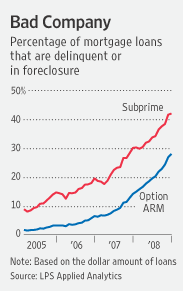
Go figure. Giving mortgages to people who can’t afford them — even with “affordability products” like NegAm loans — worked out poorly. Who ever could have seen THAT coming . . .

>

Source:
Option ARMs See Rising Defaults
RUTH SIMON
WSJ, JANUARY 30, 2009

http://online.wsj.com/article/SB123327627377631359.html

Comments

Please use the comments to demonstrate your own ignorance, unfamiliarity with empirical data, ability to repeat discredited memes, and lack of respect for scientific knowledge. Also, be sure to create straw men and argue against things I have neither said nor even implied. Any irrelevancies you can mention will also be appreciated. Lastly, kindly forgo all civility in your discourse . . . you are, after all, anonymous.

8 Responses to “Defaults Rise in Neg Am Loans”

  1. Scott F Says:

    Neg Am was always a sucker play.

    If you want to investigate Predatory Lending, start here.

  2. constantnormal Says:

    I don’t think that anyone is surprised by people who shouldn’t have been able to buy houses falling into default — the surprise comes when the falling housing prices put people who have solid incomes and were not remotely considered risks into the position of defaulting on their mortgages as the wave of unemployment sweeps through.

    In past times, when unemployment forced home sales, it was still possible for homes to be sold and the occupants moving into rental/cheaper housing. Not so this time around. This time around, the seller is caught between the balance due on the mortgage and hideous price declines on the houses, making a sale impossible, and forcing defaults and foreclosures, for people who would never before have been considered risks.

    This kind of default has nothing to do with negative amortization, option ARM, or any other kind of ARM — it’s a consequence of the housing market shrinking into insignificance.

    THAT’s where the surprise comes in …

  3. The Curmudgeon Says:

    When I first saw one of these Option ARM promissory notes a couple of years back, I actually had to sit down and read the document, very carefully, so I could understand what it was the borrower was agreeing to. (I do real estate closings for a living).

    These things came out in force just after the peak, in late 2005/early 2006. It was clearly an attempt by the mortgage industry to present another new vehicle for folks to borrow as much as possible to make a bet, along with the mortgagee, on the continued rise in value of residential real estate. They were selling, as the name of the loan accidentally implies, an option, not unlike the sale of a put option in the stock market. The “put” was the option to sell the appreciated real estate and reap the awards with very little skin in the game. The money used to finance the put did not even have to be fully-serviced–the borrower could opt to give the lender some of the anticipated appreciation by actually paying less than the accrued interest.

    Of course, the singular assumption on which these put options depended was that real estate never goes down in value. Turns out that wasn’t such a good assumption.

    Borrowers in these vehicles weren’t stupid. They were making a rational bet based on past experience. Same for the mortgage companies. It was not predatory lending. It was operating on faulty assumptions, but then everyone was doing the same. The borrowers, having little or no skin in the game, are acting rationally now when they quit paying for the option and walk away. Banks in no recourse states are left holding the depreciating asset. Thus develeraging continues.

  4. CapBeacon Says:

    Big banks are not the only institutions holding Option Arms by any means. As community and many regional banks found it impossible to compete with the likes of Countrywide, WAMU, and the like they had to resort to “gimmick” loans like this if they wanted to play in mortgages. As an investment banker in that space I quickly learned not to believe seller/issuer assertions that they only held “prime” mortgages until we had done the diligence. Often times we learned that the mortgages may have been “prime” by FICO-only standards but were actually Option Arms. I tend to agree with Goldman’s default assumptions. If you are a bank or mortgage REIT investor, whether public or private, do you homework on the mortgage portfolio and see what is really there.

  5. JohnnyVee Says:

    Option Arm Loans are not subprime loans. One had to have 700+ credit score and 20% equity. Also predatory lending, in California and probably elsewhere, is defined as a loan that the borrower cannot pay back. If the borrower cannot qualify for the loan under the full monthly payments, that is predatory.

  6. IdahoSpud Says:

    Barry Said:
    “Go figure. Giving mortgages to people who can’t afford them — even with “affordability products” liek NegAm loans — worked out poorly. Who ever could have seen THAT coming . . .”

    The Chairman of the United States Federal Reserve Bank couldn’t.
    “At this juncture . . . the impact on the broader economy and financial markets of the problems in the subprime markets seems likely to be contained,” Bernanke said in prepared testimony to Congress’ Joint Economic Committee.

    Link: http://archive.newsmax.com/archives/ic/2007/3/28/110709.shtml

  7. IdahoSpud Says:

    By the way, why Bernanke have a shred of credibility? He clearly is either disingenuous or clueless. Must be the beard.

  8. Clay Says:

    An excellent comprehensive concise report on the nation’s economy is put out by the OTS called the “Monthly Market Monitor” and can be found here each month:

    http://www.ots.treas.gov/?p=MonthlyMarketMonitor&ContentRecord_id=bf3018b7-1e0b-8562-ebae-500d639fa1d6

    The latest report was dated 1-22-09, is a little over 12 pages long, covers quite a bit of economic
    information and graphs including a plethora of graph analyses on mortgages.

    Enjoy.

60 queries. 0.368 seconds.