
L O N G Recession
The WSJ on the current recession, on track to be one of the longest ever”
“The current U.S. recession, with no end in sight, threatens to be the longest since 1933, and that helps explain why investors are having so much trouble gauging the stock market.
Models developed in the more normal times of the past few decades, based on things like corporate-profit forecasts, the interest-rate environment or the length of the average recession, have failed in the current, exceptional economy. Many have signaled that stocks were cheap and it was time to buy, but stocks kept falling and got cheaper.
Since the Great Depression, only two recessions have run longer than this one, the first ending in 1975 and the other in 1982. Each lasted 16 months, according to the National Bureau of Economic Research, the government-designated recession tracker.”
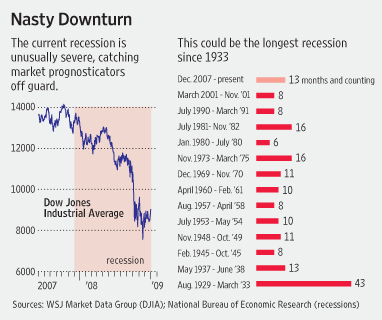
>
Source:
Rebound Wrinkle: Recession
E.S. BROWNING
WSJ, JANUARY 5, 2009
http://online.wsj.com/article/SB123110449873552059.html



January 5th, 2009 at 9:26 am
And if this particular series of events had occured, say, in 1970 prior to the internet and blogging sites, there would be a lot more people who’d have had a bad outcome…I could say a lot more, but at least today the folks who want to avoid a catastrophe with investments have had an alternative other than the MSM…..
January 5th, 2009 at 9:56 am
> The WSJ on the current recession, on track to be one of the longest ever”
Gee what an epiphany i.e. the biggest bubble and Ponzi scheme ever will take longer to work through !
January 5th, 2009 at 10:44 am
@ km4
Likely “Ponzi scheme” should read “Ponzi schemes”?
January 5th, 2009 at 11:00 am
This is not like watching a controlled demolition of a high rise building. It’s like watching an old barn fall – little by little, until it simply leans over and collapses. Not the kind of thing you want to sit around and watch.
It’s the duration of what’s coming that will kill us.
January 5th, 2009 at 11:33 am
You guys are silly! EVERYONE knows second half is going to be the end! (Just like the last second half was going to see a rebound with 62% increase in profits!)
January 5th, 2009 at 11:36 am
Oh come on…Tobias Lekovich, chief equity strategist of CitiGroup (AHEM, excuse me) said everything will be OK in the second half. I heard him on CNBS this morning, and we all know CNBS gives us the real economic farts…er facts.
January 5th, 2009 at 11:46 am
We might have been in a technical recession since December 07, but the real recession began in September. Whatever duration we predict for this one, December 07 is just government spin.
January 5th, 2009 at 11:52 am
@ Bruce N Tennessee @ 9:26 am:
Assuming I am understanding your comment correctly, I would counter your comment and venture to guess that the velocity and abundance of information via the proliferation of financial blogs and other investment-related web sites has changed the playing field for investors — not necessarily for the good or the bad — but primarily in intensity.
More information may translate into more knowledge but this increase in the speed and availability of knowledge outside of the mainstream media does not translate into more wisdom or good judgment — it actually creates more distraction and noise; hence more opportunity for an increase in bad judgment (albeit at a faster, broader and deeper scale).
“… in an information-rich world, the wealth of information means a dearth of something else: a scarcity of whatever it is that information consumes. What information consumes is rather obvious: it consumes the attention of its recipients. Hence a wealth of information creates a poverty of attention and a need to allocate that attention efficiently among the overabundance of information sources that might consume it.” ~ Herbert Simon (1916 – 2001)
January 5th, 2009 at 12:15 pm
How long does a mustard seed take to grow? We have thousands of them according to some.
January 5th, 2009 at 12:18 pm
Kent,
I’d disagree with that…mainly these blogs and other similar sites have offered alternative opinions now since the market was 13k…Barry, Mish, Roubini…these people would have not had a voice that was widely available in 1970. Sure the information is more topical…but alternatives to the MSM are available now to the average investor for only the cost of access to the internet.
Judgment is judgment…but if the alternative information is less available, well, then you may make the wrong choice from lack of information…
If your point is that too much information can result in bad judgement…well, I would always side on the side of too much information than too little.
January 5th, 2009 at 12:51 pm
I am struck by the phrase “Models developed in the more normal times of the past few decades.” What makes them normal? The historical pattern, after all, has been boom-and-bust.
January 5th, 2009 at 1:01 pm
cage match:
Philosopher/Simon> “Hence a wealth of information creates a poverty of attention and a need to allocate that attention efficiently among the overabundance of information sources that might consume it.”
Bruce > “If your point is that too much information can result in bad judgement…well, I would always side on the side of too much information than too little.”
In my readings of papers on safety, more attention is being paid lately to the idea that such things as aircraft and nuclear plant ‘cockpits’ need to be designed to reflect the limited information processing abilities of their operators – humans – rather than simply presenting every possible reading and leaving it to human judgement to sort things out.
I suspect it comes down to the kind of time available to reflect; the more time available for reflection, the more likely more inputs can be properly sorted out.
January 5th, 2009 at 1:10 pm
Bruce N Tennessee:
Yes, I agree that there is certainly more information available (i.e. The Big Picture) from which a rational investor can potentially make more prudent investment decisions as compared to periods prior to the existence of such financial blogs.
It seems, however, that you may be overlooking the fact that there are millions of other blogs out there. How many of these blogs do you believe are dispensing “good judgment?”
Perhaps we may agree that 10% of the financial blogs in the blogosphere dispense quality and useful information but the other 90% are just noise that add to the intensity of anxiety, which may explain why we are experiencing record levels of volatility.
We must also remember that the vast majority of investors do not have the capacity to choose between a “good source” of information or a “bad source” of information. An increase in information simply means more choice and more potential for confusion.
Ultimately, investors are drawn to information sources that align to their conceptions (or misconceptions) of financial markets. For example, if an investor is predisposed to a bullish view, they will likely read bullish information, which will confirm those predispositions.
Of course, none of my comments here are scientific in nature — only logical — so I will humbly admit that I could be completely wrong.
Also, I will add that I was born in the great state of Tennessee.
Cheers…
January 5th, 2009 at 2:22 pm
a) “recession” , as has been duly noted here many times, is often as much a matter of semantics as it is about economic contraction–for example, the “recessions” of ‘90-’91 and ‘01 were so mild as to be barely noticeable.
b) even though ‘29-’33 was the longest before this one, remember that it was followed by expansions that quickly collapsed, most notably in 1937. It wasn’t until we got ourselves in a good ol’ empire-building war that sustainable and more or less steady growth obtained, and lasted until the seventies.
c) the seventies through ‘82 seem very similar here….while the economy might’n contract every quarter for a longer period than ‘29-’33, it seems unlikely that true sustainable growth based on sound economic fundamentals will obtain until something “black swan-ish” happens, like a war, or a truly new political direction, neither of which is bound to happen anytime soon. It’s apt to be a long slog, and I fear we have a long way down yet to go.
January 5th, 2009 at 2:28 pm
Kent:
That thinking is way too Orwellian for me. The blogs aren’t supposed to give “good judgement”…that is up to us as a sentient being. And I strongly disagree that the majority of investors can’t make sound decisions about the source of information. Biblically it would be akin to separating the wheat from the chaff. But that too, is why blogs are a good thing, so we can discuss that with which we disagree. And I was born in Texas, but by the grace of …….you know.
January 5th, 2009 at 3:23 pm
Bruce:
I only partially disagree with you but respect your opinions completely. With regard to your commenting that you “strongly disagree that the majority of investors can’t make sound decisions about the source of information,” perhaps I could have worded my preceding comment better.
I agree that investors can potentially make sound decisions but there certainly is no evidence that investors, as a collective herd, are making more sound decisions today because of financial blogs.
I will also agree that blogs, in general, as you say, are a “good thing.”
I believe that an individual should allocate their attention much as a prudent investor might allocate their investment assets: A diverse mix of information sources (books, periodicals, blogs, etc) is certainly prudent; however, too much of a “good thing” can be potentially hazardous to one’s financial health.
Ultimately, and in my opinion, moderation and self-awareness are valuable in almost any human endeavor.
“Moderation, which consists in indifference about little things, and in a prudent and well-proportioned zeal about things of importance, can proceed from nothing but true knowledge, which has its foundation in self-acquaintance.” ~ Plato
With regard to Texas and Tennessee, both are great states but I do find it quite interesting that Sam Houston was a Tennessean…
January 6th, 2009 at 1:54 am
The more I read articles like the above, the more it feels like the Great Correction is only just getting started.