
Market Sentiment Review

Email this post Print this post
By Barry Ritholtz - January 9th, 2009, 1:45PM

We are fond of all manner of sentiment measures, including anecdotal info like this.

However, we always find ourselves going back to the data. While sentiment surveys produce a chartable data stream, we especially prefer Asset Allocation measures.

This way we not only see what people are saying, but we can measure exactly what they are doing.

>

American Association of Individual Investors (AAII)
Average Asset Allocation Survey
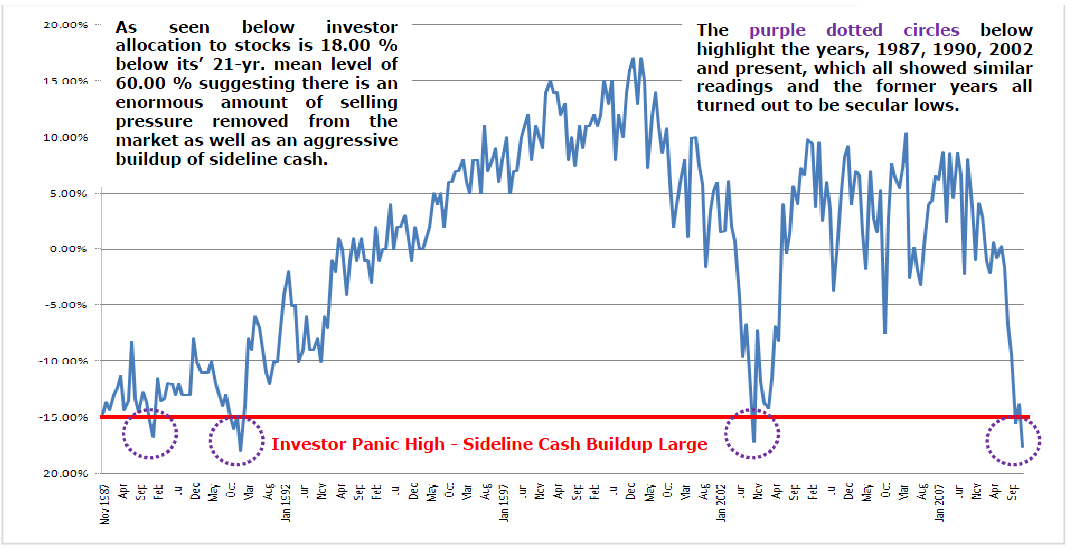
American Association of Individual Investors (AAII)
Bullish Sentiment Survey (Stocks)
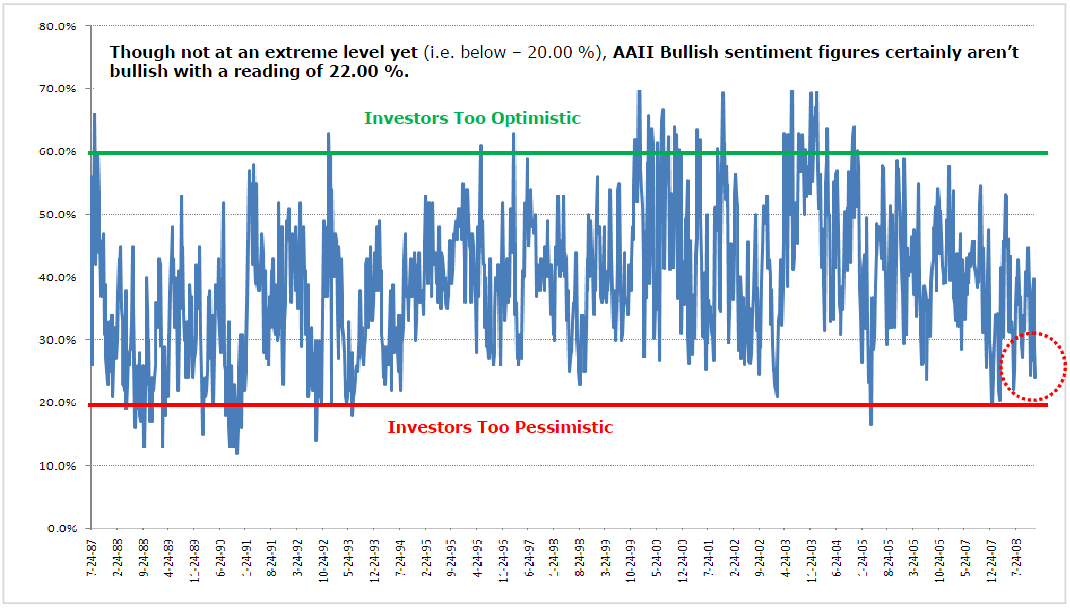
Charts courtesy of Fusion IQ

54 Responses to “Market Sentiment Review”

  1. DL Says:

    Two points:

    1 ) Sentiment does matter, but so do economic fundamentals. If this economy is indeed in worse shape than it has been since 1987, then higher levels of bearishness will be needed to signal a bottom than has been the case over the last 22 years.

    2 ) It’s a question of time frame. I do think the market will be higher in two years; it’s the next six months that I’m primarily concerned about (and the fact that we’re probably in a long term secular bear market, at least in inflation-adjusted terms).

  2. wally Says:

    “Cash on the sidelines”, eh? So when they sold their stock they didn’t sell it to somebody who took an equal amount off the ’sidelines’ to buy it?

    ~~~

    BR: Agreed, but this metric refers to percentage of cash in a portfolio — “sidelines” is really a silly word.

  3. Bob_in_MA Says:

    Sentiment was very low on the Titanic after it collided with the iceberg, that’s what kept it afloat and made for a safe voyage.

  4. larster Says:

    Didn’t this use to be a contrary indicator?

  5. Mark E Hoffer Says:

    shouldn’t the top chart: “allowcation”, naturally follow ‘Stock Market’ returns?

    if , hypo., one started w/ 50/50 Stock/Bond, and Stocks get trimmed 30%..doesn’t that, caeteris paribus, turn into ~41/59 ?

  6. Darkness Says:

    So, if cash is the next bubble, what are the possible bursting outcomes? Is inflation the only way it can burst or are their other ways?

  7. Jurgen Says:

    There is roughly $8.5 trillion of cash sitting on the sidelines; eventually it will find its way into stocks and other asset classes.

  8. DL Says:

    As the stock market bulls like to say, a bottom in the market is not a single event but “a process”.

    That way, if they miss the bottom by six months and 30%, they can still say that they correctly identified the beginning of “the process”.

  9. Concerned American Says:

    Jurgen Says:
    January 9th, 2009 at 3:09 pm

    There is roughly $8.5 trillion of cash sitting on the sidelines; eventually it will find its way into stocks and other asset classes.
    ============

    Why not just take it to Vegas? Why would it all go back in? How many times would this have to happen (total loss of trust) before people wised up? Was this time the time?

  10. pwm76 Says:

    How much weight do you give this signal? It looks like your data set only included the period when the economy was increasing its leverage at an above average pace. Now that it appears that secular deleveraging is underway, how much do you discount the signal?

    ~~~

    BR: Its a shorter term trading signal — and as you can see, its not that deeply oversold.

  11. Steve Barry Says:

    Chart 1: Immediately question it, as it wholly encompasses a debt and equity bubble. That paradigm changed last year. We are in a new regime and a chart that only looks from 1987-2008 does not apply. Also, while sideline cash may be at highs, sideline debt is off the charts.

    Chart 2: I can show a chart that measures the same thing supposedly and shows a wild jump in bullishness to levels last seen at Dow 14,000…which to believe? With short levels and put buying on fumes, I’ll believe my chart.
    http://www.investorsintelligence.com/x/free_chart.html?r=101#

  12. Mannwich Says:

    Citi looking to unload Smith Barney. Isn’t that their most profitable division? Sounds eerily similar to Lehman trying to unload Neuberger right before they went down.

    Selling their most prized assets to save a “company” not worth saving. Nice work!

  13. Andy Tabbo Says:

    @DL:

    Indeed. I don’t know how many keep citing the “bottom” in October, even though that bottom got decisively taken out in November. As you say, they’re clinging to the idea that they were correct in October….the “cognitive dissonance” is interesting to observe.

    In re: Sentiment analysis in this post.

    Do we have numbers from 1972-73 or 1931-33? I see other sentiment surveys that suggest slight more bulls on the street than bears, way up from the Oct and Nov extremes. So, for me this is an interesting bit of information that needs to be taken in with a lot of other sentiment measures that also exist.

    And also, we should be aware that we may be seeing something that hasn’t occurred in many decades…

    Quick technical aside: When a technician identifies a level that “should be” solid support like 890 on the SP500, one expects the market to hit that level and BOUNCE HARD. You see a fairly violent ricochet of something that should be key support. The day’s not over yet, but we are not getting that snap back rally one would expect at such a key level of technical support….Not Good.

  14. Mannwich Says:

    @SB: Something tells me that much of that so-called “sideline cash” will get sucked up in the deleveraging process. Since nobody really trusts the market anymore (is there any sane person out there that thinks the market isn’t a complete joke at this point?), why not just pay down debt until the carnage ends and some degree of sanity returns (if it returns)?

  15. Mannwich Says:

    Not looking so strong into the close. Confidence appears to be fading. We’ll get another bounce before the inauguration but I can’t see how we’re getting anywhere near DOW 10,000 or even S&P 1,000 bef0re we retest and likely breach the prior lows.

  16. Steve Barry Says:

    @Mannwich:

    Right…let’s look at wealth destruction…how many pretty well-off American boomers lost a big chunk of their retirement safety nets in stocks and real estate? That money is never going back into stocks in a big way. I know 2-doctor families that are now on “austerity” budgets, due to their homes and “201″k.

  17. ben22 Says:

    Here is some sentiment, got these from Bespoke:

    Strategists’ 2009 S&P 500 Price Targets:

    UBS David Bianco Price Target = 1,300 or +43.9%
    Deutsche Bank Binky Chadha (Binky?) Price Target = 1,140 or +26.2%
    Goldman Sachs David Kostin Price Target = 1,100 or +21.8%
    All of the following are also at 1,100 Jason Trennert from Strategas, Thomas Lee at JPM

    skip a few

    Merrill Lynch Richard Bernstein Price Target = 975 or +7.9%
    Barclays** Barry Knapp Price Target = 874 or – 3.2%

    ** Lehman’s 2008 price target was used for Barclays

  18. jason Says:

    UBS David Bianco Price Target = 1,300 or +43.9%

    I gotta find his dealer – j

  19. ben22 Says:

    Also from Bespoke but this is probably no surprise to anyone on this site:

    Bottoms up basis S&P is estimating the S&P 500 to have operating earnings of $81.80 for 2009.

    However, their top down estimates for as reported earnings are only at $42.24.

  20. ben22 Says:

    jason,

    I thought the same thing when I saw that.

  21. The Curmudgeon Says:

    Darkness Says:

    January 9th, 2009 at 3:04 pm
    So, if cash is the next bubble, what are the possible bursting outcomes? Is inflation the only way it can burst or are their other ways?

    Curmudgeon: No, inflation is the only way.

    Jurgen Says:

    January 9th, 2009 at 3:09 pm
    There is roughly $8.5 trillion of cash sitting on the sidelines; eventually it will find its way into stocks and other asset classes.

    Curmudgeon: And Fed prints more every day. See first comment.

  22. Big J Says:

    the video is way to obscure/narrow to be a true sentiment and/or contrarian indicator. You need something that has wider reach and is more reflective of the national consensus. My suggestions of real indicators to look for are:

    1. A cover story in Time Magazine about how we’re all going to be unemployed and living in caves for the rest of the century (they did great at marking the top of the Real Estate Bubble in 2005).
    2. Hollywood launches the new TV show “Bear” to highlight money managers who encounter precarious financial situations only to save the day via well-placed shorts. (the flip side of the 2000 show “Bull” which, along with Jeff Bezos on the cover of Time, might have been the best signal that the market was going to crash).
    3. Jim Cramer’s “Mad Money” gets canceled for lack of ratings.

    Take your pick. I think the cover stories of Time are the most impactful, though I like #2 the best, lol.

  23. Steve Barry Says:

    Further bad news about chart 2…Barrons shows that last week it rocketed to 49%, near “too optimistic” levels, matching what I have been saying for weeks with my data.

    http://online.barrons.com/public/page/9_0210-investorsentimentreadings.html

  24. Winston Munn Says:

    Jurgen Says:

    January 9th, 2009 at 3:09 pm
    “There is roughly $8.5 trillion of cash sitting on the sidelines; eventually it will find its way into stocks and other asset classes.”

    Wow. That’a some big mattress. Or are you saying that now it is sitting in classless assets?

  25. Groty Says:

    Before clicing on the charts, I was confused because I read recently that AAII sentiment has been running pretty bullish. After clicking on them I realized they are old and you are putting them up as examples.

    Just a suggestion, but since you get so much traffic, you might want to explicitly point out in the post that the charts are for illustrative purposes since they contain stale, non-current data.

  26. Ken Says:

    Jurgen wrote: “There is roughly $8.5 trillion of cash sitting on the sidelines; eventually it will find its way into stocks and other asset classes.”

    “Eventually” in this case being used in the same sense as “in the long run”, in Keynes’ famous statement?

  27. GreatWarrior Says:

    Barry, I think you got this whole thing wrong to support your rally to SPX 1040.

    Take a look at the first chart again, and compared to SP500. What does that tell you? Very similar, isn’t it? Peak in March 2000, bottom in 2002 and 2003.

    If there is anything at all, thischart has become sort of “smart money”, as the investors are not buying into the market when SP500 hit its double peak back in Oct 2007 (early peak March 2000). Also, these investors become smarter with their peak investment hit before Oct 2007 (cannot tell exactly from chart, maybe the latest peak was March 2006?).

    So, I think Barry you should follow this group of smart money. They obviously become smarter over the years.

  28. VennData Says:

    Money funds at $3.9 trillion

    http://online.wsj.com/public/page/news-financial-markets-stock.html
    http://www.forbes.com/feeds/ap/2009/01/08/ap5897872.html

  29. Don Says:

    What if there is no money to go back into the market? (Was it ever really there in the 1st place?)
    If 75% of the wealth in the U.S. is/was held by people 65 and older and they just lost an average of 35 – 40% of their invested capitol… does anyone think they are going to be in a rush to get back into the market? And if they are not in a rush and they are over 65…
    Just wonderin.

  30. Andy Tabbo Says:

    Barry,

    Maybe I don’t understand that Chart#1 and I’m missing something, but isn’t that chart going always follow the path of the market:

    For instance:

    If I have $1,000,000 and I have

    $600,000 in stocks
    $400,000 in cash then I’m 60% allocated to stocks.

    If the Stock market gets crushed and loses half it’s value then I’m left with

    $300,000 in stocks
    $400,000 in cash

    Because of the stock market crash I would then be 42% allocated in stocks without even consciously reducing my weighting?

    What am I missing?

    - AT

  31. ben22 Says:

    AT,

    I was wondering the same thing about chart 1, and wouldn’t that just conclude that over this period most people just buy and hold, thus the stock allocation rises and falls with the market.

    On the other hand, it is common for the masses to sell AFTER the market goes down, which also shows up in the chart and might be what BR is trying to show.

  32. Andy Tabbo Says:

    ben22:

    If my relatives and friends are any indication, many of them just ride their stocks and up and down no matter what’s going. There’s a few friends who I’ve been yelling at to get out of the market for the last 12 mo.s…they say “I’m in it for the long term.” For some reason, I think those are the people that will be selling at 600 S&P because “Man. Things are really bad. I lost my job.”

    I’ve always advised friends to NEVER hold stock in the company they work for, because you’re essentially doubling down. If the company goes to shit, you not only lose your job, but you also get killed on your “savings.” I think I can make a similar case for the average worker who is inherently LONG the U.S….why double down when you don’t have to?

  33. TPC Says:

    Just based on CNBC every day I would say that there are no bears out there. How many people really think the market could fall 25% in the first half of 2009? No one on CNBC…..

  34. Steve Barry Says:

    ABC Nightly news segment on unemployment…shows an ex-Goldman Sachs employee now bussing tables.

  35. Ny Stock Guy Says:

    Mannwich Says: why not just pay down debt until the carnage ends and some degree of sanity returns (if it returns)?

    That’s pretty much what I’ve been doing since last May.

  36. philipat Says:

    @An agressive buildup of sideline cash

    “Markets were down agressively”

    Off-topic but bad English really gets up my nose. Cash build-up can be significant, substantial, large..but agressive? Unless that cash pile was attcking me with self=propelling dollar bills?

    Call me English, and it’s my language!!

  37. Steve Barry Says:

    @philipat:

    Bad spelling gets up my nose…”agressive”?

  38. philipat Says:

    @agressive”?

    Agreed, apologies. No spell checker!!

  39. Mannwich Says:

    @Ny Stock Guy: And that’s what most people will do with the majority of any “stimulus package” that is doled out – pay down debt and/or sock it away for the coming depress……ahem, I mean, lingering, recession……..excuse me. I almost lapsed into being too honest about our situation.

    Without a true stabilization/recovery in the housing and job markets (that come with an increase in incomes so that people don’t have to go back to the credit well to keep up), people will not significantly alter their consuming habits to go back to buying crap they don’t need. It’s a new day of frugality and thrift.

  40. gregh Says:

    a few more thoughts and charts on topic

    http://seekingalpha.com/article/113339-high-cash-stockpile-available-for-buying-stocks-to-fuel-a-rally

  41. gritsnbeer Says:

    1929 – 1941 >>> The Great Depression

    2007 – ???? >>> The Deep Funk

  42. tselliott Says:

    I agree with some earlier comments. Majority of people are just riding this out. I’m not buying all the “sideline” cash expectantly waiting to jump back in.

    S&P is NOT cheap right now.

    We have at least another year of bad news to weather.

    I expect we break S&P 700 before this is over. **

    ** Yes, I’m fervently talking my book. Ultra shorts have been painful the last couple of months. :(

  43. jc Says:

    If it’s “just” a recession then the sentiment indicator says it’s time to buy. But sometimes the obvious answer is correct and if it looks like a duck, quacks like a duck and is seen in the company of other ducks then maybe we do have a depression in front of us. I’m sure they weren’t calling the Great Depression the Great Depression in 1929 (pretty sure anyway!)

  44. Steve Barry Says:

    @jc:

    No…even if it is just a recession, the sentiment indicator no longer says time to buy, as I indicated in a post above…it has rocketed up, just as II Bulls, during the low volume sucker’s rally and now reads much closer to SELL. This was the mother of all sucker’s rallies and caused many to turn bullish on putrid volume. As for Citigroup’s panic/euphoria, throw it in the garbage…a few weeks ago, they somehow pushed the panic and euphoria bars way down from where they had been to make it look like a panic.

    http://online.barrons.com/public/page/9_0210-investorsentimentreadings.html

  45. jc Says:

    “The thought is father to the deed”. If people believe we are having a depression then they will act in a manner that makes it more likely that we will, indeed, have a depression.

    The Intrade Depression contract is now at 45% up from 15% a few weeks ago. There’s obvious momentum building. I think the Jan unemployment numbers will take our breath away, all those state systems overwhelmed (NY,NC,Ohio and Mich – about 15% of the national population!), plus the inevitable adjustments to the bad side.

    http://www.intrade.com/jsp/intrade/common/c_cd.jsp?conDetailID=647817&z=1230617689492

  46. Steve Barry Says:

    Now that I’m more awake, the top chart does not necessarily suggest a buildup in cash…it shows investor’s allocation of their portfolio to stocks…as the market tanked, of course you have less in stocks. That is far different than saying all those people sold at the top and monetized the stock into cash that is now sitting waiting to come back into the market. It probably indicated the opposite…people rode the crash all the way down, still hold the equities and that’s why it is sucjh a low percent of their portfolio. Also, again, this chart encompasses one of the greatest equity bubbles we’ll ever see…of course the 21 year allocation is high. What we need is a chart that shows the net worth of the investor class (which must be way down) and how they may invest their next dollar.

  47. Steve Barry Says:

    @jc…more interesting is how intrade defines “depression”:

    For expiry purposes a depression is defined as a cumulative decline in GDP of more than 10.0% over four consecutive quarters. This is calculated by adding together the published (annualized) GDP figures (as detailed below). If these annualised figures add up to more than -10.0% over four consecutive quarters then the contract will expire at 100.

    Expiry will be based on official quarterly GDP figures reported by the U.S. Department of Commerce (Bureau of Economic Analysis, Table 1.1.1, “Percent Change From Preceding Period in Real Gross Domestic Product”) as reported by the BEA.

    The final quarterly GDP figures will be used for expiry – not the advance or preliminary numbers. Any revision of the final figures will not not affect the original expiry.

    Negative quarters in the preceding year will count towards the total GDP decline for expiration purposes. For example, if the total decline in GDP from Q3 2008 to Q2 2009 exceeds 10.0% then the contract will expire at 100.

  48. guss Says:

    Is cash a bubble? EWI says:http://www.elliottwave.com/features/default.aspx?cat=mw

  49. gloppie Says:

    Dow 3000.
    Globalization does not work, and people are starting, just starting, to understand it.
    It will take another year to 18 months for this reality to sink in, at which time Dow 3000 will be hit when we overshoot 4000 on the way down to 1995 level, when WTO replaced GATT.

  50. Foghorn Longhorn Says:

    Concerned American says:

    Why not just take it to Vegas? Why would it all go back in? How many times would this have to happen (total loss of trust) before people wised up? Was this time the time?

    It seems nobody wants to address this as even a remote possibility.
    The fact is stocks were flat until the 401K plans came about.
    Read this article about the blatant thievery on WS. these things can’t go on forever.

    http://www.portfolio.com/news-markets/national-news/portfolio/2008/11/11/The-End-of-Wall-Streets-Boom

    Here is a taste of it.

    Later, when I sit down with Eisman, the very first thing he wants to explain is the importance of the mezzanine C.D.O. What you notice first about Eisman is his lips. He holds them pursed, waiting to speak. The second thing you notice is his short, light hair, cropped in a manner that suggests he cut it himself while thinking about something else. “You have to understand this,” he says. “This was the engine of doom.” Then he draws a picture of several towers of debt. The first tower is made of the original subprime loans that had been piled together. At the top of this tower is the AAA tranche, just below it the AA tranche, and so on down to the riskiest, the BBB tranche—the bonds Eisman had shorted. But Wall Street had used these BBB tranches—the worst of the worst—to build yet another tower of bonds: a “particularly egregious” C.D.O. The reason they did this was that the rating agencies, presented with the pile of bonds backed by dubious loans, would pronounce most of them AAA. These bonds could then be sold to investors—pension funds, insurance companies—who were allowed to invest only in highly rated securities. “I cannot fucking believe this is allowed—I must have said that a thousand times in the past two years,” Eisman says.

    His dinner companion in Las Vegas ran a fund of about $15 billion and managed C.D.O.’s backed by the BBB tranche of a mortgage bond, or as Eisman puts it, “the equivalent of three levels of dog shit lower than the original bonds.”

    FrontPoint had spent a lot of time digging around in the dog shit and knew that the default rates were already sufficient to wipe out this guy’s entire portfolio. “God, you must be having a hard time,” Eisman told his dinner companion.

    “No,” the guy said, “I’ve sold everything out.”

    After taking a fee, he passed them on to other investors. His job was to be the C.D.O. “expert,” but he actually didn’t spend any time at all thinking about what was in the C.D.O.’s. “He managed the C.D.O.’s,” says Eisman, “but managed what? I was just appalled. People would pay up to have someone manage their C.D.O.’s—as if this moron was helping you. I thought, You prick, you don’t give a fuck about the investors in this thing.”

    Whatever rising anger Eisman felt was offset by the man’s genial disposition. Not only did he not mind that Eisman took a dim view of his C.D.O.’s; he saw it as a basis for friendship. “Then he said something that blew my mind,” Eisman tells me. “He says, ‘I love guys like you who short my market. Without you, I don’t have anything to buy.’ ”

  51. mudpuppy Says:

    Put two charts up on a blog and the genii come out of the woodwork.

  52. jc Says:

    Steve,
    I see what you mean about the AAII index. I share your feelings about a bear mkt rally here. I keep hearing the rationale that things are so bad this must be the bottom, the market looks 6-9 months ahead blahblahblah, but I don’t hear why the economy will be recovering in 6-9 months. We’ve been hearing that we’re in the 7th inning since the first inning.

    It’s going to take WPA II a long time to get in gear if the 1930s is any guide

  53. royrogers Says:

    the problem with the first chart is that you are assuming the economic factors are constant,
    this may not be a bottom in negative sentiment/action.
    The fundamental economic conditions are far worse this time around, than say in 1987

  54. jc Says:

    Intrade is now touching 50%, a coin toss about whether we’ll have a depression (-10% GDP on rolling 4Qs). It was only 5% only 10 weeks ago and then traded sideways around 15% and 30% and now is moving up sharply.

    January 8th

    15:35 GMT +00:00
    Depressing statistics

    Posted by:
    Economist.com | WASHINGTON

    Categories:
    Business cycles

    POLITICS enthusiasts may remember Nate Silver as the statistical wunderkind who made obsessive, data-oriented election horse-race coverage fun again, and won a nation’s heart. One might have expected his star to fall (set?) post-election, but instead he has continued to ply the internet with interesting, numbers-based commentary.

    Today, for instance, Mr Silver examines a range of estimates for near-term output statistics, in an effort to gauge the likelihood of America’s entry into a “depression”. Most estimates, like those from the Congressional Budget Office or the Wall Street Journal’s survey of economists, fall on a range varying from bad to grim, but few meet the standards of what we might call a depression. Intrade, he notes, defines the d-word as a 10% (or more) annual decline in output. For comparison’s sake, the CBO just estimated that the American economy would shrink about 2.2% in 2009, in the absence of stimulus.

    But get this—as Mr Silver points out, the Intrade depression contract currently prices in about a 40% chance of depression in 2009. This is remarkably high. As Mr Silver notes, Intrade prices are often less than informative due to the illiquidity of the market—there just aren’t enough traders at the site to get a price you can trust. But strangely enough, the depression contract seems to be pretty well-traded.

    Mr Silver guesses that this might be due to momentum traders, and he makes his point in a way that allows me to tie this post to a recent Free Exchange theme, which I appreciate:

    What the Intrade traders may be betting on, in other words, is other traders becoming more pessimistic at some point between now and close of the contact — a “pessimism bubble”, if you will.

    But here’s the real question. Is there a risk of a “pessimism bubble” in the real economy? And if so, are the real markets and the professional forecasters adequately accounting for it?

    There is, though it’s very difficult to know how substantial a risk it is. But as Barack Obama prepares to speak this morning on the economy and on the need for a substantial stimulus—which is very real—it’s worth remembering that we should also fear fear. Soon enough, it will be time to ask Americans to be positive again.