Who is Surprised the Economy Is Bad & Getting Worse?

Email this post Print this post
By Barry Ritholtz - January 30th, 2009, 7:05AM

I am stunned every time people/investors react in “Surprise!” to a bad set of economic data.

Hasn’t anyone been paying attention? Its a severe recession!

We have constrained credit availability, a deleveraging of managed assets into the teeth of a difficult deflationary cycle. The over-extended consumer has finally collapsed as credit has disappeard, and their stocksand homes devalue. The illusion of prosperity, caused by years of living on borrowed money, rather than organic growth, has finally been revelaed.

NY Times:

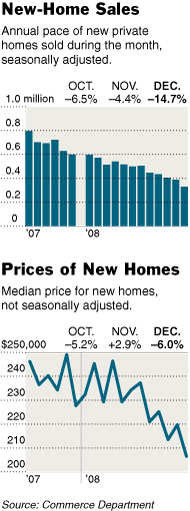
Thursday brought a hat trick of grim economic news: New-home sales fell to their slowest pace on record, businesses cut their orders and jobless claims continued to rise. Taken together, the three reports released by the government painted a picture of an economy that continued to slide as falling consumer spending and rising unemployment amplified the effects of a yearlong recession.

The Commerce Department reported that American businesses ordered fewer durable goods like computers, construction equipment and vehicles in December, cutting the prospects for growth as companies braced for a difficult 2009. Orders of durable goods fell 2.6 percent last month, to $176.8 billion. It was the fifth consecutive month of declines, after a 3.7 percent drop in November as the country slipped deeper into a recession now nearly 13 months old.

Excluding transportation, new orders of durable goods orders fell 3.6 percent. Excluding orders for military equipment, durable goods fell 4.9 percent. For all of 2008, orders fell 5.7 percent, a decline topped only by a 10.7 percent drop in 2001.

Here’s another shocker for those of you living in caves: Today’s GDP report is going to suck. But isn’t this already factored into equity prices?

Other than our pal Larry, is there anyone still waiting for Goldilocks to arrive?

>

Source:
Latest Reports Indicate Economy Is Getting Worse
JACK HEALY
NYT, January 29, 2009

http://www.nytimes.com/2009/01/30/business/economy/30econ.html

Defaults Rise in Neg Am Loans

Email this post Print this post
By Barry Ritholtz - January 30th, 2009, 6:09AM

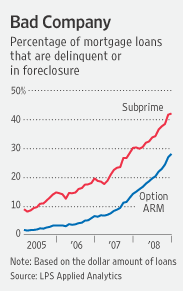
The Option Arm loan is causing trouble. The negative amortization loans, which typically see the amount of principal owed rise over the loan’s term, is seeing defaults rapidly rise.

There are ~$750 billion of option ARMs issued from 2004 to 2007;  ~$1.9 trillion of subprime and $ 2 trillion in jumbo mortgages were issued over the same period.

J.P. Morgan reported that more than 55% of borrowers with option ARMs are underwater, i.e., owe more than homes are worth.

Even worse, they are defaulting in increasingly large numbers:

As of December, 28% of option ARMs were delinquent or in foreclosure, according to LPS Applied Analytics, a data firm that analyzes mortgage performance. That compares with 23% in September. An additional 7% involve properties that have already been taken back by the lenders. By comparison, 6% of prime loans have problems. Problems with subprime are still the worst. Just over half of subprime loans were delinquent, in foreclosure, or related to bank-owned properties as of December. . .

Nearly 61% of option ARMs originated in 2007 will eventually default, according to a recent analysis by Goldman Sachs, which assumed a further 10% decline in home prices. That compares with a 63% default rate for subprime loans originated in 2007. Goldman estimates more than half of all option ARMs outstanding will default.

Go figure. Giving mortgages to people who can’t afford them — even with “affordability products” like NegAm loans — worked out poorly. Who ever could have seen THAT coming . . .

>

Source:
Option ARMs See Rising Defaults
RUTH SIMON
WSJ, JANUARY 30, 2009

http://online.wsj.com/article/SB123327627377631359.html

Is Asset Price Targeting the Solution?

Email this post Print this post
By Jack McHugh - January 29th, 2009, 11:11PM

Good Evening: After Wall Street’s recent winning streak, I guess it shouldn’t be too surprising that stocks took a tumble less than 24 hours after I had warmed to them. Whether it was earnings, economic data, or persuasive attacks on the “bad bank” concept, the news flow was pretty poor. There are plenty of people around with suggestions of what NOT to do in trying to solve the financial crisis, so it will be interesting to see what course of action the Obama administration finally settles upon. PIMCO’s Bill Gross has a thought or two to share on the subject in his latest, “Investment Outlook”, but first let’s review what happened today.

U.S. stock index futures were under pressure starting last night on earnings concerns, and those worries only intensified this morning. Allstate, Dry Ships, Illinois Tool Works, Qualcomm, Starbucks, and Textron all reported disappointing news of varying degrees. Dry Ships, just to pick one company, has been on a tear since the November lows, quintupling from just over 3 to more than 16 earlier this month. DRYS announced this morning that it had breached a debt covenant and now needs to issue $500mm in new stock. The company’s shares sank 30% today. The economic releases weren’t bullish, either, as jobless claims, durable goods orders, and new home sales were all very weak. New home sales for December fell so far that they easily set an all time record (see below).

Given the above, the stock market could have been forgiven had it dropped even more than it did at the open, but the resulting 1% to 2% declines posted by the major averages elicited few smiles. The indexes then tried to bounce, but a decent undertow soon developed that never really did relinquish its grip on the markets. Meredith Whitney, Oppenheimer’s ace bank analyst, opined that the “bad bank” concept would do little to restore bank lending (see below). Then George Soros sent his regards from Davos with much the same message (see below). Even the usual port for any equity storm — Treasurys — keeled over when a 5 year note auction went poorly. I doubt the following analysis from Citigroup helped bond prices much, either. The Citi team could have been reading from one of Jim Grant’s recent speeches when they said:

“This may sound a bit ridiculous, but we think we have begun a full-blown bear market in fixed income,” wrote Tom Fitzpatrick, Citigroup’s New York-based chief technical analyst, and London-based strategist Shyam Devani. “The commodity that is going to be the most in demand as far as the eye can see is capital. As a consequence, the cost of capital can only go one way — up.” (source: Bloomberg article below).

Stocks never did spend much time wearing the rally caps I spoke about yesterday and the averages closed right near their lows for the session. Holding up the best was the Dow (-2.7%), while the Russell 2000 (-4.2%) took on the most water. Treasury yields rose smartly, with the long end taking most of the punishment due to curve steepening trades. Yields were 5 bps to 18 bps higher, and if they keep heading northward they will become a complicating factor down the road. The dollar enjoyed a nice, 1% rally, but the strength in the greenback didn’t have a large impact on commodities. The CRB index was off a mere 0.4%, and it was interesting to watch gold head higher along with the dollar. It’s way too early to call this a trend, but if they continue to rally together, it may be a sign that investors are starting to view both of them as a flight to quality play.

With so many people taking turns to pummel the concept of setting up a “bad bank” to remove toxic assets from bank balance sheets, I thought it might be interesting to consider another possible solution, one that’s fresh off the desk of Bill Gross, head honcho at PIMCO (see below). Like many of us, Mr. Gross thinks the government’s efforts to date have been “attempted in numerous, seemingly uncoordinated ways”. Mr. Gross believes the focus should be squarely on supporting asset prices, whether via the TARP, a “bad bank” plan, or some other mechanism. Supporting the banking system alone is not sufficient, in his view, since the broken machine once known as securitization is at the core of the financial mess we’re now in.

Mr. Gross acknowledges that we “can’t bail out everyone”, but he advises policy makers that the focus going forward has to be on sectors orphaned by the lack of securitization (in his words, “the shadow banking system”). If we ignore for a moment that PIMCO has a limited advisory role with Treasury, Mr. Gross’s choices for governmental asset purchases are commercial mortgage-backed securities, credit card receivables, and municipal bonds. I’m not sure whether his plan is better than any of the others, and I’m very sure I don’t know more than Mr. Gross does about fixed income and how best to navigate that market for clients. But I do know that asset price targeting makes me uneasy. After all, didn’t the Maestro, through his frequent picking of generously low interest rates, target first the stock market and then the residential real estate market back in the day? An impartial observer would tell me to get over my queasiness and admit that almost every “solution” on offer represents a form of asset price targeting. Mr. Gross might be right, and we need all the good ideas we can find these days, but I still can’t shake the notion that targeting certain asset markets helped land us in this mess in the first place. Jack McHugh

U.S. Economy: Sales of New Homes, Durable Goods Orders Tumble

Treasuries Headed for Full-Blown Bear Market, Citigroup Says

‘Bad Bank’ Will Not Boost Lending, Whitney Says

Soros Says Bad-Bank Plan Won’t Help Increase Lending

BEEP BEEP — Investment Outlook, February 2009, by Bill Gross

The Chinese Marshall Plan

Email this post Print this post
By Marion Maneker - January 29th, 2009, 10:56PM

It was always obvious late last Summer that Hank Paulson’s decision to fully backstop Fannie Mae and Freddie Mac was driven by bullying from China. Today’s Wall Street Journal just puts a bow on it by giving us the tick-tock on the hand wringing in Beijing:

The alarm for Chinese leaders started ringing loudly in July and August as problems deepened at Fannie and Freddie. Senior Chinese leaders, who hadn’t been apprised in detail of how China’s reserves were being invested, learned for the first time in published reports that the country’s exposure to debt from those two alone totaled nearly $400 billion, say people familiar with the matter.

Fearing that the U.S. government might not fully back the companies, China demanded and received regular briefings throughout the peak of the crisis from high-level Treasury Department officials, including Mr. Paulson, on the market for U.S. debt securities — especially those of the mortgage giants. [ . . . ]

While Mr. Paulson was in Beijing for the Olympics in August, he dined with Mr. Zhou, the central bank chief, at the Whampoa Club, an upscale restaurant that serves modern Chinese cuisine in a traditional courtyard building near the city’s Financial Street.

On Sept. 7, Mr. Paulson announced that the U.S. government would seize Fannie and Freddie, but Chinese officials remained concerned.

What’s interesting to see in this story, especially the top where the Chinese leaders give American institutions a well-deserved tongue lashing, is the way the Chinese fail to see that they’ve already had the benefit of their investment in American mortgage-backed securities. In fact, the recycling of Chinese profits into American mortgage debt is beginning to look like a 21st Century Marshall plan gone awry.

By investing in the US, the Chinese primed a consumption pump that created demand for their goods. That demand absorbed the huge number of workers coming to the cities over the last decade and accelerated China’s growth. In other words, the Chinese encouraged and enabled the irresponsibility of American households because it created demand for their goods.

After World War 2, the US faced a crisis of productive over-capacity. The solution was to send a lot of money to Europe that would then be used to buy American goods. In the case of the original Marshall plan, the sorry state of post-war Europe gave the plan a humanitarian glint. But that shouldn’t mask the real value of the Marshall plan or its intent.

Flash forward fifty years and you have China eager to raise the standard of living at home. Only this time, North Americans are tapped out, not because of a devastating war but because of devasting dotcom bubble bursting. There’s no way to dress this one up as the good guys coming to the aid of their fallen cousins.

That’s a shame. I don’t know what the final accounting was on the Marshall plan loans. I’d be curious to know. But in reading these stories, I’m beginning to think the Chinese are being a little disingenuous when they keep demanding that their investment in US securities be safeguarded.

Source:

Chinese Premier Blames Recession on US Actions
By JASON DEAN in Beijing, JAMES T. AREDDY in Shanghai and SERENA NG in New York
Wall Street Journal; January 29, 2009

http://online.wsj.com/article/SB123318934318826787.html

Good Bank, Bad Bank by Dr. Seuss

Email this post Print this post
By Guest Author - January 29th, 2009, 4:30PM

For more than a decade, Joshua Brown has been managing money for high net worth clients, charitable foundations, corporations and retirement plans. Beginning his career at Lew Lieberbaum in 1997, Mr. Brown was named National Sales Manager in 2005. He is the New York City Branch Office Manager at Westrock Advisors. In addition to his career and responsibilities on Wall Street, Joshua Brown enjoys spending time with his wife and young daughter. He is the co-founder of an internet advertising business, an avid reader, the mind behind the Reformed Broker, and a single malt scotch aficionado. He is also a long-suffering New York Knicks fan…the single malt scotch helps!

~~~

Good Bank, Bad Bank by Dr. Seuss

Good Bank   Bad Bank

wells-fargo-good-bank wamu-bad-bank

Wood Bank Fad Bank

wood-bank fad-bank

Red Bank Blue Bank

red-bank blue-bank

Old Bank New Bank

old-bank new-bank

This one has This one has

a great big scar a fancy car

bank-scar fancy-car-bank1

Say! What a lot

of banks there are.

Some are sad.

sad-bank1

And some are glad.

jpm-glad

And some are very, very bad.

not-citibank

Why are they

sad and glad and bad?

I do not know.

Go ask your dad.

paulson

Some are hot.

hot-hudson-city

And some are not.

state_street_logo

The big one has

a parking lot.

parking-lot1

From there to here,

and here to there,

funny banks

are everywhere.

Thank you, Dr. Seuss!

Full Disclosure: I am currently long WFC in client accounts

Media Appearance: CNBC’s Fast Money (1/29/09)

Email this post Print this post
By Barry Ritholtz - January 29th, 2009, 3:45PM

Fast_money

>

Tonite I will be on Fast Money with Dylan Ratigan on CNBC at 5:30pm discussing with the crew on the problems with the Bad Bank idea.

My suggestions:

1. Stop interfering with the Markets! Nationalizing banks isn’t market interference, keeping these mortally wounded banks alive is! Stop pussyfooting around and admit the truth. The market knows it, investors know it.

Let the FDIC do its job. That is:

2. Temporarily Nationalize the Banks We know they are insolvent, and cannot survive without taxpayer money. Spending a 150% of their market cap for an 8% share is absurd.

Wipe out the debt, liquidate bad common holders, fire the Board and management, appoint new competent, risk sensitive management. They have 6 months to spin out a 10% stake in each of  their holdings, followed by the rest within 5 years (10 at most);

3. Taxpayer owned: Once nationalized, that 10% spin out of the components parts would be in the form of prefered to taxpayers! For BAC, you would spin out Bank of America,  Merrill Lynch, Countrywide, plus the “B/A Toxic Holdings I & II” For Citi, it would be Travelers, Citi, Smith Barney, Citi Toxic 1 & 2, etc.

4.  Now Recapitalize: With the toxic waste off of the books, you can easily recapitalize the banks. Give the old creditors a “sweetheart” deal — they get a 10% stake also, but only if they buy a matching amount in the new bank.

5. Align Compensation with Long Term Profitability: Stop rewarding traders for short term gains despite long term losses. Stop paying taxpayer monies out as dividends. Bonuses must be a function of the long term health of the company — not monthly violatility.

>

~~~

UPDATE Here is the Video:

click for video

~~~

embedded video

Earnings roundup

Email this post Print this post
By Barry Ritholtz - January 29th, 2009, 2:15PM

Qualcomm missed (31c vs. 47c-expected)
Allstate missed (97c vs. 135c-expected) a
Starbucks missed (15c vs. 17c-expected)
Lam Research missed (loss of -9c vs. loss of -5c-expected);
Ryland Group missed (loss of -140c vs. loss of -123c-expected)
Owens-Illinois beat (45c vs. 39c-expected)
Boston Scientific met expectations (13c)
USG missed (-132c vs. -49c-expected)
Boston Properties beat (138c vs. 135c-expected)
Continental Airlines beat (loss of -84c vs. loss of -86c-expected)
Eli Lilly beat (107c vs. 105c-expected)
Eastman Kodak missed (loss of -8c vs. 18c-expected)
AutoNation met (12c)
Ford missed (loss of -137c vs. loss of -124c-expected)
Colgate-Palmolive beat (100c vs. 98c-expected)
Black & Decker beat (97c vs. 69c-expected)
3M beat (97c vs. 93c-expected)
Occidental Petroleum beat (118c vs. 95c-expected)
Illinois Tool Works beat (54c vs. 48c-expected)
Royal Caribbean missed (1c vs. 7c-expected)

via Bloomberg

A “Principles” and “Principals” Meeting on “Bad Bank”

Email this post Print this post
By Guest Author - January 29th, 2009, 1:15PM
Joshua Rosner is Managing Director at independent research consultancy Graham Fisher & Co and advises regulators and institutional investors on housing and mortgage finance issues. Previously he was the Managing Director of financial services research for Medley Global Advisors. In early 2003 Mr. Rosner was among the first analysts to identify operational and accounting problems at the Government Sponsored Enterprises, in the third quarter of 2005 Mr. Rosner identified the peak in the housing market, In October of 2006 Mr. Rosner highlighted the likely contagion from structured securities and credit markets into the real economy.

~~~

Sources tell me that at 4:30 yesterday afternoon there was a meeting between Geithner,
Bair, Dugan and Bernanke. When the Chairman of a supposedly independent Central Bank is a direct participant in a meeting of political appointees we should all worry.

Rather than risk becoming a third voice in the room potentially supporting shareholder member banks of the Federal Reserve Bank of NY at the expense of prudential regulatory oversight, he should be consulted and asked his views on the policy implications to the Fed only after an initial policy consensus has been reached on oversight or policy matters. This problem again highlights the troubles of a central bank with regulatory supervision over banks.

In his last position, Tim Geithner was not hired by or paid by the Government, but rather by the Board of the shareholder owned and private corporation that is the New York Fed. Even now, Geithner has chosen a former lobbyist for one of those same banks that he used to report to as his Chief of Staff. Is this the sort of integrity that President Obama spoke of last week in his lobbying rules? It seems appropriate to consider whether the inherent conflicts of interest he brings to the table should require him to recuse himself from involvement in the discussions or decisions of the regulatory approach. Perhaps, as Treasury Secretary, he should only be involved in decisions about the funding and
management of the program after regulators devise a plan.

“Emergency measures” and an inept Congress now regularly justify regulators ignorance or interference in Congressional intent in favor of arbitrary interventions and political decisions that disadvantage the vast majority of solvent, plain vanilla and small banks. After all, it is predominantly the Fed and OCC institutions that are central to the crisis. Their efforts to circumvent the regulatory intent of risk weightings and leverage ratios through a regulatory arbitrage of structured mortgage exposures have caused the system to seize and the costs required to counter the leverage to be so extreme. The failure of oversight by those same primary regulators who now are attempting to protect the worst of their regulated institutions is a dangerous precedent and calls for Congressional
intervention.

Congress and the press should consider whether the fact that the Treasury, the Fed and OCC are determining how to resolve failing institutions constitutes regulatory overreaching. Congress intended that the Federal Deposit Insurance Corporation be the final arbiter of decisions to resolve troubled institutions and directed the FDIC to determine the “least costly” manner in which to do so. Congress, in its wisdom, left these powers to the FDIC precisely to diminish the risk of political interference by conflicted parties (including captured regulators) from impacting the safety and soundness of prudential oversight.

Where the rubber meet the road and the car hits the tree:

It has been suggested that part of yesterday afternoon’s discussion was apparently the potential budgetary implications of an aggregator bank approach relative to the insurance wrap approach. Those in favor of the wrap approach suggest that Treasury dollars are more easily leveraged in the wrap approach. I would suggest that if any approach does not resolve the crisis in an efficient and effective manner it isn’t worth spending any dollars on. I would further argue that if the “bad bank” began, not by buying all troubled assets but instead only troubled assets of troubled banks, the initial implications to the Treasury would be significantly diminished. The vast majority of state chartered banks and community banks are able to handle their currently troubled assets. It is primarily a small number of large institutions overseen by federal regulators that are most troubled. This means immediate focus should be on these banks that are troubled and cannot handle their exposures.

The manner in which the “bad bank” manages or disposes of these troubled assets could provide further leverage to the Treasury by packaging them and selling them as new Government securities. Moreover, the wrap approach leaves bad assets on bank balance sheets and thus provides the banks with the opportunity to own the upside on the recovery of assets that the taxpayer has provided the risk insurance for. A “bad bank” approach could be created with a rational back-end structure to issue securities structured so that the selling bank and taxpayers could share in any recovery on those assets and the selling bank could, in the future, be penalized for any losses not calculated in the original purchase price.

We understand that the discussion of “bad bank” versus “insurance wrap” has devolved from an all or none into an even more absurd “cut the baby in half” discussion. Sources tell us that the Federal Reserve is proposing that AFS (available for sale) assets and trading assets be sold to the bad bank while they propose that “accrual” or HTM (Held to Maturity) assets be wrapped. This approach is has the fingerprints of the NY banks all over it. Over the past several quarters these banks have moved massive amounts of troubled assets from AFS to HTM in an effort to avoid having to mark them to market, avoiding the sale of these securities to the “bad bank” would be a clear attempt to avoid a sale event and the required marking the assets. By way of background – when the GSEs were moving assets from AFS to HTM many of these same banks were screaming to the Fed and Treasury that this was inappropriate and that it shouldn’t be allowed. As important, almost all of the whole loan exposures of the banks are in the HTM accounts and those loan exposures promise to be the most rapidly deteriorating assets and the largest future losses of those institutions, circling them is not a resolution it is a delaying of the day of reckoning.

Various sources suggest that the Treasury and the Fed want banks to issue common equity to government in exchange for any capital infusion. This too appears a backdoor approach to tie the hands of a regulator created by Congress to resolve failing institutions. How could the FDIC ever be allowed to act as a prudent regulator and resolve a failed institution in the most appropriate manner, or the manner least costly to the insurance fund, if doing so would cause them to wipe out the equity stakes in banks that are owned by the taxpayer. A more traditional and appropriate approach to resolution would be for the Government, with the discretion and secrecy with which the FDIC resolves institutions, to take bad assets from those large banks rate a CAMELS 4 or 5, infuse capital in that bank and take senior preferred in return. The next morning the preferred holders of the institution would awake to find that they were equity holders and equity holders would find that they were penalized for speculating in the shares of and supporting risky behaviors of poorly managed institutions. If the bank was still in need of capital it would, as an entity with a clean balance sheet, be able to find new buyers of its common shares. Such is the rational nature of economic Darwinism.

I believe that one area that all the regulators agree on is the one that the market seemed to
misunderstand most yesterday. Whether or not the banks have to sell all their bad exposures and therefore “lift the kimono” or whether they have to sell some and get to continue to hide most on their balance sheet, the reality is that nobody is arguing anymore that the government should ‘overpay’ for the assets. Rather, there is an understanding that their needs to be a pricing mechanism that is consistent, replicable, reasonable and independent of either the sellers or third parties that may be chosen to manage the assets. As a result I do expect that there are likely to be very large write-down on bad assets sold to the “bad bank”. Part of the argument, and it seems reasonable, is that distressed buyer’s bids are determined to include an implicit hurdle rate of return and, since the
government is looking to neither make nor lose money in their purchases the price should consider that reality.

If change has really come to Washington then why is it that we continue to seek to protect the interests of precisely those banks that caused the mess at the expense of those banks that have been better managed? Why is punishing the shareholders that approved and funded the bad business decisions of those poorly run institutions as the expense of shareholders that sought to differentiate good businesses from bad ones? Shouldn’t the government recognize that it really is a time for change? With the recently changed deposit insurance limits and qualified financial contract rules, even if there are banks that are too large to wipe out counter-parties, secured debt-holders and depositors of there are no longer banks that are too big to wipe out the equity of. Perhaps that is the capitulation that, along with cleaned balance sheets, would truly mark the bottom of this financial
crisis.

>

The Weekly Spew January 2009

1- This report is not directed to, or intended for distribution to or use by, any person or entity who is a citizen or resident of or located in any locality, state, country or other jurisdiction where such distribution, publication, availability or use would be contrary to law or regulation or which would subject Graham Fisher or its subsidiaries or affiliated to any registration or licensing requirement within such jurisdiction. All material presented within this report, unless specifically indicated otherwise, is under copyright to Graham Fisher & Co. (GF&Co). None of the material, or its content, nor any copy of it, may be altered in any way, transmitted to, or distributed to any other party, without the prior express written permission of Graham Fisher & Co. (GF&Co).

2- The information, tools and material presented in this report are provided to you for information purposes only and are not to be used or considered as an offer or the solicitation of an offer to sell or buy or subscribe for securities or financial instruments. GF&Co. has not taken any steps to ensure that the securities referred to in this report are suitable for any particular investor. The contents of this report are not intended to be used as investment advice.

3- Information and opinions presented in this report have been obtained or derived from sources believed by GF&Co to be reliable, but GF&Co makes no representation as to their accuracy or completeness and GF&Co accepts no liability for loss arising from the use of the material presented in this report where permitted by law and/or regulation. This report is not to be relied upon in substitution for the exercise of independent judgment.

GF&Co may have issued other reports that are inconsistent with, and reach different conclusions from, the information presented in this report. Those reports reflect different assumptions, views and analytical methods of the analysts who prepared them.

Past performance should not be taken as an indication or guarantee of future performance, and no representation or warranty, express or implied is made regarding future performance. Information, opinions and estimates contained in this report reflect a judgment at its original date of publication by GF&Co and are subject to change.

The value and income of any of the securities or financial instruments mentioned in this report can fall as well as rise, and is subject to exchange rate fluctuations that may have a positive or adverse effect on the price or income of such securities or financial instruments. Investors in securities such as ADRs, the values of which are influenced by currency fluctuation, effectively assume this risk.

~~~

Josh Rosner’s work on the Government Sponsored Housing Enterprises, Credit Rating Agencies and mortgage markets resulted in invitations to present to the Senate Banking Committee, Forecasters Club of New York, Professional Risk Managers International Association, ABSummit Geneva, The National Association of Business Economists, National Association of Business Economists Financial Roundtable, the American Enterprise Institute, the American Real Estate and Urban Economics Association, the Global Fixed Income Institute, CFA Institute, the Hudson Institute, The Chicago Fed Annual Bank Structure Conference and the Fixed Income Forum. He has also privately presented his research to leading policy makers, legislators and regulators. Mr. Rosner has co-authored papers on the risks of Collateralized Debt Obligations to the mortgage finance market and the risk of mis-application of ratings in the structured finance market. Earlier, Mr. Rosner was an Executive Vice President at CIBC World Markets and a Senior Vice President at its predecessor firm, Oppenheimer and Company.

Monitoring the Housing Market

Email this post Print this post
By Barry Ritholtz - January 29th, 2009, 12:15PM

Delores Conway, real estate economist at the University of Southern California, talks about the state of the housing market with MarketWatch’s Stacey Delo. (Jan. 27)


(Jan. 27)

The Big Banks vs. America: A Roundtable with David Kotok and Josh Rosner

Email this post Print this post
By Chris Whalen - January 29th, 2009, 11:56AM

The Big Banks vs. America: A Roundtable with David Kotok and Josh Rosner
January 26, 2009

~~~

“Banking bailouts were sold to us as a “necessary evil” because we were told only our existing network of banks could irrigate the economy with cash and so rescue industry. Now we know they can’t do that because their legacy absorbs all the resources, it would appear more sensible to let the old banks fail and start a new generation of banks. After all, the best credit risk is the institution that has no debt. So you could say the error wasn’t to let Lehman collapse, but not to have allowed all the banks to collapse in order to have a fresh start. And right now the job market has plenty of bankers available to set up and run new institutions. With just a quarter of the $800 billion or so already splashed about you could start a whole new Wall St. It’s not a matter of saying “no more banking system” but “no more fatally compromised old banking system burdened with structural insolvency.” (Ban)king is dead. long live (ban)king.”

A reader of The IRA

The term “bad bank” is being tossed around Washington dinner tables this week, a sign that the situation facing the largest banks is reaching a boiling point. It is amazing to us to see how little people understand the choices facing us with the big banks, how narrow those choices truly are and how the numbers in terms of losses are so BIG that they will ultimately force us to do the right thing. A couple of points:

First, IRA’s estimate for accumulated bank charge offs for 2009 is in the neighborhood of $1 trillion vs. $1.5 trillion in Tier 1 Risk Based Capital at all US banks today. Good news, though, is that 2/3 to 3/4 of that loss number comes from the top 4 – Citigroup (NYSE:C), Bank of America (NYES:BAC), JPMorganChase (NYSE:JPM) and Wells Fargo (NYSE:WFC), in that order of risk profile.

Since most of the toxicity in the banking system is concentrated among the larger banks, with perhaps US Bacorp (NYSE:USB) on down viable in the long run, perhaps we can rebuild the industry using the next round of TARP funds to bulk up these relatively smaller banks and thereby end up with 10-15 larger super regionals in the $300-$500 billion asset range. There may even be banks of this size still doing business under the current names of C, JPM, BAC, etc, but these new banks will have new owners and creditors.

Second, the Good Bank/Bad Bank debate is really a political battle between the large banks listed above plus Goldman Sachs (NYSE:GS) and Morgan Stanley (NYSE:MS) et al among the Sell Side survivors in NYC vs. the rest of the industry and the US economy. In preparing their plans for review by the White House, we hear that the Fed and OCC are supporting further bailouts for the larger banks, while the rest of the industry is being resolved and recapitalized a la Washington Mutual and Lehman Brothers.

Perhaps we ought to feed the “good bank” parts of the “too big to fail” crowd, a crowd prone to leverage and bad risk management, to the smaller and plain vanilla bankers that comprise the nominal majority of the industry. This would solve many things including reducing the lobbying power that Wall Street has in Washington. Come to think of it, President Obama should think about banning lobbying by any company participating in the TARP.

Remember that the entire banking industry stands in front of the taxpayers in terms of loss absorption at the FDIC, so you can understand why the smaller banks in the industry are SERIOUSLY PISSED OFF at the large banks and their minions in the Obama Administration like Tim Geithner and Robert Rubin. Oh, and don’t forget Chairman Ben Bernanke and the entire Fed board of governors. These leading officials are increasingly talking the side of the large banks in the battle over limited financial resources, a fact that is causing the community bankers to rise in anger. Stay tuned.

Read the rest of this entry »

50 queries. 1.167 seconds.