
S&P Regression to Trend
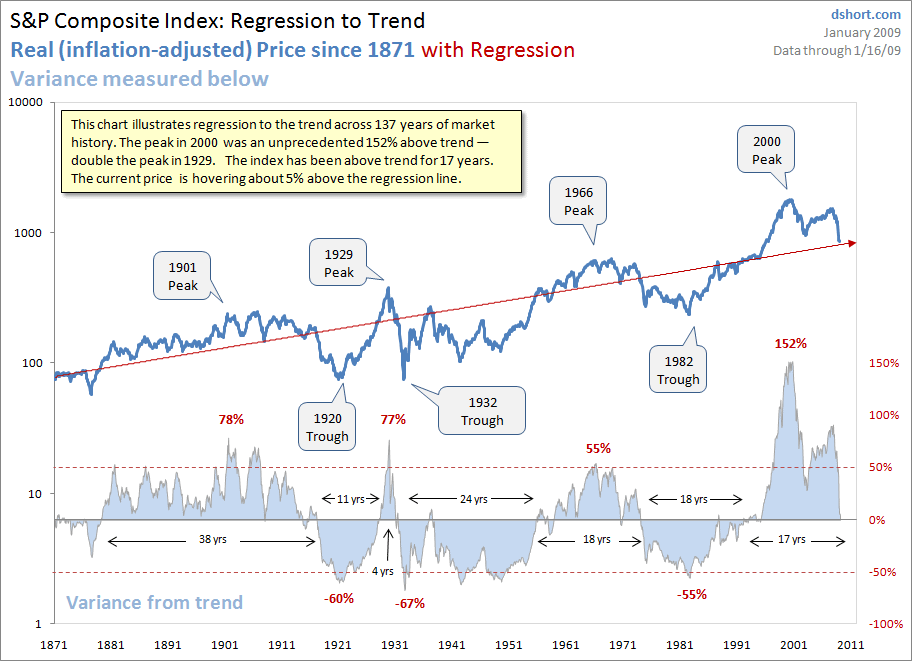
Yesterday, we discussed an ongoing Marketwatch chart on historical trend regressions (Is the Market Bottom in Sight (Again?)).
Peter Brimelow and Edwin S. Rubenstein have argued that markets bottom when they fall to 40-42% below trend.
Doug Short disagrees. As he shows in the chart below, markets have dropped as much as 67% below trend, with bottoms at levels of more than 50% below trend.
>


Tweet
Facebook
Reddit
Digg this!


January 20th, 2009 at 11:39 am
Wow, look at that…the trend line changed. Funny what adding another 100 years to the chart will do. I like this chart a lot more than the last one. Though it’s INCREDIBLY depressing…stocks have gone up by a factor of 10 in 140 years!! That’s somewhere between 2-2.5% before dividends.
January 20th, 2009 at 11:54 am
Unfortunately, I think this is the right take on the issue. The longer the data set the better imo.
January 20th, 2009 at 12:00 pm
fitting that the person that thinks it is should be lower has the last name of short. that’s good stuff.
January 20th, 2009 at 12:21 pm
Perhaps I should rethink my S&P 500 holding at 740 thesis. Scary chart indeed!
January 20th, 2009 at 12:22 pm
Look at the bright side. This secular bear market (inflation adjusted) probably won’t last beyond the year 2017.
January 20th, 2009 at 12:23 pm
Looks like we aren’t even below trend yet. 40% to go down from here… or more?
January 20th, 2009 at 12:26 pm
OT, sorta, from Bloomberg:
“Citigroup’s “core problem is that it simply doesn’t make money in any of its businesses except Smith Barney, which it is in the process of selling,” Oppenheimer & Co. analyst Meredith Whitney said in a Jan. 19 note to investors. ”
Sound like Citigroup’s core problem of not making money might be the same as the broader market has suffered for long stretches in the past.
I love Meredith Whitney. The core problem? Not making money. You could not have a more succinct analysis than that.
January 20th, 2009 at 12:31 pm
The Fed has to be entering the bull pen at least by this time I would figure.
January 20th, 2009 at 12:35 pm
Probably much more realistic, but we are still counting on the Chinese economy to recover and help us out…..er, wait, maybe not so much..
http://www.bloomberg.com/apps/news?pid=20601080&sid=aEfualBs_OUM&refer=asia
China Faces Worst Unemployment in Decades as Slowdown Deepens
Well, er….at least they’ll be buying those treasuries…er, wait, …..
I think we’ll just chart wherever the figures happen to fall…our crystal ball seems to be on the fritz…
January 20th, 2009 at 12:36 pm
John Borchers – what inning is it? is he a lefty to protect first or a power right-hander to get us out of this mess?
January 20th, 2009 at 12:51 pm
As soon as I saw yesterday’s chart I said “curve fitting”. Another attempt by the con artists to sell poor suckers “buy and hold”.
The market is the world’s largest Ponzi. In order for my $30 stock to go up, someone has to come to the table with $31. And more at the next level. And on and on. Until the well runs dry. Gamble on it and good luck. But don’t fall for the salesmen who make it out to be ownership, or a share of profits. Real investors who have enough ownership to be recognized by management get a dividend that is more than a token.
January 20th, 2009 at 12:52 pm
JB @ 12:31
What’s up with AAPL and the PPT…?
January 20th, 2009 at 1:11 pm
Hey people!
You need to think about your assumptions! The US is not the only market where there has been a trading history.
See my full comment at http://humblestudentofthemarkets.blogspot.com/2008/10/what-actually-happens-in-long-run.html
January 20th, 2009 at 1:13 pm
I’m short stocks, and happy to see the market decline. But I was sort of expecting Obama to rally the market today. Maybe he’s losing his touch (already).
January 20th, 2009 at 1:20 pm
There is an illusion of knowledge here. Just because it has happened that way in the past does not mean it will happen that way in the future over any useful time frame. You can get as much tradeable information from studying sunspot patterns or 100 years of Bulgarian wheat prices.
January 20th, 2009 at 1:26 pm
I wonder how many commenters in this thread read the linked article. The inflation adjustments in the chart above are based on CPI. The article contains another chart in which the inflation adjustments are based on alternative CPI measures often favored by commenters on this site… and that chart is decidedly more optimistic. So the commenters here seem to like alternative CPI data when it supports their biases and discard it when it does not?
January 20th, 2009 at 1:31 pm
@ DL:
I didn’t sell last Friday for the very reason that the conventional wisdom was that the markets would rally for a couple of days due to the change in administration. Oops.
____________
I think it is also worth noting that the chart seems to indicate that the last decade or so has been farther above the trendline that previous bull markets. Does that mean we will have a larger than average correction?
January 20th, 2009 at 1:45 pm
but they said ‘buy’ when
- there is blood in the streets
- everyone is bearish
- everyone is pessimistic
anyways i turned bullish today :)
January 20th, 2009 at 1:47 pm
I’m beginning to think that my DOW 7,000 and S&P 700 calls are too OPTIMISTIC. I hope not. I really do.
January 20th, 2009 at 2:21 pm
If you simply regress prices from the Great Depression to today, we are right at a 2 standard deviation event relative to historic prices. Perhaps this is a 3 standard deviation event, which makes sense in the context of a negative feedback loop combined with a ton of leverage that’s been built up in the “great moderation.” But over the “long-term,” prices are cheap today and one can make good returns with a buy and hold strategy at these prices if you are willing to ride out the current hurricane. Whether we are close to a true bottom or we are headed much lower in the coming year or two depends on if we can break this negative feedback loop that continues to tear through the economy and asset markets. Seems like the consensus right now is that we can’t.
January 20th, 2009 at 2:24 pm
@Ben: But for many smaller retail investors during a time of massive deleveraging (and job losses, lack of confidence, etc.), it will likely be more about whether or not they are ABLE to “ride out the current hurricane”, rather than being “willing to ride out current hurricane”.
January 20th, 2009 at 2:25 pm
Taking out the 817 low from last week on cash S&P500 NOT A GOOD development at all. We may very get some good bear market bounces, but the whole structure of the move down from the New Year highs is extremely ominous.
We will see 600-625 zone this year.
- AT
January 20th, 2009 at 2:32 pm
Kicking myself for selling FAZ way too soon. Oh well, still made money but I cut my profits far too short.
January 20th, 2009 at 2:34 pm
The S & P 500 started in 1957. I wonder if the composition of the artifically constructed index before the index actually existed is driving these differences. That would be a helpful follow-up analysis of these arguments.
January 20th, 2009 at 3:08 pm
And I found this article by Steve Barry:
http://www.guardian.co.uk/business/feedarticle/8288576
U.S. & UK on brink of debt disaster:
You can see he’s writing under the name John Kemp, but this obviously is a pseudonym…or maybe he’s just familiar with Steve’s debt/gdp numbers here in the BP…however he begins to sound a little less like Steveo toward the end of the article.
January 20th, 2009 at 3:12 pm
The regression trendline of the real S&P500 Index shown on the chart has a slope of 1.7 percent per year. The slope will get even flatter as this bear market continues to devastate stock prices.
Someone get Jeremy “Stocks for the Long Run” Siegel on the phone, pronto!
January 20th, 2009 at 3:15 pm
Mannwich, this (job losses, confidence broken, etc.) is all a part of the negative feedback loop or what George Soros calls a reflexive process. If it isn’t broken, it will continue to feed upon itself. I guess until we hit a clearing price that is so ridiculous that investors take a stand. Or government somehow breaks it.
January 20th, 2009 at 3:15 pm
I f we know ourselves well enough we will readily admit to submitting to our own confirmation bias and desire to act on heuristics. Calling a bottom or calling for Armageddon can be equally and intelligently argued with supportive historical data.
How many here would be willing to submit your one-year S&P price “prediction” and precisely the reasoning behind your prediction and have it published on TBP in January 2010? It would be quite entertaining if Barry would do this for “experimental” reasons…
I’m sure if a particular “prediction” were wrong, the investor would find ample evidence to justify their previous thoughts and continue confirming their own biases.
“Faced with the choice between changing one’s mind and proving there is no need to do so, almost everyone gets busy on the proof.” ~ John Kenneth Galbraith
January 20th, 2009 at 3:16 pm
the American consumer is tapped out- so the economy has nowhere to go but down- regardless of interest rates and regardless of “stimulus”. I saw the big run up when people were buying homes with nothing and now are getting out with nothing- really, why contunue to pay on an investment that did not pan out and that you leveraged 100% to purchase. After the dot com fiasco it was readily heard on finacial news shows that the best investment was housing- so that is where the sheep went next. Why work when you can make it big in the market. Just buy and flip- it could not be easier to make the big $. Except when you are the last one out. What I have always learned is that when you are getting advice from Joe Schmo how to make it big- when people with no understanding of what they are doing are telling you how to make the big dough- when everyone is buying tech stocks becauses it is a sure thing and when everyone is buying houses because the values will continue to rise- that is when you know the market is oversold and you need to cash in your chips. The economy will contract because people had no money before the housing boom (outside of housing appreciation and the accompanying home equity line) and they especially have no money now. With no reserve to fall back on all a person can do is shrink their needs and wants. You can expand credit all you like (if banks have $ to lend) but you can’t make a prudent person take out a loan. And for those who are the most reckless in our society and who would take any bank loans offered- they are the same ones who are currently unable to get a loan due to foreclosures, mortgage lates, revolving credit lates and no cash reserves.
January 20th, 2009 at 3:26 pm
Looks like in the end fundamentals do matter to the market. Reality is not a pleasant thing right now but it must be confronted and dealt with wisely. No more can-kicking down the road because the we’re the end of that road.
January 20th, 2009 at 3:57 pm
Slap a PE of 12 on that $42 of S&P 500 2009 earnings and see what that gets ya!
January 20th, 2009 at 3:57 pm
Holy financial sector meltdown… everything I see is down 20-40%
January 20th, 2009 at 3:59 pm
Wow, welcome to the White House, O. Think Bush is a very relieved man today?
January 20th, 2009 at 4:00 pm
Ben Says: January 20th, 2009 at 3:15 pm
“Mannwich, this (job losses, confidence broken, etc.) is all a part of the negative feedback loop or what George Soros calls a reflexive process. If it isn’t broken, it will continue to feed upon itself. I guess until we hit a clearing price that is so ridiculous that investors take a stand. Or government somehow breaks it.”
The Key statement is “we hit a clearing price that is so ridiculous that investors take a stand.”
EXACTAMUNDO.
There are trillions of bucks out there waiting to buy shit….but they won’t BUY ANYTHING until they know the Gummint is out of the way and will not change the rules of them. Notice that the only major asset sale done was a few weeks ago in Vegas when Kerkorian got taken out of Treasure Island for some cash. No U.S. government interfering in the gaming industry…
Also notice in California that when you whack home values by 40-50% during foreclosure….you get new buyers coming in and sales get done.
At the right price there’s ALWAYS a buyer.
January 20th, 2009 at 4:01 pm
You don’t need a chart to see that the markets needs a life support system, but putting that aside, can someone post good news about the US or world economy once in a while?
January 20th, 2009 at 4:12 pm
I need the Plunge Protection Team to come in tomorrow morning….
Can’t wait for the next Steve Liesman “Breaking News” tomorrow on the “New Plan” to save the day….
Get a little bounce to sell into.
- AT
January 20th, 2009 at 4:15 pm
WHAT HAPPENS IF THE TREND CHANGES???
January 20th, 2009 at 4:25 pm
Another tidbit on that chart which is interesting to me. I’ve done a lot of reading on 18 year cycles in Real Estate. So, it’s sort of interesting to observe the time spans of 18 and 17 years along with the 38 and 39 year time spans earlier this decade. Wonder if there is some sort of correlation there where the market, as a discounting mechanism, peaks in front of Real Estate Beaks and bottoms before Real Estate bottoms.
Every modern Depression began with a Real Estate bust of some kind.
January 20th, 2009 at 4:30 pm
SINGER @ 4.15pm
Um, if the Trend line changes then you have to assume we’re heading into some sort of modern “Dark Ages” where we see regression of mankind vs. man’s natural disposition towards “progress.”
Would be dark times indeed. Let’s hope we’re not there, yet. Although, if you study thousands of years of trends there are inevitable periods where humankind does regress for centuries after several centuries of progression.
January 20th, 2009 at 4:34 pm
Kent @ 3:15
You buyin’ or sellin”…?
January 20th, 2009 at 4:38 pm
«WHAT HAPPENS IF THE TREND CHANGES???»
The trend did change in 1995… If you look at the real trend, before a flood of credit allowed enormous amounts of buying on margin, the long term trend if much lower than the above one. The trend largely relates to P/E, while oscillations around trend largely relate to the E component.In 1995 P/Es shot up insanely, far more so than Es.
What is happening now is two distinct events: the trend itself is going back to historical norms (that means P/Es), and prices (and earnings) are reverting to (under) trend.
January 20th, 2009 at 4:49 pm
To correct someone standard deviation is only relevant to normalized data. “Your investment will compound 7% (or whatever) over 10 years plus or minus 100%” is worthless. The 90% confidence band on this data is pretty wide. The odds are significantly greater that you will be over 25% away from the trendline at any given point than you will be within 25%.
January 20th, 2009 at 4:50 pm
This is reminiscent of a point made in one Barry’s recommended books, Riding the Bear by Syd Harding. If I’m remembering correctly, although it was written in1999, it said something similar. I do remember that the book was worth a read.
Whereever I saw it, it made sense to me. My theory is that the last long cycle above the mean was the result of a natural cycle amplified by Easy Al’s policies.
I still think we could get a rally after the current shakeout gets down to or past the fall lows, people think there is a bottom in, and Obama’s measures restore some confidence. I also still think we will wind up much lower by the end.
January 20th, 2009 at 5:01 pm
@going broke:
Don’t you know we in the room are the “anti-CNBC”? Son, I can tell you 50 ways to lose money on investments, and I have tried them all…most of us have become realists because we’d learned how to lose money, now we are trying to do it the other way.
Seriously, we aren’t gloom and doomers. Even if we sound that way. BUT, we (at least I) have found that it is much more fun to hang on to what you’ve earned than to continually lose money on investments.
These rough times are where you go to economic school….you want some good news? OK, we are at least one year closer to the resolution of this thing than we were 12 months ago….
:)
January 20th, 2009 at 7:42 pm
How do we undo a debt/GDP-ratio buildup on par with 1929? Not without a similar drop, I’m afraid.
Please correct this statement if it’s wrong: As per a graph I’ve seen recently on the subject, every new dollar of debt introduced in recent years increases GDP with a multiplier of just about “1″. In other words, new debt no longer increases GDP. Therefore, if we print a $1000 bill and create an offsetting $1000 bond, the new bond will suck capital from elsewhere (raise interest rates). If we’ve indeed reached a limiting factor, then the only possible direction for debt/GDP ratio to go is “down”.
Since GDP itself appears to be decreasing, the only way to reduce the ratio is thru default! We CANNOT service our debts.
No? Yes?
I vote for technical default: print the $1000 bill without creating the $1000 bond. Can the Fed do this? Can Congress do this?
January 20th, 2009 at 7:48 pm
I’d prefer to stick with my “more recent” data than include periods before energy, medical, retail, banking (although I’d like to exclude this sector), automobile, airlines, telecommunications, technology, etc. It just doesn’t make sense to put all the data in the same series. One of the major differences is that my data started in 1939 (the beginning of S&P 500 data) while the 137 years worth of data since 1871 is from DJ-30 (or some other data prior to DJ). Based on my analysis, we’re at the bottom edge of the range. See http://www.stockchartist.blogspot.com
January 20th, 2009 at 8:07 pm
note that the trend is based on the official CPI, dshort.com also has a trendline with alternate CPI
is here:
http://dshort.com/charts/SP-Composite-regression-charts.html?SP-Composite-real-regression-to-trend-alt-cpi
January 21st, 2009 at 1:53 am
@ Bruce
I was trying to be sarcastic, :P
guess it didn’t come across that way
I too have been around the losing block a few times. Now, I mostly trade using some type of trend, but, get in late and seem to sell to early. Can’t make alot that way but the success rate is good.
January 21st, 2009 at 2:44 am
«How do we undo a debt/GDP-ratio buildup on par with 1929?»
Not only the debt GDP ratio is huge, and the marginal ratio is less than 1 (1 dollar of extra debt generates rather less than 1 dollar of GDP, or else debt would not have grown faster than GDP for the past 15 years), but there is a big difference between 1929 and today: today the USA economy is far more oil dependent, and it is one of the largest oil importers in the world, not an exporter. Whether or not peak oil worldwide has happened, peak oil USA happened in the 1970s, and that matters a great deal: in 1929-1971 the productivity enhancing effects of cheap domestic energy helped a great deal, today things are rather different.
January 21st, 2009 at 9:49 am
Look at 1907. Look at 1971. Any move below trend could easily be 5+ years away from now, with plenty of gains in the immediate future. You can see whatever you want to see in that chart.