Rick Santelli’s Planted Rant ?

Email this post Print this post
By Barry Ritholtz - February 28th, 2009, 5:47PM

I was interviewed by several journalists last week about Rick Santelli’s Rant — my exact quote was it had a “Faux” feel to it. (I haven’t seen it in print yet)

What was so odd about this was that Santelli is usually on the ball; we usually agree more often than we disagree. He’s been responsible for some of the best moments on Squawk Box.

But his rant somehow felt wrong. After we’ve pissed through over $7 trillion dollars in Federal bailouts to banks, brokers, automakers, insurers, etc., this was a pittance, the least offensive of all the vast sums of wasted money spent on “losers” to use Santelli’s phrase. It seemed like a whole lot of noise over “just” $75 billion, or 1% of the rest of the total ne’er-do-well bailout monies.

It turns out that there may be more to the story then originally met the eye, according to (yes, really) Playboy magazine.

Excerpt:

“How did a minor-league TV figure, whose contract with CNBC is due this summer, get so quickly launched into a nationwide rightwing blog sensation? Why were there so many sites and organizations online and live within minutes or hours after his rant, leading to a nationwide protest just a week after his rant?

What hasn’t been reported until now is evidence linking Santelli’s “tea party” rant with some very familiar names in the Republican rightwing machine, from PR operatives who specialize in imitation-grassroots PR campaigns (called “astroturfing”) to bigwig politicians and notorious billionaire funders. As veteran Russia reporters, both of us spent years watching the Kremlin use fake grassroots movements to influence and control the political landscape. To us, the uncanny speed and direction the movement took and the players involved in promoting it had a strangely forced quality to it. If it seemed scripted, that’s because it was.

What we discovered is that Santelli’s “rant” was not at all spontaneous as his alleged fans claim, but rather it was a carefully-planned trigger for the anti-Obama campaign. In PR terms, his February 19th call for a “Chicago Tea Party” was the launch event of a carefully organized and sophisticated PR campaign, one in which Santelli served as a frontman, using the CNBC airwaves for publicity, for the some of the craziest and sleaziest rightwing oligarch clans this country has ever produced. Namely, the Koch family, the multibilllionaire owners of the largest private corporation in America, and funders of scores of rightwing thinktanks and advocacy groups, from the Cato Institute and Reason Magazine to FreedomWorks. The scion of the Koch family, Fred Koch, was a co-founder of the notorious extremist-rightwing John Birch Society.”

What is Playboy’s evidence of this?

“Within hours of Santelli’s rant, a website called ChicagoTeaParty.com sprang to life. Essentially inactive until that day, it now featured a YouTube video of Santelli’s “tea party” rant and billed itself as the official home of the Chicago Tea Party. The domain was registered in August, 2008 by Zack Christenson, a dweeby Twitter Republican and producer for a popular Chicago rightwing radio host Milt Rosenberg—a familiar name to Obama campaign people. Last August, Rosenberg, who looks like Martin Short’s Irving Cohen character, caused an outcry when he interviewed Stanley Kurtz, the conservative writer who first “exposed” a personal link between Obama and former Weather Undergound leader Bill Ayers. As a result of Rosenberg’s radio interview, the Ayers story was given a major push through the Republican media echo chamber, culminating in Sarah Palin’s accusation that Obama was “palling around with terrorists.” That Rosenberg’s producer owns the “chicagoteaparty.com” site is already weird—but what’s even stranger is that he first bought the domain last August, right around the time of Rosenburg’s launch of the “Obama is a terrorist” campaign. It’s as if they held this “Chicago tea party” campaign in reserve, like a sleeper-site. Which is exactly what it was.

This looks like more than a coincidence. This is now a very serious charge.

I have no insight as to whether this is true or not — but it certainly deserves a serious response from both Santelli and CNBC.  If its false, then they should say so, and demand an apology from Playboy.

But if any of it is true, well then, Santelli may have to fall on his sword, and CNBC may owe the public an apology.

I am VERY curious if there is any truth to this.

>

UPDATE: March 1, 2009 5:43am

Wow, talk about link bait — that was a boatload of comments on a Saturday nite! Doesn’t anyone go out anymore? It must really be a recession . . .

UPDATE 2: March 1, 2009 7:45am

Steve at the Daily Bail writes:

I publish and write the Daily Bail.  I have posted a response to the allegations by Playboy magazine made against our site.  I am writing you personally so that you know their allegations about me are categorically untrue.  It’s unfortunate because I believe that the article did some great investigative work and then at the end they threw me under the bus for no apparent reason.  Apparently, the authors just assumed we were part of this conspiracy because of my own personal excitement about the prospect of a mid-summer tea party.  They never bothered to contact me for explanation or comment of any sort.

My response to their article is here.  Please read it so you know just how wrong they were about me and my politics.

>

Previously:
Santelli vs Cramer (January 2008)

http://www.ritholtz.com/blog/2008/01/santelli-vs-cramer/

Rick Santelli Strikes Again (September 2008)

http://www.ritholtz.com/blog/2008/09/rick-santelli-strikes-again/

Source:
Backstabber: Is Rick Santelli High On Koch?
Mark Ames and Yasha Levine
Playboy, 02.27.09 1:40 PM CST

http://www.playboy.com/blog/2009/02/backstabber.html

Read the rest of this entry »

Robert Johnson on PBS’ Bill Moyers Journal

Email this post Print this post
By Barry Ritholtz - February 28th, 2009, 4:15PM

Robert Johnson on PBS’ Bill Moyers Journal

part 1

10:11

part 2

7:40

February 28, 2009

Unsold Cars Around the World

Email this post Print this post
By Barry Ritholtz - February 28th, 2009, 2:08PM

This is circulating via email — pretty insane . . .

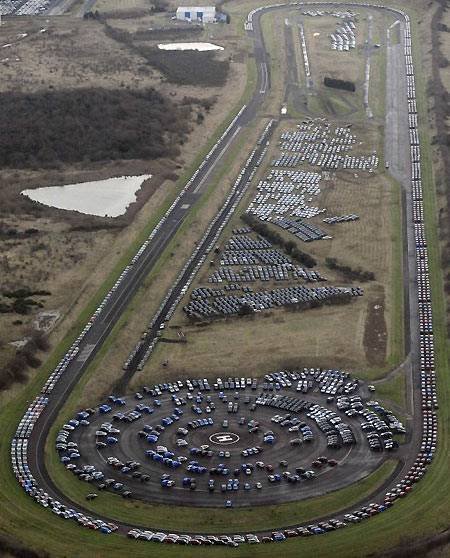
Nissan has  announced plans to cut its Sunderland  workforce by 1,200. Thousands of unsold cars are stored around the factory’s  test track


Honda is  halting production at its Swindon plant in  April and May, extending the two-month closure announced before Christmas to  four months. Honda and Japanese rival Toyota are  both cutting production in Japan  and elsewhere. Pictured, Hondas await export at a pier in Tokyo


Earlier  this week Jaguar Land Rover said 450 British jobs would go


The open  car storage areas in Corby , Northamptonshire,  are reaching full capacity


Imported  cars stored at Sheerness open storage area awaiting delivery to dealers


Newly  imported cars fill the 150-acre site at the Toyota  distribution centre in Long Beach  , California


The  build-up of imported cars at the port of Newark  , New Jersey


Stocks of  Ford trucks in Detroit , Michigan


New cars  jam the dockside in the port of Valencia in Spain


Peugeot  cars await shipment to Italian dealers at the port of Civitavecchia


Unsold cars  at Avonmouth Docks near Bristol


With many  manufacturers on extended Christmas shutdown, the number of cars rolling off  production lines in December fell 47.5% to just 53,823


Thousands  of new cars are stored on the runway at the disused Upper  Heyford airbase near Bicester, Oxfordshire, on December 18, 2008.


Sales of  new cars in the UK have  slumped to a 12-year-low and production of cars at Honda in Swindon has been  halted for a unprecedented four-month period because of the collapse in global  sales and represents the longest continuous halt in production at any UK car plant.  The announcement comes on a day when the EU’s Industry Commissioner Guenter  Verheugen warned the outlook for the European car industry was ‘brutal’ and  predicted not all European manufacturers would survive the crisis.

http://www.gettyimages.com/detail/84313837/getty-images-news

Posted via email from bigpicture’s posterous

Wall Street Meltdown – Redux

Email this post Print this post
By Guest Author - February 28th, 2009, 12:00PM

L.McDuff:

This is a sequel to a video parody I made in December 2007 entitled Wall Street Meltdown (also on YouTube) that chronicled the developing financial crisis of 2007. Redux picks up where the original left off and covers the deepening crisis in 2008.

It is scary the prophetic nature of the first video which hinted at the demise of Bear Stearns, Dick Fuld losing his job and taxpayers footing the bill for failing Wall Street investment banks well before the events ocurred. I had no idea, however, that the crisis would reach the levels it has.

L.McDuff is my pen name (actually the name of my dog).

Time For a New “New Deal”

Email this post Print this post
By Guest Author - February 28th, 2009, 12:00PM

Marshall Auerback is a Denver, Colorado-based global portfolio strategist for RAB Capital plc and a Fellow with the Economists for Peace and Security (http://www.epsusa.org/). He is a frequent contributor to the blog, Credit Writedowns, and the Japan Policy Research Institute (www.jpri.org) and a new contributor to The Big Picture.

~~~

Time For a New “New Deal”

By Marshall Auerback

University of Texas Inequality Project
Lyndon B. Johnson School of Public Affairs
The University of Texas at Austin
Austin, Texas 78712

February 1, 2009

Abstract

Historical revisionists have done much to dismiss the economic achievements of the New Deal, some even going so far as to suggest that FDR’s fiscal policies worsened the crisis.  Such arguments have been made popular during the past 25 years by economists and historians keen to debunk the effectiveness of Keynesian economics in favor of the neo-liberal Washington Consensus.  We suggest, on the contrary, that mainstream economics and policy have been unable to come to grips with our current socio-economic problems because of a lack of historical memory.

In particular, the key to evaluating Roosevelt’s performance in combating the Depression is the statistical treatment of many millions of unemployed engaged in his massive workfare programs. Including such ‘workfare’ recipients as employed presents a radically different picture for the New Deal, showing unemployment dropping by almost two-thirds from a high of 25%.  Treating these men and women as unemployed while soldiers in Germany and France were treated as having jobs has made the Roosevelt administration’s economic performance appear uncompetitive, but it is fairer to argue that the people employed in government public works and conservation programs were just as authentically (and much more usefully) employed as draftees in what became garrison states. Meanwhile Roosevelt was rebuilding America at a historic bargain cost.

As President Barack Obama confronts the most serious economic crisis since the Great Depression, it behooves him to embrace the legacy of Franklin Delano Roosevelt and introduce a new “New Deal”  as soon as possible.

Author Contact: MAuer1959-at-aol.com

Marshall Auerback is a global portfolio strategist for RAB Capital plc, a London-based fund management group.

Read the rest of this entry »

Not-So-Great Depression vs. Great Recession

Email this post Print this post
By Barry Ritholtz - February 28th, 2009, 11:30AM

Alan Abelson offers the phrase “Not-So-Great Depression” to describe the current economic syndrome — but I much I prefer Doug Kass‘ phrase — the “Great Recession.”

Hey, if we are going to be in the crapper, can’t it at least be a for an enormo clusterfuck? Wouldn’t we want to be in a really bad recession over a merely mediocre depression?

The Not-So-Great Depression moniker is a backhanded jab at the remnants of the now departed Bush administration. Its as if Barron’s is saying that the most fitting legacy for one of the nation’s least popular presidents was that even his greatest screw up was only mediocre at best.

Abelson:

“With jobs vanishing at an alarming rate, consumer confidence is dwindling apace. The latest Conference Board reading sank to 25, the poorest showing in the four decades since the survey was started. Moreover, as Goldman Sachs’ Seamus Smyth points out, the real shocker in the dismal data is consumer’s expectations, which are as close to nil as we hope and pray they’ll every get: an unprecedented 27.5, sharply below the previous low of 45.2 set back in December 1973, when the economy and the stock market were going big-time into the tank.

If nothing else, the consumer’s sour, even forlorn, sentiment makes a mockery of the notion that the good old boy will come riding to the rescue, brandishing his wand of plastic. Not a chance; the poor guy lacks both the will and, more important, the wherewithal, to go charging off on a spending binge.

As MacroMaven’s savvy Stephanie Pomboy puts it in her usual understated style: “The U.S. consumer’s legendary lust for credit died with the housing bust. As he vows to live within his means — or even (children, cover your ears) reduce his debt — all of Ben’s horses and Nancy’s men cannot get consumers to borrow and spend.”

Stephanie goes on to warn that if, as she suspects, households attempt to live the way they did before assets were confused with income, consumer spending is destined to be restrained for a long, long stretch. That means, she logically infers, that corporate profits “will be depressed for years (not just quarters) to come.” A dire prospect, she allows, that has not exactly gone unnoticed by investors, as evident in the pathetic performance of equities.

In sum, nothing in the cruel hard data or the more ephemeral mood of the citizenry persuades us that we’ve seen even the beginnings of the end of the Not-So-Great Depression. So do yourself a favor: In viewing the stock market, no matter how tempting the occasional upticks, stay skeptical.”

>

Source:
The Not-So-Great Depression
ALAN ABLESON
FEBRUARY 28, 2009
UP AND DOWN WALL STREET

http://online.barrons.com/article/SB123577868892297665.html

Michael Hudson: Six Minutes with the Renegade Economist

Email this post Print this post
By Barry Ritholtz - February 28th, 2009, 10:14AM

A weekly conversation and questions to The Renegade Economist.

9:36

February 27, 2009

Buffett: Our Worst Year Ever

Email this post Print this post
By Barry Ritholtz - February 28th, 2009, 8:17AM

Wow, that’s quite a sobering epitaph — worst year in the long and previously outperforming existence of Berkshire Hathaway.

This is amazing stuff:

“Our decrease in net worth during 2008 was $11.5 billion, which reduced the per-share book value of both our Class A and Class B stock by 9.6%. Over the last 44 years (that is, since present management took over) book value has grown from $19 to $70,530, a rate of 20.3% compounded annually.*

The table on the preceding page, recording both the 44-year performance of Berkshire’s book value and the S&P 500 index, shows that 2008 was the worst year for each. The period was devastating as well for corporate and municipal bonds, real estate and commodities. By year end, investors of all stripes were bloodied and confused, much as if they were small birds that had strayed into a badminton game.

As the year progressed, a series of life-threatening problems within many of the world’s great financial institutions was unveiled. This led to a dysfunctional credit market that in important respects soon turned non-functional. The watchword throughout the country became the creed I saw on restaurant walls when I was young: “In God we trust; all others pay cash.”

By the fourth quarter, the credit crisis, coupled with tumbling home and stock prices, had produced a paralyzing fear that engulfed the country. A freefall in business activity ensued, accelerating at a pace that I have never before witnessed. The U.S. – and much of the world – became trapped in a vicious negative-feedback cycle. Fear led to business contraction, and that in turn led to even greater fear. “

The full report is below . . .

>

berkshireletter 2009

>

Sources:
BRK: 2008 Annual Report

Letter to Shareholders

http://www.berkshirehathaway.com/letters/2008ltr.pdf

Berkshire to Post Annual Letter
DAVID GAFFEN
WSJ, FEBRUARY 28, 2009, 8:04 A.M.

http://online.wsj.com/article/SB123575572935295811.html

Berkshire Results May Be Worst Ever, by Buffett Gauge
Erik Holm
Bloomberg, FEBRUARY 27, 2009

http://www.bloomberg.com/apps/news?pid=20601087&sid=aM6K3SO2VLMo&

Buy and Hope Investing

Email this post Print this post
By John Mauldin - February 28th, 2009, 8:01AM

Buy and Hope Investing

February 27, 2009
By John Mauldin

More About the Long Run
Stocks for the REALLY Long Run
If You Don’t Like the Numbers, Then Change Them
Buy and Hope
A Few Thoughts on Taxes and Budgets
Nouriel Roubini, Yahoo Tech Ticker, and Me
New York, Las Vegas, and La Jolla

~~~~

This week Professor Jeremy Siegel (author of Stocks for the Long Run) had an op-ed in the Wall Street Journal showing that stocks are now cheap. I was on Tech Ticker, and Henry Blodgett challenged me about my e-letter last week, where I talked about how expensive stocks are. So which is it? We look at Professor Siegel’s work — and I let you decide.

But first, and quickly, I just wanted to take a moment and remind you to sign up for the Richard Russell Tribute Dinner, all set for Saturday, April 4 at the Manchester Grand Hyatt in San Diego — if you haven’t already. This is sure to be an extraordinary evening honoring a great friend and associate of mine, and yours as well. I do hope that you can join us for a night of memories, laughs, and good fun with fellow admirers and long-time readers of Richard’s Dow Theory Letter.

A significant number of my fellow writers and publishers have committed to attend. It is going to be an investment-writer, Richard-reader, star-studded event. If you are a fellow writer, you should make plans to attend or send me a note that I can put in a tribute book we are preparing for Richard. And feel free to mention this event in your letter as well. We want to make this night a special event for Richard
and his family of readers and friends. So, if you haven’t, go ahead and log on to https://www.johnmauldin.com/russell-tribute.html
and sign up today. I wouldn’t want any of you to miss out on this tribute. I look forward to sharing the evening with all of you.

There are a lot of new readers to Thoughts from the Frontline, and let me welcome you. For those of you who are not already getting your copy directly, you can get it sent to your email inbox for free, simply by going to www.frontlinethoughts.com and
typing in your email address.

Stocks for the REALLY Long Run

Last week we started a series on the basics of investing. (You can read the first part here.) Quick review: It is my contention that the initial valuation of the stock market when you invest plays an enormous part in your subsequent long-term returns. This is clearly borne out by the data. Let me reproduce one table below. This is a critical point. It clearly demonstrates that the lower the valuation of the S&P Index in terms of the price to earnings ratio (P/E),
the greater your subsequent 20-year returns.

I think most people think 20 years should be considered long-term. Looking at the S&P 500 over the past 109 years, you can find many 20-year periods where returns were less than 2-3%. And if you take into account inflation, you can find many 20- and 30-year periods where returns were negative!

So, knowing where we are in terms of P/E ratios today is very important, as it gives us a small clue as to what our prospects for returns are in the next few decades.

My good friend Peter Bernstein (who at 89 is still one of the most insightful and important analysts in the world) wrote a very insightful essay in the Financial Times called “The Flight of the Long Run.” Let me quote a few selected paragraphs:

“The cold statistics have hardly been encouraging for the traditional [buy and hold] view. On a total return basis, the Ibbotson data show that the S&P 500 has underperformed long-term Treasury bonds for the last five-year, 10-year, and 25-year periods, and by substantial amounts.

“These data are not to be taken lightly. If the long-run expected return on bonds in the future were higher than the expected return on equities, the capitalist system would grind to a halt, because the reward system would be completely out of whack with the risks involved. After all, from the end of 1949 to the end of 2000, the S&P 500 provided a total annual return of 13.1 per cent, while long Treasuries could
grind out only 5.8 per cent a year.

“But does this history really tell us anything about what lies ahead? Neither the awesome historical track record of equities nor the theoretical case is a promise of a realized equity risk premium. John Maynard Keynes, in an immortal observation about the future, expressed the matter in simple but obvious terms: “We simply do not know.”

Relying on the long run for investment decisions is essentially relying on trend lines. But how certain can we be that trends are destiny? Trends bend. Trends break. Today, in fact, we have no idea where any trend lines might begin or end, or even whether any trend lines still exist. (Emphasis mine)

Read the rest of this entry »

Roubini: Outlook for Government

Email this post Print this post
By Barry Ritholtz - February 28th, 2009, 4:15AM

Analysis and Discussion with Roubini Global Economics Chairman and Economic Professor at NYU Stern School of Business Nouriel Roubini (Starting Bell)

46 queries. 1.194 seconds.