50% Dow Retracement: 1982 – 2009

Email this post Print this post
By Barry Ritholtz - February 24th, 2009, 11:30AM

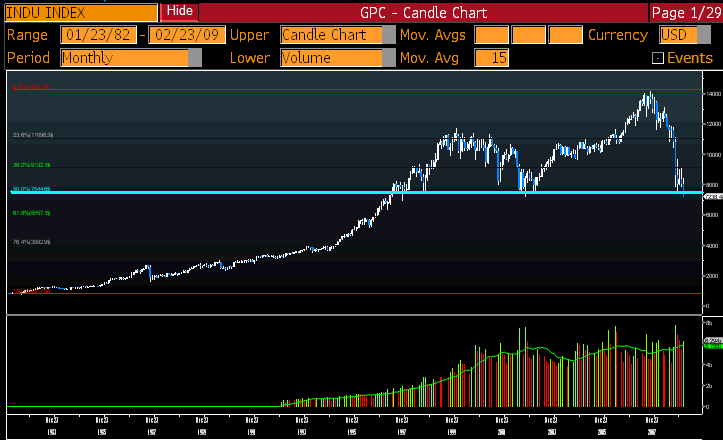
Here is something to mull over: Technically, 7,470 in the DJIA is the 50% retracement of the entire bull market that began in August 1982.

At 7,100, we not only cut in half the October 2007 highs of 14,198.50, but we have given back 50% of the 27 year move from the start of the big bull market of the 1980s to yesterday.

That is astounding . . .

>

Dow Industrials 1982 – 2009
63 Responses to “50% Dow Retracement: 1982 – 2009”

  1. CNBC Sucks Says:

    The great wealth of the IT revolution that largely powered our nation’s prosperity since 1982 has now become concentrated in Treasuries and cash hoarded by the superwealthy, or invested in the revival of China and India as economic powers, or held by the Chinese, Japanese, Arabs, and others who supplied our indebted consumption of the last two decades. As a nation, we really are not that much better – or better off – than in 1982 except that we now have computers and the Internet, and maybe a few decent gadgets. Sure, today we can live longer, but now we will also have to work longer.

    Any “recovery” – such as that proposed by Bernanke today – between now and when we truly fix our structural problems is just another reflation of indebted consumption. It is false hope and false basis for any genuine, sustained growth in the value of equities.

    It is time to innovate again, to rebuild an economy that actually produces, to let true capitalism reign in this country, but first we must re-confiscate some of those Treasuries and cash held by our rich. Without the re-confiscation, we have no capital and no chance.

  2. dead hobo Says:

    If you do a little technical analysis with a straight edge, a line extended from the 0,0 point puts the market at exactly where it would have been if it didn’t go parabolic. Evidence of a bottom?

  3. Pat Shuff Says:

    According to a CPI inflation calculator a dollar in 2009 is equivalent to forty six cents in 1982.
    Then subtract the taxes on dividends and gains. Annualized real return isn’t alot for so much bull.

  4. ottnott Says:

    Barry, by coincidence (or vast conspiracy – take your pick) we have also seen a 50% retracement of the move from 1932 low to the all-time high in 2007.

    50% retracement of 41 – 14,164 = 7,103. Yesterday’s close was 7,115.

  5. Groty Says:

    The DJIA closing low was 42.93 on June 27, 1932.
    The DJIA closing high was 14164.53 on October 9, 2007

    The 50% retrace is 7103.73.

    We’ve effectively retraced 50% of the 77 year move.

  6. mlomker Says:

    I’m a buyer at 61.8%

  7. km4 Says:

    CNBC Sucks nice post !

    > Without the re-confiscation, we have no capital and no chance.

    There will be innovation and a rebuilding of the economy but this will take some time so I’ll simply say the best days of being middle class American are gone.

    This has NOT ’suck in’ for most Americans who expect things will get back to normal again with economic bubbles in stocks and real estate.

    Not being a pessimist ….just a realist.

  8. jason Says:

    I don’t know why but this chart make me think of the elephant in the boa from The Little Prince by Saint-Exupéry…..

  9. ottnott Says:

    Buy and hold still works. You just have to use a 100-year timeframe instead of 10 years.

  10. km4 Says:

    i.e. NOT sunk in for most Americans ….so also sucks for them ;)

  11. Groty Says:

    Looks like Ottnott and I were both typing our responses about the same time. Ottnott’s closing low is correct. I was eyeballing the data, rather than using the Min function, and missed it.

    As he points out, the low was 41.22 on July 7, 1932. But we get the same results for all practical purposes.

  12. Tom K Says:

    So are we getting ready to trace out the right shoulder of a massive H&S pattern? ;-)

  13. Mark E Hoffer Says:

    that elevation of trading volume should be telling us something, no?

    paint-by-numbers, comes to mind at this whistle-stop..

  14. HCF Says:

    > If you do a little technical analysis with a straight edge, a line extended from the 0,0 point puts the market at exactly where it would have been if it didn’t go parabolic. Evidence of a bottom?

    @dead hobo:
    I’m thinking several random things:
    1) When y-axis is log vs. linear, then the meaning of “straight line” changes (although over that time scale, it actually superficially looks the same)
    2) When the linear extrapolation is taken, the starting (0,0) point really matters.

    Either way, your general assessment is interesting =)

    HCF

  15. gloppie Says:

    Anybody who’s ever look at a complex signal on a scope, will tell you this curve screams of positive feedback run amok, and that chaos (randomness) is coming. It’s fairly obvious that it wants to oscillate, (K-cycles) but somehow can’t because of too many changing factors (leverage), not to mention hysteresis (delayed reports) and malfeasance (bias).

    I am not changing a thing until we hit Dow 3000.

  16. DMR Says:

    On the bright side, the inflection point has already passed :)

  17. MRegan Says:

    OT

    M. Hoffer- scriptophily? Really? Are you just hotdogging now?

  18. Douglas Watts Says:

    I like doing MC Escher technical charts.

    More please?

    ~~~

    BR: OK, one more at the close . . .

  19. Pat Shuff Says:

    Douglas Watts Says:

    I like doing MC Escher technical charts.

    ~~~~~~~~~~~~~~~~~~~~~~~~~~~~~~~~

    Hamsters immediately sprang to mind.

  20. Andy Tabbo Says:

    When 1/3 of the stocks in this “price average” are under 15 bucks, this DJIA is converging into an index of decent companies like, Exxon, IBM, McDonalds, Walmart, 3M, JnJ with an imbedded cheap option on some of the single digit midgets.

    I’ve said this numerous times, this Dow Jones Industrials is a bogus marker because it’s an “average” and not a true index. The chart of the DJIA looked much different that the SP500, Nasdaq and the OEX since 2000. There’s a reason for this.

    I don’t do charting or analysis on this silly thing, but I’ve got targets 6590 – 6830, not too far from current levels. So maybe the DJIA bottoms before the real indexes? That’s not my forecast…just kicking around some concepts…

  21. donna Says:

    So now can we admit supply side economics doesn’t work? ;^)

  22. DL Says:

    Bernanke and Obama will try to blow an even bigger bubble than what we’ve seen so far.

  23. DL Says:

    donna @ 12:46

    Yeah, let’s go back to 70% marginal tax rates.

  24. Mind Says:

    Scary. Glad I didn’t run with the crowd. Would hate to have to jump back into those 60 hour weeks from the 90’s.

  25. HCF Says:

    Just a wild guess, but I keep on thinking that the DJIA will end this thing down between 4-6k. You have to figure at least 4 components are in serious trouble (to different extents): C, BAC, GE, and AXP. The negative psychology associated with any Dow component failing would be pretty bad, especially if the Feds come out and say “These are too big to fail” immediately before one of those companies fail.

    HCF

  26. Mark E Hoffer Says:

    OT:

    MR–

    no, not really, some of those certs are, really, rather interesting. though, as I was saying, at the very least, it may move your interests toward…

    IOW, they might learn something they never expected, of course, if they took delivery..
    ~~

    Mind,

    as you’ve already figured out, running with the crowd is a good way to get stampeded..

  27. Winston Munn Says:

    From a Joint Statement by the Treasury, FDIC, OCC, OTS and the Federal Reserve on the economy.

    “The government will ensure that banks have the capital and liquidity they need to provide the credit necessary to restore economic growth.”

    There is a fundamental flaw in an economic system when the only way to restore growth is “to provide the credit necessary”.

    Credit will not fill the productivity-wage gap. Only by sharing with labor the benefits of production growth can a healthy economy be sustained.

  28. Super-Anon Says:

    Just hang in there. Stocks always go up in the long run.

  29. Neal Says:

    Pass me an Advil…..bottle

  30. gorobei Says:

    DL,

    I think donna’s point is largely valid: supply side didn’t work, at least in term of the “massive engines of growth” and “trickle down to the middle class.” It did exactly what common sense predicted it would do: concentrate wealth in the hands of the lucky, the skillful, and the trust-fund babies. That may be a good or a bad thing, but SS as panacea, as most economists predicted, is a discredited idea.

  31. Greg0658 Says:

    bottom calling ? .. what about the disenfranchised feeling in all this

    I think many would like to go back to the days of getting a decent return on plain old savings … but we can’t can we .. when cash is provided in such stratospheric amounts to instruments of late (high return no guarantee)

  32. Andy Tabbo Says:

    HCF.

    Those stocks you mentioned are already near zero. Because the DJIA is price average, the bankruptcy of some major firms is already almost fully factored into the Average.

    For an example of how the DJIA works …..

    Let’s say you have two stocks in this “average”:

    Bank of America at $4.00/share with a Market Cap of $20bn; and,
    Alcoa worth $4.00/share with a Market Cap of $4 bn.

    BofA might be 5X bigger than Alcoa, but because they have the same price, they have same affect on the DJIA.

    This is different that the SP500 Index, where BofA going to Zero would have 5X more impact than Alcoa going to zero.

    That’s my understanding of the “average” vs. a true index….

    - AT

  33. Mark E Hoffer Says:

    Greg,

    people should remember the Reality–they recieved a decent return on ‘plain old savings’, when their savings were denominated in actual Money, not Fiat..

    http://www.minneapolisfed.org/index.cfm

    even the Fed’s pute will tell you that a $1, in ‘71, would buy more than a $5 today..

    also, the idea that there are ‘guarantees’ is…you know the rest.

  34. Todd Says:

    Supply side absolutely worked from a credit creation process. Banks, businesses, and CC issuers all made available enormous amounts of credit for consumers and business to use. The fed printed money to make sure the credit would flow when used. Credit growth rates doubled from the 80’s on when compared to the 50’s-70’s.

    Credit creation is a nice little trick to goose your returns. CC issuer adds $300 to your limit, which you gladly max out. They just have to have the cash flow to cover the increase, and just a nominal reserve for default.

    On a smaller scale the paging companies in the 90’s used this model. Cash flow is king. Anyone remember pagenet? Once growth stopped, and cash flow couldn’t cover they collapsed. We are in the same boat, just at a larger scale.

  35. Greg0658 Says:

    ps – Graphite made a point last weekend (19th@9:32 pm) that stuck with me .. I think in the open thread …

    paraphrased “where the stock market goes .. is not all the economic activity”
    its sorta the gamesphere but with consequences beyond the town of slogan “What happens here stays here”

  36. DL Says:

    gorobei @ 1:22

    Saying that policy “X” is not a panacea is not very enlightening. If policy “X” is no good, then what is policy “Y” to replace it with?

  37. sst3d Says:

    Add the inflation factor from 1982 to present and you end up with essentially zero growth over the entirety of the life of Supply Side. Nothing.

    Scott in Chicago

  38. Darkness Says:

    Dead Hobo,

    Minus that bitch by the name Undershoot who is due to come and slap everyone around a bit, yeah. Looks like we’re close.

  39. gorobei Says:

    DL @ 1:50,

    SS was sold as a panacea: revenues would rise because we were to the right of the peak of the Laffer curve, massive investment and job growth would happen, the creative engines would be unleashed, and everyone would be better off.

    Sadly, we weren’t to the right of the peak, so the plan didn’t produce the claimed outcome. I remember the Carter years sucking, and I remember the Reagan years sucking (though for different reasons.)

    I’m pretty much a neo-Ricardian. Grand policies have surprisingly little effect on long term growth because people adapt dynamically to changing policy via changed savings rates, intergenerational family transfers and the like. A long-term, consistent, govt policy is better than a series of radical shocks: people know what to expect, and plan accordingly. Short-term tax cuts, bizarre 401K conversion rules, etc, just encourage people to engage in sub-optimal economic behavior.

    Ruling a large nation is like cooking a small fish – the less you touch it, the better. Muck with the rules too much, and everyone starts hoarding gold.

  40. DL Says:

    gorobei,

    I can agree with most of that.

  41. HCF Says:

    @ Andy Tabbo

    Excellent explanation on DJIA vs. S&P500… I agree that C, BAC, and GM are pretty much discounted as being close to zero… AXP, however, is still double digits, while GE is hovering ~$9. They’ve fallen a lot so far, but are still high enough that bad things can happen. The real key is the 20 or so components that are neither dead, nor fantastic. If they collectively fall ~15% or so, then we’re down at 6000 on the DJIA, while a 44% or so fall gets us to 4000. The former, I think is probable, while the latter is improbable but not impossible. I would say the only “bulletproof” components are Walmart and McDonald’s and to the lesser extent JNJ, P&G, and Coca-cola. Where’s a good tobacco company with an addicted customer base when you need one?

    As much as I hate the Dow as an “index,” everyone does seem to know where it’s at, so I guess I’ll keep on trading it =)

    HCF

  42. flipjes Says:

    I would really like to see an inflation correction on these curves. Does anyone have the data handy?

  43. rww Says:

    If I understand Bernanke’s testimony, a few gazillions as tribute to the lords of finance and they will deign to end the recession this year.

  44. wally Says:

    That chart clearly shows the two sequential bubbles. Cut them off the chart – because they represent unsustainable situations – and you will have the answers to the question: when we will “recover”.

    We ARE recovered. Here we are. That’s it, folks.

  45. constantnormal Says:

    What I find amazing is that there are so many companies with elevated valuations — granted, these are strong, standout performers, but I seem to recall that at true bottoms, ALL companies have valuations that have gone through the press (true bottoms being not tradeable rallies, but levels that will not be breached until some time far away, after at least one substantial bull market).

    I would expect that by this point we would be seeing substantial valuation compression in practically EVERYTHING. That is not the case. There is still a lot of expectation to be crushed from this market.

    My guess is that this means we have (no surprise) several more miserable disappointing quarters of earnings devastation, waves of layoffs, collapsing economic activity (how low can it go?) and political reassurances ahead of us. More bailouts for non-performers, digging a deepening hole for the next administration. That seems to be the way politics is waged these days — leaving a bigger mess for the next guy.

  46. constantnormal Says:

    @ wally — 2:50 pm

    We ARE recovered. Here we are. That’s it, folks.

    Did I miss the downside overshoot?

  47. William Miller Says:

    And to make things that much more interesting, the Great Bull Market trendline from the same period lined up for another test just yesterday.

    See charts here – http://theeconomissed.blogspot.com/2009/02/buy-equities-again.html

    http://theeconomissed.blogspot.com/2009/02/spx-update.html

  48. dead hobo Says:

    constantnormal Said:
    February 24th, 2009 at 2:52 pm

    @ wally — 2:50 pm

    We ARE recovered. Here we are. That’s it, folks.

    Did I miss the downside overshoot?

    question:

    I don’t know. Do you need clean underwear?

  49. Mark E Hoffer Says:

    cn,

    w/this: “collapsing economic activity (how low can it go?)”

    if we had recent peak of U$D ~15 Trillion GDP, we could get to single-digit Trillion annual run rates pretty easily. roughly GDP(.6). of course, a healthy dose of Inflation, or an old-fashioned devaluation, hardly out of the question, and that # would only be seen in ‘real’ terms, as opposed to nominal..

    “There is still a lot of expectation to be crushed from this market.” –if you’re in a cube colony, do a shout-out, and subsequent nose count, to see how many of your compatriots are, still, fueling the font of the perpetual bid..though, for ease of understanding, just ask if they’re still ‘in’ their 401k’s–on second thought, you may care to procure a lexan shield, prior to asking. if you’re really brave, inquire after their ’successful’ 529 pursuits..

  50. Bruce N Tennessee Says:

    (Writing as J M Bourchers…..)

    Well, I knew it! We finish up today, and we are off to the races…today I bought AMAT, C, JPM, XOM, WMT, X, and a few others I forget the name of I was buying so fast!

    Suckers!….If you haven’t been long, you’ve been wrong….

    and I sold my QID and SKF yesterday….just before the bell..

    If only some of you dim bulbs could shine like me!

    JMB

  51. constantnormal Says:

    Bruce — you are a cruel, mean-spirited man, to kick us dogs like that. :-)

  52. constantnormal Says:

    whichever dogs you were kicking

  53. constantnormal Says:

    @ dead hobo:

    Did I miss the downside overshoot?

    question:

    I don’t know. Do you need clean underwear?

    Nope. And I have needed to do so after all the previous historical downside overshoots. Must be the Prozac.

  54. arbitrader Says:

    Just thought I would point out that if the index has given up 50% from its high then by mathematical certainty it will also have retraced atleast 50%+ from any starting point in the past that you choose (unless you can find a negative starting point). Thus it has retraced 50% of the move from the beginning of the stock market as well.

  55. worth Says:

    @ arbitrader:

    I wasn’t familiar with the universal accepted law of “by mathematical certainty,” but now that I am, it seems like a good candidate to explain lots of numerical phenomena. Thanks!

    Also, re: supply side economics, and specifically the resultant reduction of personal income tax rates, I submit that although I’d personally rather pay 30% than something much higher than that, it would clearly incent me at a corporate officer level to keep corporate profit in the corporation at, say, a 35% corporate tax rate rather than disbursing it to executives at a 50-70% personal income tax rate. In other words, when personal tax rates were much higher, you didn’t see 8- and 9-figure compensation packages being doled out like you do now. The name of the game is ALWAYS, first and foremost, tax avoidance, so if you want to limit executive compensation, just friggin’ jack that upper tier of personal income tax. Every single one of these “bailout” recipients would be far, far better off right now if they had not paid hundreds of billions of dollars to their executives in compensation over the past couple of decades. And so would America.

  56. scorpio Says:

    i would really like to see some talk about S&P eps and p/e multiples IN RECESSION. what’s the average? i heard the clowns CNBC yday morning spouting “well if eps low then u have to put a high multiple on them”, when in fact true bottoms are made by people putting low fear-based multiples on REAL and possible recurring LOW EPS. my recollection is 1980-1982 (which we will beat handily as GDP destruction, both here and abroad) averaged 7-10 X throughout.

  57. How the Common Man Sees It Says:

    That’s pretty much the baby boomers….charted. I just hope the chart doesn’t die with them. Some of us still have to trade when they are gone.I assume the second shoulder will be the USG trying to solve for the boomers. My gut tells me we won’t see that second shoulder get built….unless someone invents something. Like trees that grow to the sky

  58. Che Stadium Says:

    So now can we admit fiat currency doesn’t work? ;^)

  59. Clem Stone Says:

    It’s even worse than that! The earliest rendition of the DJIA was created by Neanderthal Man as a method of trading wooly mammoth hides. This early “Dow” index fluctuated between 0 and 1 back then. We have retraced 50% of the entire move, effectively erasing 20,000 years of financial gains. My God, we’ve got to wait another 18,000 years before the 1st Coming!

  60. arbitrader Says:

    @worth:

    I didn’t cite a law, just a fact which happens to be a mathematical certainty. Sorry if that phrase rubs you the wrong way.

  61. Xenophon Says:

    Even when things are “turned around”, who is going to go back into this market. This is like asking a child who just burned his fingers to go over and start a fire in the fireplace. The “recovery” is apt to be tepid and strung out for maybe decades.

    Another thing that will be dragging this country down is the size of our government. There are to0 many dependent persons getting government checks, whether through welfare, as bureaucrats, or as affirmative action hires. The last 30 years has seen an astonishing transformation of America. We may have to face the fact that there are underlying structural changes in our demography and social attitudes which may preclude our ever regaining the edge we once held. Time will tell.

  62. Che Stadium Says:

    @Xenophon

    I think you can add in the massive subsidies that will be paid to legacy industries.

  63. Mark E Hoffer Says:

    Xenophon,

    to your point: “The last 30 years has seen an astonishing transformation of America. We may have to face the fact that there are underlying structural changes in our demography and social attitudes which may preclude our ever regaining the edge we once held.”

    these lovely people decided to announce their presence in ‘73..
    see: “The Trilateral Commission was formed in 1973 by private citizens of Japan, Europe (European Union countries), and North America (United States and Canada) to foster closer cooperation among these core democratic industrialized areas of the world with shared leadership responsibilities in the wider international system. Originally established for three years, our work has been renewed for successive triennia (three-year periods), most recently for a triennium to be completed in 2009.

    Two strong convictions guide our thinking for the 2006-2009 triennium. First, the Trilateral Commission remains as important as ever in helping our countries fulfill their shared leadership responsibilities in the wider international system and, second, its framework needs to be widened to reflect broader changes in the world. Thus, the Japan Group has become a Pacific Asian Group, and Mexican members have been added to the North American Group. The European Group continues to widen in line with the enlargement of the EU. We are also continuing in this triennium our practice of inviting a number of participants from other key areas.

    The “growing interdependence” that so impressed the founders of the Trilateral Commission in the early 1970s is deepening into “globalization.” The need for shared thinking and leadership by the Trilateral countries, who (along with the principal international organizations) remain the primary anchors of the wider international system, has not diminished but, if anything, intensified. At the same time, their leadership must change to take into account the dramatic transformation of the international system. As relations with other countries become more mature—and power more diffuse—the leadership tasks of the original Trilateral countries need to be carried out with others to an increasing extent.”
    http://www.trilateral.org/about.htm

    Their fellow travelers are talking, for publication, about:
    • How the Financial Crisis Will Weaken the West
    by Roger C. Altman

    The financial crisis has called into serious question the credibility of western governments and may precipitate an eastward shift of power.

    Listen to this essay on CFR.org »

    • A New Trade Agenda
    by Mattoo & Subramanian

    Trade problems are an underlying cause of the financial crisis. To truly revive the world economy, a new trade consensus is necessary.

    • Who Broke Global Finance?
    by Harold James

    The current economic crisis may have one winner: the Chinese financial model, which — together with the IMF — holds the keys to fixing the problem.
    http://www.foreignaffairs.org/

    and, yes, correlation not, necessarily, = to causation
