
A Cyclical Look at P/E Ratios

Email this post Print this post
By Barry Ritholtz - February 16th, 2009, 8:31AM

Here’s another brutal look at where P/E rations might end up going before this is all over, via Bob Bronson:

I am very skeptical of earnings forecasts, because they have been so terrible for most of my adult life. The conspiracy of optimists always seems to overestimate future earnings.

Trailing earnings are real data, not opinion of guesswork. They provide a factual basis for valuation, and not a wishful or theoretical version. Those who were claiming that there is no recession have now taken to saying we are at the worst levels of the recession. Often, we see forward earnings estimates at the heart of this faulty analysis.

Forward earnings guesswork are why the analyst community missed the credit crisis, why they could expected a 20% Q3, and 50% Q4 earnings rebound. Hence, the forward earnings consensus led to calls for 1350 and even 1550 on the S&P . . . Its now about half of that.

Rather than rely on Wall Street Analysts who are chock full of the conflicts, and seem structurally incapable of catching major economic turns, let’s revisit a long term look at P/E ratios, via historical cycles.

>

click for ginormous chart
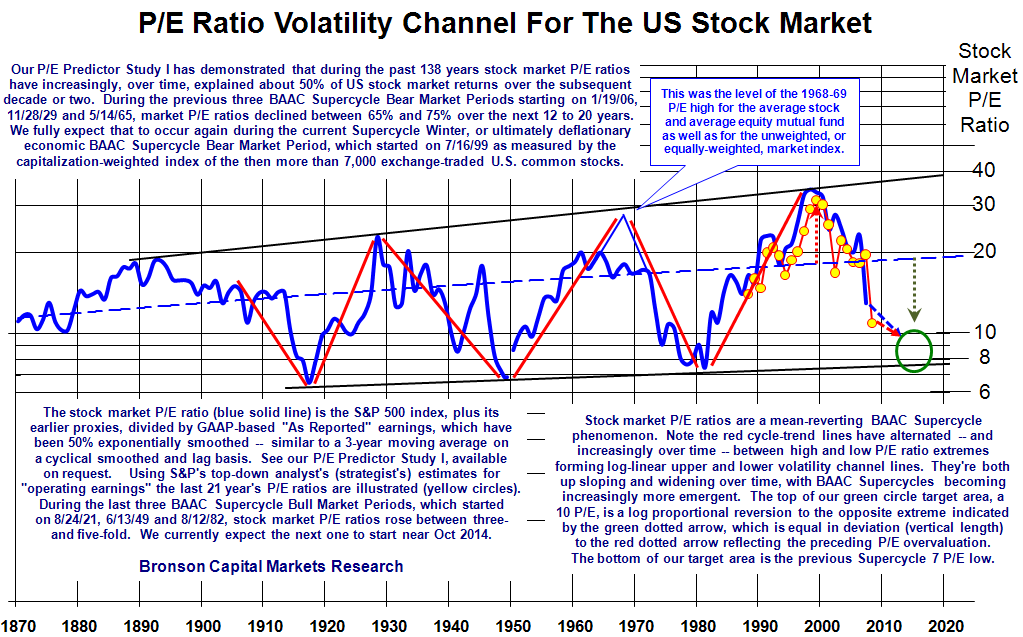
chart via Bob Bronson Capital Management

>

UPDATE February 16, 2009 11:58am

The key point of the chart is that earnings and P/Es are cyclical. Spare us the your slacker analysis, merely stating that “you can make any chart look however you want.” (At least this sarcasm is amusing).

Rather than merely dismiss this, I suggest you instead come up with something demonstrating stocks are cheap or even fairly priced. Or alternatively, due some work and prove the chart is wrong. But no more lazy junk science.

Ignore this chart if you want — but I think it suggest the market is still not “Very Cheap” based upon prior cycles.

>

Previously:
Bear Market Bottoms & P/E Ratios (January 15, 2009)

http://www.ritholtz.com/blog/2009/01/bear-market-bottoms-pe-ratios/

57 Responses to “A Cyclical Look at P/E Ratios”

  1. Scott F Says:

    8 P/E ?

    That’s rough — I can easily see 10-12 but 8 is a very difficult number to get to (barring further catastrophe)

  2. wally Says:

    This might be a good time to take a few year off.

    Is there any reasonable explanation why the PE average should be slowly drifting upward over the decades?

  3. danm Says:

    Wally:

    If you take out the last triangle which includes 2000, the line would get flatter.

    IMO, the higher PE is liquidity = more people in the market than 100 years ago. More money going into large caps just because they are large caps.

    We could argue that the big box squeezing out mom and pop shops was the effect of everybody buying overvalued large caps and giving them more and more easy money… the perfect opportunity to become more and more inefficent and greedy.

    So now throughout the world we’ve been coaxed into an Anglo type of infrastructure completely disregarding our geographic and environmental circumstances. You can keep up the apprearances for a while, but at one point the snowstorms up here in Canada will cut into that profit margin, or the Italian marble will crack and fall off and, etc.

  4. constantnormal Says:

    @ wally — Is there any reasonable explanation why the PE average should be slowly drifting upward over the decades?

    Here’s a couple — increases in population , or more likely, the tendency of central bankers to prefer slight inflation to zero inflation (putting some distance between them and deflation). The population increases would put more consumers out in the world, driving us to a more consumer-oriented economy, with more demand for goods.

    If one looks at the growth of global population, you can make a case for simple population pressures generating the demand to end this global depression, once the valuation issues and toxic debt are sorted out. In particular, emerging market nations’ economies should benefit from this, with it being less of a factor in developed nations like Japan, which is in a strong population decline.

    Can anyone tell me what’s up with the discontinuity that occurs at 1950?

  5. constantnormal Says:

    @ Scott F — “barring further catastrophe” — that’s funny.

    Appears to me that we are only about halfway through the catastrophe part of this mess, more or less.

  6. danm Says:

    Here’s a couple — increases in population , or more likely, the tendency of central bankers to prefer slight inflation to zero inflation (putting some distance between them and deflation). The population increases would put more consumers out in the world, driving us to a more consumer-oriented economy, with more demand for goods.
    —————
    Population growth is probably a good reason but not enough (think China). Something else had to propel people into buying the market… like buying stocks of blue chips and going on vacation instead or creating mom and pop shops.

    In my mind, easy money definitely paved the way.

  7. dead hobo Says:

    I really like it when you can make a chart appear to say anything you want. Especially when the written explanation sounds technical and near-mathy.

    I think these guys win today’s GOZINTA award.

    The GOZINTA award is named after famed pioneer quant Jethro Bodine, who could proudly demonstrate the gozintas upon request. The request usually came from his commodity enriched custodial uncle, who was ceaselessly impressed (3 gozinta 9 three times, ect)

    Why this chart is special: Note the center line that appears to bisect the top and bottom is skewed a bit, probably for very technical reasons. The top line conveniently ignores the middle peak, which is much lower than those on the right and left. In drawing the top line, it assumes that the very tops on the right and left are in the control range as opposed to possibly massive outliers.

    Now if these proud technicians want to explain the economics behind the rises and falls in such a way that a normal person can understand why these lines go up and down, then we have something. As a requirement, historical event parallels must be drawn so that every up and down can be intuitively correlated.

    Now it’s just GOZINTA award material. Until a narrative explanation is presented, I think is is laughably ridiculous to assume the economic circumstances of today bear any relationship to 1915, or any other pre-internet or pre-globalization period. Instead of a supercycle period of dubious years, why isn’t it just a head and shoulders chart for some godlike economic entity? Maye we’re at an economic turning point that will take us all to nirvana?

    Oh yes, and extra points for referring to an ‘analyst’ as a ’strategist’. If Mr Analyst is so smart, then why isn’t he so rich that he could have told the authors to screw off when they asked for his help with this chart? Or, then again, maybe his strategy involves some aspect of sales to those who believe in mystical charts?

    What would Dr. Bodine say?

    Wally, PE ratios are drifting upwards mostly due to the US going off the gold standard. This is just basic inflation that has been institutionalized worldwide.

  8. danm Says:

    If Mr Analyst is so smart, then why isn’t he so rich
    ——————
    When will people finally understand that intelligence and wealth don’t necessarily go together?

    Isn’t this how we got into our current situation, admiring the wealthy that is?

  9. harold hecuba Says:

    common sense will tell me the biggest credit bubble in histroy will be followed by the biggest bust. this should wipe out the entire bull run from 1994-1995..450 looks inevitable in the s+p

  10. rktbrkr Says:

    Higher PE drift is probably due to the greater convenience of losing money in the market now, phone, internet, ETFs, mutual funds, 401Ks. These all made it easier (and seem less risky) to put money into stocks. And, of course, The Great Depression was a never again happening.

  11. Bruce N Tennessee Says:

    danm Says:

    February 16th, 2009 at 9:30 am
    If Mr Analyst is so smart, then why isn’t he so rich

    danm:

    There was a classic New Yorker cartoon years ago about two old guys at their club, smoking two big cigars, and drinking bourbon in a glass, in their smoking jackets…one looked at the other and said,” If you are so rich, how come you’re not smart?”

    made me pause, at that time..

  12. s0mebody Says:

    This graph means nothing to me. WSJ has these P/E ratios for TTM:

    Dow 18.6
    S&P 23
    Nas 27

    I know the chart says the data has been smoothed, but that just reinforces what dead hobo said. You can make a graph say anything you want.

  13. How the Common Man Sees It Says:

    With the ability to dump losses and spike gains into whatever quarter they choose (post 9/11 was a classic and predictable example of loss dumping) I don’t know why anybody bothers with P/Es. Sure, they are a short term gauge, but I’m not going to invest my life savings on what the current P/E equals. When I buy a company I like to look at the balance sheet to see if there is a management in place that has grown the assets of the company over the last three years at least but five years is much better.

    As a ‘trend trader’ this is where I seek out my trends. If I see consistent growth on the asset side and consistent diminishment of or very little on the liability side then I know I have a company management who ‘gets it’ and those are the companies I will place my cash with as a co-owner. As long as the balance sheet is growing and improving steadily I know earnings, dividends and cash flow will be sustainable and will follow

  14. ironman Says:

    BR: Thank you for posting Bob Bronson’s chart again – you’ve just saved me quite a bit of searching through previous posts here! (Although I remember that you featured the chart here previously, I couldn’t for the life of me remember when I saw it nor who created it!)

    For those of you expecting falling stock prices, you can likely expect to be disappointed. Given the nature of the math involved, stock prices could remain flat or even rise and the P/E ratio will fall, as earnings may well rise faster.

  15. try2bamused Says:

    $21.50 * 7 = SPX 150

    QED.

    Have a nice day.

  16. Michael M Says:

    Barry,

    This hack seems to be begging to have his sorry arguments torn apart. Will you – or is the target too easy?

    http://online.wsj.com/article/SB123457303244386495.html

    ~~~

    BR: I haven’t read that piece — and won’t.

    My experience has been that reading the WSJ OPED page LOSES YOU MONEY. It amounts to a professional liability.

    I have found that the space is mostly inhabited by ideologues, shills, hacks and functional illiterates, who have no respect for facts. They are only occasionally punctuated by a few smart people’s work (Shiller, Volcker, etc.).

  17. dead hobo Says:

    If some people can see the Virgin Mary in a potato chip or a Jesus face in a soda pop stain on a wall, then why can’t an astute observer see a godlike entity posing in a head and shoulders configuration. This chart possesses the face of God over the past century. If you add a couple more lines you can see it clearly. He’s looking right at you.

    And also note that the final tail is very close to 2012, the year the Mayan calendar says the world is ending. We are looking at prophecy.

    All hail this chart.

  18. AZmando Says:

    “Trailing earnings are real data, not opinion of guesswork.”

    I’m not so sure this is true. Many companies’ trailing earnings are manipulated at best, fraudulent at worst.

  19. Graphite Says:

    Until a narrative explanation is presented, I think it is laughably ridiculous to assume the current economic circumstances of today bear any relationship to 1915, or any other pre-internet or pre-globalization period.

    In other words, It Really Is Different This Time. Well, I guess people have to believe this stuff in order for there to be a large enough pool of suckers for the bear market to destroy.

    I can imagine the weight of a lot of panicked boomers liquidating what’s left of their retirement portfolios as an excellent catalyst for pushing the PE ratio below 10. And now that the Fed has completely lost monetary control (wow, central banks don’t control the economy, who could have known?), the inflation explanation for a high PE ratio doesn’t even make sense anymore.

  20. dead hobo Says:

    Michael M Said:
    February 16th, 2009 at 10:37 am

    This hack seems to be begging to have his sorry arguments torn apart. Will you – or is the target too easy?

    comment:

    Obama isn’t a saint yet. Fear sells and a little salesmanship is needed to get the economy moving again.

    Oddly enough, I agree somewhat with the author, although it is far too early make a historical claim about his activities.

    I also think that things are bad but the media has ‘weeniefied’ a lot of the world. The internet psychology of the world is bringing us to a time that demands instant gratification. Obama is spending into that cultural change.

  21. Steve Barry Says:

    Saying this is not as bad as the Great Depression is like saying, “this storm is not so bad” 15 minutes into the edge of a hurricane hitting you. Obama is a pollyana if you ask me.

  22. dead hobo Says:

    Graphite Said
    February 16th, 2009 at 10:43 am

    In other words, It Really Is Different This Time.

    Hint:

    It’s different every time. Unless the pattern hold up to scientific scrutiny, as opposed to the astrology associated with technical analysis, all events have random elements. The false relationship occurs when people assume patterns control our lives.

    If something out of the ordinary occurs people assume the world has quaked and uncertainty is here. They panic. Thus, it’s different this time.

    Or, at the opposite end, the really smug and clever pattern followers think the pattern still holds and only fools thinks this time is different.

    A heartbeat is a pattern. It’s cloudy when it rains is a pattern. A jiggle on a chart is only a coincidence in a lot of cases.

    Thus, it’s always different this time.

  23. H.T. Says:

    “History doesn’t repeat itself, but it rhymes” Mark Twain.

    No SECULAR bull market has ever begun without P/E multiples in single digits. People can argue about the forward ‘09 earnings [which are finally dropping like a stone], but unless your a nimble trader, wait for the ’single digit’–and read “The Crash” –it was so devastating for the same reason why so much wealth has been destroyed in this one so far [anyone remember the 'smart money' sovereign wealth funds buying Citi at 30?]–people kept “getting in’–head faked by bear market rallies– I’m a born contrarian, but I’ll let some other sucker or lucky guy [which ever it turns out to be] get the first crumbs on this baby.

  24. tranchefoot Says:

    Obama never compared the current economic crisis to the GD. He has compared the current financial crisis to the one that precipitated the GD and he’s hoping the stimulus will prevent another. I hope he’s right and I wish him luck…

  25. usphoenix Says:

    In the pre-Postmodern days economists were assumed rational scientists, and not more reminiscent of ancient oracles dissecting pigeons to predict the future.

    As Merton Miller pounded into our heads, a stock’s price should be the net present value of its future earnings stream. Simple huh?

    Rising prices and P/Es are supposed to reflect an increased future earnings stream.

    Net present valuing should take into account the rate of inflation and/or “cost of capital”, which is also a way of drawing a comparison with a “risk free return elsewhere”. What risk premium should be applied to the NPV? If future earnings are forecast in future dollars, the NPV should discount it back in lower current dollars. So the NPV of earnings would be reduced and the price should go down. P/E should be lower. If the future stream has a higher degree of risk the price should drop, as well as the P/E. If interest rates and inflation drop prices and P/Es should rise. Doesn’t seem to work that way, eh?

    There may well be a premium or discount applied to the pricing based on all kinds of rational/irrational factors: lack of investment alternatives, more money flowing into the market and stocks bidding up prices.

    Ah yes, the market psychology manifests itself, and the snake-oil guys juice the future. Look at the dot-com run-up. Purely Wall Street driven speculation about companies that had no earnings and had no chance for them.

    As has been pointed out accounting and business practices can easily make earning horribly distorted. In fact, most CEOs probably pay dearly for guidance on how to juice earnings in ways that bear no indication of corporate well-being, but juice their bonuses. Cram all the bad news and write-offs into a down quarter so next quarter looks good. Intentionally inject noise into the earnings stream through acquisitions and spin-offs to confuse the real earning trends.

  26. DL Says:

    try2bamused @ 10:30

    QED => QID…?

  27. Andy Tabbo Says:

    Seems to be the weekend to bring out P/E charts. Clusterstock had some analysis from GMO arguing that stocks are finally “cheap” but admitting they could get much cheaper, so not a screaming buy yet.

    http://www.businessinsider.com/stocks-now-distinctly-cheap-2009-2

    It’s interesting to me that Bronson research is using phrases like “supercycle” and “bear winters”…those are terms definitely used by Wave Technicians and Kondratieff Cycle theorists. Wonder if this is their attempt to blend fundamental analysis idealized to “Long Cycle” patterns.

    For what it’s worth, I prefer to look a the K-Wave, or Long Cycles in terms of “prices” (inflation/deflation), not necessarily economic output or the stock market. Nicolai Kondratieff was focused on price. I believe the last Long Wave of Inflation peaked in the very early 1980’s with the Gold and Oil blowoffs, strong inflation, high interest rates, etc…. The Deflationary phase ended in 1998 with Oil at 10 bucks and Gold in the tank and everyone loving the U.S.Dollar. From 1998 to 2008 we saw the first “leg” up of the Inflationary Phase that should last 20-30 years. This first leg has been “jarring” and caused a Depression as economies begin to cope with this new phase of higher commodity prices brought on by some “new development” (hyper growth in China/India?). After this current bout of debt deflation finishes (2010-2012) we should see some extremely strong inflationary pressures for another 10-15 years and most likely a “global conflict” over scarce resources.

  28. DL Says:

    dead hobo @ 9:24

    “PE ratios are drifting upwards mostly due to the US going off the gold standard. This is just basic inflation…”

    It can’t be that simple, because the parameter being graphed is a ratio; nominal earnings would increase (along with the nominal price paid for those earnings) as a consequence of the currency devaluation.

  29. jpm Says:

    Will you – or is the target too easy?

    That clown used U3 stats, as if U6 doesn’t exist. (And it’s already 13%.)

  30. johnbougearel Says:

    Barry,

    Please thank Bob for providing us these earnings and earnings multiple charts these past few days.

  31. danm Says:

    I can imagine the weight of a lot of panicked boomers liquidating what’s left of their retirement portfolios as an excellent catalyst for pushing the PE ratio below 10
    ————–
    It does not have to be panicked boomers.

    All it has to be is boomers forced into early retirement and selling assets to make ends meet, their lifestlye being more expensive than what they can truly afford especially with their housing wealth disappearing. Younger people losing their jobs and liquidating their portfolios to make ends meet.

    Investors forced to deleverage, thus selling their investment portfolios to reduce debt.

  32. DL Says:

    tranchefoot @ 11:33

    “Obama [is] hoping the stimulus will prevent another [GD]”

    Partly true. But other motivations are to (a) increase the size of government, and (b) pay back political debts.

  33. johnbougearel Says:

    We may quibble academically about Bob Bronson making this chart say whatever he wants it too. But, the trajectory of quarterly earnings for the SP500 is horrendous and will remain so for the next several quarters. The outlier event of SP500 ttm earnings possibly drifting towards $15 share by Q3 09, and the SP500 remains unchanged on the year at its 2008 closing price of 900, the stock market multiple would expand towards 60.

    @Scott F:
    Constantnormal is correct, we are only about half way through this mess. If the stock market had a 50% haircut in 2008 to roughly 750, it could see yet another 50 % haircut in 2009-2010 based on the following tidbits alone.:
    Here is how we get another catastrophe to a theater near you in 2009-2010:

    http://www.ft.com/cms/s/0/30a6bed4-fb88-11dd-bcad-000077b07658.html

    The majority of 337 companies with sales more than $10 billion said “important customers were in financial distress, taking longer to pay than usual.

    The thirst for cash had grown so great that 40 per cent of global companies and 53 per cent of European ones were considering selling parts of their businesses, raising the prospect of a wave of assets coming on to the market with few potential buyers.”

    Here we have the prospect whereby a company’s assets are sold at a deep discount in a bear market/global recession/depression. This is quite the inverse of the buyout mania during the economic expansion when every company sold at a premium. The paradox of thrift comes into play, whereby a decision made by one company to sell their business is a sound idea for that business, but when collectively every business becomes a seller trying to delever, the asset deflation spiral only worsens. This is just yet another dynamic that can cause market multiples to compress well under 10 on the SP500 this year, and if the trailing twelve month earnings are going to shrink to roughly $15/share in Q3 09, the basement floor is a helluva lot lower than the 800 level that the SP500 is now trading at in Q1 09.

    Money managers/portfolio strategists must consider appropriate hedging strategies and tools for these building outlier risks!

  34. Cybernaught Says:

    Hello all.

    It’s going to be bad. We all know that. Real bad. And the worst will be: the standard of living about pre-ww1. Which, on the overall scale of things, isn’t so bad.

    Cyber

  35. dead hobo Says:

    BR challenged:

    Rather than merely dismiss this, I suggest you instead come up with something demonstrating stocks are cheap or even fairly priced. Or alternatively, due some work and prove the chart is wrong. But no more lazy junk science.

    comment: If this is just a chart that offers historical PE ratios then it wouldn’t need a myriad of red lines that suggest trends, nor would a complicated narrative be included that states Super cycles exist and imply our lives are fated. Basic information put on graphical form is good. Then, people can try to use reasoned analysis based on factual events to figure out if a predictable pattern is appearing or if the moon is in Virgo. A debate over reasoned analysis is good. A debate over a potato head Jesus is less informative.

    Personally, I think lazy junk science is the best kind of junk science. Astrology is not for the lazy, assuming one actually plans to make real charts. Having put in a lot of effort doesn’t make it any more accurate. Ask any Republican who claims tax cuts will cure anything that ails you. Now that’s good junk science!

    Actually, I think this chart is an excellent example that illustrates the psychology of the investor. As many have said before, people want to see patterns where none really exist. Most people would prefer not to assume a graph that looks a little like a ‘Kilroy Was Here’ drawing dictates their financial fate. However, the need to know is a big deal. So gurus, magicians, wonks, and all form of GOZINTA award candidates use intellectual arguments that offer obscure historical relationships to give people something to pray to.

  36. Binggan Says:

    I added my two cents here with a long term PE chart based on 10 year rolling earnings.

    http://great2cents.blogspot.com/2009/02/earnings-and-valuation.html

  37. Todd Says:

    You have to look at the balance sheets as well as earnings. If short term Liabilities are rising, they are not paying their bills. If short term assets are falling, they are either not getting the cash in. It takes a lot more work to investigate a company’s health now than two years ago. From what I’ve been looking at it looks like the fastest growing asset on companies balance sheets are deferred taxes.

    The only thing to take form this chart is that the downside still outweighs the upside.

  38. roncfp Says:

    I’d like to see an overlay of interest rates on that chart. If the market is the PV of future earnings shouldn’t we also look at the discount rate? Certainly in ‘81 the discount rate was astronomical. Not sure about the other periods. Does a sub- 3% on a 10-year Tnote now help the valuation argument for the bulls at these levels?

  39. Steve Barry Says:

    There is a reason that the very long term P/E for stocks is 14…that represents 1/14 or 7% earnings yield…add 4% for dividends and there is your 79 year average of 11% total return. The economy grows about 3% average per year in real terms…productivity gains boost that and so does inflation to get nominal earnings to hit that 7% number. Combine plummeting earnings with a bout of deflation and single digit P/Es are guaranteed. What will happen if we go have a TTM period that produces NEGATIVE as reported earnings? We are well on our way. It’s all unprecedented, just as the size of the total credit bubble is…that is your root cause. It hasn’t even contracted an iota as of the last data reported as of 9/30/08.

  40. arbitrader Says:

    I have seen this or a similiar historical P/E chart before and I always find the great depression time frame interesting. the P/E seems to be about 25 at the peak in 1929 and about 15 at the low in 1933. I suppose earnings went through the floor but this still seems amazing given that the market lost 90% and the P/E’s didn’t even get cut in half.

    That’s actually a scary prospect if something like that were to repeat. Because the P/E trough on this chart doesn’t occur until 1950. 17 years after the low of 1933.

    Can anyone provide any clarity into the P/E’s of that era and why/how that played out the way it did.

    Thanks.

  41. matt Says:

    Steve Barry: “The economy grows about 3% average per year in real terms…”

    Try 2%

  42. dead hobo Says:

    arbitrader Said:
    February 16th, 2009 at 1:08 pm

    That’s actually a scary prospect if something like that were to repeat. Because the P/E trough on this chart doesn’t occur until 1950. 17 years after the low of 1933.

    Can anyone provide any clarity into the P/E’s of that era and why/how that played out the way it did.

    comment: This is only a guess, but, the Great Depression crushed the economy. This caused the profit decline you wondered about. At that time, the money supply diminished significantly, so did credit availability, protectionist international trade was common, crops failed due to bad weather, and government didn’t really give a crap.

    This will replay only if Uncle Stupid asks bankers and other monied players about the best way to pass out free money.

  43. dead hobo Says:

    arbitrader Said:
    February 16th, 2009 at 1:08 pm

    Then I said ….

    Oops, my bad. I misunderstood your point pretty bad. Gimme my GOZINTA. Please ignore my post above. It’s pretty bad.

    You raised an excellent question.

  44. usphoenix Says:

    Forgot to explicitly mention the role of tax policy. When you drop capital gains to 15% compared to a max of 35% that also squirrels things and drives money to the market and out of interest bearing accounts. That provides a price premium to balance out the different tax rates across different investment types, “artificially boosting stock prices.

    So, perhaps a longer term evaluation might want to take that fairly recent change into consideration also. Making current prices even more depressing on a long term comparison basis.

    It’s not likely given all the countervailing forces, 401K and pension fund stock holdings, that tax policy will change anytime soon, removing the price premium for stocks.

    So, we thanks to our tax policy we get to pay more, even in a depressed market

  45. Mr.Sparkle Says:

    I would really suggest everyone that has comments about the chart go dig up the original source data from S&P (the SP500 EPS EST. file) or use Shiller’s website.

    If you just google Shiller and “irrational exuberance” his website will pop up and you can download the data he uses. Then just make your own charts/graphs. Honestly, if you are incapable or unwilling to do that much, I’m not sure that you have much business investing/speculating.

    I do think it’s worthwhile to note the exponential smoothing that is noted on the chart. This has the effect of knocking out the 2 quarters when PE was >40 (Q4/01 and Q1/02). One can argue how important that is.

    I’ve posted several comments in the last threads on earnings and have made my own charts from the data. My 2 cents before was that market participants cling to delusions until they can’t anymore which is why PEs get so elevated in a bad market. Denial and optimism are two of the most powerful and dangerous forces.

    Barry,
    Any outlook on a post on yields going forward in the face of the winnowing of balance sheets and lower share prices? There were many talking heads pointing out the 10-year yield briefly dipped below the yield (or at least projected yield) of SPX, thanks to the historic treasury bubble.

  46. lordliege Says:

    Dividend yields have fallen historically, which if they make more efficient use of, could lead to P/Es increasing over time. It would be interesting to compare these to historical productivity and debt to gdp ratios as some of the inflection points may coincide.

  47. nayyer ali Says:

    Steve Barry remark on long term return is off. The earning yield of 7% is divided into dividends of 3.5% and retained earnings which are used to expand the business. The 10% total return of the stock market comes from 3.5% dividends and another 6.5% price appreciation. The price appreciation should track the nominal (real plus inflation) growth of GDP.
    Using this chart to predict the bear market PE low is an error because the data set is too limited. If we ignore 1917 as being too pre-industrial to count for much, there are only two secular lows, 1950 and 1980. Are there special circumstances around both those data points that make them unique? I would think so. Why should we therefore make assumptions based on those events?
    Earnings are also highly volatile, and markets tend to at least try to predict the future, rather than trade off the past. I think the better number to look at is dividend yield and long term price to dividend as a better marker of possible lows.
    In my view, the only thing that matters is whether we right the ship in the next twelve months or actually have a depression. If the former happens the markets will likely have already seen their lows back in November. If not, we could go down another 10-20% from here. We have no absolute definition of a “depression” but I would suggest a 5% output gap that persists for at least 3 years. A “Great Depression” would be a 10% output gap or higher that persists for at least 5 years. For us to get to a smoothed PE of 7 or lower would take a depression.

  48. royrogers Says:

    this is the first chart Barry has ever posted that has a mathematical
    statistical significance and the PE ratio does have some ways to go lower.
    Congrats Barry, finally, an objective data that we can all use.

  49. DiggidyDan Says:

    The average P/E increase over time is in my opinion simply because of lack of data from the finite set of time the S&P has existed. This average line theoretically should end up flat as more data points are added to infinity. It has just been skewed to have an upward slope in the short term by the recent boom in stock investing via 401K plans, mutual funds, and proliferation of stock investing throughout the world as a whole via the internet and growing access to brokerage accounts. As the suckers (including me) lose all their principal in the GD 2.0 event, there will most likely result a distaste for investing in stocks and a reversion to more “safe” alternatives. The interesting thing will be to find out what this long run average of PE will end up being. Perhaps this could be a buy signal for when it is finally safe to get back in at the bottom, when the average PE line goes back to being flat!

    I also second Mr. Sparkles suggestion to play with the data from Shiller’s Yale website data. I played with the data in statistical analyses recently after a post here about Cyclically Adjusted PE. The CAPE average he has is about 15, but is again based upon limited data. Shiller uses 10 yrs inflation adjusted data he and his colleagues have collected for this, perhaps looking at the data with a 20 year average is called for looking at periods on the chart.

  50. DoctoRx Says:

    Barry

    What does the “Update” refer to re slacker analysis? What am I missing?

    Also note typo first sentence (ratio, not ration)

    It looks to me as though earnings are vanishing along with Big Money banks and that stocks will be valued against tangible book value. Looked at through that prism, when earnings do recover, it makes a lot of sense that given how low tangible book is even for the non-financial companies in the Dow 30 or S&P 500, a single-digit P/E will be appropriate.

    As an example, look how Japanese stocks went from a 50+ P/E in 1989 to near tangible book now, and have a higher dividend yield than 10 yr Japanese Gov bonds. And earnings are moving down there as well. After a 20 year secular bear, though, their stock market finally has tangible support. Our market does not.

  51. usphoenix Says:

    @DoctorRx: Your blog brings up an interesting thought. Future earnings can easily depend on survival. I recall a recent Cramer scenario where he was touting stocks simply because they had lots of cash.

    Lots of cash – good. Maybe. Depends on the accounting rules and how real the cash is. Lots of assets tied up in less utilized production capacity – bad.

  52. Simon Says:

    @ Andy Tabbo,

    Nice summary. I think we are headed for a series of compressed economic cycles as the economy butts its head on dwindling oil supplies every time growth emerges. The commentators will all focus on the wrong reasons for things finding evidence for which ever part of the cycle we are in to continue on much further with the most enthusiasm or dispear at each extreme of each cycle.

    Time your trades well and of course you will be fine.

  53. Mr.Sparkle Says:

    @DiggidyDan – I did a post breaking out the SPX by PE level and binning them by standard deviations and 1 year percent returns. (See here, if you’re interested). This was back in December when PE was just a bit over 18 based on inflated Q4 estimates. Now, it’s far worse at 29 or so. We’ll see if this quarter really represents the kitchen sink for write-offs. There is still a decent gap between operating and reported EPS estimates in the next 4 quarters from S&P.

  54. How the Common Man Sees It Says:

    @Todd Says: February 16th, 2009 at 12:53 pm

    From what I’ve been looking at it looks like the fastest growing asset on companies balance sheets are deferred taxes.

    And watch the A/R on the liability side. A company is only as strong as the customers it has and their ability to pay

  55. How the Common Man Sees It Says:

    That should read A/R on the asset side

  56. Clem Stone Says:

    It’s a nice chart but how will it help anyone make money? I bet anyone who went long term short at the chart peak in July ‘99 has sweat more than a few bullets since then. Like absolutely no bullets remaining would be my guess. If he made it beyond March ‘00, he was surely pulverized by the time new highs rolled around in 2007, fully 8 years after he put on the trade.

    If instead the chart is meant to help with short term trading, i’m having a hard time seeing how.

  57. roncfp Says:

    The value of the chart lies principally in the first sentence above the chart. “Our P/E Predictor Study has demonstrated that during the past 138 years stock market P/E ratios have increasingly, over time, explained ABOUT 50% OF US STOCK MARKET RETURNS OVER THE SUBSEQUENT DECADE OR TWO.”

    Wonderful, so they do no better than a simple flip of a coin. WTH? The chart is useless!