
Attack of the Zombies !

Email this post Print this post
By Barry Ritholtz - February 26th, 2009, 7:17AM

While the word nationalization seems to be terrifying many observers, another technical financial term is gaining acceptability: Zombie Banks.

NYT columnist Paul Krugman used the term in a recent column; Fed Chair Ben Bernanke said in Congressional testimony that there was “no such thing as a US zombie bank.” The term even has its own wikipedia entry.

Why are even discussing what sounds like a b-grade horror flick? What is a Zombie bank?

A Zombie Bank is a financial institution whose liabilities outweighs it assets, making its net worth “less than zero.” ZBs continue to operate because of the implicit or explicit government guarantee — along with truckloads of taxpayer monies.

Consider the two biggest Zombie banks — Citigroup, and Bank of America.They have each received $45 billion in capital from the US government — far more than either bank is worth. Additionally, the US had guaranteed up to 90% of the bad assets each zombie is holding — $250 billion and $306 billion respectively.

The term comes from Japan’s lost decade following their real estate bubble. The Japanese kept their zombie banks alive, delaying the eventual recovery by a decade.

The reason I favor nationalization is that I hope we here in the US avoid a lost Japan-like decade from September 08 forward. Keeping these banks propped up with more and more taxpayer monies — the Obama Administration has proposed another $750 billion more in bank-rescue aid — is not the way out of this mess.

Curse of the Zombies
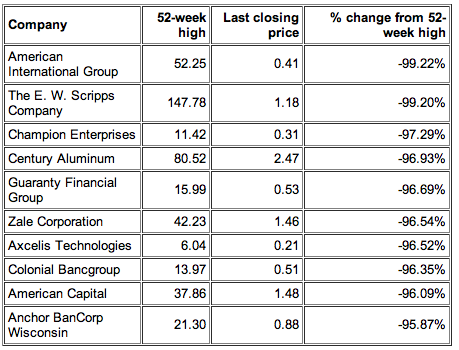
via WSJ Marketbeat

>

Previously:
The New N Word: Nationalization (February 25th, 2009)

http://www.ritholtz.com/blog/2009/02/nationalization-the-new-n-word/

Sources:
Curse of the Zombie Banks Haunts Fed
Mark Gongloff
WSJ, FEBRUARY 26, 2009

http://online.wsj.com/article/SB123560389732776681.html

There are no zombie banks, Bernanke says
Greg Robb
MarketWatchLast update: 4:05 p.m. EST Feb. 24, 2009

http://tinyurl.com/zombiefed

Zombies Must Die
Jeff Matthews
Jeff Matthews Is Not Making This Up, February 25, 2009

http://jeffmatthewsisnotmakingthisup.blogspot.com/2009/02/zombies-must-die.html

Obama’s Budget Proposes Up to $750 Billion More Bank-Rescue Aid
Roger Runningen and Brian Faler
Bloomberg, Feb. 26 2009

http://www.bloomberg.com/apps/news?pid=20601087&sid=aY8vuevw1NKs&

Zombie Banks Feed Off Bailout Money
Chris Arnold
NPR, February 17, 2009

http://www.npr.org/templates/story/story.php?storyId=100762999

Comments

Please use the comments to demonstrate your own ignorance, unfamiliarity with empirical data, ability to repeat discredited memes, and lack of respect for scientific knowledge. Also, be sure to create straw men and argue against things I have neither said nor even implied. Any irrelevancies you can mention will also be appreciated. Lastly, kindly forgo all civility in your discourse . . . you are, after all, anonymous.

28 Responses to “Attack of the Zombies !”

  1. Barry Ritholtz Says:

    A few other stories

    The Zombies Multiply
    Peter A. McKay
    Marketbeat, February 25, 2009, 11:55 am
    http://blogs.wsj.com/marketbeat/2009/02/25/the-zombies-multiply/

    Citi Confronts Global Fallout as U.S. Nears Deal on Stake
    DAVID ENRICH, HEIDI N. MOORE and JOANN S. LUBLIN
    WSJ, FEBRUARY 26, 2009
    http://online.wsj.com/article/SB123560759218177045.html

  2. try2bamused Says:

    Bernanke is creating his own companion list to George Carlin’s “Seven Dirty Words”. So far we have: Deflation, Nationalization, Zombie Bank, Transparency, Accountability. What a joke.

  3. JustinTheSkeptic Says:

    Am I the only one who feels like they are in a, ” Twilight Zone ” episode? Where are these people running around Washington, and Wall Street coming from? When to big to fail becomes, let’s drown our future in financial feces, something has to be wrong with their thinking???

    The catastrophe is not in letting things happen quickly, it is in letting these things drag on and ending up with the same result several years later instead of now. The system needs a cathartic cleansing.

  4. dead hobo Says:

    I’m still trying to understand the office psychology that takes over the business when the opportunity to do stupid things arrives. For example, did someone walk into the office one day and say “Here’s a great idea. Let’s loan out huge amounts for expensive homes to people with no documented income or assets.All we have to do is charge a little more interest, and then we can sell it.” And everyone agreed, thinking it was an amazing idea. And bigger idiots bought the packaged loans, over and over again.

    Oil at $147 last year subscribed to the same mentality. As I am fond of saying, even Nobel prize winners fell for the commodity bubble, and some probably still think it will be back soon and that it wasn’t a bubble. We sill have a little remnant inflation left over from that bubble because idiots who bought at the top for consumption purposes are still using what they bought, and don’t want to lose money on it. Prices will drop later in a lot of areas as inventories deplete and are renewed at current prices.

    What kind of mania takes over clear thinking and makes the stupid look plausible and reasonable? I’ve read a couple books on behavioral economics and understand how some of this works, but why does it seem to happen over and over again, over short time spans? It’s utterly fascinating.

    My theory is that people are basically lazy, and the laziness makes them act stupid. It’s easier to believe an expert comes from somewhere else, and doing what that expert says is a good idea. People learn at a young age that presentation is more important than substance because most people don’t like to think and will get angry if you ask them to. The average person is also a born follower, and will do what the loudest noise in the room tells them to do. This theory helps explain why people are doubtful about the current rescue plan. It’s based on reality and not the lazy way of doing things. It forces people to think and that gets them upset.

    This laziness also promotes the result that makes it appear inertia is preferable to thoughtful action. If you have to do something, it’s better to mill around aimlessly or float with the current that go off in a particular direction. That sort of independence requires effort and thought.

    **************************************************

    On another totally different topic, does anyone know how much the Japanese carry trade contributed to the ocean of free credit available for use on financing toxic assets before the crash? How much of the current problems are US based and how much are due to the return of Godzilla, in the form of a second Japanese asset bubble? Only the second Japanese bubble one was world wide. The media gave the impression that the yen was flowing freely and I recall reading a story or two that said the amount of yen available from the carry trade was immense and unquantifiable. Given how the yen has strengthened, I suspect the yen caused a lot of trouble.

  5. TheReformedBroker Says:

    worth noting that the zombie banks have taken over the met life building lobby on 45th and park

    like a scene that didn’t make the final cut of I Am Legend

  6. krice2001 Says:

    I saw Paul Krugman on Olbermann last night and he was confused by the administation’s direction with regard to the banks. He also seemed to feel that we’re following Japan’s “lost decade” example so far. I believe he referred to the administrations’s current actions as “timid”.

    I’m hoping the big banks and their proponents as well as the vocal right wing talking heads are not somehow influencing or intimidating the administration – thereby weakening their resolve to do what may be the right thing (if that’s what is occuring). I agree with Barry and others that we probably just need to nationalize, spin off assets, and regroup, painful as that may initially be. I agreed with very little with the previous administration but one thing you can say, they never seemed to be intimidated or knocked off track much by their detractors or even popular opinion.

  7. Bruce N Tennessee Says:

    Zombie banks
    Zombie car companies
    Now with 667k initial claims (and last week revised up)…Zombie employees…they are gone, they just don’t realize it…

    Seriously…I think Bernanke, Obama, and Timmaaayyyyy have had time enough to see that if an institution deserves to fail, that is probably the best course…the GM numbers this morning were in a word, unbelievable…and it is time to let some of these Zombie corpses be buried…last rites would be called for now…not further cpr…

  8. wally Says:

    Yes, they are prolonging the problem by not admitting it.

  9. Editor Says:

    Off topic politcal discussion deleted.

  10. Stuart Says:

    Given it’s not even debatable, credibly, whether Citi or BAC are zombified, why has nobody in the MSM taken Bernanke to task when he claims there is no such thing as a US zombie bank. I am so tired of officials making blatant, knowingly false assertions as if they believe the sheeple are too stupid to realize they’re being lied too. Perhaps they are.

  11. Bruce N Tennessee Says:

    And the Leading indicator…durable goods ORDERS…good grief!

  12. dead hobo Says:

    krice2001,

    I read your post above. It is much like others who claim the best thing to do is to wipe out the bad banks and this will make the problems go away. Even Paul Krugman agrees, apparently, and he’s supposed to be an expert.

    I have a couple of questions for you. Since you have an opinion on a complicated subject, you must know a lot about it. I would like you to share your expertise with the rest of us.

    1) Please define ‘nationalize’ in the proper context for your solution

    2) Briefly, how will this actually benefit anyone? Please break down your answer to the short run and a time horizon of 6 months, 1 year, 2 years, and 5 years.

    3) If aggressive bank actions are taken under a new radical policy, how will this affect account holders, borrowers, those who need to borrow, bond holders, retirees, and those who have saved for a lifetime but are caught in the crossfire? Will any of these people be harmed? If so, are they just collateral damage and only worth a pitiful shoulder shrug? If any of these people are damaged, what will happen to those who sell them goods and services? Might any of these people be impacted? As before, please break your reply into time frames.

    4) If someone causes an accident, under common law, they owe a duty to make the damaged person whole again. While it is true many bankers and other idiots will never be required to do this, the law of unintended consequences won’t absolve any ‘saviors’ from owing damages to innocent victims of their rescue plan. I wonder if Mr Krugman will use his wealth in a fine socialist manner to help out those who are wiped out because someone followed his plan? If a radical master rescue plan that puts down zombie banks willy nilly is implemented, who will be responsible for second round, third round, fourth round and further damages? The Invisible Hand? You?

    I will be awaiting your thoughtful and complete response.

    If, however, you want to admit you are just proposing a knee jerk, robotic, follow the crowd opinion to fit in without standing out, then your admission would be appreciated. I suspect most people with opinions on this subject are supporting it with nothing but hot air and a feeling of belonging.

    Just in case you use the tried and true dodge of making me go first, ok. I want to see a massively aggressive “Lend Or Die” approach. The Fed has told banks that paying dividends is evidence of mismanagement if the payer is a TARP recipient. I want to see trickle up implemented. If a bank refuses, then current law already provides solutions to take over banks that are incompetently managed.

  13. Bruce N Tennessee Says:

    http://briefing.com/Investor/Public/Calendars/EconomicCalendar.htm

    Salt mine opens now, but those of you who are looking at the “future”…there is one set of data released this morning that is considered a leading indicator…

    http://briefing.com/Investor/Public/Calendars/EconomicReleases/durord.htm

    this is a graph of the last several…and last month was revised downward…

    From looking at this…I don’t see any slowing in the “velocity” of the recession…

    I hope you read the tea leaves in a manner that gives better results…

    ….Later..

  14. HCF Says:

    >Now with 667k initial claims (and last week revised up)…Zombie employees…they are gone, they just don’t realize it…

    So I figure this means we need to barricade ourselves in an old country house with shotguns and fire… When the zombie banks and zombie employees come after us to eat our flesh, remember, aim for the head and burn the bodies!

    HCF

  15. ottovbvs Says:

    It must be obvious that “nationlization” as defined by Krugman, BR et al, while not off the table is surely at the bottom of it. Clearly some of the medium and small banks will continue to be seized by the FDIC but taking over one of the big boys is only going to happen in the case of force majeure. Krugman’s former boss at Princeton laid it out over the last couple of days if anyone want to take time to study his remarks instead of indulging in a lot of excitable rhetoric…….I have also come to the conclusion that the govt is no longer very interested in what the market thinks……They are going to prop up the banks with ever weapon in their armory short of nationalization…..Then focus on fixing the real economy with the fiscal stimulus, loosening credit markets, the foreclosure measures, the budget they are going to roll out today, and any other spaghetti they can throw at the wall….The aim will be to secure a turnaround by early next year……If this happens the market will move up….maybe very sharply….In political terms if it happens the big guy will get coronated.

  16. franklin411 Says:

    Barry,
    I’m so sick of the “can we avoid Japan’s fate?” idea. Look: America is not Japan. Period. The Japanese are risk-avoiders and diligent savers. The Americans are risk-takers and diligent spenders. That makes all the difference.

    We are not Japan.

  17. slyng1 Says:

    I haven’t looked at all the other stocks on here, but there appears to be a bit of a disconnect between the actual total return of EW Scripps (a company that before today, I’d never heard of) and their stocks % change. A few things this analysis missses:

    1. According to Bloomberg they spun off a major line of business to shareholders on June 12th – ticker SNI. At a 1-1 spin-off rate and that stock trading at just shy of 21, it would appear most of the value of the company was tied up there
    2. They’ve paid out dividends

    Don’t get me wrong, their performance has been dreadful (1-for-3 stock splits aren’t usually a good thing) but to imply that they’ve had a -99+% return is not entirely accurate.

    And again, as a disclaimer i’ve looked at the stock a grand total of 15 minutes, i’m not an expert on it…

  18. Bruce N Tennessee Says:

    309K new home sales…

    Rumor has it they sold one new home in Portland, OR

    … :)

  19. The Curmudgeon Says:

    You left off a slew of other zombies–Regions Financial and Huntington Bancshares come to mind, as both are insolvent by their recently-filed financials as Jonathan Weil of Bloomberg points out:

    http://www.bloomberg.com/apps/news?pid=20601039&sid=aw9VCSmMCu7I&refer=home

    And don’t forget GE. They bring good things to walking deadness. They’re a hedge fund/investment bank disguised as ecomagination.

    ’tis true, franklin411, that we aren’t Japan. Anybody that ignores Japan’s demography (since the early 90′s it has been reproducing at less than replacement and w/ virtually no immigration, its population is therefore aging and shrinking) in analyzing what happened and is happening there is ignoring the imperatives of biology as they relate to economic performance. And biology trumps all else. All the Masters of the Universe in finance, all the Best and Brightest in government, can’t make an economy sustainably grow whose population is not.

    Happily, the US is still growing, but only through immigration. Ex-immigration, we barely replace ourselves. Our future depends on continued immigration at least at its recent levels of about 1% of the population per year, but nativism seems to be on the upswing, and immigration seems to be trending downward.

    And yes, we are diligent spenders, but virtually all of the increases in our diligent spending over the last couple of decades has been due to the expansion of credit, as incomes have remained mostly flat.

    Depending on credit expansion for future spending growth will require a continuation of the model of the last two decades, where the rest of the world produced goods for our consumption and then lent us the money to buy them. It hasn’t worked out so well thus far, but maybe another try will set things straight, as that is what it appears Washington is now attempting.

  20. Dr. Kenneth Noisewater Says:

    The Japanese are risk-avoiders and diligent savers. The Americans are blame-avoiders and diligent suckers. That makes all the difference.

    Fixed that for you.

  21. darth beta Says:

    I don’t think it was an accident S of S Clinton happened to be in China when the Nationalization Talk started a couple weeks ago.

    Not an option 1. China won’t let that happen.
    2. Even if creditors are not wiped out, what are they entitled to? The same general assets that got the banks in this mess.

    TALF is the key, encouage large private investors to but these assets, at least the ones money good. Big Bath the rest of the losses,

    Financial Week

    By Ronald Fink
    February 23, 2009 ET

    (Bloomberg) The United States’ reliance on China to finance its trade and budget deficits may be complicating the resolution of the banking crisis, some analysts say.

    Although it is impossible to prove their contention based on publicly available data, these analysts suspect that China’s holdings of the debt of banks such as Citigroup and Bank of America are one reason the Obama Administration is hesitating to take over those banks and restructure them with taxpayer assistance.

    Although an increasing number of experts contend temporary nationalization followed by a spin-off of the banks’ good assets to private investors would be the most effective way to resolve their financial woes, that would wipe out the value of current shareholders’ holdings. What’s more, nationalization would force bondholders to take a substantial hit.

    The U.S. government, these analysts say, is simply unwilling to subject Chinese financial institutions to such losses, particularly at a time when Uncle Sam needs these overseas lenders to finance America’s growing deficits through Treasury bond purchases. While China needs these purchases to hedge its exposure to the dollar as a result of its reliance on exports, Beijing has been shifting its capital investment priorities from exports to domestic infrastructure—not surprising given U.S. imports have fallen during the recession.

    Yet China’s sudden exit from Treasuries would raise interest rates at a time when low ones are required to help rescue the struggling U.S. economy.

    In an interview last week with Henry Blodget on the investment blog Tech Ticker, analyst Christopher Whalen of Institutional Risk Analytics said that investors he had spoken with were concerned that China’s portfolio of U.S. bank debt was holding back the administration from taking the most effective steps to deal with banks such as Citi and B of A.

    In January of last year, China’s leaders refused to back an equity stake taken by its development bank in Citi. You can’t blame them for being gun shy. The securities unit at Citic (the i-bank formerly known as China International Trust and Investment Company) bet $1 billion on Bear Stearns, while sovereign wealth fund China Investment Corporation bought into the Blackstone Group’s IPO. Neither investment exactly lit up the tote board.

    But the Chinese central bank, the People’s Bank of China, likely has sizeable holdings of the debt of Citigroup and others, as might the country’s state-owned banks. While the exact extent of those holdings is impossible to determine, economists have come up with rough estimates based on the Treasury Department’s monthly Treasury International Capital report.

    Rachel Ziemba, an analyst for RGE Monitor, estimates that China’s banks and investment funds held at least $77 billion in U.S. corporate debt as of December, based on her analysis of the TIC report released last Tuesday. She could not say how much of that might be the debt of U.S. banks, but noted in an email to Financial Week that her “very conservative” estimate of China’s total U.S. corporate debt holdings is likely to be greatly underestimated because those securities are held by non U.S.-based custodians.

    Hence, Ms. Ziemba said the actual figure was likely to be closer to $160 billion.

    She added that those figures were likely to include a large amount of debt as well as asset-backed securities issued by banks such as Citi and B of A. “I would assume that there is significant exposure to bank debt, and that could pose an obstacle to resolving the bank liabilities,” Ms. Ziemba wrote.

    She cautioned, however, that Chinese investment policy was far more likely to be influenced by issues such as the U.S. government’s response to the recession here and its level of support for the dollar.

    Nevertheless, China shifted a huge amount of debt issued by Fannie Mae and Freddie Mac into Treasuries after those institutions ran into trouble because of rising U.S. mortgage defaults. That exodus was followed in September by the takeover of those government sponsored enterprises by the Treasury.

    Brad Setser, a fellow at the Council of Foreign Relations who also closely monitors the TIC report, told Financial Week that sovereign fund China Investment Corp. experienced large losses as a result of its investments in the Reserve Primary money market fund, which held a sizeable amount of paper issued by Leman Brothers before it failed last September.

    And Mr. Setser noted that based on that experience, he wouldn’t be surprised if China were trying to reduce its exposure to the debt of Citi and B of A. “Post Lehman, post [Fannie and Freddie], it seems like China is shifting back into Treasuries quite quickly,” he wrote.

    So if the scenario that played out at Fannie and Freddie scenario is any indication, the Obama administration may be waiting for China to reduce its exposure to the debt of the latest U.S. financial institutions found lying near death’s door before it nationalizes them.

    Mr. Whalen has recently said he expects Uncle Sam to step in soon after the banks report results for this year’s first quarter.

    Needles to say, he’s not expecting banner results.

    URL for this article:
    http://www.financialweek.com/apps/pbcs.dll/article?AID=/20090223/REG/902209973

  22. 10 cc Says:

    It may be too late if “Zombie Bank” is nearing critical mass but I’m not really happy with it. Zombies actually tend to be rather dumb, slow and weak; easy to get away from or kill (re-kill?) . No, bankers are far more horrifying and formidable creatures. They’re much more like Vampires in many ways.

    With Obama not looking like much of a Van Helsing, and Renfield heading up Treasury, is there anyone who can drive the necessary stake through the Vampire Bankers hearts?

    You’re pretty influential Barry. If you had a mind to, you could probably help “Vampire Banks” overtake “Zombie Banks” in the popular media.

  23. JustinTheSkeptic Says:

    Well, if I remember correctly we pissed a lot of money away on South American banks over the years, so why does China get to be different? The other side of Capitalism, is Lossism! And frankly, that is what makes the system great!!!

  24. xnycpdx Says:

    Bruce N Tennessee Says:
    309K new home sales…
    Rumor has it they sold one new home in Portland, OR

    not me. i’m still waiting for the zombie prices to fall down.

  25. farmera1 Says:

    Here’s my thoughts on why there seems to be no viable plan coming from the FED/Treasury to resolve the banking issues except to keep throwing money down the rat holes (banks, insurance companies and yes maybe auto companies):

    1) There are $500 trillion in derivatives floating out there, with many being held by the banks/insurance companies in one form or other and essentially many or most are worthless.

    2) The government had no idea or plan on how to control or deal with these derivatives when they started blowing up. It was reported that Bernanke had to be given a quick refresher course on derivatives/shadow banking system (hedge funds, investment banks etc) last August. The shadow banking system dwarfs what the government can do and the traditional banking systm. And it is thought that if the banks go down, the entire economy is in a depression for a long time and …….. no body knows for sure how long.

    3) Paulson (TARP I) wanted to buy these “toxic assets” with the original $750 billion allocated. When he really started looking under the hood, he found that there were many trillions of dollars held by the banks, (this is pure speculation on my part) and his measly $750 wouldn’t even make a down payment. Results, Paulson didn’t buy one toxic asset. INstead he gave money to the banks (aka direct cash infusion).

    So there you have it, there are so many toxic assets on the banks books that nobody knows what to do, except keep pumping money into the banks/insurance companies and keep things working as long as possible. The hope is that things might turn around in time before the government check book runs dry. That is the plan such as it is. In the mean time traditional banks are lending at probably a healthier sustainable way than previously, but the shadow banking system where much of the credit explosion came from during recent years is not loaning (a mere shadow of themselves, so to speak). An important point here is that capitalism depends on credit or it doesn’t function, so many people contend.

    Can anyone help me here, is the above possible/probable. I’m certainly not an expert on any of this but just an interested by stander who will undoubtedly deal with the eventual outcome in one way or the other. .

    I hope I’m wrong, but it appears to me the boys don’t know what to do. They are in the shoveling money and hoping mode.

    From down on the farm

    PS: Nationalization sounds fine, unless there are enough bogus assets on the banks books to take the government down with them.

  26. Big E Says:

    dead hobo was talking about how this happened. I’ve been trying to explain it to people with the following analogy:

    Imagine a group of boys on a frozen lake. They know it’s not completely frozen, but there are parts you can walk on. One boy edges out a ways, and the ice holds. Another boy edges out a bit farther because the ice held for the first guy. A third kid goes out even farther, and so on. Eventually they all get out too far, the ice breaks and they all fall in the water.

    So who’s to blame? The first kid, because he took a risk doing something he knew he shouldn’t? (even though he got away with it?) The second kid? The last kid to caused the ice break? I mean, they’re all at fault, at each step.

  27. Winston Munn Says:

    The dead and dying banks are not distressed due to bad loans. They are failing due to bad investments and bad borrowing to leverage those bad investments. What is the point in salvaging an entity that has offered nothing in return but a failed business model and undercapitalized risk?

  28. Dr. Kenneth Noisewater Says:

    Don’t forget… The attackers could be stopped by removing the head or destroying the brain..

    (You’ve got some red (ink) on you…)

85 queries. 0.262 seconds.