
Business Magazine Advertising Pages

Email this post Print this post
By Barry Ritholtz - February 1st, 2009, 8:20AM

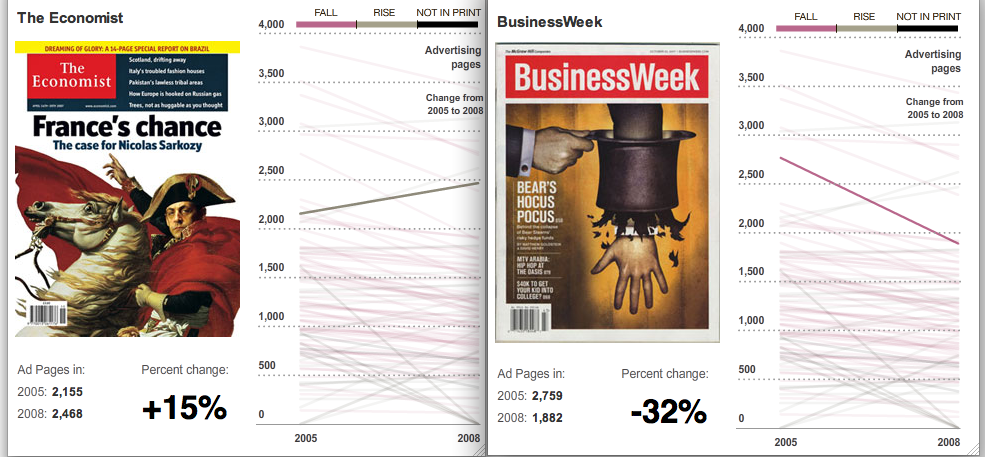
There is an interesting interactive graphic at NYT.com this morning on total advertising pages for magazines.

As you would expect, ad sales are mostly down for print. The one-two punch of the secular move to the internet and the cyclical effects of the recession are hurting ad sales. (Time and Newsweek are each down 24%).

What really caught my eye is how the different business publications are faring during the downturn and financial crisis. You might think that this should be their time — CNBC ratings are way up, versus during the 2000-03 Bear market, when they were way down.

I am intrigued by the fact that turns out not to be the case; There are clear winners and losers in this *list:

The Economist:  +15%
Barron’s: +3%
Harvard Business Review  -3%
Forbes: -17%
Fortune  -22%
Money: -25%
BusinessWeek: -32%

* These are print pages, not web; Missing from the list are Portfolio (around less than 2 full years), Smart Money and Kiplingers. I’d be curious as to how Wired is doing in advert sales. (Chris, is this public info?)

>
>

>

Source:
Mostly Gloom for Glossies
GRAHAM ROBERTS and HANNAH FAIRFIELD
NYT, February 1, 2009

http://www.nytimes.com/interactive/2009/01/30/business/20090201_metrics.html

Comments

Please use the comments to demonstrate your own ignorance, unfamiliarity with empirical data, ability to repeat discredited memes, and lack of respect for scientific knowledge. Also, be sure to create straw men and argue against things I have neither said nor even implied. Any irrelevancies you can mention will also be appreciated. Lastly, kindly forgo all civility in your discourse . . . you are, after all, anonymous.

27 Responses to “Business Magazine Advertising Pages”

  1. lg71050 Says:

    Too bad CNBC can’t do a better job. Liesman does good work, Gasparino is a wingnut and kinda thuggish, but he’s a great reporter. Radigan and Haines are ok, Fast Money is entertaining, but the rest of the crew is mostly a joke. Melissa Francis? Please. And The Kudlow Report continues to be the most hilarious hour on national television. Tax cuts !!! Mustardseeds!!!

  2. BrianSJ Says:

    Juzt a picky numbers question. Is the size of the magazine the same, or e.g. have some people cut content pages and kept advertising the same?

  3. DM RTA Says:

    The first quarter is beyond bearish for many broadcast companies. Put these two together (magazines and local broadcast) and the real question is how do you distinguish between cyclical (loud) noise and secular trends?

    What qualities define great content is being rethought as the blogosphere is influencing (permanently changing) how and what we consume. The harder the exclusive media outlets rage against “any nut can publish a blog!” the more people are reading broadly…

    Demand’s relationship to supply isn’t just a pesky detail.

  4. bytehead Says:

    Having watched CNBC from South Africa I’m surprised that they make any money. During my month there I think I remember at most two different companies advertising in one half hour, more likely one IF there was one, as the majority of the time that I watched there were none—they just ran promos.

    It was awhile before I realized that the hotel I was staying at was across the street from the Johannesburg Stock Exchange. And only because I recognized a shot of the building on CNBC. This AFTER a few walks around the area looking for the large mall that was supposed to be north of the hotel. It was west.

  5. Charlatan Says:

    If you were to arrange those publications in the order of least likely to feature a product like James Altucher’s “Rocket Stocks!” (i.e. the Economist) to most likely to feature such a thing (i.e. Businessweek), you’d end up with the same ordering as above. My point? Look, people have finally —— finally! —— been jarred into realizing that Wall Street and its pat notions about stock ownership are ways for a few people to make huge sums of money for themselves. So people are less inclined to want to read columns like, “Here are 5 stocks from your pantry to spice up your portfolio!!!”

  6. Mannwich Says:

    I’m one of those that picked up a subscription to The Economist and dropped Forbes and Fortune last year.

  7. Strassertalk Says:

    Cannot imagine that CNBC’s ratings are up. Most folks I talk with say they won’t watch it. Only two worth listening to are not CNBC: Art Cashin and Rick Santelli.

  8. carmen101 Says:

    I switched to The Economist last year. Dropped Barron’s, WSJ, and TIME.

    Lets see how long CNBC ratings can hold. Loss of interest can follow if this slump is prolonged. I’d be interested in a more detailed demographic of CNBC these days.

  9. AndrewShaw Says:

    What always surprises me in the WSJ is the amount of high-end watch ads. Is that business that good? You people have a lot of watches. Reminds me of the hooker in Risky Business, “You people have a lot of bonds”

    A recent story I saw about pawn shops showed the peril when a customer was trying to hock a Movado and the pawnbroker told him if it wasn’t a Rolex there was no offer available at all.

    Although 15 years ago a WSJ ad sold me on buying the classic Tiffany platinum solitaire for someone special, so I guess this stuff worked on me on some level, but some of these brands no one outside of Manhattan has ever heard of? (I guess the guy on Planes, Trains and Automobiles got something for his, but that was just a movie) I’ll keep my Swatch automatic, or replace it with another for $100, even if its not the best timekeeper.

    On CNBC, lots more as-seen-on-tv type product being advertised, must be a drought there.

    The other ads on CNBC really show that the whole damn thing is an infomercial really. Major sponsorship by the banks and investment companies that they cover. But who else would pay up? “The bond report brought to you by PIMCO”, interview later with Gross and AlArian…You know how it goes.

  10. constantnormal Says:

    I also subscribed to the Economist a few years back, and dropped Forbes last year.

    I have not been disappointed.

    Also allowed my print subscription to the WSJ to expire, but retained the on-line edition. Many years ago I did away with Barron’s, and Fortune only lasted a year with me a long time ago.

    There’s only so much room in my life for nonsense, and the changes in the WSJ since Rupert bought it were not to my liking.

  11. constantnormal Says:

    Looking at that list, I think that the web is hurting Forbes, Fortune, Money, and BW, as you can find content of equal or greater caliber on the web for free, with a more timely and convenient delivery.

  12. constantnormal Says:

    The web has a big advantage in ad presentation over print. A well-crafted web ad shows “the hook”, designed to snag their target market, in a manner that is not so “in-your-face” as a print ad must be, as there are no mouse-overs or click-thrus for print ads. Print ads tend to get tuned out or simply skipped over (as I do with the block of all-ads pages at the back of The Economist), whereas web ads can be mixed in with the content and get at least a glance.

    There are, of course, bad web page designs as well, packed with garish colors, pop-up windows, gratuitous animation, video, and the bane of the web, ads that shout at you through the speakers. Those I don’t return to, regardless of the value of their content.

  13. Gary Says:

    OT, but it’s weekend and you’ve got to see this: chartporn transposed on music!

    It was made with Microsoft Songsmith fed with stock charts.

  14. JohnnyVee Says:

    The Economist is a quality publication that does not pander to advertisers…at least not as much as the others. Also, the other publications got the recession/depression wrong and are being punished as readers realize they merely report truthiness not cold reality. CNBC? Well, I watch it too….while on the treadmill in the gym for market quotes not the verbage.

  15. going broke Says:

    CNBC is up? Who took the poll… NBC? But, they do have CNBC on the big screen where I get my haircut.

    OT: Here’s a monthly newsletter that’s gaining popularity. Been a subscriber for years now, very informative. Sometimes he comes off as a doom-n-gloom kind of guy but he’s just telling the facts IMO.

    http://www.gleasonreport.com/emails/2009-02-tgr.pdf

  16. Strassertalk Says:

    Idea of Howard Lindzon to shut CNBC down for a week:

    “There are just a few news sources that can move markets and unfortunately CNBC is one of them. With that kind of responsibility, should come close scrutiny. Instead, the network has gotten a free ride from regulation.” http://howardlindzon.com/?p=4023

  17. PrahaPartizan Says:

    BusinessWeek will be taking some hits as the advertisers learn that its former readers don’t particularly care to be fed the pablum doled out by the likes of Jack Welch and Maria Bartiromo. BW has cut back drastically on the number of pages of real news they’re publishing in their weekly, yet still gives three pages to these charlatans each and every week. When they were including 50+ pages of editorial, feature and economics columns in each issue, it wasn’t so bad. Now that they’re down to about 20 pages of reporting in most issues, such a large proportion just makes BW worthless as a must read.

  18. AGG Says:

    The Economist has been telling it like it is for some time so its’ readership is up. The NYT isn’t a magazine but this article says they are “getting it” about what to make noise about:

    Nobody can match Mr. Madoff for moxie, of course. And Allied is an actual company with a portfolio of assets that may be oversold. But between 2002 and 2008, while the S.E.C. did little about Allied, the company raised $1.5 billion from investors and lenders, paid its executives and directors handsomely and attacked anyone who dared criticize it.

    A spokesman for the S.E.C. declined to comment for this article.

    All this chicanery is obvious to cynics like me but this tale of constant, arrogant, in your face, highway robbery needs to be told until a LOT of people are in prison. Nothing else will do.

  19. zitidiamond Says:

    In case readers didn’t get it the other 25 times, the Washington Post once again opens its pages to Amity Shlaes and her idea that FDR prolonged the Great Depression:

    http://www.washingtonpost.com/wp-dyn/content/article/2009/01/30/AR2009013002760.html?nav=hcmoduletmv

  20. TheReformedBroker Says:

    they still publish businessweek?

    and people still read it? wow….why?

    the Boss just absolutely killed it…best halftime show in years

    back to the game

  21. How the Common Man Sees It Says:

    I assume the difference is both the philosophy of the publication as well as commoditization of ad space. As more companies can access these ad bidding spaces via the web I assume they will be more able to seek out the best value.

  22. Jojo99 Says:

    BW magazine size has declined significantly in the last year as their advertising has disappeared. They have a good web site and do have some good articles but their chief “economist” James Cooper is a joke who has been consistently wrong. Bartiromo gets to do a fluff interview every week and Jack & Suzy Welch’s column is simply pure pablum for management apologists.

    Wired mag size has also deceased a lot. I could always tell the state of the consumer tech economy by the thickness of Wired. They appear to have a great advertising sales staff. But the size of Wired these days confirms that the consumer tech market is dead for now.

    Forbes, Fortune and Money are unreadable to me.

    Some of these mags are going out of business or are going to have to merge.

  23. wunsacon Says:

    TheReformedBroker, yes, indeed. What a great performance. And the Cardinals? Oh, my god. I didn’t know they were that good. In fact, even though I was rooting for the Steelers, I’m not sure the best team won.

    I know a few people here said the bottom won’t be in until a few CNBC shows are canceled. But, what if some of these mags close? Would that be a “magazine cover indicator” or sign of a bottom? Or should we just interpret that as part of the decline of traditional media and not as the end of the bear market?

  24. OnlineBrokerReview Says:

    The Economist is the only must read print publication in my mind. Maybe my BS meter has just become more refined but BusinessWeek has really gone downhill for me in the last year or so. Every issue seems to be just filled with feel-good corporate America cheer leading puff pieces or just plain nonsense. In the latest issue there is an article titled “How the Google Model Could Help Detroit.” Seriously? I mean get lost if you are going to waste my time with that nonsense.

    I used to have so many publications that I could not keep up so I would end up tossing half of them after being unread. Nowadays I struggle to fill up my commute time with readable material.

  25. randyshamak Says:

    The content you have provided is pretty interesting and useful and I will surely take note of the point you have made in the blog.

    Today I was browsing the Internet for information on some additional means of promoting my website apart from online promotion which I have been doing. I then came across Web Windows and found that this was the most ideal solution to complement my online marketing strategy. I bought my newspaper ad space here as it has got a readership of millions and what could be a better opportunity than this to get a national coverage at half the cost of the rate card.

    I thought this information might be useful for anyone looking for solutions to get more traffic to their website at affordable rates.

  26. ottovbvs Says:

    I’ve been reading the Economist for 45 years. It was always outstanding and remains so. I hadn’t looked at Fortune for a few years and picked up a copy off a newstand at an airport a few months back and was shocked at how it had shrivelled. I used to be a great magazine but no more. Forbes is a Kudlowesque puff sheet for stock peddlers and the GOP and always has been. Business week is Economist Lite. I’d be very interested to know what’s happened to the WSJ circulation. They must have lost hundreds of thousands of bulk sale copies as all these financial institutions have foundered or slashed costs. I also suspect they are seeing desertions from trad readers like myself because the switch to general news. Basically it’s getting hard to tell the difference from the NYT or the Post in it’s general reporting.

  27. old trader Says:

    My pic for “hard copy duo” is the Economist and the Financial Times. If its not in either one of those, its probably not worth knowing about.

94 queries. 0.378 seconds.