
Case-Shiller: 2008 Home Prices Hit Record Declines

Email this post Print this post
By Barry Ritholtz - February 24th, 2009, 9:29AM

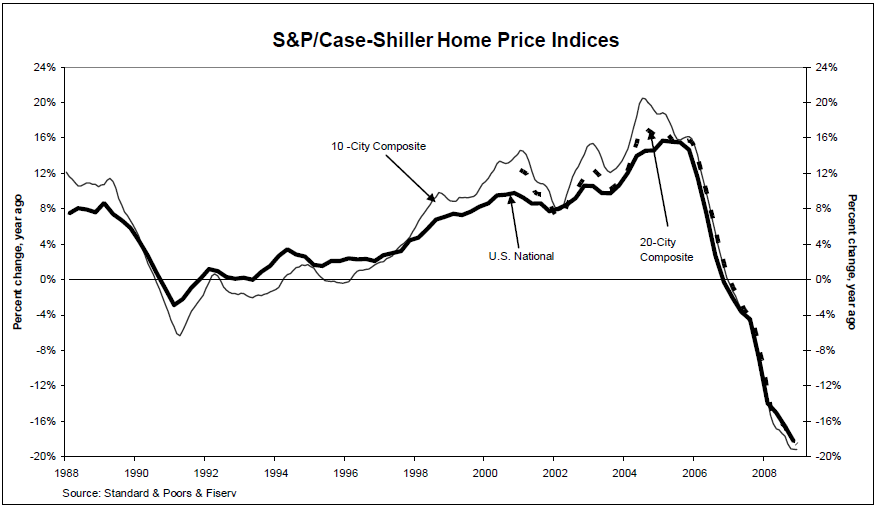
Data through December 2008, released today by Standard & Poor’s for its S&P/Case-Shiller Home Price Indices, the leading measure of U.S. home prices, show that the prices of existing single family homes across the United States continue to set record declines, a trend that prevailed throughout all of 2007 and 2008.

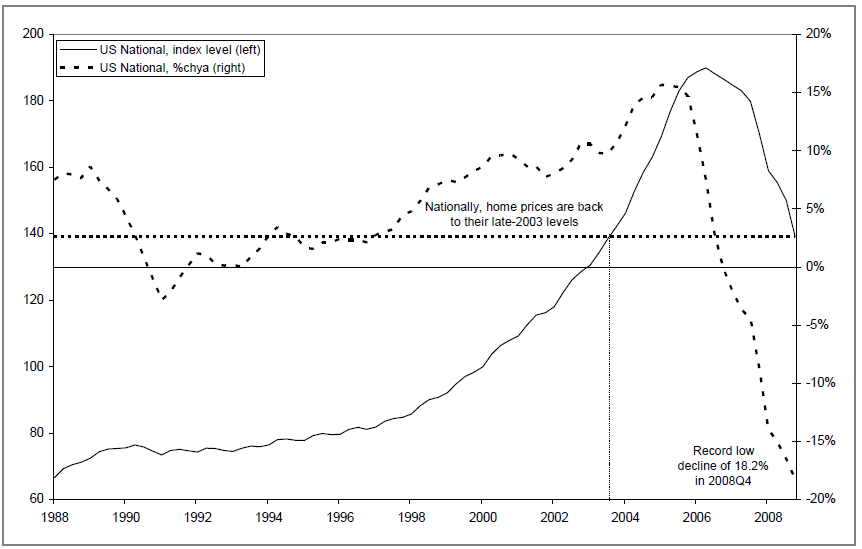
The decline in the S&P/Case-Shiller U.S. National Home Price Index declined 18.2% in Q4 2008 (vs Q4 2007); this was the largest in the data series’ 21-year history.

Year over year, the 10-City Index fell 19.2%, and the 20-City Composite fell 18.5%.

>

December 2008 Case-Shiller
>

The chart below shows that on a national basis, prices have returned to 2003 levels.

My working presumption is that these are skewed by the foreclosure driven price decreases in 4 areas: California, S. Florida, Las Vegas, and Arizona.

National Home Price Index
>

Source:
Nationally, Home Price Declines Closed Out 2008 with Record Lows
S&P, 2009-02-24 09:00:00

http://www2.standardandpoors.com/spf/pdf/index/CSHomePrice_Release_022445.pdf

http://www.homeprice.standardandpoors.com

21 Responses to “Case-Shiller: 2008 Home Prices Hit Record Declines”

  1. dearieme Says:

    Calculated Risk said “In many areas of California the builders can’t compete with lender REOs, since the lenders are selling REOs below replacement costs (including construction and all entitlements). As one developer said: “We can’t compete even if the land is free!”" So shouldn’t land there be approximately free?

  2. Paul S Says:

    And of course the REO’s are still way over priced.

  3. Jim C Says:

    If you are correct Paul, and the REOs are still “way over priced,” and dearieme is also correct, then it follows that material and labor costs must continue to go down.

  4. ben22 Says:

    BR,

    I think your assumption is correct in that saying the housing figures are at 03 levels across the country are skewed by some markets.

    I know in my area (philly suburbs/Delaware) they certainly aren’t at 03 prices. Then again, incomes here are generally higher than most parts of the country so it’s hard to say if we are still way overvalued, or just plain overvalued.

  5. edhopper Says:

    I no longer hear how prices in the New York are are immune to a decline. (That was usually explained by buyers from Wall Street and foriegners)
    But I still don’t see people believing that we are due for another 40% to 60% fall. Which we are. (Hint: Rents are still half home prices.)

  6. Paul S Says:

    Only material and labor costs for new houses must continue to go down.

  7. Peter Boockvar Says:

    The S&P CaseShiller 20 city composite home price index fell 18.55% y/o/y, slightly more than expected and its a new low for this cycle. All cities saw both m/o/m and y/o/y declines with Phoenix, Las Vegas, San Fran, Miami and LA leading the way y/o/y. Ironically, for those who believe that halting foreclosures or forcibly altering the terms of loans (as opposed to the voluntary modification on the part of the borrower, lender and servicer) is the way to go, the areas of the country that have had the highest rates of foreclosures and sharpest price drops will likely bottom first and will thus recovery the soonest. Either way, we’re not there yet but the quicker we get there however painful, the better off we’ll be and steps to artificially set a floor in housing will only prolong the inevitable.

  8. VennData Says:

    To the “working presumption” add Chicago with “…a staggering number of vacant homes…” and “165,679 [vacant] housing units…”

    http://www.chicagotribune.com/news/local/chi-foreclosure-blightfeb22,0,874184.story

  9. rktbrkr Says:

    With the sunshine states down 40% in many areas I’d say widespread jingle mail is a real possibility and if that happens it will end the debate about whether this is a recession or depression.

  10. Crankbait84 Says:

    Here’s a line chart for all the markets. It’s a little busy but interesting contrast of the bubble intensity across regions:

    http://www.newgeography.com/content/00621-case-shiller-housing-price-index-chart-december-2008-the-free-fall-continues

  11. mikesic Says:

    I know that the economy is supposed to really suck right now but I have been traveling a fair amount lately and have been to some fairly pricey places to eat….and they are all packed. I just got back from Hollywood FLA and hotels were mobbed, Jackson’s Steakhouse in Fort Lauderdale was jammed. No new construction projects but I saw no foreclosure or hardly any for sale signs. I would have thought that Hollywood would be like Middletown, DE… a place in between 2 major areas that benefit excessively from the housing boom and now is suffering. But it didn’t seem to be.

    Ben22 – I think we are slightly overvalued in Wilmington but we didn’t have the run up that other areas had. If BofA leaves (which i think it will, too onerous expense wise compared to Arizona charter) then all bets are off

  12. cfischer Says:

    Ben,

    In the same area as you.. Live in Philly(Manayunk) and work in DE. The prices are not at the 2003 levels but they certainly aren’t at the 2006 levels either. But we also never really had the run up either (for whatever reason) that Philly, NYC, DC and Boston all did.

  13. bonghiteric Says:

    Anecdotal from the western Philladelphia suburbs. There seems to be two markets here. The posted prices seen on Realtor.com, etc. and a growing short sale/foreclosure market. There is an increasing volume of homes on multi-acre tracts listed in the mid-upper six figures. Bids are being accepted that are a couple hunred thousand lower. This from the experience of a good friend who is actively looking.

    In my area I’ve seen a lot of for sale signs spring up. I’ve noticed it because it’s winter, and a colder one at that. Two acres of ground on the outer main line going for under $230K is a considerable reduction from where prices were 18 months ago.

  14. ottnott Says:

    Barry wrote: “My working presumption is that these are skewed by the foreclosure driven price decreases in 4 areas: California, S. Florida, Las Vegas, and Arizona.”

    I believe that you are correct.

    While the Case-Shiller methodology improves on median-price numbers by looking at price changes for resales of individual properties, it doesn’t correct for changes in the types of homes that are being resold.

    In many areas, it is the new housing developments and the low-price neighborhoods that are selling for huge discounts from peak and are dominating sales today. If those categories accounted for 60% of sales today, but only 40% of sales a year ago, they would have an oversized impact on the Y-O-Y change in the C-S index.

    http://piggington.com/ , which provides excellent analysis of San Diego housing prices, has a graphic indicating that the increase in sales volume between Jan 08 and Jan 09 was 3% in the 20 most expensive zip codes and 87% in the 20 least expensive.

    My anecdotal report is that my part of San Diego (least expensive portion of an expensive area) is probably down 20% from the peak, but half that 20% is in the last 4 months or so.

  15. pmorrisonfl Says:

    > Jackson’s Steakhouse
    I worked in the same building as Jackson’s a decade ago, still live in Broward. I’d say the prices and clientele of Jackson’s make it a less than ideal venue for sampling the state of the local economy. There certainly are a lot of people eating out in Broward… and I drive by several closed Starbucks as well.
    Hollywood is pretty settled, you have to go West (or North, or South) to see the rampant ‘for sale’/foreclosure signs (altohugh they’re there in Hollywood if you look). South Florida is its own little planet, so it’s hard to draw conclusions from any sample you take.

  16. Paul S Says:

    Thanks for the perspective pmorrisonfl. I had an inkling that the locale described was “higher end”.
    These are the folks who benefitted the most from the past 7 years.

  17. Mark E Hoffer Says:

    Paul,

    to get technical, not so much higher-end, as ‘older, been there longer, more settled’–read: way more Equity build-up/ lighter Notes to tote..

    had in Uncle in Hollywood who blew in ’005 b/c ‘it was getting too crowded’

    bhe,

    you make a good point about there being two markets. the Retail/MLS advertised one, and the, more informal, Auction/FSBO/REO one…as you mention, a huge delta ‘tween the two..

    cfischer,

    when I first heard of the ‘reverse-commuting’ trend, about a decade ago, I was thinking to myself: “Now, that’s intelligent.” little surprise to see one at TBP..

  18. Mike in Nola Says:

    My question is how the cities in the survey were chosen? Was it the bubble areas or what?

    I finally looked at the source S&P document out of curiosity to see how Houston was doing and found that it’s not included. It’s 4th largest city in the country? Can hardly be called a good sample.

  19. pmorrisonfl Says:

    > to get technical, not so much higher-end, as ‘older, been there longer, more settled

    To get annoyingly technical, you’re exactly right about Hollywood, and for the right reasons… but Jackson’s is the other kind of higher end. It’s in the same building as H. Wayne Huizinga’s offices. Later I worked in a building across the river, where one of the guys had binoculars. He’d watch who was getting on and off HWH’s helicopter, and call out the celebrities. Marino, Elway, etc.

  20. rktbrkr Says:

    Interesting article about cash sales in the sun bubble states. An indication how heathy our banking system is when you need 50-100% cash to buy a home in these areas (but a couple years ago you didn’t need a farthing!)

    http://online.wsj.com/article/SB123552303469165085.html

  21. binkys Says:

    Here in Manhattan (NYC), prices have not reverted to 2003. However, I expect them to. There was overbuilding. We did not have an issue with sub-prime and liar loans because the majority of our housing stock is co-operative apartments. However, the hit that Wall Street is taking will soon reduce housing prices here also as the finance industry shrinks.

78 queries. 0.602 seconds.