
GDP Goosed By TARP (Maybe)
Over the weekend, a hedgie friend added to our understanding of how bad GDP really was.
We already knew that the rise in inventory contributed 1.29% points to GDP growth. Without the inventory build, the GDP number would have been down 5.1%.And, it means that we are likely looking at a very ugly Q1 GDP.
What we also knew that the deflator fell 0.1% — the first decline since the 1954. If on top of inventories, the deflator had risen 0.4%, as consensus expected, GDP would have been down -5.6%.
What else was buried in the GDP report besides inventory and falling prices that was artificially goosing the data?
The answer? TARP. It turns out that the TARP money given to banks as recapitalization was a major factor in the total GDP number. (but see update below)
How? Uncle Sam buying a financial asset does not contribute to GDP under normal circumstances. But the Treasury purchased these assets at prices discounted to market prices. (Not as cheap as Buffett’s purchases, but still at somewhat of a discount).
The Bureau of Economic Analysis, my hedgie friend informs me, records this purchase as a Capital Transfer — its the difference between the price paid and the fair market value. Capital transfers are based on Congressional Budget Office estimates, by reducing net government borrowing or lending.
From the Technical Note of the GDP release:
Troubled Asset Relief Program
In October 2008, the Emergency Economic Stabilization Act of 2008 established the Troubled Asset Relief Program (TARP). Among its provisions, the act authorized the Department of the Treasury to purchase or insure up to $700 billion in assets to alleviate the financial crisis. By the end of the fourth quarter, the program had disbursed $243 billion to banks and other institutions in exchange for shares of preferred stock and warrants. The program also disbursed a $4 billion loan to General Motors in the fourth quarter.
Purchases of financial assets are generally not recorded in the GDP accounts (though they appear in the Federal Reserve’s flow of funds accounts). However, when the Treasury purchases a financial asset (other than a loan) at more favorable terms than are available in private markets, BEA records a portion of the purchase as a capital transfer, calculated as the difference between the actual price paid for the financial asset and an estimate of its market value. This treatment is consistent with the recommendations of the newly updated international guidelines, System of National Accounts 2008. For the fourth quarter, in most cases BEA’s estimates of these capital transfers are based on Congressional Budget Office estimates, which are prepared on a net present value basis. The recording of a capital transfer in the GDP accounts does not affect GDP or net government saving, but does reduce net government lending or borrowing.
The data on capital transfer payments do not appear in the GDP news release tables, but will be presented on BEA’s Web site in NIPA tables 3.1 and 3.2 and in underlying detail table 5.10U. (emphasis added)
Let’s go to the table 3.1:
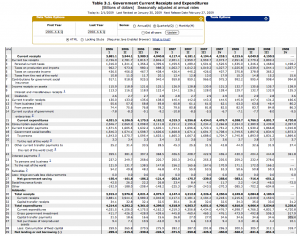
Update: Since GDP is reported as a quarterly data point, the “change in capital transfers from 3Q 08 to 4q08 was net $271 billion.” Meaning, this was about 8-10%. of the reported US economic activity — a significant (and artificial) goosing.
And there you have it: Pour billions of dollars into insolvent banks, goose the GDP for your troubles.
Ain’t DC grand?
>
UPDATE: February 2, 2009 2:15pm
Several readers have told my that BEA does not book TARP purchases as a GDP booster.
Quote: “These investments are being booked on the government’s accounts at “fair value” but they have no impact on GDP.”
I’ll see if I can verify this further . . .
>
Source:
Technical Note
Gross Domestic Product
Fourth Quarter of 2008 (Advance)
January 30, 2009
http://www.bea.gov/newsreleases/national/gdp/2009/tech408a.htm
Gross Domestic Product (GDP)
8:30 A.M. EST, FRIDAY, JANUARY 30, 2009
http://www.bea.gov/newsreleases/national/gdp/gdpnewsrelease.htm
http://www.bea.gov/national/index.htm#gdp



February 2nd, 2009 at 7:11 am
As I understand it, D.C. is built on a swamp inhabited by sinister, cold, black-eyed predators, who feed on their children, in the dark.
February 2nd, 2009 at 7:59 am
Readers of this post are probably wondering why Barry left off the concluding paragraph. Here it is:
“The change in capital transfers from 3Q 08 to 4q08 was net $271 billion. (see line 36). In a $14 trillion economy this is a delta of almost 2%. It also doesn’t foot with the discussion above, because obviously the capital transfers can’t be greater than the gross transfer. Anyway, figure it out yourself as I am off to the next post.”
~~~
BR: I’m not sure I understand what you are quoting, but you seem to be misunderstanding GDP data relative to the overall economy.
Yes, it is a $14Trillion ANNUAL economy — but GDP is reported as a quarterly data point — meaning, niot not a $14 trillion annual number, but rather a $3.5 trillion quarterly release.
That makes this transfer have a delta closer to 10%. I assume you will acknowledge that 10% of a Q for the US economy is a significant (and artificial) goosing ?
February 2nd, 2009 at 8:09 am
Wish I had incorporated my own bank. Make some crappy loans & later line up for some TARP.
David Malpass stumbling and bumbling on CNBC right now.
February 2nd, 2009 at 8:50 am
Mannwich:
The world economic news is even grimmer…
It is the D word. We were right.
But the thought that comes to mind is: now what?
February 2nd, 2009 at 9:14 am
BR-
thanks for the reply.
A few questions still outstanding:
1. Is line 36, labeled “capital transfer payments,” the correct line item?
2. If so, why is the increase from 3Q larger than the total amount disbursed by TARP?
3. Doesn’t question 2 imply that the amount gifted to banks was greater than 100% of the amount given them by TARP, and isn’t that an impossibility?
4. Wouldn’t a 2% quarterly delta indicate a ~ 8% annualized delta, so GDP for 4Q would have been off 13% with TARP and inventory adjustments backed out?
5. Does anyone think that GDP actually shrank 13% annualized in 4Q?
February 2nd, 2009 at 10:12 am
@Bruce: Had a hard time sleeping last night for that reason. A little sick to my stomach thinking about the coming week(s). Batten down the hatches.
February 2nd, 2009 at 10:44 am
When I was a teen my father gave me a book “Think and Grow Rich” by Napoleon Hill. The one line I remember most was…90% of the things we fear most never actually happen. Let’s hope to God that is true. Otherwise long guns and ammo. All The Best
February 2nd, 2009 at 10:48 am
Okay, let me see if I’ve got this straight—the GDP numbers were goosed by TARP because of the great deal the government got on the assets it purchased at “below market” prices?
LMAO.
It should actually swing the other way, sorta like that Steeler touchdown before the half, and the GDP numbers should be lowered because of the money the government spent buying orphan assets NOBODY else wanted. “Below market?” Show me some buyers in this phantom market. Otherwise the assets are worth shite.
February 2nd, 2009 at 10:58 am
I dont think TARP money was counted towards the GDP Figure.. from table 1.1.5 in the site, annualized GDP for Q4 was 14264.6 which has a Government Component of 2914.9 – Sum of Consumption expenditures of 2397 (Item 16 in table 3.1) and Gross government investment 517.9 (Item 35 in the same table).
The TARP Money in line 36 doesn’t actually flow through to the Final GDP Calculation.
This is not a case for the accuracy of the GDP numbers, but just that the TARP issue highlighted in this post is a red herring.
@ johnhaskell: I am guessing the 305.4 Billion is the estimated net transfer or capital through TARP.. That is to say BEA estimates they will overpay for the crap assets they buy from banks by 77% give or take…
February 2nd, 2009 at 11:15 am
The Woodsman
“…90% of the things we fear most never actually happen.”
But the 10% that do kill you!! This is the point Mr Nassim Taleb has been going on and on about recently
February 2nd, 2009 at 11:37 am
Highside, We are definitely in the cross hairs of something most of us have never experienced… scary times no doubt.
February 2nd, 2009 at 11:41 am
On Stocktwits they are going to boycott CNBC tomorrow. Too much misinformation being passed on to listeners. FYI
February 2nd, 2009 at 12:04 pm
OK fellow decoders, who read this headline this morning, and do you see anything that might be reported in a misleading manner?
http://finance.yahoo.com/news/Manufacturing-index-for-Jan-apf-14223052.html
Manufacturing index for Jan. rises from record low
OK…times up…35.6 is the reported number….it is still falling off a cliff…
The writer could have said something like…”Manufacturing index still declining at severe rate, but rate of decline slows slightly from last month…”
In order for the headline as written to be true, the ISM would have had to be >50…
OH, WELL….
February 2nd, 2009 at 12:08 pm
“BEA records a portion of the purchase as a capital transfer, calculated as the difference between the actual price paid for the financial asset and an estimate of its market value. ”
It makes sense to me that a mark-to-make-believe asset would improve a fantasy-league GDP.
February 2nd, 2009 at 12:13 pm
Barry:
You’re just wrong about this. A Commerce Department official confirms that the TARP investments are being booked on the government’s accounts, but there is no impact on GDP from these investments. Capital flows are not part of GDP, which is a measure of output and spending.
The technical note you quote also says clearly that “The recording of a capital transfer in the GDP accounts does not affect GDP or net government saving, but does reduce net government lending or borrowing.”
–Rex
February 2nd, 2009 at 12:14 pm
The CBO already said that the first money spent in TARP cost an estimated 68Billion in Subsidies……that would mean they bought them at ABOVE market prices….so how are they saying they bought them at a discount?
February 2nd, 2009 at 12:25 pm
I don’t follow the argument. You’re suggesting that TARP ($270) would have added 7% to the GDP in Q4. You really think the economy would have dropped 10.8% (-7-3.8) Q4? More likely, we’re seeing some of the $350b seeping indirectly back into the economy contributing 1% to GDP (-3.8% rather than the expected -5%).
February 2nd, 2009 at 1:11 pm
Barry – just got off the phone with Brent Moulton, the author of the technical note on 4Q08 GDP you cited, and he confirmed that the line item your are referring to absolutely, positively does not get included when calculating GDP. So, either the BEA is lying about how they calculate the number or your buddy gave you some bad info. You may want to check this one out further.
Keep up the good work.
February 2nd, 2009 at 1:19 pm
dogtown- thanks.
I guess the reason I thought this post didn’t make sense is because… it didn’t make sense.
February 2nd, 2009 at 2:30 pm
Paul Krugman on bank bailouts:
http://www.nytimes.com/2009/02/02/opinion/02krugman.html?_r=2&ref=opinion
Krugman is against Obama’s plan, which will reward stockholders and bondholders at the expense of taxpayers.
I usually don’t agree with Krugman; but in this case I’m glad to see that the taxpayers’ interest is of concern to him.
February 2nd, 2009 at 3:18 pm
My favorite restaurants were nearly empty in Q4, now they are full again. There was extreme fear the last 2 quarters of ‘08 because the headlines were full of banks failing, somber politicians, and total uncertainty of what centuries old blue-chip institution would fail next. That fear and uncertainty has come down now. I wouldn’t be surprised if we remain in mild recession for several more quarters, but realize that the worst is over.
February 2nd, 2009 at 6:31 pm
There is a lot of talk going around if TARP funds pump up the USA GDP.
There is not much proof in this; lets quote from the technical note from BEA that once more proofs it is debt that rules and nothing but debt:
This
treatment is consistent with the recommendations of the newly updated
international guidelines, System of National Accounts 2008. For the fourth
quarter, in most cases BEA’s estimates of these capital transfers are based on
Congressional Budget Office estimates, which are prepared on a net present
value basis. The recording of a capital transfer in the GDP accounts does not
affect GDP or net government saving, but does reduce net government lending
or borrowing.
Source:
http://www.bea.gov/newsreleases/national/gdp/2009/tech408a.htm
We see: just another monkey coming out of the sleeve of US debt, no artificial GDP pumping up but the decade old minimizing the debt is what we observe…
February 2nd, 2009 at 11:45 pm
I’ve just had one of theose “light bulb” moments when it seems like the financial problems we have are clear and solvable. TARP was a trigger event which convinced a huge number of people that we are in dire financial straights. The 90% of the people stopped spending and started saving for the following two reasons:
1) The upper 10% who benfit from all the lower 90%’s purchases had squandered the profits and wanted the lower 90% to subsidize them.
2) The lower 90% realized that the upper 10% are in firm control of the government so no help is coming.
This panics the upper 10% because it flips Ayn Rand rich psycho phsychology on its’ head. Take the following quote which is the justification of the rich for lacking compassion:
“When half of the people get the idea that they do not have to work because the other half is going to take care of them, and when the other half gets the idea that it does no good to work because somebody else is going to get what they work for, that my dear friend, is about the end of any nation. You cannot multiply wealth by dividing it.” John Gault/Ayn Rand
Now look at the same quote in the present TARP context:
When 10% (the rich) of the people get the idea that they do not have to work because the other 90% is going to take care of them (i.e. do all the work), and when the 90% gets the idea that it does no good to work because the upper 10% is going to get what they work for, that my dear friend, is about the end of any nation. You cannot multiply wealth by dividing it.
You see, Ayn, we know what you, Greenspan and the Paulson types wanted all along; Own the government and fuck the people while you elite bastards sit back and bitch about how little we work. It’s pay back time. The lower 90% is ready and willing to work. However, you upper 10% will have to get used to paying us for it.