
Job Losses in Post WWII Recessions

Email this post Print this post
By Barry Ritholtz - February 9th, 2009, 11:00AM

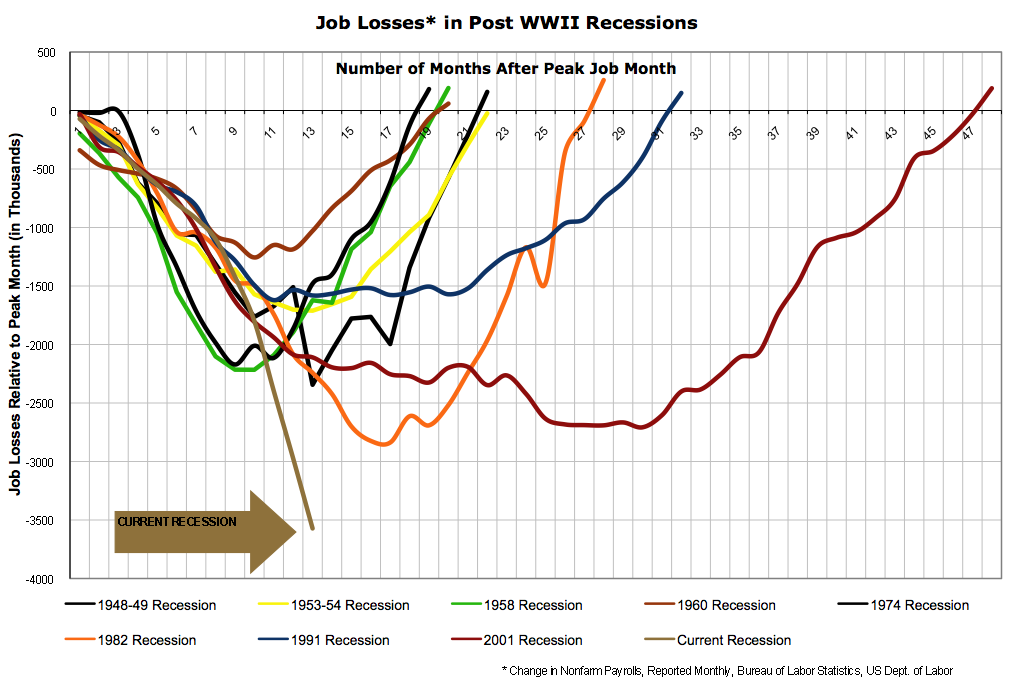
Over the weekend, we ran this chart comparing Job Losses this recession versus the prior two recessions. Today, we look at the same concept, only going back to ALL post WWII recessions

>

Amazing chart: Job Losses in Post WWII Recessions
Hat tip to Matt G. (via Swampland & the Speaker’s Office).

>

UPDATE: February 9, 2009 12:03 pm

Have a look at this chart via Calculated Risk;
The Red line at bottom shows job losses as a percentage, not total numbers.


45 Responses to “Job Losses in Post WWII Recessions”

  1. John from Concord Says:

    I’m still going to be really skeptical of this one until I see those losses expressed as a percentage of total jobs vs absolute numbers. There’s no way 1948 is comparable to today in terms of absolute numbers. This really feels like propaganda, Barry.

    ~~~

    BR: Here is the percentage changes.

    In the future, go to bls.gov or economagic.com, pull the data, and figure out the percentages.

    Your unsupported accusations of propaganda embarrass yourself. Next time, roll up your sleeves, and disprove the chart.

  2. ThomasK Says:

    It does look rather bad but shouldn’t we also take into account the size of the population? I guess more people than ever (in abs. terms) had a job at the outbreak of the current recession.

  3. dgov Says:

    That these numbers aren’t expressed as a percentage of total jobs is the only thing you need to know about this chart. Without adjusting for the total number of jobs, there is no way to know if the chart is meaningful.

    Barry, why would you post something like this?

    ~~~

    BR: Because the chart is very instructive to an astute reader.

    Let me ask you this: Why on earth would you suggest the percentage would show something else if you obviously have not done the homework on this.

  4. donna Says:

    Yes, it’s all just statistics unless it’s YOUR job, huh guys?

    Sheesh.

    ~~~

    BR: Donna, its statistics even if it is YOUR job. Objectivity is the key to understanding the data.

  5. Barry Ritholtz Says:

    1. The chart shows that the 2001 recession/job recovery was much longer than the 1991, which was much longer than 1982. Why would you think that is not significant?

    2. Population is irrelevant, what matters is total civilian labor pool. Do you believe that the population OR the Labor Pool is so much larger today than it was 6 years ago? How about 18 years ago? We are discussing minor differences in total employment.

    3. On a percentage basis, we are MUCH DEEPER than 2001 and 1991, and we are now about as deep as 1973 and 1985 — and they were already in the process of turning around. We show no signs of that yet.

    If you are going to make accusations, you may wish to do some actual research first.

  6. tranchefoot Says:

    Barry, I have to concur. It’s at best lazy and at worst irresponsible to not normalize the data in some way. Overall, I am a huge fan of your blog, tho…

    ~~~

    BR: Chart added above; “normalized data” looks even worse . . .

  7. mike j Says:

    Yes, one VERY notable thing is the increasing length from peak to regained-peak. There’s a fair chance (based on this graph, trajectory, and my wild-ass guess extrapolation) that we don’t regain Dec 2007 employment levels until 2016.

    Let that sink in a bit . . .

    -Mike J

  8. Transor Z Says:

    Here are some benchmark figures from economagic.com

    57.1 mil (1950)
    63.4 mil (1960)
    74.3 mil (1970)
    96.5 mil (1980)
    116.9 mil (1990)
    133.5 mil (2000)
    147.3 mil (2009)

  9. DeDude Says:

    Yes forget the magnitude even though it may get to look a little better if you normalize to some population or workforce number. The issue is the length. If you still 14 month into it are going straight down how long will it take to recover? That is what is scary and useful for investors.

  10. Transor Z Says:

    7.6% unemployment (quick and dirty):

    4,339,600 (1950)
    4,818,400 (1960)
    5,646,800 (1970)
    7,334,000 (1980)
    8,884,400 (1990)
    10,146,000 (2000)
    11,194,800 (2009)

  11. Barry Ritholtz Says:

    Thank you Transor Z !

  12. Transor Z Says:

    No problem. I always end up doing the grunt work to move deals forward in my r/l work (“taking the high road”), so why not in my alter-ego screw-off blog life? :-)

  13. Joe McCann Says:

    Right, but isn’t the current population much larger and the workforce as well? I mean it’s like comparing drug abuse in the 70s in the overall population say (1 million people) and now, in 2009, it’s like 10 Million. Just a hypothetical example…

    I guess I would like to know the data for all the prior recessions in terms of total population, unemployment %, etc…

  14. 10 cc Says:

    Curious how prior to ‘82, they all look fairly similar; at least in duration. Something to do with having a real economy maybe? I bet many of the younger folks here aren’t even aware that there was once a time when “laid off” didn’t necessarily mean the same thing as”fired”. Back in the day, when we had business cycles instead of credit cycles, when things slowed down you might get “laid off” at the plant for awhile but when things picked up again, chances were good that you’d actually get called back to your old job. Geezus, that era seems like eons ago now.

  15. Barry Ritholtz Says:

    See chart above

  16. flibby Says:

    This graph presents this recession as significant in part due to the normalization (not to population), but to the peak employment. Remember all that talk of the jobless recovery? It gets amplified in this characterization.

  17. Halp Says:

    That quick graph decline scares me, too, no matter how you parse it. And I don’t think the Gov’s plan is going to fix thing faster. Instead I think it’s going to prolong the problems because I don’t see it helping us to produce.

    And the way the bond markets and dollar are going it’s not looking good for the USA.

  18. nb Says:

    Impact of Outsourcing on Job Recovery???? Would be curious to hear if we see the below mentioned trend continue or reverse?

    Length of time it took to regain all jobs lost. That is for the line to come back to zero.

    1974 – 19 months
    1981 – 28 months
    1991 – 32 months
    2001 – 48 months

    As you can see, each subsequent recession has taken longer time to regain all lost jobs. One reason that I can think of, in each recession, US became more open to out-sourcing and it took longer to gain job in US. If this is valid and trend continue, this will not only be deeper job recession but would take much longer than all earlier recession.

  19. tranchefoot Says:

    Thanks for the second chart, Barry. The YoY line is especially scary.

  20. dead hobo Says:

    The most striking thing I see is that for most peaks, there is a rapid rate of decrease, some go down as fast as they went up. The others decline nearly as rapidly.

    Note that the unemployment rate chart is peaked, not plateaued. A plateau would signify a lengthy downturn. A peak is a periodic downturn followed by a recovery. Most of these peaks are pretty sharp. If the past can be used to predict the present, jobs will come back at a rate as quickly as they went away. Once the unemployment rate starts to improve, it should continue to improve.

  21. dead hobo Says:

    re my previous comment:

    UNLESS THIS TIME IS DIFFERENT.

  22. dead hobo Says:

    Also, I just remembered basic econ. The natural rate of unemployment is maybe 5% … correct me if I am wrong – I probably am but this number is close. Unemployment today is a little over 7% – I don’t know the exact number.

    Thus, using the frictional rate as a zero base, from one perspective the rate of unemployment at this time is about 2.5%. This is not good news if you are in that group, but it’s not the End of Times either.

  23. rob Says:

    I’m really pleased to see all this bullish arguement with Barry! It tells me everyone is so optimistic that we’ve bottomed and railing against BR for any bearish twist to something. To which Barry has to argue his point on everything. Ahhhh…. seems like old times and we know how that turned out. Me thinks I’ll stay short.

  24. Bruce N Tennessee Says:

    @Dead Hobo:

    Shoot, the end of times doesn’t even start until early April…

    About April 15th, as I recall…

    Seriously, about that, I wouldn’t even hazard a guess as to the decrease in tax revenue this year..

  25. dead hobo Says:

    Last comment:

    Things aren’t good, but I wonder how much of all the complaining and hand wringing about the economy has as much to do with some kind of pussy factor as it has with objective analysis?

  26. km4 Says:

    The most amazing stat is once US comes out of this recession/depression ( when ? ) I frankly don’t see many of these jobs coming back in light of continued outsourcing and downsizing where other nations are competing better and smarter for jobs ( and I’m not just talking about manufacturing in China and back office jobs in India ).

    We’re now in the the 21st century ‘knowledge economy’ so BOL to many many Americans who are looking to make more than a $40-50K service based job.

  27. skardin96 Says:

    This chart is missing something…like how much Fed spent on both Gulf War & Iraq War affected the last two recessions. Instead of begging congress for bailouts, we get wars as substitutes. Anyone want the challenge on creating a chart that correlates war economy vs recessions/employment?

  28. Marcus Aurelius Says:

    There’s no way to square one time period with another – there are simply too many variables.

    On an anecdotal level, I understand there are lines at the unemployment offices in several states, and that welfare rolls are also growing. In addition, several states cannot keep up with new unemployment claims (this, despite the fact that much of the process has been automated/computerized – something earlier periods of unemployment didn’t have). California (arguably the world’s 8th largest economy) has gone teats up.

    What’s really going to shock the doubting Thomas’ here is when recovery doesn’t happen as it has in the past. This time, we’ve hitched our wagon to the troika of debt, globalization, and consumerism – there’s no telling what course these crazy horses will run.

    I suspect the citizens of Rome also thought everything would return to normal eventually – as they always had.

    Until they didn’t.

  29. John from Concord Says:

    Barry, if I had been accusing you of propagandizing-with-intent I would have been a hell of a lot more forceful. I wasn’t and I apologize if my first comment came across that way. The Calculated Risk chart provides excellent context; thank you for adding it.

    ~~~

    BR: I’ll add another version –t he depth doesnt look as bad, but the duration is horrific . . .

  30. Super-Anon Says:

    Note the correlation between Federal Reserve activism in preventing recessions and the severity and length of recession.

  31. ThomasK Says:

    Here it is in percent decline:
    http://curiouscapitalist.blogs.time.com/2009/02/09/comparing-this-recession-to-the-last-five/

  32. Bruce N Tennessee Says:

    I came across this from Barry’s bud, Paul Kedrosky, read the entire thing, and it seems to have at least a modicum of common sense in it..

    http://baselinescenario.com/2009/02/08/baseline-scenario-2909/

    The Baseline Scenario

    “5. There is no “right” level of debt, so we don’t know where “deleveraging” (i.e., the fall in demand for and supply of credit) will end. Debt could stabilize where we are now or it could be much lower. ”

    I thought this idea, that there is no right level of debt was interesting…somehow I don’t see debt stabilizing where it is right now…

    As an update about my buddy who manufactures rubber parts for the automobile industry…he and I talked this weekend..he’s laying off more people, and at this point will not make it until the end of May…from an old thread..

  33. Todd Says:

    Considering most of the recessions are not credit crunch induced recessions, this time is different. What I find surprising is the speed or lack of lag time where unemployment accelerates in the rate of unemployed.

    If there is a lag time, and there should, we can only expect even bigger numbers to come. I’m left wondering how big a multiplier the credit freeze up is going to have on unemployment numbers.

    In the more recent past credit crunch recessions involved the rate of credit not growing fast enough, credit only growing at 1% as opposed to 3-4% or 7% since the 80’s. We could be on the verge of negative credit growth, the main question is will GDP fall faster than Credit growth falls. The other questions is if credit growth goes negative, how will it be stopped. The fed has very little power in the creation of credit.

  34. JohnnyVee Says:

    skardin96 Says: @ 1:31 pm

    Good point! With the war in Iraq and Afgan, the gov’t has been stimulating the economy for some time. We actually went into this recession with the gov’t spending $1billion on war effort.

  35. spigzone Says:

    I wonder what that chart will look like in 2012 when there are 20 mbpd less oil in the world.

    What economic and political landscape will emerge from that reality?

    http://www.arabianbusiness.com/545723-oil-output-could-fall-by-30m-bpd-by-2015 … and that’s raw production, not what’s available in the world market … whose days are very very numbered, I am to be thinking.

    I know what that landscape would have looked like under McCain/Palin – a full on oligarchic police state.

    The BIG question is what landscape will emerge under Obama/Biden.

  36. Paul S Says:

    Looking at YoY changes in the percentage chart, no other recession had the increasingly steepening downward curve that this one does- all were either straight rates of decline, or if they did curve- had inflections in them where the rate improved slightly before continuning down. 1974 is agood example of this inflection.
    Also, it seems this recession had a “pre-recession” job loss that the others seem to lack- job losses began apace in early 2006, and the rate of loss now has doubled beginning in 2008. Again- looking at 1973- there was a sort of “pre-recession” job loss, but nothing to compare with the scale of what began now in 2006.

    If the current trend compares proportionally to 1974, then we are looking at at least a 6% reduction in the workforce which will continue into 2010.

  37. How the Common Man Sees It Says:

    The second chart is great but something tells me it still has to be adjusted for boomers. I’m wondering if someone has done a demographic breakdown as well. That may also be a study you want to pursue Barry is how this whole recession is affecting the boomers as a group. I think a light needs to be shone(I think that is the first time I’ve ever typed that word in a sentence) on them because social troubles that surface in that group over the next decade will be hard to correct. We can joke about Walmart greeters but that will be the rosy scenario for many of them

    “5. There is no “right” level of debt, so we don’t know where “deleveraging”

    I would tend to agree. To say there is a right level of debt is to say there is a proper amount of theft from your future earnings because that is who it is coming from. That is, unless you can get away with sticking it to your creditors

    @Todd Says: February 9th, 2009 at 2:08 pm

    We could be on the verge of negative credit growth

    Negative credit growth? Is it possible for something to grow in the negative? Are you a government mole?

    I think we’re going to have to give you an Orwellian doublespeak penalty there bud.

  38. sinomania Says:

    What about the impact of the baby boom generation? The recessions from 1974 on affect the same group of people primarily — the baby boomers. By 1947 population growth in the USA was almost 2% with over 2.7 million increase. By 1950 growth was over 2% with an over 3 million increase.

    65 years was only 1944. Those born in 1950 will be 65 in 2015. The last real big year of the baby boom say 1961 – those workers won’t be retiring until 2026 or 2028 when they turn 67! Unless there is some amazing new bubble with all sorts of new jobs created I don’t see how employment can pick up for many many years.

  39. Scott F Says:

    Adjust for population, adjust for labor pool, adjust for baby boomers — you guys really want to make this chart worthless.

    In 2008, the market had its worse year in 8 decades — why would you be surprised that emplyoment looks horrible? The economy is a disaster. (And I am long CSCO and MSFT)

  40. Transor Z Says:

    So in corrected terms we don’t know yet how this will compare with the scale of job losses during the 1982 and 1973/74 recessions.

    @ Paul S: There was no “pre-recession job loss” from 2006. There was a marked slowing of job growth but still in the positive. Big difference.

    How much was retail and financial services employment boosted by the credit bubble? The 73/74 and 82 recessions killed heavy industry — now it’s their turn. Poof.

    As many comments on other threads have pointed out, that leaves us looking for The Next Big Thing. U.S. innovation has been focused on productivity, not production.

    I find it hard to believe that building a wind farm off the Mass. coast is going to put America back to work.

  41. ben22 Says:

    My god, some of you people could take down Dennis Kneale. Maybe even Kudlow.

    How about instead of getting caught up on the population today compared to earlier or the percentage of jobs comapred to earlier you just take a look around. No reserach required to see how bad people are struggling right now.

    the economy is crashing, falling off a cliff, this quarter looks worse than the last, which was a nightmare.

    unemployment is still accelerating, this isn’t the end.

    And I highly doubt anyone on this blog remembers what it “felt like” in 48.

    Sorry, this was my rant for today.

  42. Todd Says:

    @Common Man
    Guilty, got caught up in econo-speak. Not as bad as newspeak where negative budget growth is still positive budget growth, just not has positive as planned.

  43. The Curmudgeon Says:

    Another very relevant metric is the participation of women in the workforce since the 60’s, which recently peaked and fell somewhat, as I recall.

    I think the employment numbers here told speak of a very different economic growth picture than that of a relatively minor hiccup as we’ve generally seen since the Great Contraction. Something new is afoot. Where it leads only time will tell.

  44. How the Common Man Sees It Says:

    Adjust for population, adjust for labor pool, adjust for baby boomers — you guys really want to make this chart worthless.

    Don’t blame us, it’s all Barry’s fault. His teaching has gone and made econoskeptics of us all. This chart was just a test to see if we’d attack when provoked ;)

  45. johnbougearel Says:

    Matt G’s Swampland chart merits the following comment that BR, NB, mike j, km4, and dedude all picked up on:

    Because the business cycle has been smoothed out, the job recovery in 2001 (in brown) took almost 4 years to rebound. The next longest recovery cycle from net shedders to net creators of jobs was 1991. It took 32 months to get jobs back. The 1981 recovery (orange) from net shedders to net creators of jobs was swift, taking roughly 10 months. The total cycle was 28 months. The problem is once jobs are lost in the new economically flawed paradigm designed by central bankers and in which we now live in is that jobs do not come back. This is the great lesson in this chart and quite frankly, disheartening.