
Media Appearance: CNBC’s Fast Money (2/9/09)
>
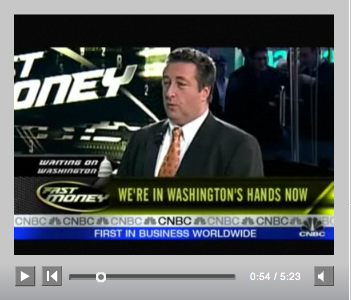
Tonite I will be on Fast Money with Dylan Ratigan on CNBC at 5:30pm discussing tomorrow’s Bank bailout plan and the good and bad ideas within it.
My suggestions:
1. Stop Regulatory Capture: Saving the banks should not be the goal; Saving the finacnial system, credit operations and taxpayers should be. No more “sweetheart” deals for the incompetant creators of the mess!
2. Bank Aggregator: Federal assistance to the private equity sector buying toxic assets sounds like a bad deal for taxpayers: We have all the risk, but private equity has all the upside;
3. Good Bank/Bad Bank is a stop gap measure. The banks that are insolvent should not be rescued. Let the mortally wounded banks die, and spin out their best components — adequately capitalized, with zero debt!
4. Foreclosure Mitigation will only work if we recognize that a modest amount of delinquent homes can be saved from foreclosure; Unfortunately, the days of easy credit put too many people in homes they could not possibly afford;
5. Expanded Insurance Wrapper: Has not worked. The Bank of America and Citigroup bailouts had the US taxpayer guarantee the bad paper; The banks still went to hell, until yet another rescue plan materialized;
6. Transparency in Governance is a good idea; Does this mean the Fed will be revealing what paper they are holding?
7. Stress test? Saving Isn’t that suppsoed to be happening already with these banks via the FDIC?
>
~~~
UPDATE Here is the Video:
>
Embeded Video



Tweet
Facebook
Reddit
Digg this!


February 9th, 2009 at 4:56 pm
Barry:
I don’t mean to sound trite, however, don’t you think that we should also talk about accountability. We seem to be relying on a cast of characters who have demonstrated high degrees of incompetence and quite possibly criminal negligence.
I only hope that you will call these MSM sycophants out, enough is enough.
Best regards,
Econolicious
February 9th, 2009 at 5:08 pm
I want to ask a dumb, naive question:
If we just outlawed physical money, requiring all transactions to go through a bank account, wouldn’t that have the net effect of either
a) inducing holders to spend the cash or
b) recapitalizing the banks by some fraction of the $800b or so that’s in circulation?
February 9th, 2009 at 5:23 pm
I totally agree with Econolicious. The economy was being run up by banks and investing institutions playing a game of hot potato(e). They used these now-toxic investment instruments to “pass the risk” and now no one wants to use their bare hands to catch the damned thing as it plumets to the ground. Someone is going to have to admit defeat and lower themselves to pick up the damned thing. And the loser has to be someone who was playing the game. They dropped the ball for all of us.
Meanwhile, I saw this, it made me sick the way the reps are still passing the buck: http://tv1.com/playlists/225
February 9th, 2009 at 6:26 pm
Time to weed the garden – NATIONALIZE THEM!
February 9th, 2009 at 6:50 pm
Nice job Barry. Let’s hope someone listens.
February 9th, 2009 at 6:58 pm
IMO Geithner and the Dems are afraid they’ll be labeled “socialists” or whatever if they nationalized the functionally bankrupt banks like CITI and BAC so they’ll continue their incremental goulash of capital investments and guarantees – and now “guarantees” to vulture investors.
So they’ll continue throwing good money after bad for a couple more rounds. They’re afraid of the backlash against the sticker shock of a multi-trillion bank salvation and the current proposal won’t be big enough to rescue the zombie banks or unlock the current credit freeze.
The talking heads have gotten comfortable using the term “depression” , thats where we are now.
February 9th, 2009 at 7:00 pm
Caught it by accident. Good job. Only trouble is, you don’t give millions in contributions to politicians, so your suggestions have little chance of being implemented until the next collapse later this year or next.
February 9th, 2009 at 7:19 pm
You and Chris need to keep WHALEing on them about the banks. Good job.
(Dylan’s OK. But it’s a shame it wasn’t a Melissa Lee night, eh??)
February 9th, 2009 at 7:23 pm
http://www.calculatedriskblog.com/2009/02/cnbc-bad-bank-plan-is-dropped.html
That is good news, I guess, but I wonder what kind of dog’s breakfast Tiny Tim has cooked up? All these things are really just kicking the can down the road, sucking in more unwitting shareholder cash into bank equities until the inevitable happens: nationalization of all the big cesspools, and consolidation of some clean local/regionals, who will inherit the earth, or at least the brave new world of lower leverage, much less fractional, reserve banking.
There will be a rally, and we will sell it. Rinse, repeat.
February 9th, 2009 at 8:08 pm
Instead of “too big to fail” we should be talking about “too big to save.”
February 9th, 2009 at 8:13 pm
Hey Barry, Great Start.
Here’s a quick rundown of MY 12 step plan (just like an alcoholic!) to get OUT of this DEPRESSION v2.0
(look here for the actual steps… I dont want to “bloat up YOUR blog” here…
http://sos-newdeal.blogspot.com/2009/02/top-ten-list-what-i-believe-and-want.html )
Specifically, point 9 and 10 are:
9. Lobbying Reform. Need to eliminate pay to play.
10. A Truth and Reconciliation Commission to uncover fraud, lies, and dishonesty in our society.
those are a START to keeping the system clean.
I also think that # 7 and 8 will also help.
7. Tax reform. Start Here: I call this the Millionaire’s Minimum Tax. Make over 1 million in GROSS income last year (individuals OR corporations!) You pay a MINIMUM of 1% of your GROSS.
8 Mandatory Job Training/Conscription/Community Service (whatever we call it EVERYONE will do it, either in Military or NON-Military options!
So… In essence, I agree that pay to play, lobbying, the revolving door of congress to lobbyists and Ca$h MUST be stopped..
Thanks for listening… I appreciate a place to say ‘atta boy to you…”
BUT most of all, I feel we need to OUTLAW CDO’s and related stuff.
February 9th, 2009 at 8:34 pm
Barry you say: “Let the mortally wounded banks die, and spin out their best components — adequately capitalized, with zero debt!”
Isn’t that good debt/bad debt? what’s the difference between that and good bank/bad bank?
February 9th, 2009 at 9:14 pm
Looks like you’ve got an uphill battle with these clowns.
http://www.talkingpointsmemo.com/archives/2009/02/surreal_–_and_must-see.php
February 9th, 2009 at 9:51 pm
Gotta love CNBC.com
At 6.19 they run a headline: ‘Bad Bank’ Is Dropped From Financial-Rescue Package. The afterhours market hits the skids…Yen goes bid…Euro gets dropped fast…and then a while later…
Bad Bank 2.0 back in the plan.
What a joke organization. This is not even a “market” most of the time…
The leaks, the rumors, the PPT……
February 9th, 2009 at 10:45 pm
Barry, i am so impressed. You can really think on your feet! Enjoyed your appearance immensely.
Andy, reworked your models yet?
February 9th, 2009 at 10:48 pm
When the black swan guy starts commenting on the financial crisis I think Joe The Pumbler may be next. What does Colonel Sanders think?
February 9th, 2009 at 11:08 pm
hey karen.
Yes, the model is much clearer now for bulls and bears. I can only see one short term bearish count, and that is the move from 944 to 804 was the first wave down in the final move lower. The second wave, which, I thought had completed on 1/28/09 at 878, is now finishing (finished today?). The prime targets for this second wave up are the 50% retrace at 874 or the 61.8% at 890. We hit the 874 today pretty spot on. It’s easy to see a nice big ABC pattern up off the 803 lows now, though this second wave has lasted longer than I thought it would, but well within the rules. As I mentioned on my last technically oriented post, it’s probably better for bears to just sit out until 800 gets taken out, though I must admit I’m a seller into the 880-890 type of level for sure.
The bullish case would have to be that the larger degree fourth wave still has not completed and we’re moving to at least 930, if not 1008. The bullish case doesn’t start to be considered until we decisively take out 890.
I
February 9th, 2009 at 11:14 pm
Andy, that’s all fine; however, you know how i like to KISS. The p&f on the $spx is 1010.
February 9th, 2009 at 11:25 pm
also for karen in case you still like gold….
I can still sort of see a case for gold grinding to 1000, but I think it’s sticking out like a sore thumb compared to everything else…not a gold bug.
Here’s a provocative article that was posted on nakedcapitalism…it’s a little long….but it may give anyone looking at the “reflation trade” some other considerations….
http://www.nakedcapitalism.com/2009/02/steve-keen-roving-cavaliers-of-credit.html
His theory is basically:
Fiat currency injections and fractional reserve banking system do not lead to credit/lending/money growth.
Money growth comes from the fact we have a “credit money” system that is operated by those who extend credit: namely financial institutions. Banks will continue to extend credit as long as there are people willing to take on debt. Once the merry-go-round stops, you end up with credit crunches that cannot really be abated by “printing money.”
Essentially, the neo-classical school on monetary theory might be wrong…
I’m not sure I fully believe everything there, but it certain goes along with my world view that cycles are powered by the collective mass of human feelings/emotions. When people don’t feel like borrowing any more, you can’t make them borrow, no matter how much you toss at them. And when banks don’t feel like extending credit anymore because they’re concerned about the creditworthiness of firms, you cannot make them extend credit. The credit-based system of money is so substantial that the Fed is essentially powerless.
February 9th, 2009 at 11:32 pm
Barry,
Nice job. New tie? Where’s that purple one?
I liked when you clarified for Macke you aren’t supporting, just explaining, that was funny.
February 9th, 2009 at 11:38 pm
Andy, yes, i still like gold. Here is a provocative look at fiat currency for you to consider “Why Do We Have Taxation?”
http://www.safehaven.com/showarticle.cfm?id=5407
Will try to catch up with you tomorrow…
February 10th, 2009 at 12:02 am
Proposing to insure bank assets at an above-market value is bad economics, but it’s probably good politics, particularly at this particular point in time (i.e., right after the pork-laden “stimulus” package). The insurance plan is a way to “kick the can” down the road a ways; buying time is often very useful in politics.
February 10th, 2009 at 12:50 am
This may be off topic but maybe not:
http://articles.moneycentral.msn.com/Investing/JubaksJournal/why-the-ceo-salary-cap-is-a-joke.aspx?page=1
Why don’t these politicians get it?
February 10th, 2009 at 5:19 am
for AGG, simple, they’re paid not to “get it”
BTW, what happened to “The Great Depression”? Brit politician with some cred now says it will be worse than TGD.
http://business.timesonline.co.uk/tol/business/economics/article5699906.ece
February 10th, 2009 at 6:16 am
Sounds as if you are gearing up to slam the ‘as yet to be announced plan’ . Please try to have an open mind; our country needs to have this work!
Thanks for your blog; I respect your opinions.
February 10th, 2009 at 7:05 am
Ranger:
That is why expecting political leadership to change your individual life is such a hopeless proposition. All the folks who expected the new administration to be vastly different from the old one now get the sober perspective…the names have changed, but the policy remains the same.
I have an open mind, sometimes when the wind is right you can hear the ocean in my head….but that openmindness won’t make this work…
Have you read what the plan is going to do?
It is VERY similar to the Paulson plan, just more of it…
February 10th, 2009 at 7:34 am
Yes VERY similar to the Paulson plan – with just a couple more convolutions – guaranteeing the vulture funds against future losses after having guaranteed CITI,AIG and BAC for a half trillion. So we’ll have a trillion or two of guarantees outstanding, valued at practically nothing and as the worser quarters march by we will have to make good on them and we’ll hear Geither and Bernanke droaning on how these losses were “unimaginable” just like we heard from Greenspan a few months ago.
And while we argue about mark-to-market accounting escalating defaults on mortgages, business and credit card loans are turning these paper losses into real losses so taxpayers will be pumping hundreds of billions into these bankrupt banks each quarters.
Like giving transfusions to cadavers – and we don’t even change doctors.
Thank god this isn’t real money, just fiat money we can print and not have to worry about repaying with real money thanks to the miracle of hyperinflation
February 10th, 2009 at 8:42 am
Barry, question – Any idea how these guarantees are valued, the $500B for CITI,AIG&BAC and whatever else will be guaranteed to the bank vultures?
Is this cash basis accounting – these are all zero cost til they make claims against their guarantees? Is this a replay of AIG type guarantees?
February 10th, 2009 at 8:44 am
One thing that stands out clearly to me: Geithner is the WRONG guy for this job.
A second thing: This BS of “leadership-by-trial-balloon” is going to get old very quickly.
February 10th, 2009 at 8:57 am
BR: I love your site, it’s one of my must visits at the start and end of each day, but there are times when it descends into self parody not to mention self contradiction. Take this statement above which I also saw you make on FM not a show I normally watch because it’s about as substantial as Dancing with the Stars but I tuned in to see you.
“Saving the banks should not be the goal; Saving the finacnial system, credit operations and taxpayers should be. No more “sweetheart” deals for the incompetant creators of the mess!”
When you said it last night I thought the banks ARE the financial system and credit operations! Then all this Red Queen “off with their heads” stuff. Who are you speaking of? The twenty or so people that constitute the senior management and boards who sit atop each of these institutions or the hundreds, nay thousands, of people in senior financial and legal political positions throughout the system who really make most of the management decisions usually in a committee format because in the main that’s how big businesses are run.
Popular wisdom here seem to boil down to get rid of Geithner, Summers, Romer, Volcker, Orzag who don’t have a clue what they are doing and after all know nothing about the subject, and turn it all over to us or Jim Bunning because we we/he would make a far better job of solving the problem.
February 10th, 2009 at 9:01 am
I get the feeling that these private investors are being used as straw buyers for these toxic assets, they come in and overpay for some assets to give the banks cover to raise their marks on these assets and then they collect the guarantees when they sell at a loss, a public-private partnership to fleece the sheeple
February 10th, 2009 at 9:09 am
It’s really fabulous that you are out there, saying what needs to be said. At least someone is.
February 10th, 2009 at 11:24 am
according to Karl Denninger, looong, don’t know anything about Denninger
“Depending on the different types of collateral, investors will get roughly $100 of lending for every $5 to $16 of cash they put up to invest. The rate investors will have to pay will be set at one percentage point over interest rates based on London interbank offered rates.
The loans the Fed makes to investors are nonrecourse, meaning investors can’t lose any more than the money they put upfront on the security. If a hedge fund defaults to the Fed, its collateral is the securities themselves. There also are no margin calls, meaning the Fed can’t demand additional payments of cash from borrowers if the underlying securities fall in value.
Investors see these as important inducements to the program. But a Treasury Department inspector general warned that the program was vulnerable to fraud by the private sector.”
Ugh. Here’s the issue folks – “non-recourse” loans aren’t loans in the traditional sense and they certainly aren’t “discounting a note.” This is an example of the blatantly unauthorized activity by The Fed.
The Fed justifies this under the “exigent circumstances” clause in The Federal Reserve Act which allows it to make loans to corporations and even individuals (as opposed to just banks) in the event of market dislocations. However, nowhere is The Fed authorized to make loans not backed by collateral or to take ownership of assets with the exception of Treasuries and other agency securities backed by The Full Faith and Credit of The United States Government – even under exigent circumstances!
The potential fraud problem with this program is immense and allowing Hedge Funds (as they apparently intend to do) into the mix makes it even worse. Without recourse if The Fed miscalculates the haircut required to be protected since losses at The Fed flow back to Treasury this is an unallocated spending of taxpayer dollars, which is explicitly unconstitutional (all spending bills must originate in The House.)
To the extent The Fed’s exposure is capped at the spending authorized in The Tarp, this might pass constitutional muster. But in that case the total amount of assets that can be put into the program is whatever TARP II funds are allocated, and that clearly is not their intent – the intent of the TALF is to use the normal fractional reserve lending paradigm to lever up at somewhere between 8:1 and 15:1 on those assets for the people who “buy and tender” them to The Fed. As such if they allocate $100 billion of TARP II money to this program the maximum exposure could be anywhere from $800 billion to $1.5 trillion, yet the maximum allowed legal exposure to Treasury is the authorized $100 billion dollars.
While restarting the markets for these securities is an important function one must realize that there already is a market for them. The reason they are not trading is a fundamental disagreement on value. The banks are holding these assets at (for example) 95 cents on the dollar in “value”, while the market says they’re worth 20 cents. There are plenty of buyers at 20 cents, there might be a few at 25 cents, but there are none at 95 cents.
If The Fed comes in and offers to take them at 85 cents (haircut 15 from par) and they turn out to be worth at least 85 cents, then The Fed doesn’t lose anything, the taxpayer is fine, the banks book the 10 cent loss against current market prices and those who buy them have whatever spread they can obtain to lever up with. If a hedge fund can lever up at 10:1 against this and make 10% they will make a hell of a lot of money – and provided the collateral performance doesn’t go below 85 everything seems ok.
But what if the market price – the 20 cents – is the real value? Then there’s a problem – the hedge funds get their cash flow on these assets for however long it lasts but their capital invested was only 1/10th of the face value and the loan is no-recourse.
Let’s say Sir Hedgie has $100 million of these “assets”; he requires only $10 million in cash. Let’s further assume that these “assets” kick off an aggregate coupon of 10% at their current discounted acquisition price.
If Sir Hedgie gets one year of performance in payment of that coupon before it all goes boom, he’s ahead because if the explosion occurs later he simply doesn’t care. The important part is that he is ahead even if a year from now the securities turn out to be worth exactly nothing, since he can only lose his $10 million in original capital he gives to The Fed, not the levered amount he has in securities.
So who eats the $90 million in losses? The Fed does, and guess what – it flows through (see the top of this post) to Treasury, which means you eat it.
The problem with this scheme is that if they put $100 billion into it through the leverage they’re allowing there could be a full trillion of assets in this pool, yet the Hedge Funds only have $100 billion at risk (10:1 leverage) and no recourse. So if the paper goes bad there’s $100 billion in capital held by The Fed against the loss, but if recovery ends up being 50 (against the discounted purchase price) then the other $400 billion in losses is taken directly by The Federal Reserve and passed through – without a spending bill allocating that $400 billion.
The Fed and the rest of the Banksters (including Treasury) are counting on you and Congress both to be too stupid to understand the risk exposure here and why this is both unconstitutional and must not be permitted. They obfuscate what they’re doing through multiple layers of BS and bluster, when in the end the bottom line is that they’re trying to restart leveraged lending against trash, where they have every reason to believe that the ratings on these securities are worthless and in fact the paper is contaminated at best.
It’s a scam, but you can bet it will rocket the stock market if they can manage to slip it under people’s noses – for a while.
The more interesting result will be what the bond market thinks of this.
Most of those folks have an IQ larger than their shoe size.
February 10th, 2009 at 1:44 pm
BR-
Did you mention that your comments were for entertainment purposes on FM? I watched the clip, and the answer is no. So please don’t claim that average investors should be taking Cramer as an entertainer.
I would not normally put this comment in, but I think that it is fair in light of your previous comments.