
No Housing Recovery Before Further Price Declines

Email this post Print this post
By Barry Ritholtz - February 21st, 2009, 9:03AM

From today’s UP AND DOWN WALL STREET column comes these two charts, which should be quite familiar by now to TBP readers . . . plus a few words on what they mean, via Alan Abelson. They emphasize and repeat our prior assertions that home prices remain way too elevated:

“ALTHOUGH WE’VE ALWAYS BEEN a firm believer that a word is worth a thousand pictures, the two charts adorning this page, we’re forced to admit, provide eloquent and graphic descriptions of why housing still isn’t able to get out of its own way and why there’s still plenty of room on the downside for prices.

We lifted the charts from a recent commentary by our estimable friends at ISI Group. As their respective headlines nicely explain, one shows the ratio of house prices to rents; the other, the median house price divided by median family income.

At a glance, they both relate the same message: House prices are still too high, and not by a modest amount, either. Nor, ISI reckons, will reducing the number of foreclosures, desirable as that may be, halt the erosion in prices. While fewer foreclosures are likely to slow the rate of decline, they won’t reverse the downtrend or determine “where homes prices end up.”

And while the sharp contraction in residential construction of new houses is obviously a plus, the homebuilders, at last report, were still building appreciably more houses than they were selling, and inventories of unsold houses are huge.

But given the remorseless rise in unemployment, which, if anything, is destined to accelerate in the months ahead, the simple fact that so many people are too strapped to afford to buy a home, is, we believe, the most formidable barrier to even a tepid housing recovery.

For that to happen (much less to get a sustained and reasonably robust rebound) will require home prices to suffer a further steep decline, in tandem with a radical improvement on the jobs front.

House prices, in our bloodshot view, have another 20% or so to fall before hitting bottom and, at the earliest, we’re talking sometime next year. And, possibly more important, a meaningful brightening of the current, profoundly bleak jobs picture, isn’t in the cards for certainly as long, if not longer.”
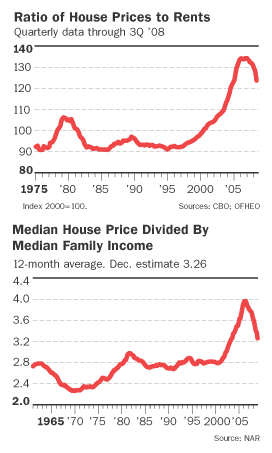
As mentioned on FM, its taken 2 years of housing price declines — and a 25% drop — to get us to the 5th inning or so. From here, another 10% is a modest decline, and another 20% drop, forecast by ISI, is a more significant price drop.

However, these are not worst case scenarios, and I will spare you the details of those, as they are truly sickening.

>

Previously:
Residential Real Estate Price Freefall (January 27th, 2009)

http://www.ritholtz.com/blog/2009/01/residential-real-estate-price-freefall/

Homes: Still Too Pricey to Stabilize (February 18th, 2009)

http://www.ritholtz.com/blog/2009/02/homes-still-too-pricey-to-stabilize/

Source:
Double Trouble
ALAN ABELSON
Barron’s FEBRUARY 23, 2009

http://online.barrons.com/article/SB123517396995937201.html

Comments

Please use the comments to demonstrate your own ignorance, unfamiliarity with empirical data, ability to repeat discredited memes, and lack of respect for scientific knowledge. Also, be sure to create straw men and argue against things I have neither said nor even implied. Any irrelevancies you can mention will also be appreciated. Lastly, kindly forgo all civility in your discourse . . . you are, after all, anonymous.

58 Responses to “No Housing Recovery Before Further Price Declines”

  1. DC Says:

    I’ve heard suggestions that we bulldoze houses to cut supply.

    I don’t think wrecking new homes makes sense, but careful disassembly might. Certainly the appliances and fixtures could be removed with no trouble and sold as upgrades elsewhere. The stuff is brand new so it’s in no worse shape than a typical floor model.

    Much of the wood in houses is particle-based anyway so recycling that is no great hurdle, is it? A granite countertop is not difficult to remove. Meanwhile the labor comes from the same guys who built them so that gets them working again, though who pays them is a good question.

    Maybe it’s too much trouble or is simply unworkable, but if the oversupply is as big as it appears then we ought to have some trials to see if careful, methodical disassembly is a viable option for at least some of the housing stock.

  2. Marcus Aurelius Says:

    DC: That solution does not address affordability. We could also drastically cut jobs at most businesses in the US in order to keep the wages of the remaining jobs at 0r near their current levels, but it wouldn’t help the unemployment situation. Tis is not a supply/demand problem, as there are plenty of both.

  3. larster Says:

    It looks like the Obama administration is trying to put a line in the sand at the Fannie Freddie max of $4oo thousand and change. Anyone above that will be on their own, as this is where the action will be with the Alt A, etc bubble bursting this year and next. This is probably why the traders were ranting with Santelli. They have houses with much larger loans and face a beating from those in that category oif house w/100% loan to value originally.

  4. danm Says:

    You’ve got an economy built on spending more than you bring in. And boomers are just starting to realize that you can’t borrow to retire. I always thought this consumer society would hit a wall when boomers would start retiring and here we are!

    Many of them probably thought they’d keep on working until they can’t but reality is that 40% of people are forced into retirmenet due to health problems or job cuts. And that stat is from the last few decades when things were good; imagine now with the depression!

    Most of the boomers wealth is in their house. If their house is going down 20K instead of going up 20K, that means they have to save 40K to fund their retirement!!!!

    Barely anybody did their homework and, thanks to the internet, the stats were there for all to to see…

    Everybody knew there was a baby bust: Gen-X. If they looked at the stats they would have known that they’d have a 5-10 year problem selling their overpriced homes due to a small cohort, Gen-X, that would not have enough money to buy up their multiple dwellings.

  5. Mark E Hoffer Says:

    Much of the wood in houses is particle-based anyway so recycling that is no great hurdle, is it?

    Please appreciate that particleboard comes in many styles… low density, medium, and high. It comes with a variety of glues and surfaces. It comes with different particle sizes.
    MDF has less variability in market specifications. MDF edges can be exposed and finished without edge banding. MDF can be routed and even embossed. Particleboard will make a flatter shelf with less creep, especially if it has a solid wood face or edge.

    Do not discount one product just because the standard fasteners do not work well. Use fasteners (and finishing) intended for that product.

    Gene Wengert

    ——————————————————————————–

    I’ve spent the last 15 years convincing clients (mostly the time wasting know-it-alls) that MDF is an entirely different product than particleboard. It drives me nuts when people see a bundle of 5/8″ super-refined MDF on the shop floor and visions of 3/8″ particleboard Wal-Mart furniture go through their minds. There’s a local shop that uses 1/2″ CDx plywood with butt joints for boxes and drawers sides and claims “all wood cabinets” while knocking my deal! Give me a break, that’s roof decking! What’s next, 7/16″ OSB? Amen to using the correct joinery and fasteners, be it with particleboard, MDF, thermofused melamine or veneer core plywood. By the way, if you’re getting water, you don’t need a different cabinet builder, you need a different plumber!
    http://www.woodweb.com/knowledge_base/MDF_versus_particleboard.html

    or, to simplify, the various glues in ‘particle board’ does Not lend themselves to ‘easier recycling’. they, the glues, are, actually, viewed as contaminants, sometimes HazMats, in the Recycling Stream..

  6. Paul Jones Says:

    Obama is trying to rewind the clock to 2005.

    Why in hell does he think that is a good idea?

    The last 4 years are something we want to repeat?

  7. The Curmudgeon Says:

    @DC:

    While people were going hungry in the cities during the Great Depression, the Roosevelt Administration (taking Keynesianism to its logical conclusion) was destroying crops at the farms in order to ameliorate what it saw as an oversupply of foodstuffs causing agriculture to suffer from low prices.

    There was some oversupply, to be sure, but mostly the farm prices were declining, like all things at the time, because of a contraction in the money supply, as gold was flowing out of the treasury.

    Even the WSJ’s Holman Jenkins advocated bull-dozing houses to alleviate the oversupply. It would be hard for me to imagine anything more stupid as a government policy, with the possible exception of the Homeowner Stability and Affordability Plan.

    Here’s an idea: Let the market work its way to a bottom without government interference. (I know it’s too late for that, but still). If the market finds a place where bull-dozing houses is a good idea, fine, but let the market determine that. The more government intervenes, the more it exacerbates the problem. Nobody can know what a house is worth because the government refuses to allow prices to find their natural level, which in turn prevents transactions from happening, which further depresses prices, etc.

    Government intervention in the market works like this: With an 800 lb gorilla in the room, are you sure you still want that banana?

  8. franklin411 Says:

    Paul,
    I really doubt the Obama plan is even remotely capable of “re-bubblizing” the housing market, even if that was the intention.

    Barry’s right about affordability, but he should point out some key facts about the period from 2001-2009:
    * Affordability went down because wages were flat and jobs never recovered from the 2001 recession
    * Productivity soared along with corporate profits, but none of this trickled down to workers
    * Soaring corporate profits were not reinvested in R+D. They were distributed to shareholders instead
    * This was one of the most dramatic periods of decline in unionization in modern American history
    * Inflation in health care was through the roof
    * Inflation in higher education placed a college education out of the hands of the middle class
    * Government investment in education and infrastructure stagnated
    * Americans were able to survive by the extensive use of credit in order to bridge the shortfall between their wages and the cost of living

    This suggests that:
    * We need to re-unionize America to restore wages
    * We need to re-invest in education and infrastructure
    * We need to re-invest in R+D
    * We need to fix health care

    The only way we’re getting out of this long term is to make a 25 year commitment to invest in things that will undo the service economy created by the failed economic policies of the last 25 years.

  9. bonghiteric Says:

    @ Mark E. Hoffer,

    What was all that shit about particleboard? What the F***, has anything got to do with particleboard? What the f*** are you talking about?

  10. franklin411 Says:

    PS–It’s also interesting to note that everything I said about the period 2001-2009, with the exception of health care and education, was true of the period 1921-1929. Scary, huh?

  11. Mark E Hoffer Says:

    bhe,

    maybe time for a re-load? DC, in his post, was asking a Q:, I was answering it..

  12. danm Says:

    For me, the increasing size of houses has always defied logic. I wonder how may people think of entropy when they make long term decisions.

    As square footage per dwelling markedly increases and as the housing stock grows and gets older, the cost of maintenance and renovations is sure to balloon. This means that over the long term there will be an increasing demand on resources and energy just for maintenance, never mind growth which our economic system is based on. It does not help that materials in newer house don’t last as long as those in older houses.

    This is so obvious… take a walk in nice neighborhoods. The smaller homes are usually better maintained than the larger ones.

    We’ve been running on a tread mill. We’re getting slower (population aging) and the carpet is going faster (more demand in resources and energy).

    The housing boom of the last few decades was built on our owning resources and energy forever but
    China still has enough capital to buy a huge % of private resource and energy companies.

  13. deanscamaro Says:

    I think Mark E. Hoffer is trying to focus on something besides the tragic state of the economy, which is not all that bad an idea. All the opinions on this blog are like a shotgun blast at 500 yards; they are all over the map and really mean that there are as many opinions one way as their are the other; no one really knows what needs to be done in this uncharted territory. Combinations of government/business fixes and “let the problems of the economy work themselves out” solutions are all probably pieces of the puzzle. The frenzy of bloggers shouting out the causes to the problems and solutions they know will fix everything, are just everyone’s way of dealing with their frustrations. Ride the Tide!

  14. DC Says:

    – Curmudgeon

    Just for the record, nothing in my post mentioned nor implied a role for government. I was asking whether disassembly could make economic sense, i.e. is there a reasonable market response.

    Sometimes wild ideas are idiotic. Sometimes they jump-start problem solving.

    – Hoffer

    I am aware that MDF is fused with what are likely toxic glues, but that in and of itself did not necessarily disqualify MDF from recycling as far as I knew (e.g. circuit boards are filled with toxins but it’s worth the effort to reclaim the metals).

    I’m not a builder. Just a guy who sometimes asks questions in order to learn things.

    The Hostility Index is running high this morning.

  15. The Curmudgeon Says:

    “Affordability went down because wages were flat and jobs never recovered from the 2001 recession
    * Productivity soared along with corporate profits, but none of this trickled down to workers
    * Soaring corporate profits were not reinvested in R+D. They were distributed to shareholders instead
    * Inflation in health care was through the roof
    * Inflation in higher education placed a college education out of the hands of the middle class”

    All of the above can be traced to one cause: The US federal reserve’s attempt to manipulate the currency to avoid deflation in the face of falling prices for labor and inputs world-wide.

    Get a stable currency policy, one that allows for inflation and deflation, as the case allows, and you wouldn’t cure the problems that differential wage rates across international borders create, but you wouldn’t fuck up the entire world economy trying to mask over them.

  16. river Says:

    been reading TBP since September when the crisis started, and found that it is a good place to get perspective on these interesting times we live in (I am not an investor, actually a structural engineer who has not had any new buildings come across my Desk since November). Anyways, I had an anecdotal story about how high prices are, and when they started getting that high. . .

    My sister moved to San Diego from Oregon in 1999, buying a house in La Jolla for 170k, her first home. It was a typical starter home, 1200 sf, 2 bedroom, 2 bath, 2 story common wall condo with a small garage and small yard, if you could call it that. Not much of a house, and I think they started with an FHA loan and mortgage insurance.

    I think they were able to refinance within the first year or year and a half to get rid of the mortgage insurance, as the price appreciated enough to get to 20% equity. They also did some kitchen remodeling, etc.

    They sold their house in 2005 for 450k, almost 3 times their initial price! I just looked up their house on Zillow the other night, and it still shows that the house is 350k, with all the price decreases that we have had since 2006. At 350k, that house is still in my view much too expensive for a starter home, or for an average family income, which I think is 60k/year for San Diego.

    I guess my question is that I do believe that housing should still be falling in price, but all the charts that I see put up all deal with the nation as a whole, but they don’t really deal with the “curve breakers,” like Florida, California and Arizona. What effect do these super bubbles in real estate have on the overall real estate market. I know in Oregon, the californians would cash out of their housing bubble and pay cash for houses up here, basically raising our prices, and in our markets, like Bend, raised them a lot.

  17. rktbrkr Says:

    Can another 20% down in RE and rising unemployment result in anything other than a depression? How is that avoidable?

    I don’t see how the proposed mortgage plan by O’B will help many homeowners, everybody over 400K excluded eliminates an awful lot, not more than -5% equity eliminates anyone who bought in the last 5 years without putting in much equity.

    So by elimination it benefits those who bought more than 5 years ago and/or with a decent amount of equity and probably in a modest neighborhood.

    I assume they had a lot of data available and tried to configure a program that would stem a runaway decline and massive foreclosures. But then again the plans we’ve seen the past year we’re all shoot from the hip so maybe I’m giving too much credit.

  18. rktbrkr Says:

    Buy a house, get a greencard. Simple, no cost to taxpayers, solution that will benefit the country in the long run to boot. We need someone to buy the vacant McMansions next door, we can do our own yardwork for the next couple of years!

  19. danm Says:

    I assume they had a lot of data available and tried to configure a program that would stem a runaway decline and massive foreclosures. But then again the plans we’ve seen the past year we’re all shoot from the hip so maybe I’m giving too much credit.
    ——————–
    Can we really believe a solution can be found in a couple of months or a few weeks?

  20. river Says:

    One other point about my anecdote. At least in California, the house prices were on the upswing in 1999, at least to the point that you could have 20% equity pretty quickly. In reading the news, you would think that the house crisis started in 2004 when they started giving more and more loans to subprime borrowers. In my view, the subprime borrowers were just the big wide foundation of the pyramid.

  21. Mark E Hoffer Says:

    Much of the wood in houses is particle-based anyway so recycling that is no great hurdle, is it?

    DC,

    your Q: wasn’t about ‘Recyclability’, it was about ‘ease thereof’, no?

    IOW, the closer to Forests, speaking of wood-products, one is, the easier the material is to Recycle–they call ‘new’ materials ‘Virgin’, for a reason, wouldn’t you know..

    past that, some Q’s are, of course, fine and dandy, lack of Research, or, worse, an extinguished Spirit of Inquiry, especially coupled w/ a prickly ‘tude, not so much…

  22. DC Says:

    @ DC says : “Much of the wood in houses is particle-based anyway so recycling that is no great hurdle, is it?”

    Well, that’s ignorance for you. As Hoffer pointed out, the glues make it supremely toxic. I find via The Google that MDF is a real landfill problem. Also leaches formaldehyde. Breathe deeply and smell the newness!

    So there you go. Turns out that not only is MDF a bitch to recycle, it’s slowly killing us in the meantime. Seems there is an outfit in Britain with claims to a process (nvirocleantech.com) but apparently I tripped over one of the more challenging environmental issues.

    Nothing ventured, no humiliation or flagellation gained.

  23. Mark E Hoffer Says:

    DC,

    that’s the ol’ Pepper~ as you see, while we still have the Internet, it just ain’t that hard.. (:

  24. Chief Tomahawk Says:

    Hey River: Ever had a steak at The Acropolis?

  25. mark mchugh Says:

    I think this frustration was at the heart of Santelli’s rant (and the attention it’s gotten) .

    There are so many of us that had to settle for renting or much more modest homes thanks to the “loser mortgages”. For years, people who never saved 10 grand in their lives were allowed to drive house prices ever higher. And now, we want to rewrite contracts, so they can stay?

    Think, for one minute, about all the strain those losers put on people who had intentions of paying off their mortgage. In my case, the real estate bubble literally put us in marriage counseling. I’d say, “Just because everyone else is jumping off bridges (financially), that doesn’t mean I’m gonna.’” Thank God our counselor actually believed that house prices might be too high. Can I get reimbursed?

    The Federal Reserve has about the simplest job description in the world:
    http://www.federalreserve.gov/aboutthefed/mission.htm

    STABLE PRICES – Easy Al decided to get jiggy with his interpretation of two simple words in 2001 and because of that, we have no price stability in anything, anywhere on the planet. And now, they think the solution is to stabilize the root cause at elevated levels. HFS

  26. miamiocean Says:

    You know the old joke — Bill Gates walks into a bar — the average salary of all the patrons rises to one million dollars.

    These charts are somewhat misleading if the averages include all home prices at all price points. I would like to see a chart like this for lower end, “starter”, homes. I have a friend in Va whose $625k house has increased by $1k since he bought it two years ago. He is now whining that a refinance for his jumbo, 95% LTV mortgage doesn’t meet the conforming loan limits for lower interest rates. Somehow I find it hard to be sympathetic when my home value has dropped nearly 50% from its peak (which was insane to be sure).

    There are sometimes circumstances that throw a wrench into people’s budgets and this was something that happened to many Floridians in 2006. My home insurance company raised my windstorm annual premium from $1300 a year to $3900 a year in 2006. My hazard insurance (fire etc.) is around $900 a year, so my home insurance climbed from $2200 a year which was affordable to $4800 a year and I was really hit hard financially. It was a serious shock to my budget. By the way, the original increase notice was $7200 a year premium (from $2200) for a 2bdrm/1bath 1250 sqft 1950′s home, and I reduced it to $4800 with a 10% deductible – about $25k – even with approved window shutters.

    My home has been through three Cat 1 hurricanes and numerous tropical storms over the years and has suffered no damage and I have had no other claims. The likelihood of my home suffering more than $25k in insured losses during a hurricane is not as high as you would think. A new roof on my 1200 sqft home would run about $10k-$15k at present prices, maybe closer to $20k at post-hurricane prices. A Cat 3 or higher hurricane that passed within 30 miles of my home could produce a level of damage over $25k, but think about how long the Florida coastline is. Thirty miles is not a big target.

    For many homeowners in Florida, the outrageous increase in home insurance prices increased mortgage payments (for those with escrow) by hundreds of dollars a month. If you had an adjustable ARM on top of that (which I did not), the mortgage would be at levels above what many could afford. In 2006, there was a flight of homeowners from Florida due to the windstorm insurance rate increases. This added to the existing home inventory and significantly increased the foreclosure problem when owners could not sell. Last year, every block had a home for sale. I am not kidding. This year, owner’s have either been foreclosed, are renting or quietly hanging on by their fingernails. Interestingly, the people I know who had no mortgages received a much lower increase of about 10-20%. Those folks could have just canceled their insurance, the people with mortgages did not have that option.

  27. Winston Munn Says:

    * Affordability went down because wages were flat and jobs never recovered from the 2001 recession
    * Productivity soared along with corporate profits, but none of this trickled down to workers

    The only thing you neglected to mention was the new debt that was required to fill the wage/production gap.

  28. Dan Duncan Says:

    BongHitEric @ 10:30…Aren’t you a bit uptight for a ganja afficiando?

    I don’t know…something about a Type A weed whacker is definitely unappealing. “Dude! Where are my fucking Doritos?”

    You’re a regular stereotype smasher…A voice for the hemp community: “We really are a diverse group of people! We’re not the easy-going caricatures as portrayed in the movies. We can get angry too!”

    Yes…an inconclastic stereotype smashing bong hitter…

    ….Except, of course, for the fact that you managed to be completely oblivious while doing so.

  29. globaleyes Says:

    http://www.creativeclass.com/creative_class/2009/02/20/just-say-no/ <— Here’s an example of a socialist government (Sweden ) that said NO to government bailouts and in the process rebuffed General Motors for failing a formerly owned state-owned company (Saab ).

    Rick Santelli, take note.

  30. Thisson Says:

    @Curmudgeon,

    Productivity isn’t supposed to trickle down to workers to boost their wages. The mechanism for that is for the workers to save and purchase equity; not borrow and dig themselves deeper holes.

    @DC & Mark Hoffer – the idea of bulldozing homes is ludicrous. There is not an overabundance of homes (witness the large numbers of homeless people everywhere, and the rate of homelessness is increasing). The problem is that we have a shortage of affordable homes, because people were building unaffordable McMansions instead of more cost-efficient housing such as apartment complexes.

    The equitable solution is for renters and underwater home owners to swap residences. And that will happen when housing and rent prices come down significantly (which I view as inevitable). The administration’s attempt at propping up housing is futile and only serves to prolong the crisis.

  31. sherparick1 Says:

    The median house price in 1955 was apparently $22,000 in 1955 dollars. Milk was .92 a gallon in 1955. Although I agree with the shadowstats and others that inflation was undercounted by the BLS the last 25 years, its web site still can give you an approximate number for what these figures mean in current dollars. For a house, that is $173,326.34 in 2009 dollars. For a gallon of milk $7.25 (which even if you buy organic is significantly higher then it is today and hence why we have a lot less dairy farmers now then we did then). Another 15% decline from last quarter’s median price of $206,200 will take us down to that level. Since there still the sales rate is still at 11 to 12 months and the vacancy rate indicates that there are about 1,000,000 houses and condos/apartments sitting empty, and with unemployment accelerating, I don’t see much magic around that will sustain these prices. So R. Timm, I don’t think as a % of income that housing prices can be sustained at a greater proportion of income then they were in the 1950s (I chose 1955 because it came between two short, sharp, recessions (1953-54) and (1957-58) that probably depressed prices). Food was a significantly higher percentage of household budget in the 1950s.

    As to the “fairness” or “moral hazard” of the Obama plan. I don’t think it was people buying a home to live in that drove the bubble, but rather investors who were expecting to flip the house after a 10 to 25% return during the hot bubble years of 2003-2005. The bubble started to deflate here in Northern Virginia in last half of 2005. Then builders started getting stuck with spec houses they wanted to unload (I thought I had gotten a deal) and investors were walking away and mailing the keys into the banks and each month the price rise in the Washington Post from the previ0us years started decelerating.

    The Fisher and Hyman Minsky theory of the Great Depression is being proved, that that excessive debt on personal and corporate balance sheets, created by irrational exuberance at the end of a long period of growth, produces a deflationary credit situation once the reality hits that all this debt will not be repaid. A Keynesian strategy in response helps shift this personal debt into Government debt where it can be paid off long term while mitigating the social cost of the downturn. To the extent that the Obama housing plan shifts this debt from individuals and corporations to the Government, and thereby improves individual and banking balance sheets, the quicker it will restore the economy to normal functioning.

  32. spigzone Says:

    A 30% DROP IN WORLD GDP IN SIX YEARS … ? Maybe, maybe not, but 20% … dead certain.

    ANY financial writer or blogger that does not take into account the arrival of permanently declining conventional oil production is whistling into the wind. It is THE central fact of what is happening in the world, why the world economy is crashing so much faster and deeper than any of the ‘experts’ can account for. The IEA came out in their november report, which was based on an in depth study of the worlds 800 largest conventional producing oil fields, stated FLAT OUT those fields were CURRENTLY experiencing an aggregate decline of 6%, expected to reach 9% in a few years. This is the deepest, most comprehensive study ever done on the worlds oil fields.

    WHAT IS THE DISCONNECT HERE?????????????????

    It is truly bizarre, the most shatteringly, screaming, ECON(OMICALLY vital fact in this worlds history has just been VERIFIED in an absolute, irrefutable report and seemingly the entire economic ‘expert’ and ‘blogging’ community blithely ignores this tyrannasaurus rex in the room as it tries to puzzle out WHY the economic situation is deteriorating so much faster and deeper than anyone predicted and pontificate on what needs to be done and when it will turn around. Anyone in the ‘economic’ sphere that is. Go over to James Kunstlers ‘Clusterfuck Nation’ and you will find no such blinders.

    This will make the tenth or so post on a Big Picture article on this and I have yet to hear from B.R. or have a reader reply to what I am saying with any remotest grasp of the gravity of this.

    Try this on for size, it refers to a recent Merril Lynch report stating flat out the possibility ezists the world will be producing 30 million barrels a day less oil by 2015 than it does today. That is a 35% drop. That equates to AT LEAST a 30% drop in world GDP. IN SIX YEARS.

    http://www.arabianbusiness.com/545723-oil-output-could-fall-by-30m-bpd-by-2015—merrill

    This needs to be FACED. It’s coming whether heads are in the sand or not. I’ll guarantee the US Military is utterly aware of the situation and moving with dread certainty to address it, they are in an all out program to create the capacity to convert coal to liquid petroleum. Like germany did in WWII. THEY are the ultimate hard physical reality based organization. They simply cannot afford to be otherwise.

  33. Mark E Hoffer Says:

    Thisson,

    just to be clear, don’t confuse me as being in support of that stupid idea. if we wanted a ‘jobs program’ with positive Economic benefit, we’d be, far, better off re-legalizing Industrial Hemp..

    though, seeing that ‘thinking’ like this: “A Keynesian strategy in response helps shift this personal debt into Government debt where it can be paid off long term while mitigating the social cost of the downturn. To the extent that the Obama housing plan shifts this debt from individuals and corporations to the Government, and thereby improves individual and banking balance sheets, the quicker it will restore the economy to normal functioning.”–is, still, extant, I’m not holding my breath for Sense to become common..

    Simply, we’ve two choices: We can let the Market ride, or we can let “the Gov’t” ride us..seemingly, as it stands, it’d be wise to bring your saddle blankets..

  34. try2bamused Says:

    If housing reverts to the 70s cyclical low, it’ll take years to play out. That’s a 30% drop from here, and that’s assuming median family income holds up by then.

  35. Cybernaught Says:

    When the game of musical chairs (tournament) ends (all available resources are taken over by one entity or group), the resources are distributed equally for the next game. That needs to happen. The folks that ran the financial system messed up. Most probably because the system had risk/reward ratio’s out of whack.

    They need to go. The present system cannot, and must not be propped up anymore. Build up the Federal Credit Bank and start an honest, transparent, bank. THAT will put money to work in short order.

  36. Steve Barry Says:

    The hosuing boom in a nutshell…we had a nic elittle golf driving range near me…they closed it in 2007 and plopped about 10 Mcmansions on it, one right on top of the other. Who wants to pay $1.5 Million and get no land? This was pure greed and stupidity.

    As I ride down Central Avenue in Westchester now, my favorite hobby is spotting the new commercial vacancies.

  37. Mark E Hoffer Says:

    spigzone:

    see: Duncan Clarke
    Chairman and CEO of Global Pacific & Partners, Author
    The Battle For Barrels
    Peak Oil Myths and World Oil Futures

    Select an Audio Format
    Real Player Win Amp Windows Media mp3

    It is widely accepted that global discoveries of conventional oil have peaked and that the era of cheap oil has gone forever. The Battle for Barrels demonstrates that this ‘Peak Oil’ theory is fundamentally flawed. Duncan Clarke provides fresh insights, based on years of experience at the cutting edge of the global exploration industry, that rebut these alarmist ideas.

    Duncan Clarke is Chairman and CEO of Global Pacific & Partners, a private advisory firm operating from offices in London, The Hague, Johannesburg and Nicosia. The Battle for Barrels draws on his global experience of over 25 years in the international oil exploration business. He gained his PhD in economics in 1975, and was a lecturer, economist and advisor, before establishing GP&P, with a focus on economics and strategy in the worldwide upstream industry.

    Contact Information
    Duncan Clarke
    Global Pacific & Partners
    Suite 7, 4 Montpelier Street
    Knightsbridge, London SW7 1EE
    http://www.petro21.com | Book Information

    Peak Oil, and GHG-induced AGW, are two of the greatest, and most successful, advertising campaigns (see also: agitprop, and the work of Bernays) known, in human history, to date..

    further: http://www.financialsense.com/resources/peakoil.html

  38. dps Says:

    Like the effects of Bill Gates walking into a bar and the new ten $1.5 million McMansions, aren’t the average housing prices a little skewed? Stockton, Pheonix et. al. are really locations that have houses for no (or very few) buyers because their most previous economic booms were solely home building related (throw in a few strip malls too). The available jobs now don’t match the available houses and who wants to drive an hour and a half to work? Some areas like Detroit and Cleveland are losing jobs and will probably continue to do so no matter what the economy does.
    If new (surely overpriced) houses in those location were treated as having no or very little value (as is there are no buyers because the job market is so weak), what would that do to overall average prices? What are home prices doing in areas where there are real jobs or have prospects for employment in a future economy?

  39. Broken Says:

    @mark mchugh:
    “For years, people who never saved 10 grand in their lives were allowed to drive house prices ever higher. And now, we want to rewrite contracts, so they can stay?”

    Actually, I think that those who “bought” those houses would be happy now to swap places with those who were prudent like yourself.

    Unfortunately, the US economic system has been geared to reward maximum expenditure and punish those who are frugal. I remember not being eligible for a needs-based scholarship because my parents saved two much money despite having six children. A co-worker of my dad who lived down the street, with near identical salary, did qualify for the same scholarship for his children because he didn’t save a nickle.

  40. impermanence Says:

    The system (financial community and government) is trying to prop up housing prices for one very simple reason. Real estate is the basis of almost all collateral. What do banks care about the most? Collateral.

    The price of homes will make it back to the mean eventually. As it has been said, you will have to literally throw these thieves out of the country; otherwise, they will steal every single thing not nailed down.

  41. miamiocean Says:

    The more I think about this, the more those graphs in the article do not make sense to me. I suppose they could reflect that true level of “affordability” in the present housing market at some price levels, however I am not so sure they say much about affordability for houses at the lower end of the market – in the starter home arena. The ever increasing sizes of homes built in the last 10 years certainly has had an effect on the makeup of the present housing market. If the median housing prices are computed from a database of home sales, I could see a situation developing in the past two years, that extreme price differentials for sales at differing price points in the market could lead to a skewing of the median home price.

    I know graphs are great at illustrating a point, however one should take them with a grain of salt unless you have an understanding of the potential errors and biases due to an under or over sampling within a data set. Price indexes that can be compared nearly one to one over “normal” years, may be disconnected in extreme “abnormal” years. From what I am seeing on the ground, lower-priced houses are already approaching reasonable values, if not there already. I am guessing that is where the Obama team has tried to target most of the relief in order to stem an increasing downward spiral in that particular segment of the market.

  42. AGG Says:

    LOL
    What a coincidence that right when housing costs went exponential due to easy credit and stupid tax policy, lo and behold, the CPI is gamed with the owener equivalent rent. Nobody wants to talk about the ouright theft through inflation and gamed numbers that corporations and the government carried out on non-management employees. Now it’s blown up in their crooked corporate and goverment faces. Good. And, like many people here observe, it ain’t ovah.

  43. AGG Says:

    To those with the incurable allergy to government (oh horror, scream, agh!).
    You have all worked for a corporation. Who, exactly, was governing you in the workplace? Was it the evil government or some asshole, fascist, slave driving, cunning, greedy manager who wanted to fuck you and your wife and get you to smile while he did it? Oh, you say, YOU were that manager and that’s the market in action…..
    It sure is.
    We get it folks. If you are a business dictator, democracy in the workplace is bullshit. The boss rules, period.
    If you are citizen of a country, Governent is a burden to your dictatorship rights so you want as little government (i.e. someone bigger, badder and tougher than you with the power to order you around) as
    possible. Poor widdle puddy tats don’t want anyone telling them what to do. Stuff it. Your lemon socialism is what’s behind you free market claptrap. You just want to be free to shoot anybody who outcompetes you. You want the profit on the upside for you and subsidy on the downside from us. Stuff it. We really, really get it. We know how to give a middle finger too.

  44. spigzone Says:

    Mark E Hoffer:

    This is from Duncan Clarke’s site under the ‘corporate profile’ heading … “Our relationships are based on close connections built with leading world national oil companies and senior executives from super-majors and worldwide independents in Africa, Asia, Latin America, MidEast, Europe and North America. We have executed Roadshows for Governments and National Oil Companies for over a decade, these conducted in world oil capitals, to market acreage, assets and investment potential.”

    “executed Roadshows for Governments and National Oil Companies for over a decade” … what, no claxxons going off in your head? because they sure as HELL are going off in MY head.

    Cambridge Energy Associates and the International Energy Agency are, respectively, THE ‘authority’ governments and ‘the media’ turn to on all things fossil fuel related. Go back three, four and five years and compare the predictions made by these two bodies AND the ‘peak oil crazies’ and compare those predictions to the present state of production and CURRENT predictions for future production. IF you do so you will find the peak oilers had it nailed and the CEA and IEA had their heads 200 yards up their asses.

    ANOTHER person who nailed his predictions was Matthew Simmons, co-founder ad Chairman of Simmons Simmons and Company International, the largest and most successful PRIVATE energy investment bank in the world. That’s as in INVESTING ACTUAL AND VERY LARGE SUMS OF MONEY based on HOMEWORK done by or overseen my Matthew Simmons.

    You get the DIFFERENCE between a Matthew Simmons and a Duncan Clarke?

    Matthew Simmons wrote ‘Twilight in the Desert: The Coming Saudi Oil Shock and the World Economy’ published in June 2005, THE book that started the peak oil theory rolling. Matthew Simmons is held in highest regard by his fellow energy investment bankers and industry insiders for his unparalleled ability to absorb and analyze data … which, of course, is WHY he is the most successful energy investment banker. He’s the Nuriel Roubini of energy investment. A walking expertly analyzed encyclopedia of his profession.

    Last summer Matthew Simmons predicted by 2015 the world would be producing NO MORE THAN 65 mbpd by the end of 2015. This is the ballpark figure more and more hard nosed analysts are coming up with.

    The IEA, International Energy Agency, the world body sponsered by the western industrialized countries and headquartered in Paris, for years has been making what the peak oil crowd considered to be Alice in Wonderland future petroleum production projections – what the western POLITICIANS wanted to hear. What changed? The spike of oil prices to $140 bbl. at which time those politicians realized it might be a good idea to know what was REALLY happening with the worlds oil fields. That’s when the IEA, which had the data sets and access needed, were given a MANDATE to find the fuck out. That initiated an all out PRIORITY in depth comprehensive study of the worlds 800 largest producing oil fields, unconventional oil production and what was happen on the exploration front. The result of that study produced the CURRENT 6% annual aggregate decline in production figure with the expectation that wold increase to 9% in a few years.

    Now the IEA is on the same page as the peak oilers with the crucial difference that it is backed up by the most in depth and comprehensive study ever done of the world’s petroleum fields pruducing the most accurate HARD DATA based predictions ever done.

    Of course that is only a FRACTION of the data I am basing my posts on. I got very very busy studying this in depth, getting on the ‘internets’ for the first time and then buying a computer etc., from the very day I finished Mr. Simmons book in Aug. 2005, which was actually purchased by the librarian in my town’s teensy weensy 300 sq. ft. library based on it being on the top ten Amazon list and the FIRST part of it’s title. “Twilight in the Desert’. The librarian thought she was buying a romance novel for her almost exclusively female clientele. I happened in the day after it arrived, GRABBED it, and read it through with one 4 hour sleep break.

  45. spigzone Says:

    I never did get around to commenting on how insane it is to be speculating on the future housing market without taking into account oil supply will be some tens of millions of barrel a day short of demand in six years. The price will be somewhere far north of $300 bbl by then of course and gas WILL be rationed AND north of $10 gal. Outer burb housing, if not served by a workable mass transit system, will be … well, worth a fraction of TODAY’S prices for sure. Proximity to mass transit/commercial zones will be tomorrows Location Location Location mantra.

    How can a discussion of ANY aspect of the economy be valid that does not take into account the world’s oil supply situation?

    It’s just fricking strange.

  46. spigzone Says:

    Mark E Hoffer:

    Excepts from Duncan Clarke’s website on his “The Battle for Barrels’ the book you referenced as underlying your reasoning. http://www.petro21.com/research/index.cfm?id=301

    “Peak Oil’s pessimistic geotechnical paradigms are at odds with most industry views.”

    Right. Try this … Nouriel Roubini’s pessimistic paradigms are at odds with most industry views.”

    “Their rejection of the discipline and findings of Economics is a cardinal weakness that leaves unaccounted both the economic and geopolitical forces that drive key decisions of oil reserves, exploration, development and productio”

    Are you fucking KIDDING me? their rejection of the discipine and findings of ECONOMICS??? Matthew Simmons came across an exceedingly valuable and otherwise unobtainable data base at the International Socienty of Petroleum Engineers in Houston while doing a study on Oil Field Depletion Dynamics, where his banks INVESTMENT opportunities were obviously headed. That data base contained the papers submitted by Saudi Arabian oil engineers to their Professional Society for peer review and, if accepted, to be published by the society. You see, other than this overlooked little loophole, Saudi Arabia was an information BLACK HOLE. Matthew Simmons copied off these studies, some 200 of them, added in everything available from when Aramco was still Privately owned, whatever other geologic and production data was available, the IEA hard shipping figures and the like, holed up in his remote Maine cabin for several weeks, read through all the data and ANLYZED it. You understand these were ENGINEERING papers, about problems and solutions to various obstacles encountered in driling for and extracting oil across Saudi Arabia, in other words extremely DETAILED and HARD data on precisely what was going on in the Saudi oil fields across time. Data Matthew Simmons was pre-eminently qualified to piece together and get a very accurate and complete picture from.

    SO … it’s easy to get the gist of Duncan Clarkes patter, it SCREAMS ‘bullshit’ … a shill for the Oil Majors.

    a few more examples of his specious tripe. He doesn’t ecen make a pretense of basing his conslusionas on Hard Data.

    “As a result the explicit, implied, and heavily-dramatised post-peak socioeconomic, political and human dramas that some forecast with unbridled certainty for the early 21st Century, are false images for the near-term world oil future. In a nutshell, the world is not up the proverbial creek without the necessary paddle.”

    “The Battle For Barrels provides fresh, comprehensive and seasoned analytical insights, with polemical reflections on the Peak Oil debates (including on its architects, adherents, allies, activists, and even critics), to counterpoint these alarmist ideas..”

    “The Battle For Barrels provides fresh, comprehensive and seasoned analytical insights, with polemical reflections on the Peak Oil debates (including on its architects, adherents, allies, activists, and even critics), to counterpoint these alarmist ideas.”

    Not sure why I’m botherig with this. Someone gullible enough to swallow this swill is lacking is discernment sufficient as to probably miss what I am pointing out.

    So it goes.

    .

  47. Pat G. Says:

    But we can’t afford further price declines in housing. Those people won’t be able to refinance then spend, in order to keep the American Ponzi Scheme going?

  48. AGG Says:

    February 17 – Bloomberg (Sarah Mulholland): “Riverton Apartments, a high-rise complex in Manhattan’s Harlem neighborhood, is set to be auctioned off Feb. 20 because owners Rockpoint Group LLC and Stellar Management have been unable to modify loan terms, according to Trepp LLC… A recent appraisal valued the property at $196 million, compared with a valuation of as much as $340 million when the complex was last appraised in December 2006…”

    That was on the 17th. I guess we are getting to about $146 million by now. Or were there any bids at the auction? If this keeps up, things are goig to get really cheap.

  49. Mark E Hoffer Says:

    spigzone:

    I hear you about Duncan Clarke, it’s part of the reason I posted that inkblot, though I find curious that “Big Oil” gets blamed for supporting the, supposedly wrong, case of ‘no GW’, and, also, here, at least, blamed for supporting the ‘no peak oil’ case..

    though, this: “Of course that is only a FRACTION of the data I am basing my posts on. I got very very busy studying this in depth, getting on the ‘internets’ for the first time and then buying a computer etc., from the very day I finished Mr. Simmons book in Aug. 2005, which was actually purchased by the librarian in my town’s teensy weensy 300 sq. ft. library based on it being on the top ten Amazon list and the FIRST part of it’s title. “Twilight in the Desert’. The librarian thought she was buying a romance novel for her almost exclusively female clientele. I happened in the day after it arrived, GRABBED it, and read it through with one 4 hour sleep break.” certainly, recommends your spirit of inquiry..which, especially on this topic, is Paramount, in order to wade through the tremendous volumes of information found–pro and con..

    here’s another snippet:

    ““Supply crunch” is not peak oil – IEA
    Posted on Wednesday, November 7th, 2007
    There is no contradiction between the International Energy Agency’s forecast of long term oil supply growth to 2030 and a “supply crunch” by 2015, according to its chief economist Fatih Birol. Mr Birol insisted today that the short term crisis would not be caused by a fundamental shortage of oil but by entirely man-made factors.

    Speaking at the launch of the IEA’s latest World Energy Outlook in London, Mr Birol reiterated both the Agency’s long term forecast that oil production will reach 116 million barrels per day in 2030 – up from around 86 mb/d today – and the evidence that supply will fail to to meet demand much sooner. The IEA’s reference case demand forecast requires an additional 37.5 mb/d in gross production capacity by the middle of the next decade, but new projects announced so far by oil companies will add only 25 mb/d, leaving a shortfall of 12.5 mb/d.

    In answer to a question from lastoilshock.com, Mr Birol denied there was any contradiction between the two predictions, because any short-term crisis would be solely due to above-ground factors: “What we are saying is we could have a supply crunch to 2015 if we do not see enough investments coming to the markets, if we do not see production growing at a level to compensate the declines and meet the demand, and if the oil demand growth is not dampened in the OECD countries, China and India.”
    http://www.davidstrahan.com/blog/?p=73
    http://www.icerocket.com/search?tab=web&lng=&q=not+peak+oil

    also, “peak oil hoax” makes for an interesting input to your fave i-net searcher..

  50. toddie.g Says:

    @ river …..interesting anecdotal story about your sister and San Diego real estate…..keep in mind that the income vs house prices and cost to own vs cost to rent are national numbers…in San Diego and other bubble areas, the ratios got even more out of whack. It would be very interesting to know what the very local ratios are in bubble areas.

  51. Avl Dao Says:

    @ danm Says: 2/21 at 10:10 am
    A good number of folks born between 1960-1970 were flippers and buyers via NINJA loans (my generation). We were being ‘dumbed-downed’ by a burgeoning realtor pitch to be the dupes to bailout the boomers in a decade or two, but thank goodness the market crashed first.

    @ franklin411 2/21 at 10:27 am
    Good points. A renaissance in local manufacturing and a big movement towards local production models are part of a solution that is financially and environmentally sustainable. Re-unionizing will be tricky, and it alone wont put a solid floor under wages as long as our GDP has a strong import component tied to lower-wage overseas exporters. If capital markets do NOT emerge from this global crisis resembling their former selves, perhaps the needed local manufacturers that do emerge can use a worker-owned ownership model. Big IF there on capital markets.

    A 25-yr commitment to anything is extremely unlikely if the current economic crisis brings a repeat of the last structural economic upheaval of 1973-1982 when the US kicked mfg to the curb and embraced a Service based economy with debt-fueled consumer spending driving 70% of GDP. 1973-1982 saw us cycle thru 4 Presidents. To bad people assume economic crisis only yield electoral stability ala Roosevelt’s 4 wins in the 30s & 40s.

  52. bonghiteric Says:

    Hoffer, you pedant, it was a quote from The Big Lebowski.

  53. MarkMacKenzie Says:

    Two things about those graphs.

    The ratio of house prices to rent is a bit skewed because rents are so low because of the supply and demand for rental real estate. I have never thought this to be a valuable metric as it assumes everybody can go out and get a loan for a home.

    The second graph omits mortgage rates which has a significant impact on affordability. Right now, housing affordability is actually the highest on record for the 3.5 decades that the NAR has been tracknig the data.

    With all of that being said, home values are indeed going to continue to plummet based on the ongoing supply and demand imbalance for real estate. The month’s supply of housing is the metric that you want to be following.

  54. Mark E Hoffer Says:

    bhe,

    I’ll just suppose that, in your orbit, footnotes are tres` pedantic, no?

    or, should I understand that all of Life’s great lessons are embodied w/in flickering images?
    ~~

    “A renaissance in local manufacturing and a big movement towards local production models are part of a solution that is financially and environmentally sustainable. “–franklin411

    we should remember that it is Local Finance, first, and foremost, that assisted our previous Economy– based on local mfg., et al..

    shipping funds out of the County, cross-Country, or trans-Nationally, does little to irrigate the, nearby, fields of employ.

    Avl, above, makes a fine point. the restructuring of our Economy, ~’73-’82, was a grand misdirection, a plot scarcely understood by many of its Actors, and ‘un-understandable’ by many that paid the price, of admission, to see it. While hailed, in retrospect, as a Critical Failure, it was, file under: Ripley’s, a Box Office smash for its Producers..If only ‘the Academy’ would give an Oscar to those chaps, we’d be that much further along.

  55. JD64 Says:

    “Yes, there are other fundamental issues with our economy, but the housing market led us into this recession and the housing market will lead us out. It just won’t be solely at the hands of the government, it will be to some degree at the hands of the American people,” said TheGreatAmericanHousingRecovery.com. “Simply put, the issue is fundamental supply and demand. There are just too many homes for sale on the market. If we can get Americans to pull their homes for sale off the market then we immediately alter the supply side of the model.”

  56. The Elusive Housing “Fair Value” | The Big Picture Says:

    [...] several standard deviations away from the norm to extremely over bought, over valued levels. As prices have come down, these metrics are getting closer to typical levels. They remain elevated, but no longer [...]

  57. The Elusive Housing “Fair Value” | All about MICROSOFT Says:

    [...] several standard deviations away from the norm to extremely over bought, over valued levels. As prices have come down, these metrics are getting closer to typical levels. They remain elevated, but no longer [...]

  58. The Elusive Housing “Fair Value” | Low Interest Student Loans Says:

    [...] several standard deviations away from the norm to extremely over bought, over valued levels. As prices have come down, these metrics are getting closer to typical levels. They remain elevated, but no longer [...]

113 queries. 0.368 seconds.