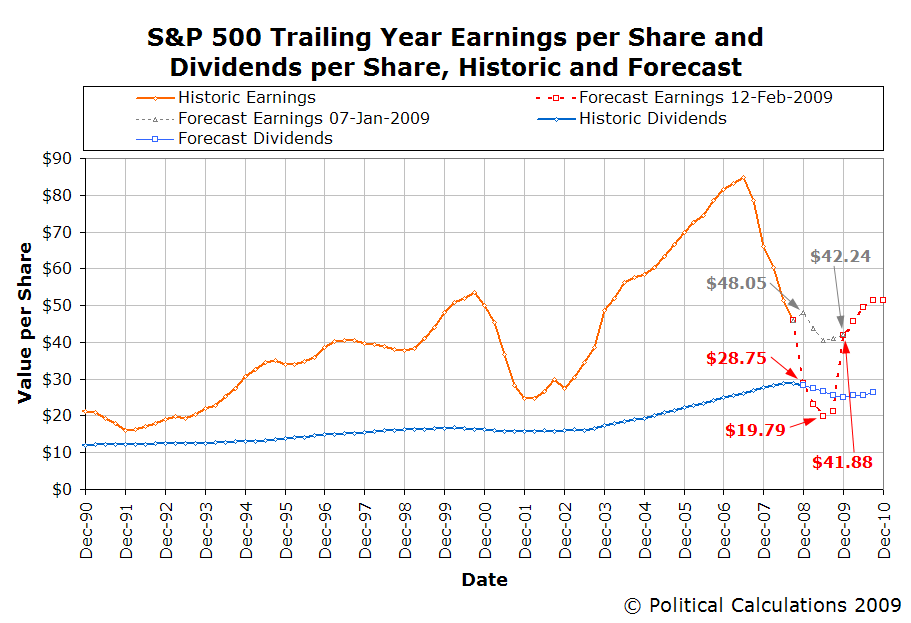
Quick heads up! The trailing year earnings data in particular has continued to slide since we created this chart. The following numbers shown on the chart would change as follows (at least as of 23 February):
2008-Q4’s $28.75 would now be $26.16
2009-Q2s $19.79 would now be $14.37
2009-Q3’s (not indicated) would now mark the bottom for earnings at $12.62
2009-Q4’s $41.88 would now be $32.41
The forecast earnings slowly improves from there. Note also that forecast trailing year dividends per share has declined from $24.90 to $24.60. Our original source for the data is S&P’s Earnings and Estimates spreadsheet.
Any thoughts on today’s WSJ Op-Ed by Jeremy Siegel? His point is market weighted earnings are a more appropriate measure of value and make the S&P look more attractive on a P/E basis.
FLFish: I think Siegel is likely on the right track and I’d like to see a comparison of the data (although I wouldn’t want to do it – talk about a monstrous amount of work!)
I think ideally, you would want to have both parts of the P/E ratio determined according to the same rules to minimize apples-to-oranges comparisons. I’ve demonstrated that the index’ dividends per share (which can be though of as the best-believed “sustainable” component of earnings and are weighted according to market cap) is particularly valuable for assessing the valuation of the index.
Actually, Siegel’s argument seems ridiculous to me.
Suppose everyone bought the market through an index and there were one million investors, all owning an equal share. Joe investor owns more of Exxon-Mobil than Jones Apparel, but his share of Exxon-Mobil’s $10 billion profit is $10,000. His share of in Jones Apparel’s lose is likewise $10,000.
Yesterday I posted an anecdote about the shadow realty market in the outer Main Line of Philly. One thing I didn’t add was that when my friend was researching properties at the township office the administrator mentioned that the banks were witholding properties from the market for fear that they would drive down home prices with the backlog that they have. The administrator told my friend that she had seen nothing like it in 20 years. I only mention this now because I just heard CNBC radio reporting on today’s NAR housing numbers and presuming that banks were holding onto these properties as the market bottom forms and the can get better prices.
The other thing about Siegel is that he has a financial stake in the “Wisdom Tree” ETF’s. They don’t use “cap-weighted” indexes. I haven’t read his article, but maybe it’s just an advertisement for Wisdom Tree ETF’s
Any thoughts on today’s WSJ Op-Ed by Jeremy Siegel? His point is market weighted earnings are a more appropriate measure of value and make the S&P look more attractive on a P/E basis.
You notice these guys are never arguing for changes in bull markets? Only when they are caught with their pants down do things need to be re-engineered
“If investors have cash on the sidelines, they should not wait too long to put it to use,” says Jeremy Siegel, Wharton business school professor at the University of Pennsylvania and well-known markets commentator. “There are good values out there in equities — especially in financial stocks — and you will be rewarded in the long run if you start dollar cost-averaging now.”
That is quite an AMAZING chart. The difference between the forecast earnings charts is a derivative of a derivative and thus has a unique divinatory power. In this case, that power divines that things are much worse than they seem. Capitalize “much”.
why use a multiple of 15? i keep seeing and hearing the number 15, mostly because that tends to validate today’s levels, using $50 eps. but the eps is surely heading lower than that, probly a range of $30-$40 over the next couple years. and while 15 is the average P/E ratio since 1900, these are hardly average times. and the low end of the range, which we’ve hit many times, is 7-10 X, and that low end can persist for years, as witness most recently the late 70s-early 80s. inflation may have helped to make the break-out low in P/Es then. who knows what will drive us there this time. but i’d be thinking about that low end a little more than any historical average.
Ya gotta love the sky rocketing earnings starting Q209. That would be because? Oh right V-shaped ‘recession’. Hold on to your hats kids, there’s a wake up call coming.
yeah i have an opinion on jeremy siegel. his mind has deteriorated immensely over the years and now he is ready for the looney bin. the man has gone completely mad
if i had to venture a guess i would say we are on the verge of an all out meltdown. i think that meltdown was about to occur on monday. if you had watched the global bond markets they all traded pinkish which is quite unusual while equities were getting pummelled. this was an organized situation where money was going nowhere but to SUPPORT global equities. this has become quite a frequent event. stocks remain overvalud in every metric.
traded pinkish .. I say good .. time for corporations to borrow from our excess cash in savings with payback requirements .. instead of drop the coin in the slot .. *#* .. better luck next pull .. we’ll put that donation to good use
ps – I do appreciate the tv programming they provide nearly free of charge
like Verizon wireless’s .. Perfectly unPretentious Presentaion … should have aired at the SuperBowl .. I love it .. gotta catch it on tape
Wished I could have chimed in on Jeremy Seigel earlier – but better late than never…
Here is the problem Mr Seigel – go back and calculate the index using your method – THEN determine whether the market is cheap. One can’t compare the index now using your metric without making a long term comparison, which, is nearly impossible given all the companies that have changed etc… The whole point of the valuation method is to use the SAME comparison throughout the ENTIRE length of time, not come up with a new valuation and say it is “cheap” by historical standards.
Idiocy at it’s finest… Can’t even believe the editorial was written…
While yesterday's US stock market close was poor, Asia and Europe didn't follow today as debt in Greece, Spain, Portugal, etc... rallied, their CDS narrowed and stocks bounced. The Greek finance minister said January tax revenues came in above expectations and that spending was below target for the month and said "that means the deficit reduction for January is well within what we have promised." The euro is rising in turn. Also helping is the story that Trichet is headed to the European Union leaders summit a day early in order to address Greece's problems even as the Greek finance...
February 25th, 2009 at 1:29 pm
Quick heads up! The trailing year earnings data in particular has continued to slide since we created this chart. The following numbers shown on the chart would change as follows (at least as of 23 February):
2008-Q4’s $28.75 would now be $26.16
2009-Q2s $19.79 would now be $14.37
2009-Q3’s (not indicated) would now mark the bottom for earnings at $12.62
2009-Q4’s $41.88 would now be $32.41
The forecast earnings slowly improves from there. Note also that forecast trailing year dividends per share has declined from $24.90 to $24.60. Our original source for the data is S&P’s Earnings and Estimates spreadsheet.
Yeah, we’ll have to make a new chart. Soon….
February 25th, 2009 at 1:33 pm
Any thoughts on today’s WSJ Op-Ed by Jeremy Siegel? His point is market weighted earnings are a more appropriate measure of value and make the S&P look more attractive on a P/E basis.
February 25th, 2009 at 1:39 pm
Okay so take that chart and draw a trend line from 1990 until today. It looks like we should be roughly around where we are (near 45.)
Now consider that the last 25 years are so had a lot of growth that was simply overleveraging and bring the slope of that trend line down somewhat.
Slap a 15 multiple on it – where does that leave us with S&P’s fair value?
February 25th, 2009 at 1:44 pm
@FLFish:
Paul Kedrosky thinks he’s crazy…
http://paul.kedrosky.com/
“Feel free to explain why Siegel’s right, of course. I think he’s mad.”…..
February 25th, 2009 at 1:46 pm
FLFish: I think Siegel is likely on the right track and I’d like to see a comparison of the data (although I wouldn’t want to do it – talk about a monstrous amount of work!)
I think ideally, you would want to have both parts of the P/E ratio determined according to the same rules to minimize apples-to-oranges comparisons. I’ve demonstrated that the index’ dividends per share (which can be though of as the best-believed “sustainable” component of earnings and are weighted according to market cap) is particularly valuable for assessing the valuation of the index.
February 25th, 2009 at 2:02 pm
Actually, Siegel’s argument seems ridiculous to me.
Suppose everyone bought the market through an index and there were one million investors, all owning an equal share. Joe investor owns more of Exxon-Mobil than Jones Apparel, but his share of Exxon-Mobil’s $10 billion profit is $10,000. His share of in Jones Apparel’s lose is likewise $10,000.
February 25th, 2009 at 2:06 pm
OT but I couldn’t resist,
Yesterday I posted an anecdote about the shadow realty market in the outer Main Line of Philly. One thing I didn’t add was that when my friend was researching properties at the township office the administrator mentioned that the banks were witholding properties from the market for fear that they would drive down home prices with the backlog that they have. The administrator told my friend that she had seen nothing like it in 20 years. I only mention this now because I just heard CNBC radio reporting on today’s NAR housing numbers and presuming that banks were holding onto these properties as the market bottom forms and the can get better prices.
February 25th, 2009 at 2:27 pm
FLFish @ 1:33
I haven’t read it yet. But I give only minimal weight to the views of someone who has never had a bearish thought in his life.
Besides, to Siegel, the “short term” is probably no less than five years.
February 25th, 2009 at 2:32 pm
Bob_in_MA @ 2:02
The other thing about Siegel is that he has a financial stake in the “Wisdom Tree” ETF’s. They don’t use “cap-weighted” indexes. I haven’t read his article, but maybe it’s just an advertisement for Wisdom Tree ETF’s
February 25th, 2009 at 4:20 pm
@FLFish Says: February 25th, 2009 at 1:33 pm
Any thoughts on today’s WSJ Op-Ed by Jeremy Siegel? His point is market weighted earnings are a more appropriate measure of value and make the S&P look more attractive on a P/E basis.
You notice these guys are never arguing for changes in bull markets? Only when they are caught with their pants down do things need to be re-engineered
February 25th, 2009 at 4:32 pm
I just did a search and found this. Check the date, heehee.
Jeremy Siegel Says Get Ready to Buy
By Gregg Greenberg TheStreet.com Staff Reporter
8/10/2007 11:55 AM EDT
URL: http://www.thestreet.com/p/funds/etf/10373603.html
The “Wizard of Wharton” says don’t worry.
“If investors have cash on the sidelines, they should not wait too long to put it to use,” says Jeremy Siegel, Wharton business school professor at the University of Pennsylvania and well-known markets commentator. “There are good values out there in equities — especially in financial stocks — and you will be rewarded in the long run if you start dollar cost-averaging now.”
February 25th, 2009 at 4:57 pm
That is quite an AMAZING chart. The difference between the forecast earnings charts is a derivative of a derivative and thus has a unique divinatory power. In this case, that power divines that things are much worse than they seem. Capitalize “much”.
February 25th, 2009 at 6:11 pm
why use a multiple of 15? i keep seeing and hearing the number 15, mostly because that tends to validate today’s levels, using $50 eps. but the eps is surely heading lower than that, probly a range of $30-$40 over the next couple years. and while 15 is the average P/E ratio since 1900, these are hardly average times. and the low end of the range, which we’ve hit many times, is 7-10 X, and that low end can persist for years, as witness most recently the late 70s-early 80s. inflation may have helped to make the break-out low in P/Es then. who knows what will drive us there this time. but i’d be thinking about that low end a little more than any historical average.
February 25th, 2009 at 6:20 pm
Ya gotta love the sky rocketing earnings starting Q209. That would be because? Oh right V-shaped ‘recession’. Hold on to your hats kids, there’s a wake up call coming.
February 25th, 2009 at 8:18 pm
yeah i have an opinion on jeremy siegel. his mind has deteriorated immensely over the years and now he is ready for the looney bin. the man has gone completely mad
February 25th, 2009 at 8:26 pm
if i had to venture a guess i would say we are on the verge of an all out meltdown. i think that meltdown was about to occur on monday. if you had watched the global bond markets they all traded pinkish which is quite unusual while equities were getting pummelled. this was an organized situation where money was going nowhere but to SUPPORT global equities. this has become quite a frequent event. stocks remain overvalud in every metric.
February 25th, 2009 at 9:19 pm
traded pinkish .. I say good .. time for corporations to borrow from our excess cash in savings with payback requirements .. instead of drop the coin in the slot .. *#* .. better luck next pull .. we’ll put that donation to good use
ps – I do appreciate the tv programming they provide nearly free of charge
like Verizon wireless’s .. Perfectly unPretentious Presentaion … should have aired at the SuperBowl .. I love it .. gotta catch it on tape
February 25th, 2009 at 9:31 pm
Wished I could have chimed in on Jeremy Seigel earlier – but better late than never…
Here is the problem Mr Seigel – go back and calculate the index using your method – THEN determine whether the market is cheap. One can’t compare the index now using your metric without making a long term comparison, which, is nearly impossible given all the companies that have changed etc… The whole point of the valuation method is to use the SAME comparison throughout the ENTIRE length of time, not come up with a new valuation and say it is “cheap” by historical standards.
Idiocy at it’s finest… Can’t even believe the editorial was written…
February 26th, 2009 at 2:49 pm
Here’s the updated version of the chart, showing the data as we know it today.
February 27th, 2009 at 2:56 pm
Thanks to all for the responses!