
The Return of John Maynard Keynes
English economist John Maynard Keynes, seen here circa 1940, believed no one in America was smart enough to run it. Walter Stoneman and Samuel Bourne
click for audio
Source:
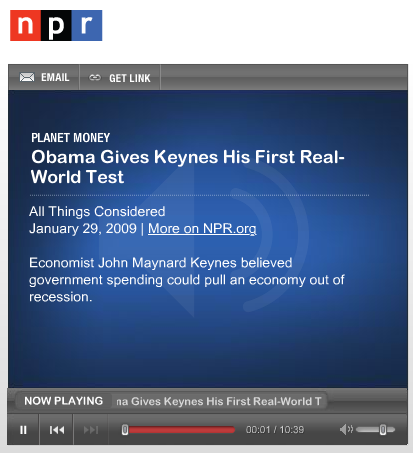
Obama Gives Keynes His First Real-World Test
Adam Davidson and Alex Blumberg
NPR, All Things Considered, January 29, 2009
http://www.npr.org/templates/story/story.php?storyId=100018973&ft=1&f=1001



February 3rd, 2009 at 6:59 pm
The attached article was ridiculous.
“Politicians took the Keynesian message that government spending can be good and ran with it. They paid for the war on poverty and the war in Vietnam. They sent a man to the moon. All the while, they piled up the federal budget deficit, convinced that Keynes gave them a free pass.”
Actually, no. The federal debt DECREASED from 1950-1980. See, here’s a helpful chart of what actually happened! http://en.wikipedia.org/wiki/United_States_public_debt
“Prescribing Keynesianism to some politicians is like prescribing crack to a coke addict. In the 1970s…the U.S. had high unemployment, and the Keynesian solution stopped working. The national government spent and spent, but unemployment only got worse. ”
Uh, not according to that chart. I’m a little mystified as to how we recklessly “spent and spent” in the 70’s, yet the national debt declined to its lowest point–either as a straight number or as a percentage of GDP–from 1940 to the present. Were the bookkeepers also on crack? Maybe the numbers are on crack? Because this article suggests they’re lying.
“[In the late 70's] came inflation, something Keynesians had no answer for…After the economic misery of the 1970s, it was the Keynesians’ turn to walk in the wilderness…a school of thought…replaced Keynesianism. The discipline of economics includes many different groups — the monetarists, the Chicago school and supply-side economics.”
So, under Carter the monatarists were right and they beat inflation with a recession. Cool. And, uh, if you look at the chart, you’ll notice that Keynesian economics never went away, it just got a new name! Once the “supply side economics” team took over, government spending goes through the damn roof in 1980, (and kept climbing with a brief lull under Clinton).
It was Keynesian deficit spending, but for some reason everyone agreed it didn’t count if you spent it on the military and tax cuts instead of infrastructure & human capital investment.
Ugh, what a ridiculous article. These figures aren’t hard to find–I’m confused as to why there’s a fairy tale about how and when we did and didn’t spend. Still, I guess it supports the Republican fairy tale that they are fiscally responsible and cut spending. Which, uh, not so much. They actually deficit spend MORE–and on really dumb things.
February 3rd, 2009 at 8:29 pm
@theorajones
Still, I guess it supports the Republican fairy tale that they are fiscally responsible and cut spending
Fairly tail indeed, the difference is that the spending went to private enterprises directly. Under Bush the Military and many of its primary responsibilities are outsourced.
February 4th, 2009 at 9:34 am
Thanks for pointing out the elephant in the room (pardon the pun), viz., “the Republican fairy tale that they are fiscally responsible and cut spending.” The Republican position in action has been to argue for tax cuts and to spend yet more on “defense”. The deficit from tax cuts is a not a worry to them because of supply-side magic. The effect of their policies is to structurally and permanently increase US borrowing from abroad: i.e., to sell-off America in bits in pieces to pay for increased current private consumption from the tax cuts and increased public consumption in the wars/military build-ups. Whenever the topics of government spending on non-military items or counter-cyclical fiscal policy come up, then they talk about fiscal responsibility.
February 4th, 2009 at 7:40 pm
theorajones,
“Actually, no. The federal debt DECREASED from 1950-1980. See, here’s a helpful chart of what actually happened! http://en.wikipedia.org/wiki/United_States_public_debt”
Just a clarification that may make you rethink your position, the actual debt levels did not decreased from 1950 to 1980 in nominal dollars. Inflation adjusted dollars of debt outstanding may have declined but that is a function of the loss of purchasing power ascribed to those dollars, not the total outstanding.
This chart may help – http://www.cedarcomm.com/~stevelm1/usdebt.htm
Just something you may want to consider in your argument.