
Wall Street Still Says “BUY”
“Analysts completely missed the boat again with the subprime and credit crises. They should’ve given some early warning signs to investors to bail out, or at least lighten up their portfolios. That warning never came.”
-Jacob Zamansky, investor securities lawyer
>
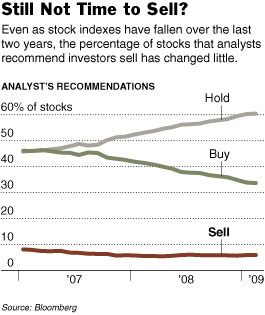
Today’s Times looks at an issue that is one of our longstanding complaints: Wall Streets BUY bias.
Why is any of this still a surprise? Given the inherent conflict of interest between underwriting/syndicate and investing, it shouldn’t be.
The iBanks do not want to risk offending potential banking deals, M&A clients, or other corporate advisory.
Here’s an excerpt:
Even now, with the recession deepening and markets on edge, Wall Street analysts say it is a good time to buy.
Still.
At the top of the market, they urged investors to buy or hold onto stocks about 95 percent of the time. When stocks stumbled, they stayed optimistic. Even in November, when credit froze, the economy stalled and financial markets tumbled to their lowest levels in a decade, analysts as a group rarely said sell.
And last month, as the Dow and Standard & Poor’s 500-stock index suffered their worst January ever, analysts put a sell rating on a mere 5.9 percent of stocks, according to Bloomberg data. Many companies have taken such a beating in the downturn, analysts argue, that their shares are bound to bounce back.
Maybe. But after so many bad calls on so many companies, why should investors believe them this time?
When Internet stocks imploded in 2000 and 2001, Wall Street analysts were widely scorned for fanning a frenzy that had inflated dot-com shares to unsustainable heights. But this time around, credit rating agencies, mortgage companies and Wall Street bankers have shouldered much of the blame for the Crash of 2008, and few have publicly questioned the analysts who urged investors to buy all the way down.
Does this still surprise anyone . . . ?
>
Previously:
Only 5% of Wall Street Recommendations Are “SELLS” (May 16th, 2008)
http://www.ritholtz.com/blog/2008/05/only-5-of-wall-street-recommendations-are-sells/
Analysts Belated Downgrades (November 18th, 2008)
http://www.ritholtz.com/blog/2008/11/belated-downgrades/
Source:
Why Analysts Keep Telling Investors to Buy
JACK HEALY and MICHAEL M. GRYNBAUM
NYT, February 8, 2009
http://www.nytimes.com/2009/02/09/business/09analyst.html



Tweet
Facebook
Reddit
Digg this!


February 9th, 2009 at 9:12 am
I know this has been posted frequently, but true is true, and some people have a way with words:
“It is difficult to get a man to understand something, when his salary depends upon his not understanding it!”
– Upton Sinclair
February 9th, 2009 at 9:23 am
or, there’s Warren Buffett’s “Don’s ask a barber if you need a haircut.”
February 9th, 2009 at 9:37 am
When investors say this they are demonstrating how clueless they are about the structure of the financial system.
Here in Canada a huge % of asset are being managed by brokerage firms and asset managers which are owned by the banks.
On the investment counseling /asset manager side, most assets are managed according to investment policies which are controled by outside consultants (i.e actuaries, committees) who use past data to predict the future. So the portfolio manager rarely has a say in the asset-mix decision.
On the brokerage side, investment advisors are being pushed to increase assets and to have them managed by the asset manager firm they own . So investment advisors are more and more salespeople with less and less investment management knowledge. What they know is what is coming from the economist employed by the brokerage house.
There is no way in hell any bank will let their economist say sell equities and go into cash for at least 2 major reasons:
1. Equities (funds and trading) are way more profitable than money market.
2. Banks would go bankrupt. Imagine if all brokers/investment advisors, after listening to the econiomist and strategist on the morning conference call, called up all their clients at the same time and told them to sell equities and go into cash…
February 9th, 2009 at 9:51 am
When I was in high school I worked at my friend’s father’s auto shop. His dad was a good guy, very kind, but if you brought in your car because of a “strange noise” you better believe your wallet was going to turn that noise into a masterpiece….
February 9th, 2009 at 9:53 am
If you want a good laugh try imagining the junk that actually has a sell rating on it
February 9th, 2009 at 9:56 am
Even more moronic is the “sell” signals they put out after stocks have tanked 95%. There really should be a repercussion effect for making the wrong calls. Something more immediate and damaging than just their reputation. As an engineer if I design something wrong and it hurts somebody, I don’t have the defense of “Well market internals changed since my design so I can’t be held to my design.” There should be legislation that requires a running total of all recommendations that an analyst makes and historically track them up until he unwinds that position. That way a client can see immediately how that analyst performs a balance between reward and risk. Then the efficiency of the analyst market would be on display for all the public.
February 9th, 2009 at 9:58 am
When I was in high school I worked at my friend’s father’s auto shop. His dad was a good guy, very kind, but if you brought in your car because of a “strange noise” you better believe your wallet was going to turn that noise into a masterpiece….
A friend was shocked when I told him that his ‘great dentist’ probably sold him more work than he actually needed. Face it folks. It happens at every door you walk into when you are the customer. You don’t look like a person wanting something you are either this month’s or this month’s and next month’s mortgage payment depending on how good a salesman they are and how big a sucker you are
February 9th, 2009 at 10:15 am
Someone please explain to me why these people are still counted on by anyone for “investment advice”? Always a great time to buy (but never to sell)……good grief.
February 9th, 2009 at 10:17 am
Maybe. But after so many bad calls on so many companies, why should investors believe them this time?
Same reason as alway: because they *want* to believe.
Recent issue of the New Yorker had a quote (sorry read about 3 issues on a flight and don’t remember which one). Roughly remembered: It’s called a confidence game for a reason. Because you are confident in me? No. Because I give you my confidence.
February 9th, 2009 at 10:30 am
Well, if the hedgies aren’t in a panic and selling off then it might be a good time to buy into something.
Oil services has a big gain potential. NYMEX oil is priced under Brent and has been for a while. Usually, Brent costs less. At some point (tomorrow, Spring, Summer, later) the traditional parity will return and WTC will burst forth in price. Commodity traders and ignorant reporters will mistake this for the promised return of high oil prices and all oil prices will rise. Both will come down to probably $50 to < $60. However, the price rise and overshoot will also include oil services. The bottom is now. The top is tens of percent higher than today, to be followed by an eventual decline to compensate for the overshoot.
Also, good weather brought people to the malls last weekend. Perhaps the recent frigid weather was a contributor to poor retail sales and pent up demand will appear for a while?
Nat Gas is still a loser and may decline to the mid $3 or lower in a few months. Good for disposable income, though.
Otherwise, large cap domestic is a probable winner until the recovery becomes self sustaining and a safe place to wait it out.
February 9th, 2009 at 10:37 am
The bias is a given. If it exists I’d like to see that chart going back 40 years for pssible contrary indicator perspective….
February 9th, 2009 at 10:43 am
Why just blame the analysts? The financial press always looks for any possible bullish spin in any news. Could you imagine the sports news or the weather reporting like the financial press?
Headline: February 9, 2009 Temperature 42, four degrees higher than expected. We expect summer to start next week.
February 9th, 2009 at 10:46 am
Mannwich Said:
February 9th, 2009 at 10:15 am
Always a great time to buy (but never to sell)……good grief.
reply: Right and it will always be that way. Buying is optimism and the promise of good times. Selling is perceived as something losers do. Sellers are correcting their bad judgment. Winners never have bad judgment and therefore have nothing to sell. People who perceive themselves as winners buy at the top and stoically sell at the bottom. Winners see that increasing slope continuing on into infinity. Why would you sell if your stock is on its way to infinity?
The best way to put an ‘L’ on your forehead is to be a professional and tell your client to sell, especially if the client was told to buy earlier. It’s best not to say anything because it might prompt uncomfortable questions. Especially if you say sell and it goes up afterward. Never saying ‘sell’ is a minimize the maximum loss strategy in a down market. You can hide in the herd.
People who can’t sell belong in CDs. Except for those who buy from me when I sell.
February 9th, 2009 at 10:52 am
With a very modest back ground in economics, I don’t consider myself to be expert reader of the ‘tea leaves”
But in late July 2007 when I heard the banks were no longer loaning money to each other, I knew in my “gut” that was not a good thing! I sold everything and went to cash. Thought if I was wrong in my assessment I could always get back in.
If I saw the storm clouds coming, the trained pro’s did also!
It was simply not in there interest to recommend to there clients to get out.
February 9th, 2009 at 10:53 am
I said
Otherwise, large cap domestic is a probable winner until the recovery becomes self sustaining and a safe place to wait it out.
addendum:
I meant as a buy and hold. This sector will be among those that rise first. It’s probably not going much lower. Just when it takes off is anybody’s guess.
February 9th, 2009 at 10:57 am
If you say “buy” for long enough, eventually you will be right…
February 9th, 2009 at 11:10 am
@ How the Common Man Sees It
“It happens at every door you walk into when you are the customer.” Caveat Emptor.
Many (some?) people educate themselves when in the market for an appliance, a car or other major purchase, researching the best buy/value and then go into the marketplace, ever watchful for the dealer who is most “honest”, usually the one who least misrepresents the product and terms of sale (financing offers, etc).
It is ASTOUNDING how cavalier are consumers of services far more critical to their well-being, i.e., legal, medical and financial.
I learned long ago the hard way to be as knowledgeable as possible as a litagee, patient, and investor and to always make it crystal clear to attorney, doctor or investment adviser that I am in charge and their responsibility is to provide all the facts and options in order for me to make informed choices. Not to suggest that I micro-manage my surgeries, court room motions or day-to-day trading, but these professionals damn well better keep me up to speed on the why’s and wherefore’s and decision point criteria and I damn well better have done m homework so I know whether they are blowing smoke up my fundament.
February 9th, 2009 at 11:18 am
I’ll be back in the Stock Market when major sports agents and players, movie stars and television talent make half the salary for half the contract term.
As odd as it may seem I’m also keeping and eye on the rate escorts are charging to identify a bottom.
February 9th, 2009 at 11:20 am
@Al: That’s slowly happening in MLB, where a whole slew of good players haven’t signed yet and spring training just a few weeks away. Never happened before as far as I can remember. These players are in a state of denial over things and seem to have no idea that things have changed dramatically and they won’t be making the kind of coin they had been making for quite a while now. Ray Durham is considering retirement because he has received “no offers from anyone to even turn down”. Timing is everything in life as we all know.
February 9th, 2009 at 11:21 am
Most investing advice sorts assets classes by recent performance and recommends what comes out on top. After 20 years of “investing” I’ve come to realize you should be looking to go long with what sorts out to the bottom.
February 9th, 2009 at 11:21 am
@rob: “Even more moronic is the “sell” signals they put out after stocks have tanked 95%.”
That often means it is time to buy.
February 9th, 2009 at 11:31 am
Reminiscent of 1929
February 9th, 2009 at 2:28 pm
But Larry Kudlow says it’s a great time to buy because the market is low. What should I do?
February 9th, 2009 at 2:44 pm
My kid just got braces, upon the advice of his orthodontist, even though his teeth work and look fine. I asked my wife if she’s aware of any mom that took their kid to the orthodontist to see whether they needed braces received a recommendation against it. She looked at me as if I was from Mars.
It’s called agency costs. There are agency costs w/ management to shareholders, professionals to clients, tax-spenders to taxpayers–in a complex society dependent on capturing efficiencies due to specialization, very little heed is taken of costs due to the misalignment of incentives and priorities from the specialists to the customers of their specialty.
Indeed. Never ask the barber whether you need a haircut, nor the orthodontist whether your kid needs braces, nor the tax-spenders whether more tax dollars should be spent, nor the financier whether financial products are a good idea or not. The answer that most benefits the specialist is the one you will receive and it is rarely an answer that does not involve some direct remuneration for him.
February 9th, 2009 at 3:14 pm
Anyone see Roubini and Taleb about an hour ago? Being right doesn’t get them any respect from the CNBC crowd.
http://www.cnbc.com/id/15840232?video=1027496846&play=1
http://www.cnbc.com/id/15840232?video=1027524452&play=1
BTW, wish they would stop erroneously referring to Roubini as “Dr. Doom;” that title belongs to Marc Faber.
February 9th, 2009 at 4:23 pm
I agree that the buy calls are a little silly, but some of them could actually be very smart if they are being made today on the right stock.
Like someone above I get more annoyed by the call for SELL after a stock drops 50, 60, 70% etc. To me that’s even worse because I fully expect the buy all the time garbage.
The funny thing is, you still get a reaction, almost every single time, if an analyst upgrades or downgrades a stock no matter how many times guys like Barry point out how dumb they really are. You know, if my job was to look at a select group of companies all day and I had all kinds of access to them I’d hope I could do a better job than these fools. But then, that’s every job.
Mike in Nola,
I am a huge Faber fan and I agree, they need to stop calling Roubini Dr. Doom, Faber owns that. Roubini has a more doom type face, the sloppy tie, the bad hair, Faber typically wears that goofy smile, a better dresser, and a slick do’ so maybe people can associate that better to Roubini.
February 9th, 2009 at 4:40 pm
This speaks volumes how sell-side analysts strategize to monumental shifts in the economy. if these guys are advising how to manage client portfolios, clients are in for a heap more of trouble. This picture says sell-side analysts/strategists have learned nothing about how to adapt and survive. There deer in the headlights strategy (illustrated below) shows no aptitude for managing risks. Every stock in the world virtually provided several sell signals through 2008, yet less than 10% could actually claim to have seen the writing on the wall and say sell. The other 90% remained fixated upon their buy and hold strategy. It is all they flipping know, the dumb clucks! This is what I was afraid of seeing, that one of the great lessons taught in 2008 was to sell, yet 90% of the professional market strategists did not learn this most important lesson. Main Street remains in a heap of trouble with these inflexible strategists still on their side and managing their portfolios.