
Charting Household Net Worth
Last nite, I mentioned U.S. Household Net Worth fell 18%. This morning, Rolfe Winkler sends along this chart based upon the Q4 2008 Flow of Funds from the Federal Reserve.
>
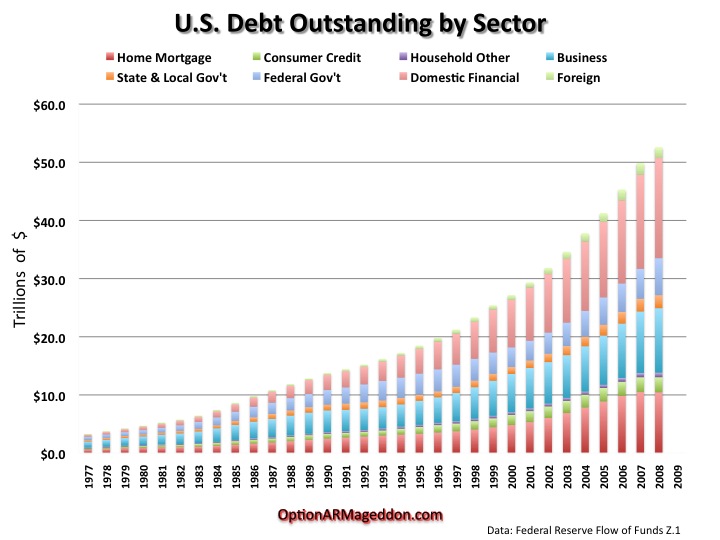
To put data from the chart above in perspective, the one below compares the data to GDP. I’m using annual data here, so the increase at the end of 2008 is understated. GDP for the full year 2008 was higher than 2007. But Q4 2008 GDP was lower compared to Q3. So towards the very end of the year, the denominator (GDP) is going down even as the numerator (Debt) is going up. On a percentage basis, this means Debt/GDP is presently rising at an accelerating rate.
>
Source:
Charts: U.S. Debt Expanding, Homeowner Equity Crashing
Rolfe Winkler
Option Armageddon, March 12, 2009 – 9:51 pm
http://optionarmageddon.ml-implode.com/2009/03/12/updated-debt-stats/
Previously:
US Household Net Worth Falls 18% (March 12th, 2009)
http://www.ritholtz.com/blog/2009/03/us-household-net-worth-falls-18



Tweet
Facebook
Reddit
Digg this!


March 13th, 2009 at 12:01 pm
Chart seems confusing — I see 8 bars in the chart, only 6 categories in the legend.
Despite that, the “big picture” looks grim — SB has of course been pounding this point for quite a while.
March 13th, 2009 at 12:02 pm
Barry,
We continue to hear stories in the MSM and on CNBC that the banks just aren’t loaning money..I don’t routinely read Rolfe Winkler’s website, but after you posted this, I went over and read a little. One thing interested me in his posting, and that was the MetLife study listed below…frankly if American households are in this kind of economic shape, then no fiscally prudent banker should be loaning new money….just a thought..
http://www.housingwire.com/2009/03/10/most-americans-hanging-on-by-a-financial-thread-study/?utm_source=mortgagenewsclips+test+list&utm_campaign=8c2da07f3d-RSS_EMAIL_CAMPAIGN&utm_medium=email
Most Americans Hanging on By a Financial Thread: Study
…and, if this is the case, and unemployment is still rapidly increasing, then I would expect fewer contributions to retirement plans this year because the money is needed for day to day living..
I also see that more companies are cutting wages..this steamroller is gathering a head of steam also…
March 13th, 2009 at 12:05 pm
Agreed with Whammer. What’s what on the chart? There are 2 greens and 2 reds.
~~~
BR: Raise your resolution! There are 8 color bars:
March 13th, 2009 at 12:09 pm
@ Whammer — if you follow the link to Rolfe’s site, his picture has 8 items in the legend. BR has an older version here.
~~~
BR: Count again — I see 8 — I had Rolfe send me this white version (pretty!) of his black chart about an hour ago
It should be the exact same chart, but different background color.
UPDATE: Ahhh, I see, the key is missing 2 components — but all of the components are show in the chart
March 13th, 2009 at 12:13 pm
From top to bottom, the chart elements should be (I think):
*) Foreign
*) Domestic Financial
*) Federal Gov’t
*) State & Local Gov’t
*) Business
*) Household Other
*) Consumer Credit
*) Home Mortgage
March 13th, 2009 at 12:21 pm
The Federal Gov debt must refer to the debt held by the public and does not include intragovernmental holdings (such as the social security trust fund). Since the chart runs through 2008 this debt also doesn’t include a bevy of new debt that has or will be added (eg, the stimulus spending).
March 13th, 2009 at 12:40 pm
@constantnormal — Thanks, that cleared up my question as well …
March 13th, 2009 at 12:45 pm
So glad to see government debt taking up slack of falling consumer and mortgage borrowing. We can’t keep the party going without growing debt. “Party on, Garth!”
March 13th, 2009 at 12:47 pm
The nominal $ chart provides no value whatsoever. The Debt as a % of GDP is much more informative although it appears the selection of 1977 as a starting point was used for the purposes of showing that we are currently in some unprecendented debacle. If the graph is expanded to show the debt/GDP during WW II it would indicate that we’ve had massive debt on the national balance sheet before and have recovered successfully. In fact the post war period was one of unprecedented growth and prosperity. I think it would be wise for all of the chicken littles to look at a much longer period of history.
March 13th, 2009 at 1:00 pm
Prediction: The chart is going to be a lot taller in 2009 and 2010.
And here’s a friendly little reminder for all the Obamanomics cheerleaders:
“(Chinese) Premier Wen Jiabao noted that Beijing is the biggest foreign creditor to the United States and called on Washington to see that its response to the global slowdown does not damage the value of Chinese holdings.
“We have made a huge amount of loans to the United States. Of course we are concerned about the safety of our assets. To be honest, I’m a little bit worried,” Wen said at a news conference following the closing of China’s annual legislative session. “I would like to call on the United States to honor its words, stay a credible nation and ensure the safety of Chinese assets.
March 13th, 2009 at 1:02 pm
“Of course we are concerned about the safety of our assets. To be honest, I’m a little bit worried,”
Understatement of the year.
March 13th, 2009 at 1:02 pm
@constantnormal — thanks, that is clear on Rolfe’s site. BR, I’m still only seeing 6 in the legend here in the white version. Firefox 2.0.0.16 on a Mac.
March 13th, 2009 at 1:09 pm
R Timm,
to this: “show the debt/GDP during WW II it would indicate that we’ve had massive debt on the national balance sheet before and have recovered successfully.”
remember, we ‘recovered’, mainly, due to the fact that we had little, to no, foreign competition, and we were rebuilding ‘the World’, as well as building ‘Suburbia’, here..
China, for instance, then, was locked down under Mao. Today? not so much..
“The River– familiar Friend, though never the Same”
or, as Dylan reminds us: “The Times, they are a’changin’”
past that, and OT:
anyone else see this ‘rally’ as just completing a Wave 4, in EW parlance.
meaning, it’s over, and heading Lower, prob. til’ the ~end of the Month..
March 13th, 2009 at 1:12 pm
If the graph is expanded to show the debt/GDP during WW II it would indicate that we’ve had massive debt on the national balance sheet before and have recovered successfully. In fact the post war period was one of unprecedented growth and prosperity.
——————
See: http://www.nakedcapitalism.com/2008/07/has-deleveraging-even-begun-not-for.html
March 13th, 2009 at 1:14 pm
I would like to see how much of that debt is purely health care related. Exactly how much of the household/personal/business debts are purely health issues. That’s been the beast eating our feast the last 20 years IMHO.
March 13th, 2009 at 1:16 pm
Tom K,
to your post re: China
the Chinese should note that their loans are denominated in Federal Reserve Notes. With that, if they’ve a problem with their ‘future value’, they should take the matter up w/ BenBer y Cia..
we’d do well by telling the FedRes to pack up their ‘Notes’ and go home, where/ever that is..
IOW, if we really needed sour Notes, we could rent an Organ Grinder for a whole lot less..
March 13th, 2009 at 1:19 pm
If the graph is expanded to show the debt/GDP during WW II it would indicate that we’ve had massive debt on the national balance sheet before and have recovered successfully. In fact the post war period was one of unprecedented growth and prosperity.
See: [http://www.nakedcapitalism.com/2008/07/has-deleveraging-even-begun-not-for.html]
(This may get posted several times – the blog seems to object to urls and fails to post on occassion)
March 13th, 2009 at 1:23 pm
Debt isn’t necessarily bad, so long as its maturities are matched to the life expectancies of the assets bought with it, and the assets can be expected to throw off tangible returns for duration of their lives.
Here’s an example:
Borrowing money to win WWII and become the most powerful nation economically the world has ever seen? Good call. It was borrowing money to invest in a brighter future, and we are still enjoying returns from the investment.
Borrowing money to build McMansions and consume big-screen TV’s? Not so much.
March 13th, 2009 at 1:27 pm
Every time you show this I wanna sell this rally. But it’s Spring, and who knows how far we will ramble?
March 13th, 2009 at 1:28 pm
@Curmudgeon, your point on matching the debt to the life expectancies of the assets is a great one, and gets back to good fundamentals. How many folks borrowed 30-year money to pay for those big-screen TVs??? Way too many.
March 13th, 2009 at 1:34 pm
Whammer,
flip that over, too. look at the CP market–how many “Firms” were borrowing on 30-60- 90-day paper, to fund multi-year commitments?
to your answer: Way too many..
March 13th, 2009 at 1:36 pm
@lb,
just to 2x-check, it ain’t Spring yet, don’t be fooled by the clock-change.. (:
March 13th, 2009 at 1:42 pm
Too much debt is too much debt. There is a limit at or near which it causes a loss of confidence and a credit collapse.
The identity of the party holding the debt makes very little difference; the reason is quite simple: all the debt of individuals, corporations, governments is ultimately all debt on the same party: the individual consumer, employee or taxpayer. All those various debts are claims on the future work of the same party. What matters is the amount of debt compared to the realistic probable future work capacity minus the amount of that work required to sustain current expenses. Obviously when defined that way there is a clear limit beyond which the probability of payback sharply decreases.
A credit bubble can push debt to the collapse point. So can a sudden increase in the cost of current expenses – like an oil price surge, for instance.
And here we are. The logical course now is to destroy the excess debt. Our government, however, is working against us in that goal and is therefore prolonging and possibly worsening the collapse.
March 13th, 2009 at 2:03 pm
and this, again:
http://clusty.com/search?input-form=clusty-simple&v%3Asources=webplus&query=Fractal+Economics
should give sufficient background to some of the ideas ‘wally’ alludes to..
March 13th, 2009 at 2:25 pm
It will all end in tears. Peeps will be extra quick to sell those 8-bedroom McMansions when crude hits $100.
March 13th, 2009 at 2:29 pm
The government could easily discourage further increases in debt by eliminating the tax deductibility of interest. Deductibility by all corporations – - financial and non-financial.
The government could even go so far as to prohibit any tax deduction in the event of a borrower default. The result of such a tax policy would be that credit would become less available and more expensive. But if such a change in the tax code were phased in over many years, the result would be far less debt in the U.S. economy, and greater financial stability.
(Of course, this will never happen. But it’s a thought).
March 13th, 2009 at 2:31 pm
@James: Thanks for the link. That is a good chart. The only thing wrong with it is it doesn’t start at zero so the change is somewhat exagerated.
@ Curmudgen: I like your point about assets. I agree MEW was too often used for immediate gratification. One saving grace so far has been that US assets abroad have consistently returned higher rates of return than those of foreign governments purchasing assets in the US. As long as the US is able to borrow long term at very low real interest rates we should continue to make sizeable investments both domestically and internationally.
March 13th, 2009 at 2:37 pm
Barry, the chart itself has all the colors, but the legend is missing two of them.
~~~
BR: Thanks for the clarification — I’ll get a corrected chart for Rolfe.
OK, its been updated
March 13th, 2009 at 2:54 pm
What matters is the amount of debt compared to the realistic probable future work capacity minus the amount of that work required to sustain current expenses.
Your assumption is hanging on ‘realistic probable future work’.
Obviously when defined that way there is a clear limit beyond which the probability of payback sharply decreases. A credit bubble can push debt to the collapse point. So can a sudden increase in the cost of current expenses – like an oil price surge, for instance. And here we are. The logical course now is to destroy the excess debt.
Which means default, and that means many many worse things (like war, famine and pestilence) than trying to work off a large debtload. In particular, the large debt load is due to GDP not keeping up. So if GDP can be kept up, the weight of the future debtload will drop considerably.
Shift part (about half) of the consumer mortgage debtload to the federal balance sheet, and part (not all) of the financial debtload (about 1/3rd) to the federal balance sheet, and write off (about 1/3rd) part of the financial debtload. Then attempt to jack up GDP. If it doesn’t work over the long term, then you can default on the fed debtload, and you’re no worse off than you were if you defaulted now.
That’s exactly what happened during the Great Depression and WWII. (The real trick is to pull it off without breadlines and a war.)
If we assume (permanantly) flat or falling GDP than the debtload is growing infinitely as we head to the future, then defaulting makes sense. Not otherwise.
max
['Not unless you like looters burning down your house.']
March 13th, 2009 at 2:59 pm
What stands out to me is how small the gov’t debt is compared to private/business/household debts. This is obviously the strategy on a macro level….
Move private debts onto the public balance sheet at cheap long term rates (at least for now)….and then hope things get better over the next few years.
March 13th, 2009 at 3:01 pm
Given that “the next election” is never more than two years away, the government will perpetually try to inflate an even bigger bubble. The question from the investment standpoint is, how long can they keep this game going.
According to the Steve Barry school of thought, the “day of reckoning” may finally be at hand, i.e., we may finally be forced to face the debt monster in our midst.
I’m not convinced. Certainly, the higher the debt level, the more unstable the economy, and the greater is the probability that recessions, when they occur, will be deep. But I have faith in the politicians to push off the current economic problems into the future (even if they make matters worse in the long run). A year from now, I think we’ll see lower consumer debt, but higher government debt.
March 13th, 2009 at 3:06 pm
Andy Tabbo @ 2:59
“Move private debts onto the public balance sheet at cheap long term rates (at least for now)….”
An issue that no one ever seems to talk about is the composition of the newly issued Treasury debt. I think that quite a lot of it is short term. I read somewhere that 70% of the debt held by foreigners is for maturities of 5 years or less.
In any case, if most of the Treasury debt is short-term, we could be facing a huge increase in borrowing costs in the next 5 years or so.
(If it were up to me, I’d be selling as many 30-year bonds as the market could absorb).
March 13th, 2009 at 3:06 pm
Does this include all the money those folks that Obama is finally going after have their money hidden from the gov’t (and from taxes) in offshore banks?
The good news, that even eight years after Bush received the OECD FATF report on the extent of this problem finally something’s being done and contrary to all those defenders of tax cheats like the Wall Street Journal opinion page, the Swiss are beginning to cave.
http://news.bbc.co.uk/2/hi/business/7941717.stm
“…However, while it [Switzerland] will now abide by international rules on bank data sharing, it said it would only respond to “concrete and justified” requests…”
Which does beg the question, what if a request is “justified” but not “concrete?”
March 13th, 2009 at 3:16 pm
VennData @ 3:06
Even if the Swiss government is willing to give up on financial services as a source of revenue (which I doubt), there are still a lot of other tax haven countries.
March 13th, 2009 at 3:17 pm
I just heard CNBC ramble thru trade deficit figures stop’g short of when the last time we here in the good’ole USA had a Trade Surplus. Thought I’d check it out, rather than ask. Seems we are proud of only -$36B this past month.
http://en.wikipedia.org/wiki/Trade_deficit
United States trade deficit (1991-2005). The United States has posted a trade deficit since the late 1960s (and trade deficits in the late 1960s forced the US off the so-called gold standard in 1971), and it has been rapidly increasing since 1997. The US trade deficit hit a record high of 817.3 billion dollars in 2006, up from 767.5 billion dollars in 2005.
The problem we have here in the good’ole USA is we are not country oriented any longer. Corporate culture has us … well We dropped the A to just US …… a few play I.
March 13th, 2009 at 3:31 pm
The graph of debt as a % of GDP is interesting. Since 1980, debt as a % of GDP increased by roughly 95% over 20 years of Republicans in the WH (3.3%/year) and roughly 15% over the 8 Clinton years (1.4%/year).
I don’t know if that’s merely correlation or if causation is involved, but it’s interesting none-the-less.
March 13th, 2009 at 3:35 pm
DL,
to your point re: USTreas funding maturities.
this flick, from ’81: http://www.imdb.com/title/tt0083006/
has a telling plot-line, should be ‘dug up and viewed’..
March 13th, 2009 at 3:37 pm
“it has been rapidly increasing since 1997″
Clinton return of serve for ’96 campaign contribs..continued MFN for China, and then some..
March 13th, 2009 at 3:55 pm
ps – WWII comparison .. World, it bothers me that while I was busy doing my job building buildings and refueling power plants my nation of brothers were building financial weapons of mass destruction coupled with military weapons of minor medium and mass destruction.
I hope we get our act together before the world makes US the next theatre !! What a mess .. What’s a fix .. oh ya more credit.
That is not an opening GOP, your global view is a big part of the problem, corporate growth over country.
We don’t get Bloomberg TV here .. so this crisis has me follow’g the business channel available …. so CNBC this pss (paraphrased) “the public is villainizing the Upper Echelon and Wall Street and forgetting their role in all this”
PLEase .. 3-Mile Island .. did the nuclear industry beg off responsibility (blame the electricity customer .. maybe but doubtful)
March 13th, 2009 at 6:56 pm
This chart tells the real story too bad I can’t use it because of its visual flaws. Also it would be nice to see where the chart got its numbers from.
March 13th, 2009 at 6:58 pm
Here is the correct chart:
http://optionarmageddon.ml-implode.com/wp-content/uploads/2009/03/slide18.jpg
March 13th, 2009 at 8:11 pm
“On a percentage basis, this means Debt/GDP is presently rising at an accelerating rate.”
This should come as absolutely no surprise. Debt compounds and therefore grows exponentially. At some point, the growth becomes asymptotic, and the curve collapses.
We are at that point now.
March 14th, 2009 at 11:29 am
annual change of household net worth by four-year presidential term.
1952-’56 (Eisenhower) + 5.0 percent
1956-’60 (Eisenhower) +2.9 percent
1960-’64 (Kennedy-Johnson) +4.8 percent
1964-’68 (Johnson) +5.4 percent
1968-’72 (Nixon) +3.2 percent
1972-’76 (Nixon-Ford) -0.1 percent
1976-’80 (Carter) +4.1 percent
1980-’84 (Reagan) +2.6 percent
1984-’88 (Reagan) +5.7 percent
1988-’92 (GHW Bush) +2.0 percent
1992-’96 (Clinton) +4.6 percent
1996-2000 (Clinton) +7.3 percent
2000-’04 (GW Bush) +3.2 percent
2004-’08 (GW Bush) -2.7 percent