
GDP-Based Supercycle Valuation And Timing Oscillator
Bob Bronson (BRONSON CAPITAL MARKETS RESEARCH) looks at GDP and Valuation:
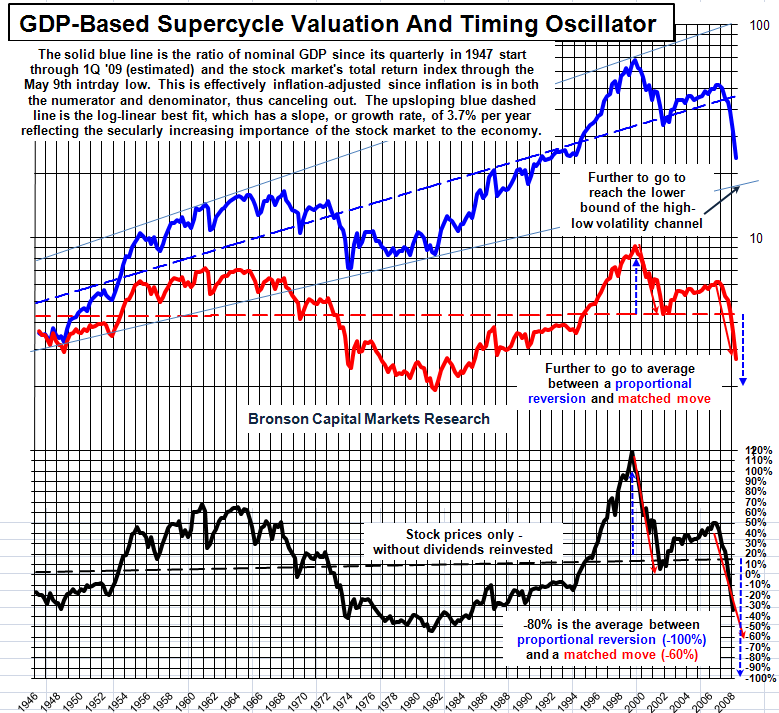
We prefer the following construct of the stock market vs. GDP. Note that it does not require any multi-year averaging, like the methodology illustrated in the chart at the bottom does, and as required for corporate earnings in Supercycle market P/E valuation metrics. And our metric better identifies the actual peaks and troughs in the stock market, unlike the other metric which is fuzzy. But they both tell the same story: we are getting closer to the stock market bottom, but there still is way to go.
Using GDP, which Buffet has said is his favorite stock market secular valuation metric, also further explains why our index below, as well as our Supercycle market P/E ratio have upward secular trends. This is because the stock market has historically-increasing importance to individuals and families/households, and thus for the whole U.S. economy.



March 16th, 2009 at 1:38 pm
Ok, interesting. However, what am I to imply from this? How does this translate to A) specific levels on indices, B) over what time horizon, and C) do target levels change depending upon time elapsed?
Since this is a ratio of, “…nominal GDP…” to, “…stock market’s total return index…” I can’t simply assume that indices must contract a total of 80% before they hit bottom. In fact, much like a P/E ratio, we know that a constant P and rising E yields a smaller P/E, as does a declining P and a constant E.
So, should my takeaway be that if the market rebounds strongly (denominator) while GDP continues to contract (numerator) that we can get to the -80% mentioned? Or, if GDP flattens and stocks continue to fall… You get the idea.
Again, interesting relationships, but somebody please tell me why this is relevant. I’m clearly missing the context of the message.
BTW, what exactly is the, “May 9th intrday low?”
March 20th, 2009 at 9:56 am
Correlations with the U.S. GDP are fine for the world that was but not for the world that is.