Grading Geithner

Email this post Print this post
By Barry Ritholtz - March 12th, 2009, 10:30AM

Via the WSJ comes this scorecard from Economists:
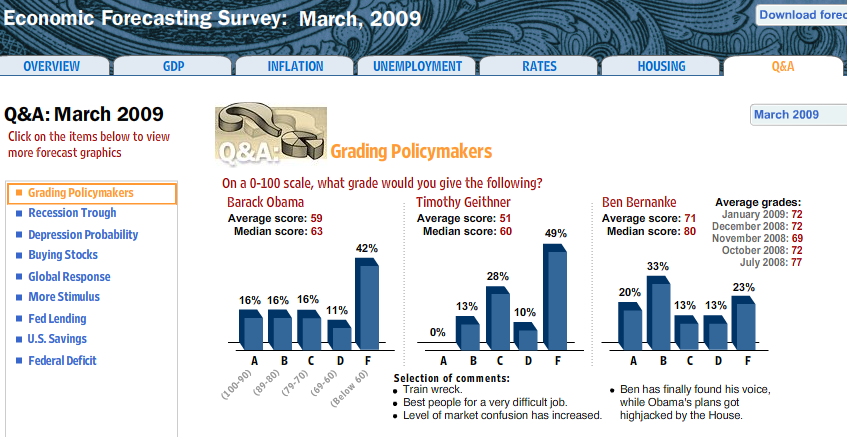
Of course, given the horrific track record economists have amassed . . .

>

Source:
Obama, Geithner Get Low Grades From Economists
PHIL IZZO
WSJ, MARCH 11, 2009

http://online.wsj.com/article/SB123671107124286261.html

15 Responses to “Grading Geithner”

  1. WaveCatcher Says:

    Loved this comment from Alan Abelson of Barrons when he said that Geithner reminded him of “those engaging juveniles that made Leave It To Beaver so much fun to watch.”

    Until that comment, I couldn’t put my finger on why he bugged me so much…

    He will resign before the end of the year.

  2. Moss Says:

    Are these the same economists who totally missed this meltdown?
    I believe their average error rate is higher than the sub prime foreclosure rate.

    Geithner may be over his head but most of these experts should be looking in the mirror.
    Talk about calling the kettle black.

  3. Bob A Says:

    WSJ is a Rupert Murdoch/Fox New RNC Obama bashing machine.

    Please…

  4. leftback Says:

    Wonder how many of these “economists” own high priced NYC area real estate and cannot wait to see massive reflation so they don’t have to eat their jumbo mortgages and live without the benefit of bloated compensation…?

    This will all end in tears, one way or the other. Bonfire of the Vanities, part deux.

  5. constantnormal Says:

    @ Bob — I agree, since the Murdock takeover (and the coincident(?) exodus of a lot of WSJ staffers) the neocon op-ed looney bin has broken free of its confines and is polluting the carcass of a once-great newspaper.

  6. willid3 Says:

    i wonder if economists have replaced the weatherman in reliability? the weatherman has at least of late been more right than wrong, they have even been able to predict todays weather almost with better than 75% accuracy. not some thing we can say about economists. who seem to not be able to predicts todays economy with better than 10% reliability. if that

  7. franklin411 Says:

    Completely agree with Barry…Is there some kind of goofy Stockholm Syndrome effect here that makes us go back to the same jack@sses who caused the mess for opinions on how to fix it?

    Personally, I don’t care what the Republicans, economists, or Wall Street think should be done. We should let them have their say and then do the exact opposite of what they suggest!

  8. gnomic Says:

    Back before Rupert owned the WSJ, I might have given the poll some credence. Now its just another Fox Noise outlet for GOP propoganda.

    I agree that Summers and Geitner are worthless though. Obama needs to nationalize the lot of ‘em, and rebuild our financial system into a global competitor for the next century rather than a has-been of the last century. Its not like there is a downside – banks aren’t going to hate him any more.

  9. Calvin Jones and the 13th Apostle Says:

    They give Geithner mediocre marks but Bernanke high marks?

  10. Mikey Says:

    I’m sorry but I am not the type to inflict pain & suffering on another human being but after seeing last night’s NBC Nightly New report http://www.msnbc.msn.com/id/3032619/vp/29643726#29643726 on former Goldman Sachs (GS) banker and former GS CEO and Treasury Secretary Hank Paulson-appointee Neel Kashkari (he is still in power???), I ask WFT??? [sorry for the crude language but I am super angry]. The presence of TARP architect Kashkari (along with the continued appointment of Sheila Bair) explains why Geithner has not done anything bold: they are all DEFENDING Paulson’s TARP policies (e.g., private-public partnership, aggregator bank)!

    In addition, Kashkari has a CONFLICT OF INTEREST because he probably would like to save his former firm Goldman Sachs (geez, if he went back, wouldn’t he be a millionaire managing director?), which we now know is a primary benefactor of the AIG bailout http://www.ritholtz.com/blog/2009/03/backdoor-bailouts-for-goldman-sachs/ .

    If President Obama fancies himself as President Lincoln, Secretary Geithner is like General McClellan who got fired after five months for inaction and lack of command ability. Geithner has been brainwashed to protect the interests of Wall Street oligarchy http://www.pbs.org/moyers/journal/02132009/watch.htm , and I now have zero confidence that he serves the public interest. Like I said I hate to inflict suffering on another human being but I agree that Geithner should be gone by June http://www.ritholtz.com/blog/2009/03/geithner-gone-by-june/ : for bold action to fix the economy Obama needs a General Grant.

    Again WTF (pardon my French), but why is Paulson-appointee and TARP architect Kashkari still there?

  11. Pat G. Says:

    I think Geithner’s routine actions (which would be Paulson-like) in this crisis are being held in check by Obama and rightfully so. This also deflects criticism away from Obama and directly at Geithner. Smart.

  12. leftback Says:

    Geithner and Kashkari are there solely to clean up Hanky Panky’s mess.
    Once the CDS mess is in hand and the perp walks have begun, we can clean house.

    We will give them both the heave-ho overboard this summer.

  13. skardin96 Says:

    Turn the table around and these economists will likely fail as policy makers too. It’s like asking baseball hitters which pitchers in the major are great hitters and vice versa.

  14. JoWriter Says:

    @ Mikey Says: “Obama needs a General Grant”

    My Civil War history is kind of sketchy,, but to continue the metaphor – what do you view as Atlanta?

    I know Gen. Sherman did that, but didn’t Grant order it? or somehow have resposibility for that March from Atlanta to the Sea?

  15. Mikey Says:

    @JoWriter says: “What do you view as Atlanta?”
    If you mean how once-and-for-all ending the banking crisis could be “decisively broken” http://en.wikipedia.org/wiki/Sherman%27s_March_to_the_Sea#Background_and_orders_for_the_March , it would be Wall Street working for Main Street (yikes!) with the following two ideas.

    ——————————————–
    IDEA #1: Nationalization (err, “Capitalization”) of Insolvent Bad Banks To Create Ultra-Clean New Banks

    The simplest, most straightforward, and easiest-to-understand good/new bank proposal is for the government to create ULTRA-CLEAN NEW BANKS with pristine balance sheets and tabula rasa loan portfolios.

    » Ultra-clean new bank gets FDIC-insured deposits and the insolvent bad bank’s core operational assets (including capital market operational assets essential for financial system stability). Freed from the headaches of delinquencies, workouts and charge-offs of legacy loans, the “expert” old management team (e.g., Citigroup CEO Vikram Pandit, BoA Ken Lewis) manages the new bank. [Although Pandit's memo was a bit disingenuous because he not include writedowns of bad loans http://www.ft.com/cms/s/2/1997b610-0d7d-11de-8914-0000779fd2ac.html .]

    » ENTIRE old (performing & non-performing toxic) loan portfolio plus cash from consideration of operational assets go into the Chapter 7 bankruptcy estate for old creditors, counterparties and shareholders (after all, that was the bet that they took!) to liquidate in an orderly fashion (like run-off mode of insurance companies)–thereby avoiding asset liquidations at “fire sale” prices. (Note that with the ENTIRE loan portfolio there is no MESSY need for the FDIC to sort out current toxic from now-performing but soon-to-be toxic loans, which would be the case for Sheila Bair’s aggregator bank proposal. Of course the ultra-clean new bank could be paid a servicing fee by the Chapter 7 estate and buy its performing loans as an arms-length transaction on the secondary loan market.)

    » U.S. Government capitalizes new tabula rasa (blank tablet) loan portfolio. A bold FRESH START catalyst to revive the American economy, under the Fed’s current 10% reserve requirement a $700 billion capitalization creates fresh $7 trillion lending capacity OVERNIGHT http://www.cnbc.com/id/15840232?play=1&video=1051910745 [per Joseph Stiglitz, seek 1:25 to 2:00]. Moreover, because a new bank has zero loans in its portfolio it would have NO excuses not to lend to creditworthy borrowers. How is that for restoring confidence!

    » Regarding the CORPORATE CONTROL issue of nationalization, as suggested by Nicholas Kristof (and the above proposal) http://www.nytimes.com/2009/02/12/opinion/12kristof.html , EVERY man, woman and child in the United States could be granted common shares (including voting right) of every government-created ultra-clean new bank. Since the American People individually–and not the federal government–will elect the board of directors, corporate control will be in PRIVATE HANDS. As is the usual case, additional equity capital could be raised through initial and secondary public offerings–which would have the salutary benefit of creating a float for trading in the stock market.

    For details see:
    http://cift.haas.berkeley.edu/docs/nabi/nabi-Nov11.pdf [see especially Figure 4 (p. 8)]
    http://www.youtube.com/watch?v=_ZAlj2gu0eM [seek 10:20 to 12:15 for elevator pitch].

    ——————————————–
    IDEA #2: Contribute Common Stock of Ultra-clean New Banks to Social Security & Medicare Trust Funds.

    For example like killing with two birds with one stone with the same issuance of federal debt, the $645 billion and $453 billion planned for Social Security and Medicare in President Obama’s FY2010 budget could initially be directed to recapitalize bad banks whose issued common stock would then be entirely contributed to the federal entitlement trust funds.

    » Using the Peter G. Peterson Foundation’s present-value fiscal exposure estimate of $56 trillion with a 75-year horizon (stipulated by Congress) and 3% discount factor (guess-timate), for a $1 trillion investment in ultra-clean new banks the minimum total annual return-on-investment (capital appreciation, dividends) is ROI = 8.7% based on the following ballpark calculation:

    $56 trillion x (1 + 3%)^75 = $1 trillion x (1 + ROI)^75.

    As a point for comparison, from the end of 1949 to the end of 2000 the S&P 500 provided a total annual return of 13.1%. Economically, think of this as a gigantic version of David Swensen’s equity-oriented Yale endowment fund (NB. Swensen is on Obama’s Economic Recovery Advisory Board) in which the government is getting in on the rock-bottom ground floor as an opportunistic VULTURE INVESTOR by contributing first-round seed capital to create “fresh start” ultra-clean new banks with pristine balance sheets, tabula rasa loan portfolios, and the core-banking operating assets of insolvent banks; but unlike the speculative nature of vulture investing, the now heavy hand and watchful eye of prudential supervision by bank regulators should make investing in these ultra-clean new banks safe and suitable for the federal entitlement trust funds. Most importantly, as the economy improves, the common stock prices and dividends of the ultra-clean new banks should rise, thereby improving the solvency of these federal entitlement trust funds.

    » Piggybacking off its annual mass mailings and leveraging paperless electronic proxy (e-proxy), the Social Security Administration has the logistical capacity to facilitate the proxy voting of 300 million Americans. This will not only engage the American People in corporate democracy but will also give them a say in setting Wall Street compensation.

    » According to ZeroHedge, “The TALF…will generate up to 20% virtually risk-free returns to investors.” http://zerohedge.blogspot.com/2009/03/could-talf-be-biggest-disappointment.html If this is true then instead of hedge funds and private equity funds the FEDERAL ENTITLEMENT TRUST FUNDS should benefit from this SWEETHEART DEAL, which could use the cash flows for their entitlement disbursements. Again, newly-issued asset-backed securities (under TALF, only AAA-rated tranches) should be safe and suitable for the federal entitlement trust funds if together with TALF’s low-cost loans and guarantees from the Fed and Treasury, the originators were prudentially supervised and too align incentives, as recently proposed by Congressman Frank last week http://www.bloomberg.com/apps/news?pid=newsarchive&sid=a2poB5rN4YIc , retain the first-loss equity tranche on their balance sheets.

    ——————————————–

    In closing, the Financial Times (02-07-09) reported that the much-larger-than-subprime Option-ARM default wave will not crest until the summer of 2011 [http://www.ft.com/cms/s/0/1ed1d3e2-f4f3-11dd-9e2e-0000779fd2ac.html , see graphic], which suggest that the two-year horizon test to March 2011 of Secretary Geithner’s stress is not at all a “worst-case” scenario . The predictable consequence is that even after raising more equity capital during the six-month period after the stress test, bad banks will again need to raise even more equity capital through 2012.

    From a public policy perspective, “the problem” to be solved is not maintaining the capital adequacy of borderline-insolvent bad banks but rather creating fresh lending capacity in the U.S. banking system: the former is Secretary Geithner’s piecemeal approach of keeping alive zombie banks like Japan did during its lost decade—-the latter is a BOLD, FRESH START, BIG BANG APPROACH of once and for all detoxifying bad banks by sequestering their entire old (performing & non-performing) loan portfolio into Chapter 7 bankruptcy estates for orderly liquidation, and recapitalizing them as ultra-clean new banks which would irrefutably show that America’s banks are ready, willing and able to lend to rejuvenate the U.S. economy.

    Increasingly the American People see insolvent banks as black-hole money pits where good money is being thrown after bad. The fresh start approach of contributing the common shares of ultra-clean new banks to the federal entitlement trust funds would bring the American People onboard by:

    » Killing two birds with one stone by using the same issuance of federal debt to solve the problem of insolvent bad banks and the future insolvency of the federal entitlement trust funds (which has the counter-intuitive argument that the greater the expenditure to recapitalize banks today, the less strain on the federal budget tomorrow);

    » Turning lemons into lemonade by affirming the federal government’s promise of Social Security and Medicare (while sidestepping the politically suicidal “third rail” decision of cutting benefits)—-and hopefully, passing Universal Health Care;

    » Creating a magic silver bullet that provides budgetary headroom for President Obama to accomplish his ambitious goals of restructuring the American economy to compete in the 21st century while balancing the federal budget through a new revenue source to finance the federal entitlement trust funds.