Has the Economy Hit Bottom Yet?

Email this post Print this post
By Barry Ritholtz - March 15th, 2009, 11:40AM

There is an interesting article in the NYT Week in Review (and not just cause I get a few words in).

BTW, what got left out of the article was our discussion of various ratios, and the issue with inventory (there’s too much) and affordability (debt servicing, down payments).

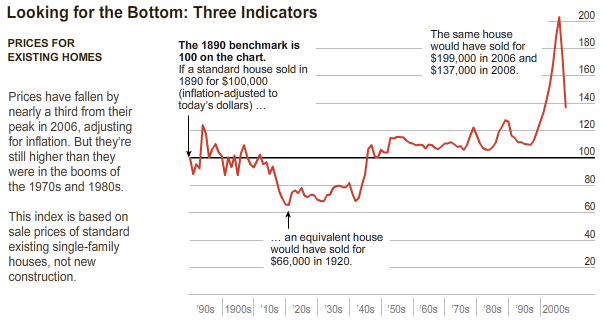
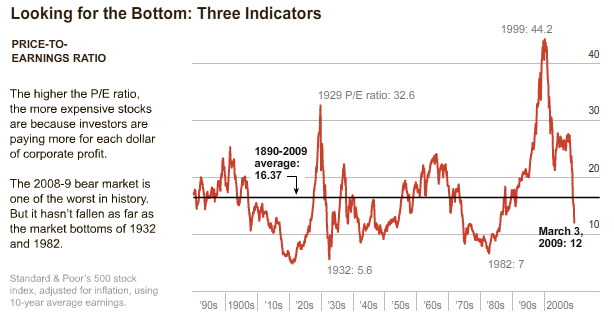
The charts are particularly telling:
>

Source:
Has the Economy Hit Bottom Yet?
VIKAS BAJAJ
NYT, March 14, 2009

http://www.nytimes.com/2009/03/15/weekinreview/15vikas.html

45 Responses to “Has the Economy Hit Bottom Yet?”

  1. Marcus Aurelius Says:

    No.

  2. Steve Barry Says:

    Using 10 year average earnings probably makes sense 99% of the time…but may not make sense when we may not see such earnings again for 20 years.

  3. Steve Barry Says:

    Steve Liesman was utterly horrified on Meet The Press today about the thought of the consumer saving their stimulus. He also said that he warned early on how bad sub-prime would spread, so he should not fall under John Stewart’s criticisms. What a joke.

    ~~~

    BR Did he give a date and a clip ?

  4. Steve Barry Says:

    The housing chart tells a lot…one thing…it is basically Shiller’s chart (which I update myself regularly), and stands more like 150 today, not 140…

  5. Avl Dao Says:

    Good stuff. I love good graphics as well as the next guy and am a huge Edward Tufte fan. But it’s dangerous to let loose a mainstream media hungry for simplistic black-n-white story narratives amidst a general reading public still cycling through their Kubler-Ross Grief cycles and stuck on the 1st 4 of 7 cycles.

    I hope that as people pull data points from across upwards of 90 years of history, they adjust them within the context of the demographics (population & workforce size,etc), Main Street economic indicators (employment rates, bankruptcies, household debt levels, etc) and Wall Street economic indicators (inflation/deflation, health of debt & currency markets, regulatory environment, fiscal & monetary policy, etc) that are germane to that data point’s moment in history.

    Also toss in what the world looks like geo-politically at the points in time drawn upon for projecting or extrapolating: wars? Uni-polar, bi-polar, or multi-polar world-scape?

  6. dead hobo Says:

    Is the economy ready to turn up now, probably not.

    Do these charts tell me much, not really. My build in bullshit detector goes off EVERY time someone provides a chart and says or implies “SEE, The mathy graphs. These are patterns and they control our lives.” It’s just more astrology in this context.

    Undoubtedly, PE rations are going to get worse before they get better and housing will settle a bit more while the bottom level inventory is working out. Historical stock prices DON’T follow these graph so tightly. Just look at Yahoo and see for yourselves. Also, consumer spending will be close to 100% of disposable income for a long time, mostly because disposable income is decreasing at this time.Also, and more importantly, it’s the nature of Americans to spend. If any saving is going on then it will be released in a pent up spending explosion when a little security is felt.

    To be blunt, I hope to owe a lot of money on my last day on Earth, and have little cash to back it up. Unfortunately, I’m too frugal and this will not happen, most likely. I don’t have anything against those who think this way.

    Also, I don’t mean to be crass, but 8% unemployment is only 3% above base frictional levels. The world isn’t over for 97% of the 95% outside of the frictional population.

  7. Avl Dao Says:

    That said, is there a pain differential between a Bear market bttm that emulates the 18-year meaderings of 1964-1982 across the crater’s vast floor in a mega-sized ‘L’-shaped recession, versus an S&P dropping further in 2009 to a p/e of $11 based on actuals, not expected earnings, and recovering to only today’s level in 2010…

    Has the concept of a bottom gotten a wee bit dumbed-down? Or super-simplified for media-narrative purposes?

  8. The Curmudgeon Says:

    Of course it has (hit bottom). GE, GM, C, BAC, Buffet, JPM, et al., essentially said so last week, and we all know how prescient have been their forecasts in the past.

    And don’t you think for a minute that there was any behind-the-scenes government coordinating of the cacophony of plutocrats singing praises to how effective all this stimulating has been and how great was their respective businesses. It was like a scrabble of Puritans singing Psalms to the almighty.

    (But, it was good to see your name in print, BR).

  9. bonghiteric Says:

    Perplexing comments from Christina Romer on MTP today. When asked what the consumer should be doing her response was, I’m paraphrasing, spend money–”go out and purchase that car you’ve been considering.” Spending in the short term will allow the can to be kicked further down the road.

    Let me get this straight: Americans should take on more debt, contribute to weakening the dollar, save less.

    I could’ve missed the part where she said she was addressing only the consumers who worked for the Financial Products Unit at AIG.

  10. the economic fractalist Says:

    The bottom in terms of absolute asset valuations and percentage declines going forward from 15 March 09 is both far below and far in the future……..

    4/10/8/1 of 6-7 Weeks – Major Equity Devaluation Immediately Ahead

    As of 15 March 2009 the Operative ideal Lammert Fractal Progression for the Wilshire is 4/10/8/1 of 6-7 Weeks.

    The progression and ongoing integration of the macroeconomic universe’s internal factors is defined in its asset valuation saturation curves and is absolutely and perfectly mechanistic and predictable.

    (This post was amended from its original version; gold will likely have one to two more weeks of growth prior to its major devolution.)

    Over the next 5-6 weeks equities will have a major devolution in value as a 4/10/8/1-2 of 6-7 week Lammert fractal series is completed. This fractal progression can be seen more clearly with the use of the NIKKEI, FTSE, and DAX. This identified sequence has allowed a highly probable solution for the long term asset valuation fractal evolution.

    The two cardinal mathematical laws defining the quantum progression of the macroeonomy’s asset valuations over time along the continuous valuation saturation curve that defines the self balancing macroeconomic system and constitutes the empirically and evidence based science of nonstochastic saturation economics are x/2-2.5x/2-2.5x/1.5-1.6x and y/2-2.5y/2-2.5y. The first series x/2-2.5x/2-2.5x/1.5-1.6x is a four phase fractal progression with the first three fractal quantum units representing asset valuation growth progression and the last 1.5-1.6x fractal quantum representing asset valuation decay.The above cited 4/10/8/1 of 6-7 week fractal is a four phase fractal proportionalty of this law. The recent 5 day valuation rise of the Wilshire conforms to a 1/2/2 day fractal saturation growth series or a 9/19/16 hour unit saturation fractal growth series constituting the first three quantum units of the four phase series. y/2-2.5y/2-2.5y is a three phase decay fractal with serially lower nodal asset valuation lows defining fractal decay.

    The utility of this scientific model is its predictability of asset valuation saturation areas. Intervention to moderate can then occur. The saturation time frames identify the complex macroeconomic system’s limits and boundaries in terms of maximum sustainable total debt load, maximum asset overproduction and oversupply, and maximum job numbers that produce the base wages to support debt load and ongoing demand for the overvalued assets. Those parties controlling monetary policy and interest rates, those parties regulating loan parameters, and those parties creating tax advantages for certain assets can now anticipate these asset valuation saturation area highs and modulate excess debt and asset overvaluation by raising interest rates, increasing the restrictive parameters on lending, and providing tax advantages for savings to prevent asset speculation. Using the model of saturation macroeconomics and anticipating the macroeconomy’s asset value saturation areas, proactive action can be taken: the asset valuation saturation highs will then be lower; speculation and leverage will be thwarted; debt load at the saturation area will be lower; and the follow on absolute asset valuation lows and sharp rises in unemployment via the inevitable asset valuation quantum decay and rising relative debt burden will be moderated.

    Gold, after a final 1-2 week growth period ahead, will devaluate sharply over the subsequent 7 to 8 weeks. Gold and gold equities are also following a 4+/11/7 of 8-9/ 7-8 weekly fractal progression series.

    As non-money asset valuations collapse, remaining outstanding debt grows relatively larger in size with ever greater difficulty in ability to adequately service. After gold’s devolution there will be little doubt that this collapse is a profnd deflationary collapse where money owed on overvalued assets purchased near the leveraged valuation saturation highs cannot be repaid by declining after tax wages and the declining absolute number of jobs.

    From the Wlshire’s March 03 lows and using nodal lows: the weekly fractal decay progression is 75/189/189 weeks. The second fractal of 189 is slightly more than 2.5x of the 75 week base, but the 75 week base fractal contains a time period of proportionally fewer trading holidays. This y/2.5y/2.5y decay sequence may be an interpolated second fractal of yet a larger 17/36/36 quarter year fractal decay series commencing in October of 1998.This is a millennium size decay fractal.

  11. dead hobo Says:

    the economic fractalist Said:
    March 15th, 2009 at 12:37 pm

    ….. The two cardinal mathematical laws defining the quantum progression of the macroeonomy’s asset valuations over time along the continuous valuation saturation curve that defines the self balancing macroeconomic system and constitutes the empirically and evidence based science of nonstochastic saturation economics are x/2-2.5x/2-2.5x/1.5-1.6x and y/2-2.5y/2-2.5y …

    reply:

    Prove it.

  12. zot23 Says:

    Yes, the bottom is in if this is a normal cyclical downturn like in the 80s or 90s. Business should pick up, technicals can take hold, and we level off.

    No, the bottom is not in if this is a depression like the 1930s. Business will spiral downward, technicals will be shattered, and we only level off or gain as a breather to further drops.

    Which do yo believe in? The press and Wall Street desperately want to believe in the first situation, any decent sniff test leads a person to believe in the latter. I don’t blame the moneyed folks for believing in the first, they lose everything if it isn’t true. Like having a child with cancer, no matter what the doctor and tests say, you’re going to hope against hope for a recovery – I mean, why not? The truth is the worst possible scenario, there is nothing more to lose by living in denial for a bit.

  13. DL Says:

    Steve Barry @ 1:07

    “Steve Liesman was utterly horrified … about the thought of the consumer saving their stimulus”

    Yes, people like Liesman argue that saving the stimulus money is a bad thing. It’s bad, they argue, that people will take that money and deposit in a bank. At the same time, the Liesman types want to take taxpayer money and just give it to the banks.

  14. mark mchugh Says:

    $47B in state budget deficits estimated for 2009.

    $85B and counting state budget deficits estimated for 2010.

    How many homeowners do you know willing to accept that their house is worth 30% less than ‘06?

    I think this is just the eye of the reality storm. We’re going to go from trying not to be Japan to aspiring to be Japan before this is over.

  15. larster Says:

    MM- “How many homeowners are willing to accept that their home is worth 30% less thasn 2006?

    Not many and fewer than that in SoCal. State budgets are a seruious issue due to their inability to raise sales or property taxes. Service cuts will be deep and finally wake up those true believers that think “Americans can do anything”. Except maybe Jindal.

  16. Steve Barry Says:

    I spoke to several people this weekend who told me, “you were right…we should have listened to you”…then when I tell them it’s going to get much worse, they are still speechless…nobody has yet said, “we agree.”

  17. MRegan Says:

    @Mr. Fractalist

    TWo comments

    WTF dude, it’s Sunday and please sir may I have some more.

    WRT to dh’s challenge, please prove it when I am not around, I think the proof would hurt more than the assertion.

    EF said:

    “As non-money asset valuations collapse, remaining outstanding debt grows relatively larger in size with ever greater difficulty in ability to adequately service. After gold’s devolution there will be little doubt that this collapse is a profnd deflationary collapse where money owed on overvalued assets purchased near the leveraged valuation saturation highs cannot be repaid by declining after tax wages and the declining absolute number of jobs.”

    To tie in MM’s and other’s comments, I offer this tidbit:

    In Cville, Va a house is being offered @238,900 (saw it on Craigslist- hahaha, uh no, I have a dump truck fetish) so anyways, I decide to look into it, get on the muni’s website and look at the property’s card. (see 772 Ridge Cville, Va if you don’t believe me)

    Transactions history (as best I can recall):

    2005 230,000 (a couple)
    2002 125,000 (a couple)
    2001 44,500 (some guy)
    2001 38,900 (some finance company)
    1997 47,500 (a Shifflett)

    The 2002 to 2005(6) jump in real estate prices in some areas is not explainable by anything other than credit expansion. The irrational price placed on the cost of money from that period will continue to wreak havoc. What we need to do is firesale all the crap we have accumulated for 2 trillion dollars and write up flyers in only Cantonese and Mandarin.

  18. Marc1 Says:

    The P/E graph is used to imply that stock prices are at the bottom. Of course, there is another variable in determining stock price. P/E is multiplied by earnings to determine price. Are earnings at the bottom?

    Is this P/E graph based upon trailing 12 months of earnings? Consider that with the economy peeling 20% off, that earnings will peel off as well. The gov’t will spend to try to fill the GDP gap (because we luv luv luv that GDP number as a measure of the health of the economy) but the gov’t doesn’t have the money to do it.

    Consider that on an inflation-adjusted basis consumer spending went up 25% from 2000 to 2008. However, median household incomes went down slightly. How can that be? Well, the obvious: consumers borrowed money. So, just as people overspend before Christmas only to have a quiet January, consumers should pull back not only to the 2000 levels but a below in order to pay their bills.

    What does that say about where GDP is headed, corporate earnings, and resultant stock prices? Perhaps the market in its infinite predictive wisdom has already factored that in, but I’d need some data to back that up.

  19. MRegan Says:

    Also, from Boing Boing:

    http://www.boingboing.net/2009/03/14/partial-list-of-corp.html

    http://www.keionline.org/blogs/2009/03/13/who-are-cleared-advisors/

    If we don’t begin to grapple with the fact that the STATE has chosen the motto “By the Corporation, for the Corporation, and of the Corporation”, then none of the rest matters.

    What is noted in the links provided above is proof positive that the STATE does not relate to the INDIVIDUAL and the your juridical personhood is displaced by the exigencies imposed on the STATE by the uncontrolled juridical personhood of the CORPORATION.

    Here are a few questions even Mr. Starbuck could wrap his head around:

    Do you owe allegiance to a STATE that is actively dismantling the foundations of your juridical personhood?
    Do you owe allegiance to a STATE that has actively conspired with the CORPORATION to harm you?
    Do you owe allegiance to a STATE that has likely been seized by a subset of the population and seeks to impose upon you the price of their insatiable greed?
    Is there a constitution upon which to take an oath when entering the military?
    Do you owe allegiance to a STATE that has not fulfilled its part of the social contract?
    Do you owe allegiance to a STATE that has no recourse other than violent coercion to fulfill its promises to the CORPORATION?

  20. Bob_in_MA Says:

    Since I’m still short, I was looking in to the possibility of a sharp rebound as occurred in 1974.

    I’ve been scanning the Fed’s Flow of Funds data and the differences between this period and that are amazing, the main factor being inflation averaging around 6-7% in the 1970’s.

    For the period Dec 1972 to Dec 1974:
    - The S&P 500 almost halved
    - Yet household net worth INCREASED slightly (It fell 15% in 2008)
    - Disposable personal income increased more than 20%
    - Household debt was 65% of income (It’s currently 130%.)
    - Non-financial corporate net worth INCREASED by 45%!

    That last one is the real crux. The price of equities fell 45%, and the value of the companies increased 45%. The q ratio went from .89 to .33 (at the October bottom it was even lower.)

    Equity prices are currently down 50%, but net worth is flat (and probably will fall next year as commercial real estate takes a big hit. The q ratio is .52 now.

    Also, there was no financial crisis in 1974 and no collapse in world trade.

    Basically, there is almost nothing similar between this period and 1974, except that both are severe bear markets.

  21. ottovbvs Says:

    zot23 Says:

    March 15th, 2009 at 12:52 pm
    Yes, the bottom is in if this is a normal cyclical downturn like in the 80s or 90s. Business should pick up, technicals can take hold, and we level off.

    No, the bottom is not in if this is a depression like the 1930s. Business will spiral downward, technicals will be shattered, and we only level off or gain as a breather to further drops.

    Which do yo believe in? The press and Wall Street desperately want to believe in the first situation, any decent sniff test leads a person to believe in the latter.

    ……….You might want to see the doc if your sense of smell tells you this is remotely like March 1st, 1933…..Unemployment was at 25%……As hobo above points 8.1% unemployment is only three points above what is considered effective full employment…….The country had roughly 20,000 banks at the time……All were closed either because they were bust or because of state declared bank holidays some of which had been going on for six weeks….Do you see any banks closed……And the govt’s policy at the time:balanced budgets and tax increases……This is clearly going to look a lot more like the early 80’s than the early 30’s.

  22. ottovbvs Says:

    MRegan Says:
    March 15th, 2009 at 1:58 pm

    Real estate valuations are very spotty…..In my town we have a little furore going on at present over the state mandated five year revaluations which have produced some eye-rollers (mine has more than tripled since 1999)…..appealing this I’ve done a lot of research in the local market which seems to be down about 15% in value from its peak at the end of 06…..but the fact is real estate is still selling although volume is down around 18%……As those charts which BR showed about a week ago showed the foreclosure problem is concentrated in six states which have 80% of them…….My takeaway from this is that while Case Schiller is showing declines around 30% nationally once you strip out the usual suspects prices are going back to 2003/4 levels…..this is not a national catastrophe…….Taking your Cville example, sure they’re not going to sell it for $238k but what about $200k which is a lot more than they bought it for…..I’ve compared notes with folks I know in Atlanta, Savannah, Baltimore, and even certain neighborhoods in west LA, and it’s the same story…….declines around 20% but no sign of a return to 90’s valuations.

  23. Bruce in Tn Says:

    The bottom is not in.

  24. scorpio Says:

    Obama and his economic Team of Two craven: Wall St has his number, his administration probably over at least on the big stuff like economy, regulation, bailouts. the disappointment among those who hoped for something different will be deep, about as deep as the next leg down.

  25. ottovbvs Says:

    scorpio Says:

    March 15th, 2009 at 3:10 pm
    Obama and his economic Team of Two craven: Wall St has his number, his administration probably over at least on the big stuff like economy, regulation, bailouts. the disappointment among those who hoped for something different will be deep, about as deep as the next leg down.

    ……Sound more like wishful thinking to me……a pity some of these predictions can’t be saved and replayed in two years time a bit like Kudlow’s or Luskin’s.

  26. franklin411 Says:

    I loved Katty Kay (BBC) this morning on Meet the Press. She had a great point about how Europeans aren’t as panicked about the economic collapse as Americans are because Europe has a decent social safety net. Unlike Americans, Europeans aren’t constantly worried that they’re one bad cough away from complete destitution.

    Oh, to be one of those poor, unfortunate Europeans that the Republicans are always warning us we will become if we listen to Barack Obama!

  27. DL Says:

    Bruce in Tn @ 3:04

    Insofar as this website is concerned, you be “preachin’ to the choir”

  28. ottovbvs Says:

    franklin411 Says:

    March 15th, 2009 at 3:25 pm
    Oh, to be one of those poor, unfortunate Europeans that the Republicans are always warning us we will become if we listen to Barack Obama!

    ……I have to say I’ve lived and worked in four countries…….and the one with the best combo of lifestyle and the one that worked most efficiently in all the routine areas of life was without question France…..They have their vagaries like all societies but France is a very well run country……probably because it’s very centralized (thanks Napoleon) and has the best educated ruling elite in the world……just look at their embrace of nuclear power……no messing about……it generates about 90% of the electricity…….their healthcare system is superb too……

  29. ottovbvs Says:

    DL Says:

    March 15th, 2009 at 3:32 pm
    Insofar as this website is concerned, you be “preachin’ to the choir”

    ……Some of us are out of tune

  30. wally Says:

    I think those are very interesting charts. What they tell me is that we have NOT YET entered hard times… we have just come down off a high.
    We think things are tough because we got accustomed to the high life.
    Whether the charts predict the future or not – I don’t know.

  31. MRegan Says:

    Otto

    What I was too lazy to note clearly was that the move between the 2002 purchase at 125k and the 2005 at 230k pinpoints the fluff in the system. The move from 44,500 to 125,000 is probably justifiable based on remodeling, improvements etc (if you don’t know that the Shiffletts are like the Jukes then you can’t infer what I was suggesting- again laziness on my part) all of which leads me to respond that I agree with you that 90’s levels in most markets are unlikely unless this is what Barry McGuire was warning us about back in 1965. It sure doesn’t count if you are 44+ years off.

  32. E Says:

    MRegan, as a fellow Virginian, I must give you kudos for the use of Shiffletts in your post. Two f’s and two t’s, no less. That’s quality inside joking, and just wanted you to know that someone else got it.

  33. ottovbvs Says:

    MRegan Says:

    March 15th, 2009 at 4:25 pm

    ….I could see what you were getting at but taking my little local example which is reinforced by the input I gathered from elsewhere, a lot of this “fluff” is not really going away……A sensible local realtor tells me she thinks prices have actually bottomed in our market…….BR lives more or less opposite me across the sound and I suspect he’d tell a similar story for LI ie. back to 2003/4 at worst…………my source in west LA claims only about a 10% decline……I can’t remember the numbers but it’s something like 70% of homeowners have been in their houses for over five years so there’s huge inertia in this market

  34. buddy318 Says:

    zot23 Says:

    ……….You might want to see the doc if your sense of smell tells you this is remotely like March 1st, 1933…..Unemployment was at 25%……As hobo above points 8.1% unemployment is only three points above what is considered effective full employment…….The country had roughly 20,000 banks at the time……All were closed either because they were bust or because of state declared bank holidays some of which had been going on for six weeks….Do you see any banks closed……And the govt’s policy at the time:balanced budgets and tax increases……This is clearly going to look a lot more like the early 80’s than the early 30’s.

    zot23, You miss two very importnant points: The first is that if you calculate unemployment the way it was caclulated in 1933, we are currently at over 18%. (John Williams, Mint.com etc. etc.) and we only hit that 4 years after 1929. The second is we didn’t have the large conglomerate bankins sytems we have now. Add up all the branches of WAMU, Citibank, Wachovia etc and we probably have the same or greater individual bank branch failures.

  35. MRegan Says:

    Thanks E although now I feel bad about my cavalier maligning of a family in Virginia. I can only note that Regan is derived from old Gaelic and means angry and impetuous which are the principal symptoms of a**holes so sorry all you Shiffletts and sorry about the Jukes parallel and hell all you Jukes sorry about referencing you as Ur-Hillbillies…sh^t there’s no end to it…

    Otto all of this hopefully helps one to get a handle on the hydraulics of the RE market. You note: “a lot of this “fluff” is not really going away” and that makes me think that with many properties ‘holding’ value in a context where individual properties are cratering in price due to foreclosure, seizure etc that seems to point to some funny volatility. If interest rates increase sharply to match the straightjacket imposed on ‘creditworthiness’, then what?

    Also here’s another property price anecdote which I share in hopes of spurring some cogitatin’:

    Family sold in Oct 08 commercial property which hand been owned continuously by the Family since 1930 (bought for cash- less than $6000- I think 3000 but can’t recall) sale price 3.2 million 78 years later. Will that kind of expansion happen again? Follow on. Would you rather have 3000 dollars in 1930 or 3.2 million in 2008?

  36. ottovbvs Says:

    buddy318 Says:

    March 15th, 2009 at 5:06 pm
    zot23 Says:

    zot23, You miss two very importnant points: The first is that if you calculate unemployment the way it was caclulated in 1933, we are currently at over 18%. (John Williams, Mint.com etc. etc.) and we only hit that 4 years after 1929. The second is we didn’t have the large conglomerate bankins sytems we have now. Add up all the branches of WAMU, Citibank, Wachovia etc and we probably have the same or greater individual bank branch failures.

    ……..Unemployment calculations are a bit of moveable feast but even if one accepts your premise there is of course the fact that many analysts believe the 25% figure is way below what it actually was in 1933……And does your local mall or 5th Avenue really “smell” like 1933? I didn’t see many apple sellers on 5th on Friday. As for the banking system it was its very fragmentation that was one of the major sources, arguably the main source, of banking instability back then……Fewer big institutions regardless of how many outlets they have are actually much easier to both prop up and regulate……..In fact the US banking system is still incredibly fragmented by comparison with other countries and it’s one of the reasons for the continuing regulatory problems……The sooner we get 50 banks for the SEC to regulate the better

  37. ottovbvs Says:

    ……As a ps and just for kicks I looked up how many banks we still have…..Apparently 9500 with assets over $100million….It’s a huge task trying to regulate all these different institutions even if most of them are good boys….Here’s a link to the figures

    http://wiki.answers.com/Q/Total_number_of_banks_in_US

  38. ottovbvs Says:

    …….And as a pps and for more kicks I just checked the number of banks there were at the onset of the Depression…..25,000!!…..Can you imagine trying to regulate 25,000 banks in the era of green eyeshades and leather bound ledgers……and trying to communicate with those old stick phones……That’s the great thing about blogs like BR’s….it makes you question your assumptions.

  39. Avl Dao Says:

    @ buddy318 March 15th, 2009 at 5:06 pm

    Buddy, you’re right on the money, so stick to your guns.
    We’re witnessing Class A online obfuscation when people cherry-pick dates from the 1929-1941 period to ‘prove’ that March 2009 is hardly an economic crisis in terms of unemployment, bank failures, etc.
    First of all, there’s nothing magical about 1933. Secondly, we know we employ more sophisticated obfuscating algorithms on jobless numbers than in 1929, the BLS ‘birth-death’ model for small biz jobs being prima facie evidence.

    Bank failures, by assets involved, can and should be one of many mileposts for where we are. And rather than count branches, use in your bank count the entire paper-trail of bank acquisitions by the financial institutions that received 2008 bailout funds separate from the TARP. And rather than count boarded-up banks, count FDIC/OCC/FRB seizures and sales.

    On the flip-side, it is mind-numbingly juvenile to use 1929-1941 as nearly the sole benchmark for what is happening today. It would be like the national weather service offering up an easy-to-repeat goofy narrative of the horrific unnamed Hurricane of 1900 (Galveston) and her 6-12K death count as the primary measurement for issuing hurricane warnings and assessing damages in the decades since, and concluding that America has had no hurricane problems for over 70 years as evidenced by the ‘fact’ that no hurricane has come close to even the low-end of Galveston’s 6k deaths …and offering further goofy headlines like “Katrina’s 1,836 deaths made her a mere 31% of the Galveston storm and thus also renders her irrelevant as a real hurricane! America is technically hurricane-proof!”

    The NWS would be discredited and their mgmt removed. Any media sources that parroted such NWS rubbish would likewise be discredited and fold thru loss of ad revenues.
    It’s time we begin to explore responding to today’s obfuscators in like fashion; it is one thing to make the case that one emotionally wants all of today’s economic nightmares to go away; that’s an understandable human response. But it is another to willfully wage online campaigns to obfuscate and cherry-pick data and not expect sustained long-term credibility repercussions.

  40. flipspiceland Says:

    No. The idea of regulation at the Federal Level for something, an entity as important financial institutions should be a State run authority.

    A single State authority (3 sectional ones for Californica and other large population states) or regional one can certainly get more done, ‘more better’ , and faster than a single Central authority with 10,000 banks to watch over. It’s easier for the proletariat to rise up in revolt against Harrisburg, than it would be to rise up against the White House.

    It appears that the reason why Central Banking is the way things run in this country is to mask, not expose, the shenanigans going on behind the curtain.

    I don’t expect, especially the way Bernanke is acting with AIG,—not giving the people who now own this institutiont–the information they demand, AS OWNERS, that this would ever be permitted. Why?

    I leave it to your imagination. You can bet it’s not for the people.

  41. ottovbvs Says:

    Avl Dao Says:

    March 15th, 2009 at 6:37 pm
    We’re witnessing Class A online obfuscation when people cherry-pick dates from the 1929-1941

    …….Er…..actually I was cherry picking the inception of the GD from 1929 to 1933……Perhaps you’d like point out where 1941 was mentioned…..What’s magic about 1933 is that it was the depth of the GD by just about every econometric measure …..Katrina?…..Galveston?…..Any more non sequiturs you want to throw in…..number of times Paris Hilton has had sex?…Favorite dogs in California……

    flipspiceland Says:
    March 15th, 2009 at 6:40 pm
    No. The idea of regulation at the Federal Level for something, an entity as important financial institutions should be a State run authority…….(3 sectional ones for Californica and other large population states)

    ………So this would give us something like 9500 banks regulated by say 75-100 separate regulatory authorities overseen by house and senate committees in 50 state houses……..Yep…. this makes entire sense

  42. zot23 Says:

    Who said anything about 1933? I mentioned the 1930s as an era, a generational downturn where an unsustainable credit bubble popped and deflation took over the economy. The Great Depression lasted a good 12-14 years by my count. So if this is Great Depression II, doesn’t that make this 1930? And as stated above, we didn’t have the world’s reserve currency, a massive military, and a very well funded FED around in 1929 to soften the blow. Comparing now to then is apples and oranges, at least until the govt runs out of money to throw into the grinder propping up AIG and the like.

    So imagine what would our world be like today if the FED did not bail out AIG, did not have access to the TARP, and all those cascading institutions were allowed to fail. You’re honestly saying that would remind you of the Great Depression even a little bit?

  43. scorpio Says:

    Bernanke on 60 Minutes: we need the “political will” to keep writing checks to Wall St

  44. Avl Dao Says:

    Thankfully this community of readers can…and is… voluntarily executing an ‘ignore’ button.

  45. jr Says:

    zot23 Says
    “the Great Depression lasted a good 12-14 years by my count.”

    The “Great Depression” was actually a three – four year depression followed by a recovery, followed by a nasty recession later in the decade – GNP actually grew 8 percent in 1934, 8 percent in 1935, 14 percent in 1936, and 5 percent in 1937.