
NBER: Household and NFP Differences Are Cyclical

Email this post Print this post
By Barry Ritholtz - March 31st, 2009, 11:45AM

Shorter version:

When the NonFarm Payroll outperforms the Household Survey, its an economic expansion; When HH survey outperforms NFP, its an economic contraction (recession)

>

Longer version:

This may be a bit wonky for some of you, but its quite fascinating:

One of my longstanding peeves has been the way some bulltards cherry pick between the Household Survey (which measures Unemployment) and the Establishment Survey (which measures non-farm payroll, occasionally called job creation). Whichever is bigger is what they choose to emphasize. The folks who abuse the data that way are economic charlatans, and should be cast out as pariahs — or at the very least, ignored. Here’s why:

These two reports measure very different things. The numbers can be off by 100s of 1,000s of jobs — and still be consistent with each other.  As we have discussed all too many times, the Household survey measures:

- Agriculture and related employment;
- Uncompensated Workers;
- Unpaid Family Employees;
- Part Time Workers;
- Workers absent without pay from their jobs;
- Self employed, Work-at-home Contractors;

–none of which are counted in the Establishment (Non-Farm Payroll) Survey.

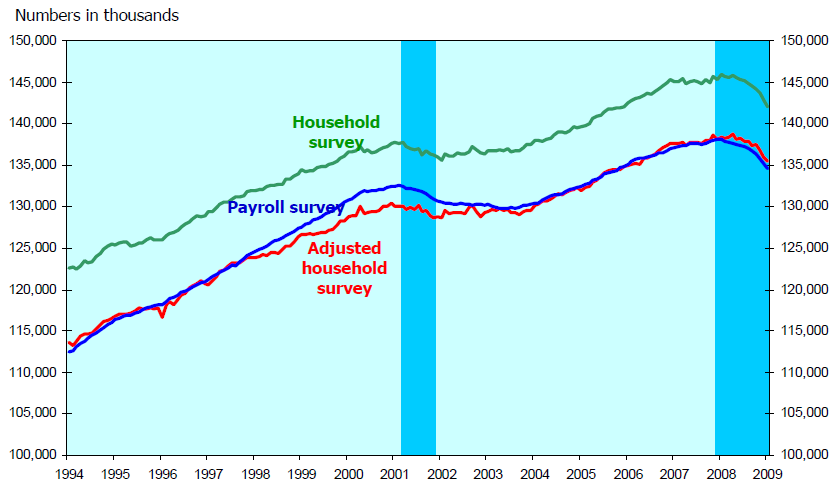
In the past, the BLS has looked at and compared the two data series. Once they made an adjustment so both surveys were counting the same thing, any gap between the two disappeared (see chart below).

However, lest we waste a good data series, the NBER looked into whether this differential had any value as an economic indicator. And according to this recent NBER paper — Exploring Differences in Employment between Household and Establishment Data — the answer is yes.

Note that the NBER is the group that determines the official beginning and ends of recessions. (The paper’s authors are from BLS, Census, and U Maryland Economic depts — they may or may not represent official NBER views).

Phillipa Dunne of the Liscio Report summed up the research thusly:

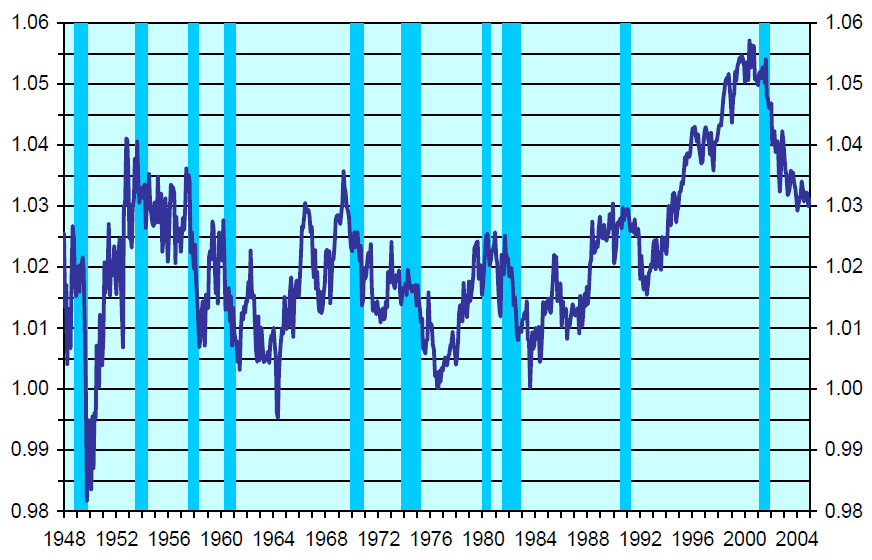
“The study demonstrates that divergences between the Current Employment Survey (aka the Establishment Survey or Nonfarm Payroll) and the Current Population Survey (aka the Household Survey) are “cyclical phenomenon,” with the CES outpacing the CPS during business-cycle expansions, and then falling back during recessions and the early stages of recoveries. The 60-year history of the ratio between the two surveys graphed below shows this clearly. (Take that, Kudlow & Co.) Also note that the ratio failed to rise during the most recent recovery, which seems to underscore the ongoing weakness in terms of employment growth.

Based on characteristics of respondents discovered in their study, the authors contend that tight labor markets create a growing number of marginal jobs that often go unreported in the Household Survey, e.g., establishments hiring short-term workers to cover busy periods, which begins to lift the Establishment Survey. As economic conditions continue to improve, workers tend to drop informal jobs (which would be reported in the CPS but not the CES) for formal jobs (that would be reported in the CES), thus widening the gap between the two surveys. These trends then reverse as economic activity falls off, with establishments laying off workers who then turn to informal employment, moving from the CES to the CPS. (see graphs below).

At first blush, that’s a reasonable interpretation of the two data series. I will see about adding this to our regular monthly charts . . .

I previously ran this graphs from BLS showing 1994-2004; Here is the updated version through 2009:

Household and Payroll Survey Employment, Seasonally Adjusted, 1994-2009
SOURCE: Bureau of Labor Statistics, February 6, 2009.

Ratio of Establishment Survey Employment to Household Survey Nonagricultural Wage and Salary Employment, 1948-2004
Source: Bowler and Morisi, 2006

>

Previously:
Redux: Household versus Establishment Surveys (July 8th, 2006)

http://www.ritholtz.com/blog/2006/07/redux-household-versus-establishment-surveys/

Household versus Establishment Surveys, part 42 (October 10th, 2006)

http://www.ritholtz.com/blog/2006/10/household-versus-establishment-surveys-part-42/

Sources:
Exploring Differences in Employment between Household and Establishment Data
Katharine G. Abraham, John C. Haltiwanger, Kristin Sandusky and James Spletzer,
NBER Working Paper No. 14805, March 2009

http://www.nber.org/papers/w14805.pdf

The Envelope Please: NBER Study finds ratio between Establishment and Household Surveys to the Cyclical
Phillipa Dunne
The Liscio Report, March 30, 2009

http://tinyurl.com/dlkn2f

23 Responses to “NBER: Household and NFP Differences Are Cyclical”

  1. aitrader Says:

    Which figures you usin’ there for your graphs BR? The fresh-off-the-press guesses or the revised “that’s what we really meant” figures?

    I find both sets from both survey’s cooked and suspect. But I guess it’s the best we have to work on.

    What do you think of http://www.shadowstats.com? Could his be more accurate or is he just some anti-government shill?

    ~~~

    BR: That’s from the NBER paper

    I like John’s work (I moderate it a touch).

    But what this ratio does is compare these two series, which I suspect are consistent in their biases. The ratio should provide some good info relative to each other . . .

  2. lburgler Says:

    *thus* is already an adverb.

    “thusly” is like saying slowlyly

    ~~~

    BR: Verily, I say unto thee:

    Usage Note: Thusly was introduced in the 19th century as an alternative to thus in sentences such as Hold it thus or He put it thus. It appears to have first been used by humorists, who may have been echoing the speech of poorly educated people straining to sound stylish. The word has subsequently gained some currency in educated usage, but it is still often regarded as incorrect. A large majority of the Usage Panel found it unacceptable in an earlier survey. In formal writing thus can still be used as in the examples above; in other styles this way, like this, and other such expressions are more natural.

  3. Mark E Hoffer Says:

    aitrader,

    Williams passes Dr. James Hamilton’s smell-test, see:
    http://www.econbrowser.com/archives/2008/10/shadowstats_res.html

    and, JDH is nothing, if not thorough in regard to econometric statistics..

    further: http://clusty.com/search?input-form=clusty-simple&v%3Asources=webplus&query=John+Williams+shadowstats

  4. Bruce N Tennessee Says:

    Well, this is again a little off topic (NO!)…but you won’t get a great number of comments on this topic when you stray into wonkland anyway, Barry…so I wondered if you considered this a new form of “Cramdown”…..

    http://www.cnbc.com/id/29975321

    GM’s Young: Union, Bondholder Offers ‘No Longer Valid’

    “In other words, instead of giving the UAW and bondholders cash or new debt, they should be forced to take as much stock as possible.”

    ..and will the UAW still love Obama after this?

    Just wondering….

  5. leftback Says:

    @ Bruce: SPX 803. One assumes that LB’s burger is already grilling on Bruce’s BBQ?
    Feeling good about yesterday’s new longs right now.

  6. Bruce N Tennessee Says:

    Lefty,

    Aren’t you retired yet? What are you doing with all that money?

  7. DL Says:

    Bruce @ 1:20

    He’s going to give it all to charity (unless Obama takes away the tax deduction).

  8. Bruce N Tennessee Says:

    I wonder if he’d take GM stock, DL…

  9. guidepostings Says:

    815 is the line in the sand for quarter ending melt-up. they may get close – but i have my doubts they capture it.

  10. leftback Says:

    “What are you doing with all that money?”

    Making more, old chap. :-)

  11. Bruce N Tennessee Says:

    Be careful, they say the paper now is almost impossible to duplicate….

  12. call me ahab Says:

    @ guidepostings-

    what do you think about the market fading the last hour? I was thinking that may be a possibility with all the data soming out tomorrow.

  13. Transor Z Says:

    Interesting. Looks like there’s a one- to two-year leading spike entering recessions and then a ~two year lagging bottom on the recovery side for the recessions in the late 60s, early 70s, 80s and 90s recessions. Odd.

    Trying to read the top graph and assuming a “spike” where that itty bitty separation occurs in late 2006, that would seem consistent with past patterns.

    Am I seeing that correctly? If so, this might be a good seismograph…

  14. guidepostings Says:

    a strengthening market in the 1 pm trading hour usually closes the day strong.

    this time could be different due to the epic battle being waged between the bulls and the bears.

    my daily target of 804 was nosed up to. i just bought some shorts to see if it weakens here. it usually gives up the ghost about 15 minutes prior to 2 and then unravels to the close. if the market restrengthens post 2:18-2:20 i will exit.

  15. Transor Z Says:

    Sorry, I meant to say tiny separation in EARLY 2006, not late.

  16. leftback Says:

    Mr Shorty is starting to get his ‘nads squeezed here at 809. That Bear can be vicious.

    Here at Schadenfreude we made some timely buys of crude this morning at around $48. Noice.
    We are watching the action in AUY SLW and WFT which we picked up yesterday. We like that.

  17. call me ahab Says:

    why the rally? where’s the good news?

  18. leftback Says:

    @ahab: It’s End of Quarter, baby !! The good news is the fees….

    Good news might be a less than apocalyptic ADP number tomorrow.

    Also Rep. Bwarney Fwank is mouthing off about suspending or amending mark-to-market, which won’t make the banks solvent but might enable the big con job to continue a bit longer. Now, it seems to us that even the most bearish trader wouldn’t want to bend over with Mr Fwank behind them.

  19. Bruce N Tennessee Says:

    @call me ahab:

    I saw this last night, but I wouldn’t be surprised that the PPT could become this…

    http://seekingalpha.com/article/122892-japan-s-government-mulls-buying-up-to-205-billion-in-stock-etfs

    Japan’s Government Mulls Buying Up to $205 Billion in Stock ETFs

    …it seems to me it is a short step, once you are going down the stairs, to go from buying treasuries to buying stock…

    A 24/7 PPT….I can’t wait!

  20. call me ahab Says:

    “Bwarney Fwank” – crack me up

    @ Bruce-

    If the USG sponsors a PPT then they should be out front with it like the Japanese- I know there has been some speculation about a PPT that manipulates the market secretively- not sure but some days it sure seemed like- last minute saves at the end of the day.

  21. leftback Says:

    The Japanese PPT is clearly Out of the Closet.

  22. FromLori Says:

    Just wondering if you saw this report…

    Home Prices: Low, But Still No Bargain
    Forget low mortgage rates and the buyer’s market. Real-estate prices still have a long way to fall.
    By BRETT ARENDS

    Article
    Comments (4)
    MORE IN INVESTING »
    EmailPrinter Friendly
    Share:
    Yahoo Buzz

    facebook
    MySpace
    LinkedIn
    Digg
    del.icio.us
    NewsVine
    StumbleUpon
    Mixx
    Text Size

    Homeowners are watching anxiously for any signs of housing market stabilization. So, too, are all those who believe the market may hold the key to the economy.

    And yet the most recent data makes for more gloomy reading.

    The closely watched Case-Shiller index, which tracks prices across twenty major cities, shows that through January the crash was getting worse, not better.

    And yet, even after these declines, homes overall still may not be that cheap relative to wages. More on that later.

    http://online.wsj.com/article/SB123853857749575441.html

  23. usphoenix Says:

    I am fascinated. The CNBC is captivated, or trying to hold their crowd.

    The traders are playing. Everyone else is hiding out. Which I suppose is how it should be.

    So the national media gets to “stimulate” the economy and the news according to how the traders see things. But for every trader that wins, another loses. Why don’t they report that?

    Just a musing about how irrelevant all of this is except to traders.