
Inflation Adjusted Housing
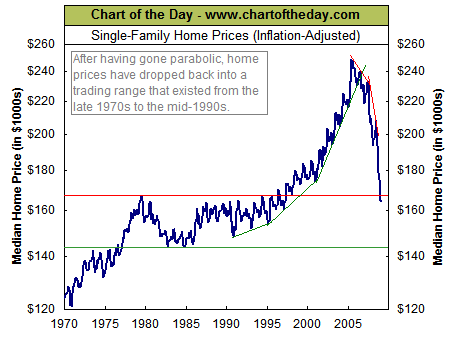
The Chart of the Day has an interesting look at median prices of single-family homes in the US on an inflation adjusted basis (below).
Where COTD goes off base is looking at a single factor — price — and ignoring all else.
That brings us to today’s chart which illustrates how housing prices have dropped 33% from the 2005 peak. In fact, a home buyer who bought the median priced single-family home at the 1979 peak has actually seen that home lose value (1.6% loss). Not an impressive performance considering that nearly three decades have passed.
Its a bit misleading to use a single factor — inflation – for the purpose of generating investment returns regarding housing.
Whenever we discuss home ownership, we must also recognize 1) Tax benefits of mortgage interest deduction; 2) Mortgage vs rent payments that you would have been making otherwise (with zero return); 3) non-monetary benefits of owning your own home.
I have been one of the biggest bears on housing for the past 4 years — but the chart below fails to tell the complete home ownership story from an investor’s perspective.
>



March 29th, 2009 at 3:19 pm
Any idea which of the many housing medians is plotted?
March 29th, 2009 at 3:56 pm
“Whenever we discuss home ownership, we must also recognize 1) Tax benefits of mortgage interest deduction; 2) Mortgage vs rent payments that you would have been making otherwise (with zero return); 3) non-monetary benefits of owning your own home.”
And on the negative side as a homeowner you have property taxes which are considerable and relentless, and insurance which goes up every year regardless. You also have ongoing maintenance expenses and the occasional, unexpected big repair bill – think reroof, HVAC replacement, etc. All of these, it should be noted, come out of your AFTER tax income, assuming we’re talking about a primary residence and not a rental property.
Your observations were a tad incomplete here, Barry.
~~~
BR: I wasn’t attempting to make an exhaustive list.
But you made my point — a single data point doesn’t cut it . . .
March 29th, 2009 at 4:02 pm
Surely, if we’ve learned nothing else at all in the housing mess, it’s that one’s own housing is NOT an investment. At best, it might be a form of forced savings (through mortgage amortization) that we can hope will roughly keep pace with inflation.
March 29th, 2009 at 4:18 pm
Also need to keep in mind what you could earn on the capital not invested in a home.
And, for us who lived in the lower priced areas and didn’t carry a lot of debt, that there hasn’t been a mortgage deduction for a while; the standard deduction was bigger.
March 29th, 2009 at 4:53 pm
yon’ QOTD:
“It is generally agreed that casinos should, in the public interest, be inaccessible and expensive. And perhaps the same is true of Stock Exchanges.” —John Maynard Keynes
“home ownership”, traditionally, fell into the “inaccessible and expensive” category..
or, differently, too bad no one updated this part of Keynes’ ‘model’, to include ‘housing’..
though, really, this story is, merely, yet another facet of ‘excess credit/leverage’..
the body of the Stone, the Federal Reserve, is still, too, well y good.
let us, continue to, hack at the branches–it’s exercise, if nothing else.
March 29th, 2009 at 4:58 pm
Drey-
I would also add that there is no return on new roofs, HVAC, etc. When you buy a house, you expect these things to be functional. The only monetary impact is less money for the seller as the buyer looks to protect himself. I would say that in my experience any tax advantages are quickly eaten up by maintenance expenses.
March 29th, 2009 at 5:09 pm
The idea that housing is something you manipulate in order to scam the public was pretty much the creation of the investment community in this country. Housing policy in a society, one would think, is supposed to be about designing mechanisms (or preferably allowing the free market) to make it possible for people to live reasonably. Unfortunately, the money people got a hold of it, and every bit of it, zoning, development, construction, sales, financing, the media, and all which accompanied these institutions, in order to maximize profits and separate as much money from people as possible, until it reached the absolutely absurd proportions it did a few years ago.
History has been quite clear that the financial community, left to their devices, will and have done absolutely anything for money. Creating another Ponzi scheme out of housing is nothing compared to war, to extorting people over health care costs, and driving up the price of staple foods to turn a quick buck. This is what these people do. It’s just amazing that people a shocked every time it happens.
March 29th, 2009 at 5:27 pm
“I would say that in my experience any tax advantages are quickly eaten up by maintenance expenses.”
Totally agree, larster. I’ve thought about this a lot over the years and have come to the conclusion that, aside from appreciation which is no longer a given, renting vs. owning is about a wash. Mike in Nola adds the key point that opportunity cost for the capital tied up in a home is not factored in, and I would add, somewhat obviously, that RE is the most illiquid of all investments. God forbid you should need to get your money out in a hurry or you will find the true meaning of being f**&#d.
March 29th, 2009 at 5:44 pm
drey: you got it right on captial being tied up.
After Katrina my wife had to get a job in Houston. Our house was ok except for having Allstate buy us a new roof. I wound up having to do a bunch of delayed maintenance that I had planned to “get around to sometime.” I wound up commuting for 3 years til we could get rid of it a few months ago. We had decided to rent it out (it was a double). Nothing I looked forward to more than being an absentee landlord in a declining economy.
The capital being tied up is another problem that has been mentioned in articles about real estate: you are prevented from migrating to a better labor market if you can’t sell the house. I finally got my Texas law license and there’s not nearly the concern about applying for work in other cities (except that we like Houston pretty well).
And finally, there is a certain lack emotional element to it. Yeah, it was sad leaving the place where we raised our kids, but I wasn’t as nearly concerned about Hurrican Ike hitting Houston and damaging the apartment building as I was about Gustav hitting Louisiana and damaging the house. If the apartment becaame uninhabitable it was an inconvenience; we could easily pick up and move.
March 29th, 2009 at 5:54 pm
One observation which contains a vague sort of question. The housing market has an illiquidity based on its regional nature which makes these national figures a little misleading. The housing bubble occurred in an irregular fashion concentrated in certain markets. While the price of housing has gone down in all markets, the overall national numbers are skewed by the extremem bubble markets. If one was in the market for a house or condo in South Florida a few years ago it did not help matters that housing in, say, North Carolina was not undergoing anything like the bubble in prices in South Florida. You could not buy a cheaper house in North Carolina if your job was in South Florida barring the rather extreme action of picking up and moving your family hundreds of miles away, hoping to find a job there, etc.. It is not like stocks where one can move from an overvalued sector to an undervalued sector with a few clicks on your computer.
I suspect for most regions the idea that housing is now worth less than it was worth in 1979 is simply not true. It is the extreme bubbling rise and consequential crash in certain markets that skews the entire picture. That raises the following question: is it possible somehow to exclude the more extreme markets–California, Nevada, Florida, etc.–and get an idea of the actual decline in the valuation of the bulk of the housing market? I realize that this will matter little to the financial institutions who are holding MBS on those bubble areas, but it will matter a great deal to the economic decisions made by the everyday people who live in those vast regions of the country that did not experience a severe housing bubble and decline. And for that reason it will likely have a large effect on the bottom up recovery which eventually will take place.
March 29th, 2009 at 6:51 pm
Judging by the Case-Shiller numbers, it really appears as though all markets saw exponential growth, just not to the degree that the coasts did. The property values in certain rustbelt cities appear to have been propped up by the credit bubble, even though they didn’t rise by all that much. Now, they’ve collapsed below pre-bubble prices.
March 29th, 2009 at 7:11 pm
I guess the plebian response is, “Is there *any* graph today that does not look like an Evil Knievel graph?”
March 29th, 2009 at 7:56 pm
aitrader,
why do you think it’s referred to as “Economy Ramp n’Crash”?
March 29th, 2009 at 8:06 pm
Hey, and if you buy right now, Uncle Sam will throw in an $8000 sweetener for you at tax time. Heard you’ll be able to claim state taxes on a new vehicle purchase this year too. Just a house of cards waiting to tumble down…
March 29th, 2009 at 8:34 pm
You have a point with your items 1 and 3, BR, but are wrong about 2.
It would appear people have been making those payments with negative return. More to the point, you have two components to a house payment and one of them is rent, the other is savings – if your return on borrowing is greater than the cost of it. The higher rent goes to item 3. Item 1 is iffy – you may get a deduction, but an apartment renter may get an indirect benefit here in the form of lower rent (and a direct benefit in some states). But item2 goes right to the heart of housing as an investment, and it is not.
March 29th, 2009 at 8:48 pm
One must also remember that the median house in 1979 was considerably smaller than the median house today…
March 29th, 2009 at 10:28 pm
Thanks, sbailey:
I was just about to write that. Its one thing to be inflation-adjusted, another caveat would square-footage-adjusted.
March 29th, 2009 at 10:32 pm
Pureguesswork,
The data involves median house price, not average. By definition half of the data clocked in above the median price and half the houses clocked in below the median. It doesn’t matter if the half of the data above the median includes many houses in FL, NV, CA, AZ. What matter sis the mathematical consistency. It is still legitimate data.
To capriciously attempt to remove data points that are above the median simply because “they’re too high” (e.g. simply cuz they were in Cali, AZ, NV, FL) would be like me arguing that all the really hot days should be removed from median temperature data cuz, well, cuz “those were summer days!!.
Or am I missing something?
March 29th, 2009 at 10:38 pm
Ok, Barry, what I really want to know is how does an inflation adjusted housing investment compare to an inflation adjusted investment in the SP 500 (or any other stock market benchmark) over the past 30 or so years? If you don’t have these charts, no one will. I do know that in my neighborhood you’d have been better off putting your cash into a house in 1999 than into the stock market, which comes as a surprise to me.
March 30th, 2009 at 2:46 am
“Whenever we discuss home ownership, we must also recognize 1) Tax benefits of mortgage interest deduction; 2) Mortgage vs rent payments that you would have been making otherwise (with zero return); 3) non-monetary benefits of owning your own home.”
This is a rather disappointing bit of Yun-ish drivel, something which your site is usually above. COTD (I did not read the original article) is simply analyzing the real prices of housing. You, for reasons I can’t understand, have suddenly lost objectivity about housing and investing.
[BR: No, I haven't suddenly lost objectivity or become a cheerleader. I disagree with the overall impression this chart creates]
What does item 2 mean? Are you implying that paying rent is a net loss while paying mortgage is an investment? If so, then you should provide a full rent vs buy analysis instead of seemingly trotting out the moribund “Renting is Throwing Your Money Away Argument”, an argument which is unfounded and errroneous in most cases.
[BR: You have to live somewhere !]
What are the “non monetary benefits” home ownership? Major repairs, insurance, illiquidity? What about the non monetary benefits of renting such as minimal risk, preservation of liquidity, freedom of movement? And since when have you ever waxed lyrical about the hedonics of investing? Do you advocate buying GM shares over buying Toyota shares because of the additional utils achieved from “buying American”? What about buying AIG bonds instead of Walmart bonds because they use prettier font and nicer paper for the coupons? From a purely economic point of view, these are valid arguments but I can’t recall seeing anything of that type made on this site.
[BR: If you have no clue what non-monetary benefits are, I cannot explain it to you in a few 100 words]
I am truly at a loss to understand the point of your story other than you own a house and have finally hit the wall, allowing your emotions to override your objectivity. Or have I missed something? If so, mea culpa and I retract.
March 30th, 2009 at 7:22 am
One of my lifelong goals has been to make some money in the stock market, cash out at a profit, and use the profit to buy a house. In other words, convert potentially temporary stock profits that are useless unless used into a house. Then pay for it with OPM and monetary inflation. So far so good.
The only balance remaining on my mortgage is a small balance in a 5/1 ARM that just went to a little over 3% (I had thought it was going into the 2% range but I was wrong about the add-on amount over the treasury rate. Also, the bastards adjusted over the 1 year instead of the 6 month, which added about .25%) Either way, thy payment is probably less than some big spenders paid for Starbucks in given month before the crash. I have enough in a CD to pay it off, and it’s earning about the same amount as the new rate.
I’d rather live here than in a tent, an apartment, a box by the tracks, a relative’s home, or someone else’s place being rented to me. Many people probably feel the same about their home and don’t understand busybodies who complain about their desire to own one.
The only problem is that my house is in a high real estate tax area. That sucks. When real estate recovers, I may sell out and buy in a location that has minimal state taxes and minimal real estate taxes and does not price their homes like those in Crazy Town.
March 30th, 2009 at 8:51 am
ya missed my sarcasm about non-monetary benefits. I was listing such wonderful benefits as having a highly illiquid asset. Sure, there are other benefits such as being able to knock down a wall when you want without having to ask the owner.
As far as having to live somewhere, I did not deny. I won’t bore you with rent vs buy calculations since you know more than I do, but renting is a nice option for many, many people.
What is the overall impression of the chart? That, purely as an investment, a house has not made any real returns since 1979? Did COTD include rental equivalents? Are you including equivalent rent in your analysis and do you consider that a non-monetary benefit?
The issue appears to be investment returns on housing. Suppose this chart was about GM shares? Would it have elicited the same reaction from you?
I apologize for my somewhat sarcastic first post since it was fairly trollish, but I hold you to a high standard, one which you have earned so far.
March 30th, 2009 at 9:12 am
Anybody have access to more details on the source data and methodology behind this chart? I’ve been following carefully the various developments in the housing market for a while now, and this doesn’t pass the smell test. It seems to say housing has returned to a “fair value”. I don’t buy it… Frankly it smacks of something the NAR would publish. And I don’t mean that as a compliment.
March 30th, 2009 at 10:55 pm
“Also need to keep in mind what you could earn on the capital not invested in a home.”
Or lose. After all it’s not like stocks have done any better in this market than housing as far as holding their value, let alone appreciating.
I think everyone understands the rent vs. buy arguments, but I wonder how many people who argue against ownership are basing most of their argument(s) on the inflated house prices we’ve seen in the last few years.
March 31st, 2009 at 1:53 pm
OUCH! THAT HURTS!!