
Stock Buybacks vs Performance

Email this post Print this post
By Barry Ritholtz - March 26th, 2009, 3:00PM

As you can imagine, most of these have been jumbo losers:

>
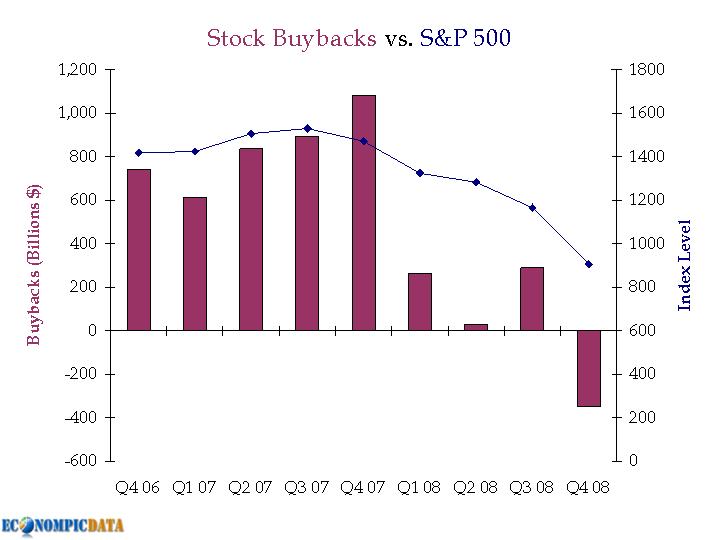

Chart via Jake at Econompic
>

Marketbeat:

Share repurchases by components of the Standard & Poor’s 500-stock index fell to lowest level in the fourth quarter of 2008 since the third quarter of 2004, according to S&P, as companies retreated into a hole, preserving cash as the market tanked.

According to the Federal Reserve’s flow of funds data, released quarterly, the biggest buyers of shares in the 2005-2007 period were U.S. corporations, coming at a time when households and mutual funds were net sellers of U.S. equities. The frenzy hit a peak in the third quarter of 2007, according to Standard & Poor’s, when $171.95 billion in repurchases took place – dovetailing neatly with the market’s peak.

>

Source:
If Corporations Don’t Buy Stocks, Who Will?
David Gaffen
WSJ MarketBeat March 26, 2009, 12:08 PM ET
http://blogs.wsj.com/marketbeat/2009/03/26/if-corporations-dont-buy-stocks-who-will/

32 Responses to “Stock Buybacks vs Performance”

  1. Barry Ritholtz Says:

    And we know why: These buybacks took place with shares at lofty prices, and the buybacks were central to improved earnings-per-share results.

  2. Mark E Hoffer Says:

    “the buybacks were central to improved earnings-per-share results.”–BR

    no doubt.

    so much for fiduciary responsibility..what good was SarbOx, again ?

    too bad Goodyear never got into the ‘Balance Sheet’ biz..

    would have needed triple-digits to quote it..
    http://finance.yahoo.com/q?s=GT&

  3. Super-Anon Says:

    Buy high; sell low.

    Just be sure you do it with other people’s wealth.

  4. leftback Says:

    It goosed the CEO bonuses, though. Corrupt bastards… More pitchforks and torches, Barry !!
    Better still: Progressive taxation and Clawbacks.

  5. matt Says:

    I have been trying to get this point across to my colleagues for years. Everyone raves about how much more efficient share buybacks are instead of dividends. The problem is that they ALWAYS occur in droves when stocks are most overvalued. Just distribute my dividends, thank you.

  6. wally Says:

    Even mighty Warren Buffett has had to face the reality: you may save your cash for the rainy day when you can buy cheaply, but when that day comes you need your cash to patch the leaks in the roof. Being counter-cyclical is easy to talk, very hard to do.

  7. Short Man Says:

    @ guidepostings 3:25

    Agreed – This rally still has some length to it I believe. Not time to load up on shorts yet. We may get a pullback in the next couple of sessions but then look for another leg higher to the 900 area. Then start taking profits and building a short position.

  8. jlj Says:

    “The frenzy hit a peak in the third quarter of 2007, according to Standard & Poor’s, when $171.95 billion in repurchases took place – dovetailing neatly with the market’s peak.”

    1) The chart shows the peak in the 4th qrtr 2007 @ 1,000+billion ????
    2) Go back to the article and it has the peak in the 4th qtr @ $1081 Billion.
    3) Since 2004 article says $1.78 trillion in buybacks, $970 in dividends.
    4) Wonder what the combined $$ would be if you went back to 1999 and end of Glass -S and added together the buybacks, dividends, taxes, cds payments, cdo payments and bonuses paid out how that number would compare to dollars spent on the bailout? Would it look like the Gov is simply paying back the financial sector all the monies they paid out in the last ten years, plus making them whole on all the CDS bets??

  9. guidepostings Says:

    off topic
    deleted by editor

  10. Rajesh Says:

    Some of the “corporations” buying stock were private equity groups gorging on cheap credit to create tomorrow’s bankruptcies.

  11. MRegan Says:

    MH-

    A Cipesa é a marca líder em reconhecimento de mercado em Alagoas…
    Tércio Wanderley, um dos maiores produtores de açúcar e álcool do país, com larga experiência na construção civil.

    Are you talking about Cipesa…Tércio Wanderley?

  12. Jdamon33 Says:

    Steve Barry -

    What do you think about the NAZ being up for the year now? Is it time to add to the QID or are you just crossing your fingers that another leg down will start sometime soon?

  13. MRegan Says:

    MH

    Tércio Wanderley
    “one of the country’s largest producers of sugar and alcohol, with ‘years of experience’ in civil construction”

  14. Mark E Hoffer Says:

    MR–

    I caught that, though, what are you referencing?

  15. Ken Says:

    I have this nagging recollection of a post on an economics blog – perhaps this one, or Calculated Risk – late last year, comparing the total amount paid in dividends by some group of companies over the past five years with the total amount borrowed by those companies. The amounts were essentially the same. It was rather similar to the analyses of the airline industry that come out every few years, which indicate that the industry as a whole has made no profits since the invention of flight. Wish I could remember more details.

  16. seobook Says:

    Were you looking for this 1 Ken?

    “Over the last four years, since the buyback boom began, from the fourth quarter of 2004 through the third quarter of 2008, companies in the S.&P. 500 showed:

    Reported earnings: $2.42 trillion
    Stock buybacks: $1.73 trillion
    Dividends: $0.91 trillion”

    http://www.ritholtz.com/blog/2008/12/quote-of-the-day-earnings-dividends-buybacks/

  17. SWMOD52 Says:

    This one frosts my tomatos. The current public corporation totally messed up. Why can’t they pay a dividend? When did that become a dirty word? The stock holders are getting hosed.

  18. Moss Says:

    Looks like a great contrarian indicator.

    Issue debt, buyback stock, deduct interest expense, reduce dilution, goose EPS, get bonus.

  19. moneyneversleepsblog Says:

    Makes it hard for CEO’s to come out later in the year and say we’re doing a buyback and it is GREAT for shareholders!

    Bring back the dividends…

    http://moneyneversleepsblog.blogspot.com/2009/03/stock-buybacks-vs-s-500.html

  20. usphoenix Says:

    IMHO, the trend started in the late 80s is accelerating. Explain to me which CEO actually has to deal with “shareholders”. Wall Street yes. All these “board member” agents and consultants being paid mega bucks to represent the board and executives: yes.

    Boards don’t represent shareholders. Executives don’t represent shareholders.

    Most shareholders are probably Boomer pension funds, and indirectly pensioners hoping their pension doesn’t go bust. They paid for it and earned it. And BO will sell out to keep the pension funds from going bust. Pitchforks and torches.

    So stock buybacks are nothing more than a way to juice the stock price to juice executive bonuses.

    That flies in the face of Merton Miller’s advice about stock price and corporate investment.

    But that’s all become so much bull shit.

    There’s nothing real about the stock market.

  21. danm Says:

    If you ask me the whole thing is a farce… when you buy back shares, logically the stock price should not go up. It should stau flat.

    Yes, eps increase but the cash level goes down so the multiple should also decline… I could argue that by spending the cash, the co has increased its funding risk and its future growth potential.

  22. danm Says:

    the co has increased its funding risk and its future growth potential
    ————-
    Should be: decreased future growth potnetial

  23. Andy Tabbo Says:

    This is probably my single largest irritation with public companies–buying back their own stock. 80-90% of the time it’s the WORST use of cash. When a Board buys back their own stock, they’re basically saying:

    “We’ve analyzed many different investment opportunities around the world, and we’ve decided that our stock, among all the stocks in the world, is the very best stock to buy. Therefore, we are NOT going to dividend the cash to shareholders to make their own decisions. We’re going to buy our own stock.”

    It’s simply ridiculous. All in an effort to appease Wall St.’s finest and goose the EPS.

  24. TPC Says:

    Contrarian indicator methinks….

  25. karen Says:

    Andy, i agree completely with your opinion on stock buybacks, 98% of the time on that is the case. but 2% of the time, a stock gets manipulated or driven down because of unprecedented market conditions, and then I’m all for it. Of course, I’m referring to the price getting driven to near zero…

  26. usphoenix Says:

    @karen: spoken like a true trader.

  27. karen Says:

    oh, phx, don’t tease me. i’m just an idiot that is able make money… dumb luck.

  28. How the Common Man Sees It Says:

    @matt Says: March 26th, 2009 at 3:19 pm and various others re: dividends

    I agree wholeheartedly. Give me the dividend and a good drip plan and let me decide if company cash is to be used for share buybacks

    @danm Says: March 26th, 2009 at 8:02 pm

    If you ask me the whole thing is a farce… when you buy back shares, logically the stock price should not go up. It should stau flat.

    From the bottom line company perspective yes but from the trading side you are reducing the float and thus are (supposedly) changing the supply/demand fundamentals of the shares

  29. BlankReg Says:

    I expect to see a correlation between stock buybacks and large insider sales.

  30. danm Says:

    If you ask me the whole thing is a farce… when you buy back shares, logically the stock price should not go up. It should stau flat.

    From the bottom line company perspective yes but from the trading side you are reducing the float and thus are (supposedly) changing the supply/demand fundamentals of the shares
    ————–
    I know this is what happens but it makes no sense fundamentally. That is a great example of the market being inefficient at pricing the true value . When this happens, I know there will be a correction sometime down the road since stocks trade around their intrinsic value.

  31. Mark E Hoffer Says:

    “If you ask me the whole thing is a farce… when you buy back shares, logically the stock price should not go up. It should stay flat.”

    actually, one could make the case that the shares should trade lower due to increased ‘costs’ of Event Risk.

    whether, or not, the funds were borrowed, the transactions reduce Cash, decrease flexibility in responding to \exogenuous/ shocks–which, do, happen.

    LSS: the ’stock buy-back=good’-myth was created at the same skools that produce the ‘bankers’..
    funny how it creates Corporate dependency on ‘Banks’, maybe it’s, just, a coincidence..

  32. How the Common Man Sees It Says:

    whether, or not, the funds were borrowed, the transactions reduce Cash, decrease flexibility in responding to \exogenuous/ shocks–which, do, happen.

    Are you talking pre or current fed-will-lend-to-anybody-that-can-fog-a-mirror eras? ;)