
Bear Market Rally? Look at Gains & Volume

Email this post Print this post
By Barry Ritholtz - April 24th, 2009, 1:28PM

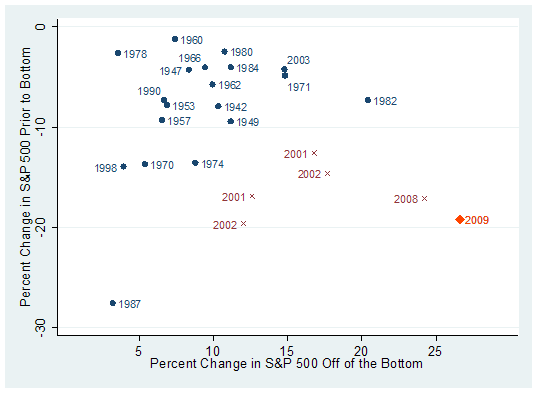
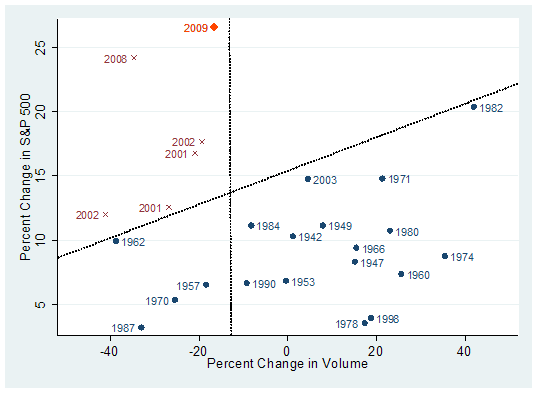
In the light of today’s rally, perhaps it would be instructive to look at the volume on some past rallies. Fortunately, William Hester at Hussman Funds has done the heavy lifting for us, as these two charts show:

>

Changes in S&P 500 Leading to, and Coming Off of, Major Troughs
rallyvolume1
(Note: Data set = bear-market bottoms since 1940 )

Volume Changes From Major Bottoms
rallyvolume2
(Note: Data set = bear-market bottoms since 1940 )

Charts courtesy of Hussman Funds

Eventually, one of the Bear market rallies will be the one that is the turnaround. But until then, its guilty until proven innocent.

>

Source:
Trading Volume Separates Bull Markets from Bear Rallies
William Hester, CFA
Hussman Funds, April 2009
http://www.hussmanfunds.com/rsi/rallyvolume.htm

40 Responses to “Bear Market Rally? Look at Gains & Volume”

  1. Barry Ritholtz Says:

    I love these quotes:

    Volume tends to expand in the main direction of the trend. In a bull market, advances accompanied by increasing volume or declines on diminishing volume are taken to be bullish. Conversly, in a bear market, declines are accompanied by increasing volume and advances show diminishing volume. Volume should always be studied as a trend (relative to what has preceded).

    - Richard Russell, The Dow Theory Today

    The bottom is preceded by a period in which the market declines on low volumes and rises on high volumes. The end of a bear market is characterised by a final slump of prices on low trading volumes. Confirmation that the bear trend is over will be rising volumes at the new higher levels after the first rebound in prices.

    - Russell Napier, Anatomy of the Bear (his study of the four great stock market bottoms of 1921, 1932, 1949, and 1982).

    Whether it was William Peter Hamilton

  2. krbecarson Says:

    you’re missing the volume chart!!

    http://www.hussmanfunds.com/rsi/rallyvolume2.gif

  3. Barry Ritholtz Says:

    Its there!

    Refresh

  4. call me ahab Says:

    go to the link- this isn’t a volume chart- right?

  5. call me ahab Says:

    ah- there it is!

  6. krbecarson Says:

    :)

  7. HCF Says:

    Seems like there is the obsession with the “stress test” today on CNBC.

    Let me think: Hasn’t the last 18 months been a huge frickin’ stress test???!!! Didn’t they all fail? Isn’t that why there is TARP in the first place?

    HCF

  8. call me ahab Says:

    you’re not saying the 2009 data point is an outlier- are you?

  9. call me ahab Says:

    Here is an excerpt of a CNBC article discussin the upcoming “Stress Test”:

    “The tests will also require some institutions to come clean about weaknesses and commit to a course of action to regain health. Those salvage plans could include seeking further government assistance and, at the extreme, replacing senior managers. ”

    wow- replacing managers, telling us the truth- that’s freakin’ extreme- you would think that would be the least that’s required

  10. DL Says:

    There was a rally in 1933 which beat the present one.

  11. dead hobo Says:

    Thanks for the insight. I’m glad to see the charts explain it all. I erroneously considered national and world wide economic fundamentals as providing at least a little influence. I’m happy to discover that the stock market is really a self contained microcosm that runs on it’s own rules. And these rules have little to do with the underlying health of the business behind the stock. I feel much better about putting my savings into common stocks now. I was worried for while. I see I was mistaken.

  12. Mannwich Says:

    Back from my vision exam. Eyes dilated, so seeing my trading account is a struggle, thankfully. Good to see the three ring circus beginning to intensify.

  13. DL Says:

    dead hobo @ 2:08

    Regression to the mean…?

  14. Robin Says:

    Dumb question: what does red/blue coloring mean?

  15. leftback Says:

    DL @ 2.07pm:
    “There was a rally in 1933 which beat the present one.”

    That’s my nightmare scenario. :-(
    Take a look at FXP, I just got some under $20.

    All the charts are the same. FXI, EWT, JNK, SPX they all look the same – tired.
    More than tired, they look like they just spent seven weeks on the back of Richard Branson’s Ski-Doo.

  16. batmando Says:

    “Dumb question: what does red/blue coloring mean?”
    explained Hussman Funds
    http://www.hussmanfunds.com/rsi/rallyvolume.htm

  17. dead hobo Says:

    DL,

    Yes. I used to do what the voices in my head told me to do. Now, I’ll just look at the charts and let them tell me about impending good times or impending bad times.

  18. R. Timm Says:

    BR please go on TV and tell everyone you expect this bear market rally to fizzle and for the market to retest its lows soon. My SDS shares are getting clobbered.

    You worked miracles on your last call.

  19. leftback Says:

    “BR please go on TV and tell everyone you expect this bear market rally to fizzle”

    No Bears allowed during rallies. You know the rules on CNBC.
    Right now it’s all mustard seeds, green shoots, morning in America and f***ing Goldilocks.

  20. Onlooker from Troy Says:

    DL Says:
    April 24th, 2009 at 2:07 pm

    There was a rally in 1933 which beat the present one.<<<

    Yeah but they had less history to learn from, less information available in a much less timely fashion. You’d think we’d learn better from history and wouldn’t blindly follow a hopeful path based on very thin evidence as far as they did. Time will tell!

  21. constantnormal Says:

    @ DL 2:07

    “There was a rally in 1933 which beat the present one.”

    So far. The current rally may extend for a longer time than expected.

    “Markets can remain irrational longer than you can remain solvent” — Keynes

  22. Onlooker from Troy Says:

    Another indicator:

    http://www.bloomberg.com/apps/news?pid=20601087&sid=au8cyqeJFifg

    Insider selling, generally a good indicator.

  23. HCF Says:

    Bullshit rally continues!
    Chrysler going under -> Bullish
    GM going under -> Bullish
    Housing terrible -> Bullish
    Banks alive only because of free money -> Bullish

    How come I can’t see the green shoots? Maybe I’m the insane one?

    “Strange days have found us
    Strange days have tracked us down
    They’re going to destroy
    Our casual joys
    We shall go on playing
    Or find a new town”

    - The Doors

    HCF

  24. leftback Says:

    The longer this thing goes on the more likely it is that we experience a crash.
    I am sure this would come as a shock to many, but several of the ingredients are there.
    Low volume, short squeeze, insider sales. It’s not bullish.

    Wait for the close and then kitchen sink it on the short side. That’s my plan.

  25. constantnormal Says:

    @ Onlooker —

    a picture is worth a thousand words …

    http://online.barrons.com/edition/resources/media/b-insider.gif

  26. Outlier Says:

    @HCF, you’re not supposed to _see_ the green shoots, your are supposed to _smoke_ them.

  27. dead hobo Says:

    leftback Says:
    April 24th, 2009 at 2:58 pm

    Wait for the close and then kitchen sink it on the short side. That’s my plan.

    reply:
    ————-
    Good luck, This rally seems more phony than all of the others. That being said, there’s some real smart operators managing this one, I believe.

  28. R. Timm Says:

    @ Leftback 2:58- thats what I thought last week buying SDS at 69 Thursday. Monday looked so promising as a crash to start the week but it didn’t last. Maybe next week we can only hope.

    I was oggling FO back when it slipped under $20 and am kicking myself now. I guess everyone is drinking liquor and playing golf.

  29. spoonman Says:

    lb @ 2:58
    That was my thought too, but I am made cautious by the potential for a run-up to 950. I think I’m going to keep some powder dry, just in case

  30. HCF Says:

    @ Outlier:

    I think many market participants are doing much more serious stuff than smoking green shoots!

    Green shoots, white lines, and Mr. Brownstone anyone? lol…

    HCF

  31. zero529 Says:

    Nice chart, but would be much more instantly readable if they’d switched the axes. Nevertheless, exactly the information I’ve been wanting to see posted.

  32. Outlier Says:

    who needs drugs when you can smoke the entire market?

  33. dead hobo Says:

    At this point, I suspect there will be a huge boost in the last few minutes. Suckers will be a little suspicious on Monday, but will be drawn back in by mid week. This is educational. Is it always like this?

  34. drollere Says:

    not sure how “bear market” is defined (many of these were only cub markets), but the outlier cluster of points since 2000 (and excluding 2003) is the standard pattern of either a definitional change or a causal, substantive change in the variables being plotted.

    what first comes to mind is that all the outlier bears share the same pattern: volume lower, volatility higher. that doesn’t look like the basic reallocation, restructuring etc. that lays the foundation for a robust bull run.

    even so, this market is looking less and less freaky all the time. yes the volume is low, but it appears to be consolidating. how many shorts here are going to get badly pinched? the bubble is dead — long live the bubble!

  35. constantnormal Says:

    Wow, lb — looking at the last few minutes of trading, you must have thrown in your kitchen sink that was loaded with anvils (ticker=ACME)

  36. Business & Finance Blogs » Blog Archive » New Reality Check Says:

    [...] “Bear Market Rally? Look at Gains & Volume” (The Big Picture): [...]

  37. gollum Says:

    constantnormal’s link is quite scary…

    The market is at a very important point, if it breaks thru we might not see a new low on the major world stock indexes.

    But I think the rally might fail. It was more than due, but quite overdone by now.

  38. james hogan Says:

    You know, I think the missing link here is the internet, and the increased distribution of information.

    What I mean is that the public can see that the policy makers are cognizant of the problems, and are taking steps to try to correct the imbalances. (Just for the record, I would have done something considerably different, but then they don’t pay me to do that.)

    One of the greatest things that has ever happened to the human race is the development and expansion of the internet. It has put so much information at the fingertips of ordinary people (like me).

    Most of the charts and graphs the come from an earlier era need to be taken with a grain of silicon; it really is different now.

  39. james hogan Says:

    Addendum to the previous post: It should read “Most of the charts and graphs THAT come from an earlier era…”

    It should also include the ability of the public to access huge, enormous amounts of information on almost any subject imaginable. Since the economic downturn started in 2007, I’d bet (and I haven’t looked) that the queries on economic subjects has at least tripled from the previous era.

    Americans may be many diffenent things, but the one thing that they all are is cognizant of their economic circumstance.

  40. Mark E Hoffer Says:

    jh,

    w/this: “..but the one thing that they all are is cognizant of their economic circumstance.”

    I’d wonder. see: “John Maynard Keynes often employed flowery language like “animal spirits” and “liquidity trap” to describe things he did not understand. He was, after all, more of a bureaucrat than an economist. In fact, he would best be described as an anti-economist because he eschewed things like supply and demand and held the opinion that government could run the economy.

    So, for example, he could not understand why people would invest resources in risky adventures that helped keep the economy growing at full employment. He therefore substituted “animal spirits” for the profit motive. These spirits allow entrepreneurs to proceed with a naïve confidence and to set aside concerns over losses. Similarly, the failure to invest was also a psychological problem that he dubbed the “liquidity trap.” This trap occurs when investors seek liquidity in cash and when monetary policy — in terms of cutting interest rates — no longer produces an increase in investment.

    The problem with Keynes is that he thought that if entrepreneurs lose their collective nerve, the government should socialize investment, prop up demand and employment, and provide assurances to drive the economy back to full employment. He did not understand how the economy works so he could not understand how the economy corrects itself once a contraction occurs…”
    http://www.mises.org/story/3413

    and remember this guy’s message: http://www.mindpollen.com/