GDP

Email this post Print this post
By Peter Boockvar - April 29th, 2009, 8:41AM

Real Q1 GDP contracted by a greater than expected 6.1% vs forecasts of
-4.7% but the components were very mixed. Personal spending rose 2.2%,
greater than estimates of .9% but Inventories subtracted 2.8% off GDP,
falling by $103.7b and Govt spending took off an uncharacteristic .8%
from GDP. Trade added about 2% points. Taking out the huge impact that
the inventory drawdown had on GDP, Real Final Sales fell 3.4% after a
6.2% drop in Q4. Also, relative to expectations, the price deflator rose
2.9%, 1.1% more than expected, thus NOMINAL GDP was only .3% worse than
expectations. Residential construction fell by 38%, the biggest decline
in this down cycle and spending on equipment and software fell by 33.8%.
Core PCE rose 1.5%, .5% more than expected. Bottom line, the huge
inventory drawdown will be reversed to some extent to the upside, thus
helping economic activity and that’s why the market hasn’t responded
much to the weaker headline #.

DISCLAIMER
Although the information contained herein has been obtained from sources
Miller Tabak + Co., LLC believes to be reliable, its accuracy and
completeness cannot be guaranteed. This report is for informational
purposes only and under no circumstances is it to be construed as an
offer to sell, or a solicitation to buy, any security. At various times
we may have positions in and effect transactions in securities referred
to herein. Any recommendation contained in this report may not be
appropriate for all investors. Trading options is not suitable for all
investors and involves risk of loss. Although the information contained
in the subject report (not including disclosures contained herein) has
been obtained from sources we believe to be reliable, the accuracy and
completeness of such information and the opinions expressed herein
cannot be guaranteed. An options disclosure document may be obtained
from Mr. Jay Stenberg, Miller Tabak + Co., LLC., 331 Madison Avenue, New
York, NY 10017. Additional information is available upon request.
Member NYSE, NASD, CBOE, PHLX, ISE, NFA.
Member SIPC.

King Report: Bonds Are Tanking

Email this post Print this post
By Bill King - April 29th, 2009, 8:15AM

king-logo

>

Stocks rallied early and bonds sank on Tuesday on expectation that the release of GDP today would show a better than consensus number. The peculiarity of trade accounting mandates that GDP will be revised higher due to declining imports, which actually indicate economic ebbing.

Stocks tried to conform to the pattern of rallying into FOMC soirees. This suggests a reversal today after the Communiqué is released – unless it contains unexpected bullish news…Because bonds are tanking, we wonder if the Fed will announce an increase in its $300B monetization plan. It would please Bill Gross.

The window for stocks to rally is closing. The most bullish seasonal, the propensity of stocks to rally from November 1 to April 30 (particularly small caps and tech), ends on Thursday. The short-term upward seasonal bias (end-of-month & start-of-month) ends on Friday.

Technical indicators on stocks and major indices are negative or rolling over because the momentum of the rally that commenced in mid-March has dissipated and volume remains soft…Banks, abetted by FASB accounting changes and other facilities, are issuing beaucoup securities. The Treasury is issuing like crazy and the May refunding looms…Insider selling is exploding.

fed-monettize

30-year bond continuous future – The Fed better have a scheme to remedy this dire looking chart.

More for today – GDP (-4.7% is consensus but the market expects a sharply higher revision) will impact early trading. As usual, traders will have a knee-jerk reaction to the headline number. But one must scrutinize the details of the report to gauge ‘real’ activity…Analysts expect a sharp upward revision due to lower imports, which actually indicates economic weakness…Government spending should be a factor.

Fed’s headed for a showdown with the bond market

Email this post Print this post
By Peter Boockvar - April 29th, 2009, 7:51AM

As the FOMC meets for a 2nd day, they will likely take comfort in what
has occurred since their last meeting where they took the daring move of
deciding to buy treasuries to manipulate the level of longer term
interest rates. After rallying $70 the day of that meeting, gold has
given it all back, the CRB index is unchanged, oil is flat, the S&P’s
are up about 10%, the average 30 yr mortgage rate has fallen to 4.62%
from 4.89%, LIBOR is down to 1.03% from 1.29%, and the KDP high yield
index is down almost 200 bps. The fly is the implied inflation rate in
the 10 yr TIPS which has risen to 1.51% from 1.15% and the 10 yr yield
is still at 3%, although some will argue it would be higher if it wasn’t
for the Fed. If the FOMC doesn’t increase the size of treasury purchases
today, we could rip right thru 3% on the upside. ABC confidence rose to
the highest since early Oct. The MBA said purchases fell to an 8 week
low while refi’s fell to a 6 week low.

DISCLAIMER
Although the information contained herein has been obtained from sources
Miller Tabak + Co., LLC believes to be reliable, its accuracy and
completeness cannot be guaranteed. This report is for informational
purposes only and under no circumstances is it to be construed as an
offer to sell, or a solicitation to buy, any security. At various times
we may have positions in and effect transactions in securities referred
to herein. Any recommendation contained in this report may not be
appropriate for all investors. Trading options is not suitable for all
investors and involves risk of loss. Although the information contained
in the subject report (not including disclosures contained herein) has
been obtained from sources we believe to be reliable, the accuracy and
completeness of such information and the opinions expressed herein
cannot be guaranteed. An options disclosure document may be obtained
from Mr. Jay Stenberg, Miller Tabak + Co., LLC., 331 Madison Avenue, New
York, NY 10017. Additional information is available upon request.
Member NYSE, NASD, CBOE, PHLX, ISE, NFA.
Member SIPC.

Ugly Process: Rationalizing Insolvent Banks Existence

Email this post Print this post
By Barry Ritholtz - April 29th, 2009, 7:16AM

Of the many issues that arise via the banking bailouts we have seen, perhaps the most pernicious is how corrosive the process becomes. It corrupts even the most well intended parties.

The latest example is the stress tests, which run the risk of being window dressing. As noted last week, the Stress Tests themselves weren’t very stressful. And, now that some of the results are coming in, the cure for inadequate capital is not more capital, but an accounting trick — converting preferred stock to common. As Paul Kasriel of Northern Trust describeed it, this amounts to nothing more than Accounting Alchemy — the finacial equivalent of lead into gold.

Thus, we see the major test for the sector was inadequate to cleanly identify potential weakness. And even by that soft standard, the cure is inadequate.

US banks are suffering a solvency problem, and what they need is more capital, not an accounting sleight of hand. Yet that is precisely what they are getting — the same clever financial engineering that led to the crisis in the first place. All Treasury needs is more leverage and a few derivatives and the transformation into the financial Borg will be complete.

From Bloomberg:

“At least six of the 19 largest U.S. banks require additional capital, according to preliminary results of government stress tests, people briefed on the matter said.

While some of the lenders may need extra cash injections from the government, most of the capital is likely to come from converting preferred shares to common equity, the people said. The Federal Reserve is now hearing appeals from banks, including Citigroup Inc. and Bank of America Corp., that regulators have determined need more of a cushion against losses, they added.

By pushing conversions, rather than federal assistance, the government would allow banks to shore themselves up without the political taint that has soured both Wall Street and Congress on the bailouts. The risk is that, along with diluting existing shareholders, the government action won’t seem strong enough.”

All this goes to show is that receivership was the correct approach to this in the first place. Instead, we get “Gentleman B” stress tests and nonsense accounting gimmicks. The Treasury and Federal Reserve can no longer be considered honest brokers of the process. They too have been corrupted by the ugly process of rationalizing insolvent banks ongoing existence . . .

>

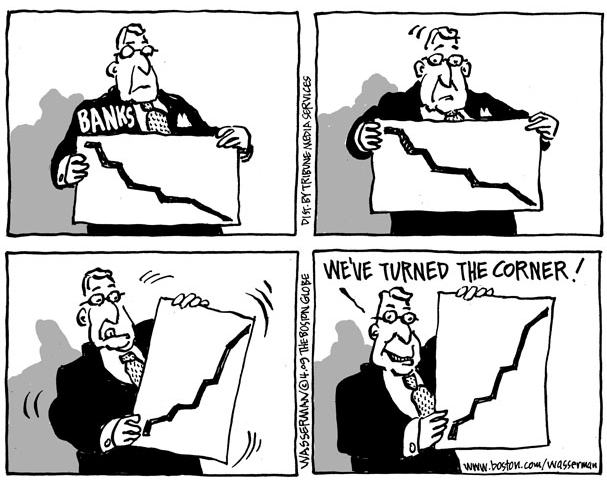
Turning the Corner?
corner
via Dan Wasserman

>

Previously:
Stress Test: Not Very Stressful (April 24th, 2009)

http://www.ritholtz.com/blog/2009/04/stress-test-white-paper/

Sources:
Fed Is Said to Seek Capital for at Least Six Banks
Robert Schmidt and Rebecca Christie
Bloomberg, April 29 2009

http://www.bloomberg.com/apps/news?pid=20601087&sid=aiz06xRmmeOQ&

Preferred Equity into Common Equity – Accounting Alchemy?
Paul Kasriel
Northern Trust, April 27, 2009

http://web-xp2a-pws.ntrs.com:80/content//media/attachment/data/econ_research/0904/document/ec042709.pdf

See Also
Time for Bank Creditors to Share the Pain?
DAVID LEONHARDT
NYT, April 28, 2009

http://www.nytimes.com/2009/04/29/business/economy/29leonhardt.html

Banks and Economic Data Wrestle to a Draw

Email this post Print this post
By Jack McHugh - April 28th, 2009, 11:00PM

Good Evening: Multiple crosscurrents prevented stocks from making much headway in either direction today, with the major averages finishing appropriately mixed on light volume. Negative stories about the banks and their impending need to raise capital clashed with positive surprises from today’s economic data releases. Given that the banks have been the leaders in both directions since this bear market began, the recent underperformance in the KBW bank stock index may portend a downward resolution to the sideways range the averages have been in for most of April.

Depending upon the news service one chooses to frequent, the swine flu is either dangerously spreading or is well on its way to being contained. Fearing the former, most foreign bourses were under decent pressure last night, but the stocks and bonds in the flu epicenter of Mexico were actually higher at one point today before finishing with modest losses. Perhaps the safest thing to say about this story is that it’s too early to really know whether this strain of swine flu can spread as rapidly around the globe as has the media hype surrounding it. In any case, U.S. stock index futures were down 2% or so as Tuesday dawned. That the Wall Street Journal ran a story about some major banks needing more capital probably also contributed to the early weakness (see excerpt below).

Yet, for the second day running, U.S. stocks suffered only half as much damage as the futures had been indicating. Some analysts take this action as a sign of latent buying power on dips in equities, but a better explanation (at least for today) lies in a piece of less negative than expected news on the housing front (see below). The S&P Case Shiller home price index, released 30 minutes prior to the commencement of trading, showed metropolitan home prices slipped 18% in February versus the negative 19% reading in January. Some tried to herald this better than expected data point as evidence that home prices are bottoming, but, as anyone with a “for sale” sign in their front yard can tell you, a slower rate of decline in price is cold comfort for those trying to sell a home.

After dropping approximately 1% just after the opening bell, equity prices were already on the comeback trail when the next economic news items hit the tape. Consumer confidence in April jumped to 39.2 from March’s 26.9 reading, the largest such rise in three years. Since most of the gains came from the “future expectations” aspect of the survey, economists were quick to hail the results as indicative of a pick up in consumer spending. I’d be happy if the vaunted U.S. consumer somehow found a way to climb up off the canvas, but taken in the context of the whole data series, a reading of 39.2 is not exactly bullish. Consumer confidence was in the 40s back during the dark days of last November, for example, and readings around 110 were not uncommon back in early 2007. Thus, while 39.2 may not be a great number, it was good enough to push stock prices into positive territory today. This happy economic backdrop was only reinforced when the Richmond Fed reported that manufacturing in its district declined at a pace that was gentler than had been forecast.

The major averages responded well enough to these data points to stay mostly above the unchanged mark. Helping to hold prices in check, however, was a follow up to the Journal’s story about the capital needs among the major banks. According to FBR, which administered its own, slightly more rigorous version of the government’s stress test on these institutions, said that Bank of America may need as much as $70 billion in fresh equity (see below). In a further blow to Ken Lewis and his directors, CalPERS announced it was voting against Lewis and his BOD slate at the upcoming annual meeting. BAC shares declined, as did those of Citigroup and other financial companies.

Despite these concerns, equities enjoyed an afternoon rally that saw the major averages logging gains of 1% or more. But this strength didn’t last and prices fell back at the closing bell. The final tally was mixed, with the Russell 2000 sporting a gain of 0.7%, the NASDAQ giving back 0.33%, and other averages finishing with fractional losses. Call today a draw. In contrast to the lack of volatility seen at the NYSE, the Treasury market saw plenty of it. Government bonds were down across the board, and yields rose between 5 and 14 basis points in a decidedly steeper curve environment. The dollar responded by dropping 0.7%, but, like equities, commodities were mixed. Other than a decent drop in metals both precious and base, most sectors comprising the CRB were trendless as the index itself dropped just less than 0.5%.

By almost any measure, fundamental or technical, the U.S. stock market looks to be a bit confused. Biding their time and waiting for more information, prices are thus moving sideways. The economic data has indeed seen some green shoots emerge, but it seems too early to tell whether these growings will become either flowers or weeds. The economic data and corporate earnings have been mixed, and about the best one can say about them is that the rate of decline is slowing. Given the Herculean efforts by the Fed, Treasury, and Congress, such an outcome, while not pre-ordained, is not surprising. The question before investors is whether this “less bad than expected” news flow is enough to signal the type of change President Obama promised when he was swept into office.

I’m no expert, but looking at the internal indicators of the market’s health, it’s just as hard to use technicals when trying to pinpoint an imminent trend in stock prices. The plunge into the early March lows and subsequent rebound into April has left the averages trading sideways at levels just below where they entered the year. Volume and volatility have both eased, and while the lows on the chart are rising, so too are the highs falling. One gets the sense that the indexes are coiling and ready to break out from their recent mid point at 850 or so in the S&P 500. Both the bulls who’ve declared a new bull market and the bears who are selling into what they perceive to be a bear market rally have both been disappointed of late.

Divining a directional change in market prices is tricky, even foolhardy, but perhaps the market leadership names will be instructive. Ever since the great bear market of 2007-2009 began, it has been led by the financial stocks. No matter which direction Mr. Market has chosen to wander, it has been the KBW bank index that has fallen hardest or soared the most. Falling more than 85% into March, the BKX rose just over 100% into mid April. But, while the other averages have been marking time, the BKX is now down 16% since its April 17 high. No matter what our government says about the true health of bank balance sheets, the real stress test for the U.S. stock market lies in what happens next to the BKX. I have a feeling the major averages will start following the banks should they continue moving lower, but who really knows? The safest prediction I can make is that the S&P 500 won’t be hanging around 850 much longer.

– Jack McHugh

U.S. Stocks Retreat, Led by Banks on Balance-Sheet Concern

U.S. Economy: Consumer Confidence Leaps, House-Price Drop Slows

Bank of America’s Lewis Loses Calpers Support, May Need Money

Fed Pushes Citi, BofA to Increase Capital
(subscription required for full article)

The Big Picture Conference: Capitalism After the Crash

Email this post Print this post
By Barry Ritholtz - April 28th, 2009, 7:30PM

I mentioned a few weeks ago we were hosting a conference in NYC on  June 3 2009. The conference is coming together nicely, with some terrific name guests committed:

• Former CNBC anchor Dylan Ratigan is the master of ceremonies;

Black Swan and Fooled by Randomness author Nassim Taleb is the morning keynote

• Doug Kass will be discussing the Future of Hedge funds, regulation, and performance

• Banking and credit experts Chris Whalen and Josh Rosner will be looking at the Banking System After TARP & PPIP

• We will have a panel on the Financial Media and the Crisis: How’d they do? and so far we have confirmed Randall Forsyth (Barrons), Jesse Eisinger (Portfolio, WSJ), Dan Gross (Newsweek, Slate, NYT),  Dylan Ratigan, (CNBC, Bloomberg TV, tba)

One of the cool things about having a blog sponsor a conference is the interactive nature of the format. For the panels and Q&A, blog readers can submit queries. And some of the video will be posted here, too. I am very jazzed about it.

Save the date: June 3rd, 2009
New York Athletic Club (Sixth Ave. and 59th St

Full details to follow this week

~~~

UPDATE: April 28 2008 10:06 pm

The registration site is now up and running!

http://secure.pnmi.com/bigpicture/

inflation/bonds

Email this post Print this post
By Peter Boockvar - April 28th, 2009, 4:39PM

While commodity prices have sold off the past 2 days due to concerns
with the impact that swine flu will have on global growth, the implied
inflation rate in the 10 yr TIPS today has risen to the highest level
since early Oct at 1.51%. The dynamics impacting the bond market remain
the concerns with huge amounts of supply that would most impact the
longer end of the curve as the shorter end is more influenced by fed
policy (2 yr and 5 yr auctions were good), a slowing rate of economic
deterioration based on recent data, bigger picture inflation concerns
due to the Fed’s monetization of govt debt and lastly a possible game of
chicken between the Fed and the bond market as the 10 yr yield is at the
same level it was the exact day before the FOMC announced their plan to
buy Treasuries. Does Bernanke admit to himself that fighting the market
is probably a bad idea or does he think rates would be higher without
him and double down as a result.

DISCLAIMER

Although the information contained herein has been obtained from sources
Miller Tabak + Co., LLC believes to be reliable, its accuracy and
completeness cannot be guaranteed. This report is for informational
purposes only and under no circumstances is it to be construed as an
offer to sell, or a solicitation to buy, any security. At various times
we may have positions in and effect transactions in securities referred
to herein. Any recommendation contained in this report may not be
appropriate for all investors. Trading options is not suitable for all
investors and involves risk of loss. Although the information contained
in the subject report (not including disclosures contained herein) has
been obtained from sources we believe to be reliable, the accuracy and
completeness of such information and the opinions expressed herein
cannot be guaranteed. An options disclosure document may be obtained
from Mr. Jay Stenberg, Miller Tabak + Co., LLC., 331 Madison Avenue, New
York, NY 10017. Additional information is available upon request.

Member NYSE, NASD, CBOE, PHLX, ISE, NFA.

Member SIPC.

Swine Flu Commercial, 1976

Email this post Print this post
By Barry Ritholtz - April 28th, 2009, 3:50PM

Hat tip GMSV

Afternoon Reading

Email this post Print this post
By Barry Ritholtz - April 28th, 2009, 2:45PM

Today’s readings:

INVESTING & TRADING

Estimates of economic costs of a flu pandemic (Telegraph) The World Bank estimated in 2008 that a flu pandemic could cost $3 trillion (£2 trillion) and result in a nearly 5pc drop in world gross domestic product. The World Bank has estimated that more than 70m people could die worldwide in a severe pandemic. See also Seeking Lessons From the Past to Fight Flu

• Fed Pushes Citi, BofA to Increase Capital (WSJ)

J.P. Morgan Is No. 1 Goldman Sachs once ruled the Street. No more. Now the bank to admire—and fear—is Jamie Dimon’s J.P. Morgan Chase. (Portfolio)

Berkshire’s 31% Decline Spurred by Derivatives Buffett Derided (Bloomberg)

Can a Rally Last on Diet of Junk? (WSJ)

Dykstra’s business: a bed of ‘Nails’ (ESPN)


ECONOMY

The Bogus Bank Recovery (Newsweek)

How libertarian dogma led the Fed astray (FT)

Treasury Announces New Plan to Aid Mortgage Holders (Bloomberg)

32% Say Spending Less Is Their “New Normal” (Gallup)

GM to pull the plug on Pontiac (Money)


WAR/MEDIA/POLITICS/ENERGY
Sen. Specter To Switch Parties, Democrats Near 60 Vote Majority (Washington Wire)

How ’07 ABC Interview Tilted a Torture Debate (NYT)

Condé Nast Pulls Plug On Portfolio And Some 80 Jobs; Website’s Odds Of Survival Slim (Paid Content) See also Are magazines doomed, too?

• and just for fun: McGraw-Hill net down 22 pct, FY revenue view cut (ha ha)


TECHNOLOGY & SCIENCE

Crucifying Craigslist

•  Is an iPhone on Verizon’s horizon? (GMSV)

•  No, not an iPhone: New Gear from Apple and Verizon Wireless? (Business Week)

• Dont forget the vaporware: Microsoft, Verizon in Talks to Launch iPhone Rival (WSJ)

Ahhh, that felt good!

The Next Great Bubble?

Email this post Print this post
By Guest Author - April 28th, 2009, 12:53PM
Vitaliy N. Katsenelson, CFA, is director of research at Investment Management Associates in Denver, Colo., and he teaches a graduate investment class at the University of Colorado at Denver. He is the author of “Active Value Investing: Making Money in Range-Bound Markets” (Wiley 2007).

~~~

One more bubble, please.

After the bubbles in technology, housing, and commodities, we saw the mother of all bubbles: the one in global liquidity. The world economy seemed to require bubbles for its continued functioning.

I get the distinct feeling that investors’ prayers are now being answered: There’s a new bubble now – or an old one is being re-inflated, depending on your perspective even as I type this. I’d like to call it the Troubled China Revival Program (TCRP).

Why start reserving bubble-naming rights? Well, I recently received an email from a friend that had the following subject line: “China … Record Loan Addition, Record Money Supply, Record Auto Sales, Record Imports of Copper, Iron Ore, and Coal, Strong Property Sales.”

I checked every figure (the hyperlinks above are mine), and every single one checked out. I couldn’t quite believe what I was reading. I had thought China was in a spiraling-down recession. But even the decline in electricity consumption — a true gauge of economic growth — decelerated from 3.7% in January and February to a mere 0.7% in March. (Take a look at the FXI for more.)

So is China really the first nation to rebound? Is this the first sign of a rebounding global economy?

I’m sorry to say that the answer to both questions is no.

Read the rest of this entry »

48 queries. 1.074 seconds.