Recessions Past & Present

Email this post Print this post
By Barry Ritholtz - April 21st, 2009, 11:16AM

recession-post-and-present

>

Source:
2nd Quarter 2009 Economic Commentary and Outlook
Andrew Horowitz, CFP
Kevin Hoffmann
http://www.horowitzandcompany.com/


3 Responses to “Recessions Past & Present”

  1. matt Says:

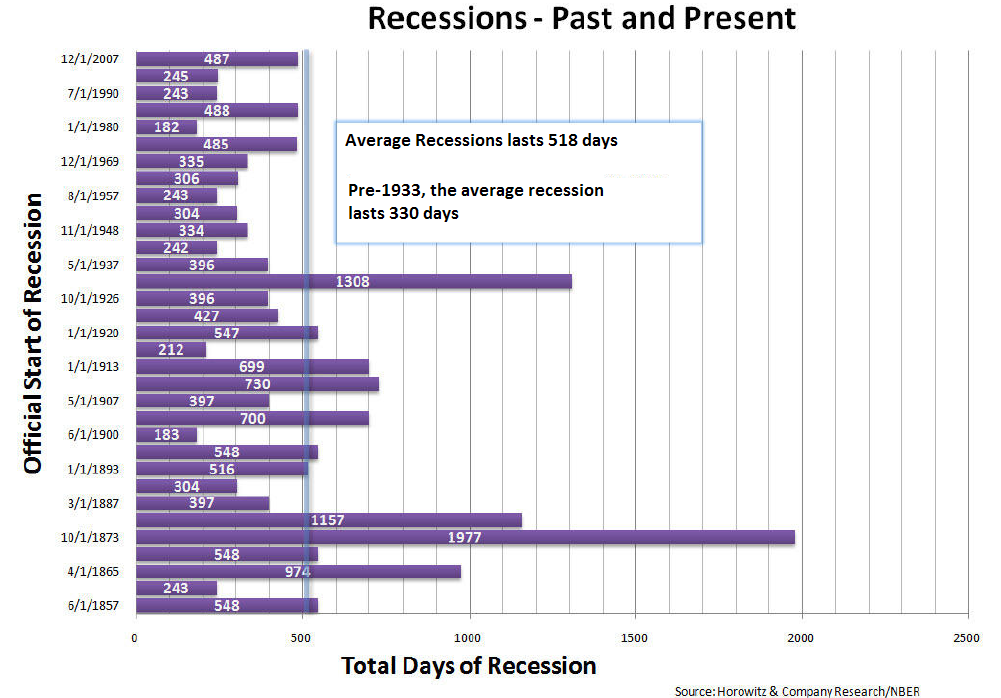
    Any ideas why recessions last longer (on average) since 1933? The ability of fiat currencies to allow imbalances to persist longer? Reluctance of policy makers to make tough choices (seizing/nationalizing insolvent TBTF/TBTS institutions)? The general direction of economics (trickle down, supply side…), post war era?

  2. kevinbenglish Says:

    I would argue that “average” is the wrong statisitical measurement to apply to this data set — the average is being significantly skewed by the recessions lasting 1977 and 1308 days. A better statistical measurement to apply to this data set would be median.

    Some results:
    median 397 (for entire set of data)

    Also, post-1933 the average recession was 330 days (not pre-1933 as indicated on the graph).

  3. ronanlyons Says:

    Kevin makes a good point – median is better than mean when outliers are the way they are.

    There is also the issue of severity. 2001-2006 was quite a mild “recession” by the metric of employment – see for example the Pelosi “scare graph” (http://short.ie/recess1 or http://short.ie/recess2).

    Incidentally, the 1870s episode is well worth investigating in more detail (cursory overview here, http://en.wikipedia.org/wiki/Long_Depression). That recession practically lasted 20 years. Hopefully, if we learnt the importance of domestic fiscal response between 1870 and 1930, we have now learnt the importance of the monetary response and the importance of keeping global trade channels open since the 1930s.