
The Bernanke Revolution
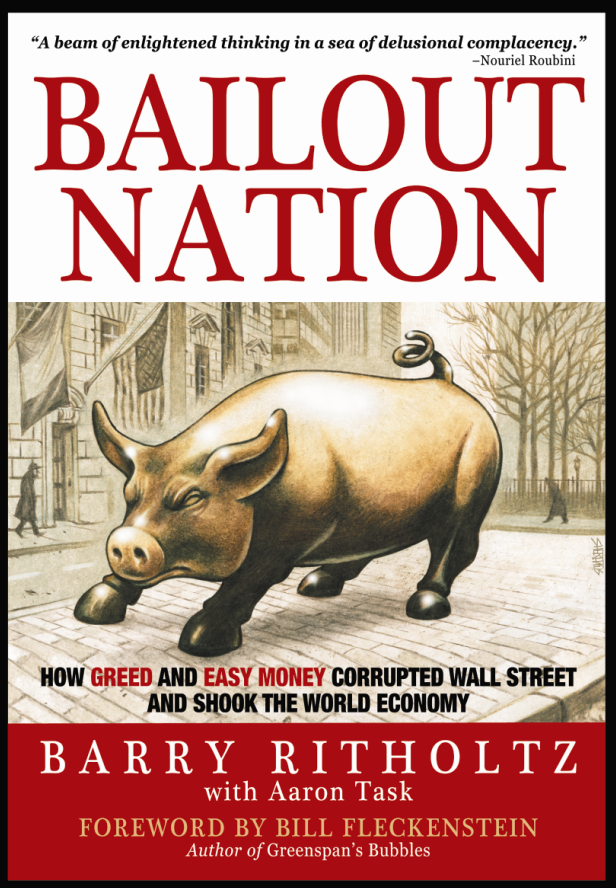
There was a fascinating article in the Washington Post yesterday about Chairman Ben Bernanke. It very much paralleled my thinking in the early chapters about the Federal Reserve in Bailout Nation.
From the Washington Post:
“Famously soft-spoken, Bernanke is an unlikely revolutionary. He is, after all, a career economics professor who lacks the charisma of a skilled politician. He also happens to run an organization designed for inertia: Decision-making authority is shared with four other governors in Washington appointed by the president; the heads of regional Fed banks in 12 cities who answer to their own boards of directors; and a staff of 2,000 that is led by economists who spent decades working their way through a rigid hierarchy.
Yet in the past 18 months, Bernanke has transformed that stodgy organization, invoking rarely used emergency authorities. His decision to do so has drawn criticism — he has transcended traditional limits on the role of a central bank, stretched the Fed’s legal authority and to some, usurped the responsibility of political authorities in committing vast sums of taxpayer dollars.”
From Bailout Nation:
“From those relatively modest monetary and fiscal powers, the Federal Reserve has evolved into something that would be unrecognizable to its founders. Under the guise of economic expediency, the Fed has grabbed power, dramatically widening the areas of its responsibility. Since the 1990s, the Federal Reserve System, a private corporation registered in the State of Delaware, has behaved as though it were in charge of anything economic—moderating the swings of the business cycle, maintaining interest rates, supporting the value of depreciating assets, even intervening in the stock market.
During the economic collapse and credit crises, there was a distinct lack of financial leadership in the United States. With President Bush’s approval rating at historic lows, the White House showed little inclination for facing the storm. As the many crises began heating up in 2007, the leadership vacuum was apparent. It was into this empty space that the Fed inserted itself , seizing more and more authority. It wasn’t so much a power grab as a reluctant filling of the void. Steve Matthews, writing for Bloomberg, observed, “What started as a meltdown in the market for subprime mortgages has turned into a worldwide credit and economic crisis. Bernanke, now the Fed chairman, has responded with the most aggressive expansion of the Fed’s power in its 95-year history.”
Good stuff . . .
>
Source:
How Bernanke Staged a Revolution
Neil Irwin
Washington Post, April 9, 2009; Page A01
http://www.washingtonpost.com/wp-dyn/content/article/2009/04/08/AR2009040804401.html
The Improviser
Steve Matthews
Bloomberg Markets June 2008
http://www.bloomberg.com/news/marketsmag/mm_0608_story2.html



April 10th, 2009 at 9:49 am
I’m bothered by the misplaced word ‘revolutionary’ in that description. It is not revolutionary to reinforce the central economic structure at the expense of a country, and particularly not when those are ‘private’ institutions. It is the opposite. It is reactionary; ultra-conservative.
April 10th, 2009 at 10:11 am
Try this one:
The Chinese want out of our debt, but as the largest holder, can’t do so without a stampede out of Treasuries, and loss of their “investment”. I thought this was a nice catch-22 for the US.
BUT, Bernanke’s “Revolution” could be providing the cover they need:
The FED is buying treasuries with quantitative easing with trillions–it’s brilliant! The Fed could be buying our debt back from the Chinese while creating more debt at Treasury with more bonds that no one will buy so we will have to buy them with the Fed’s infinite balance sheet letting the Chinese sell more of what they have… and I’m getting dizzy …. we’re screwed and China rules the 21st century
April 10th, 2009 at 10:13 am
On the one hand, I’m inclined to give Bernanke a lot of credit for thinking “outside the box”. On the other hand, bankers, and the politicians who are supposed to oversee them, are likely to take a more insouciant attitude towards risk in the future than would otherwise have been the case. Moreover, it remains to be seen how successful the Fed will be in “unwinding” its balance sheet in time to avoid inflation.
April 10th, 2009 at 10:17 am
I wouldn’t say revolutionary either. If I were the Post, I would have titled the article “Bernanke Steps Up.” I would go further than Barry and say that the Bush administration and the Republicans in Congress consciously shirked their Constitutional responsibilities for partisan reasons. They believe that it is in the best interest of the GOP if President Obama fails to repair the American economy, and they believe in the doctrine of Party Uber Allis.
The President and the Treasury Secretary have done an admirable job, but Bernanke is to be credited for having realized early on that the house was burning down and half the Fire Department (the GOP) had decided to go out and get plastered at the local strip club instead of fighting the fire. The Fed had to step up to the plate to save America from a Great Depression II scenario, and it did so.
April 10th, 2009 at 10:22 am
“Famously soft-spoken, Bernanke is an unlikely revolutionary
—————————-
He is doing everything he said he’d do and now people are surprised?
Man, people really see what they want to see, don’t they?
April 10th, 2009 at 10:32 am
Indeed not “revolutionary” at all.
The correct term is “reactionary”
From Wikipedia; “Reactionary (also reactionist) refers to any movement or ideology that seeks a return to a previous state (the status quo ante) and opposes changes in society that is deemed harmful. The term originated in the French Revolution, to denote the counter-revolutionaries who wanted to restore the real or imagined conditions of the monarchical Ancien Régime. In the nineteenth century, the term reactionism denoted those who wished to preserve feudalism and aristocratic privilege against industrialism, republicanism, liberalism and socialism.”
All they want is for the damn spending spree to continue. They don’t want people to save or be more cautious. “All we need is to layer more new debt on top of the old one, and all will be fine”
Revolution comes after this denial period we’re in, when the sheeple is broken and jobless.
The Revolution, if we get one, has not even started yet, mark my words.
April 10th, 2009 at 10:49 am
franklin,
you may care to cut out the middleman:
http://www.spiritsquad.com/info.html
~~
wally,
you make a fine, and accurate distinction.
http://www.thefreedictionary.com/reactionary
April 10th, 2009 at 10:56 am
I highly recommend George Cooper’s “Origin of Financial Crisis.” I recently finished reading it and it goes into great detail about the role of the federal reserve as a governor on the credit creation process. It explains how the Fed’s practice of targeting consumer inflation is unneccessary because consumer goods actually are efficient markets. The Fed should target asset prices through the credit creation process as asset markets are demonstrably inefficient. We have had a very misguided Fed policy of flooding the markets whenever credit contracts but have done relatively little to retard credit growth as asset bubbles formed.
The book goes on to explain 3 scenarios for the future based on Fed policy. It appears we are taking the “inflation monster” approach, a stealth tax on the prudent to benefit the irresponsible.
April 10th, 2009 at 11:02 am
I’ll speculate that Bernanke wanted to move even faster but was hampered by 1) the inertia as described above, 2) his limited tenure and 3) the refusal of the ECB to participate. Nevertheless, he has moved quickly enough to (hopefully) prevent the “Great Depression II Scenario” from unfolding and hopefully to avoid permanent destructive damage to our economy.
Now what is needed is for our leadership to develop policies to create a more balanced economy, acknowledging that consumer deleveraging will take many years and debt-financed consumerism has ended. While more government jobs are OK in the short run, they do little to improve the economy in the long-run. (Sorry Krugmanites, but it is a fact.) Governmental institutions, including educational institutions, are not exactly hotbeds of productivity and innovation. We do not want to run the risk of substituting a government bubble for the consumer bubble.
Ultimately we need to develop a globally competitive private sector based on affordable capital, skilled labor and a fairly priced exchange rates. From my perspective, this translates into higher savings, more Voucher Schools and H1B Work Visas and an international trading currency coupled with a weaker dollar.
Sorry, I got a bit OT.
April 10th, 2009 at 11:26 am
I love how people assign their own definitions of words. The word revolutionary was used correctly as far as I can tell.
rev⋅o⋅lu⋅tion⋅ar⋅y
–adjective
1. of, pertaining to, characterized by, or of the nature of a revolution, or a sudden, complete, or marked change: a revolutionary junta.
2. radically new or innovative; outside or beyond established procedure, principles, etc.: a revolutionary discovery.
3. (initial capital letter) of or pertaining to the American Revolution or to the period contemporaneous with it in U.S. history: Revolutionary heroes; Revolutionary weapons.
4. revolving.
April 10th, 2009 at 11:39 am
The following was written in early 2006 (not by me), well before the current crisis by a foreign observer, who offers a different take on what the kind of actions taken by the Fed that the Washington Post writer calls “revolutionary”:
It’s like they’re trying to reassemble a cow from a truckload of hamburger. The results are likely to be neither pretty nor successful.
April 10th, 2009 at 11:41 am
“Revolutionary” is probably ok usage here, but “preemptively counter-revolutionary” might be correct also…
April 10th, 2009 at 11:41 am
We are exactly where we should be in uncharted waters.
We have an excellent Captain and Crew
Steady as she goes…The Storm will end.
The Goal is to keep this massive ship afloat
until all of the coordinates line up and we
reach calm water.
PS.If any of you are still watching Fox News
you’ll see and hear the rodents of the last
Captain and Crew’s ship swimming for survival
God Bless America….steady as she goes.
April 10th, 2009 at 11:51 am
Two Printing Presses: One at the Fed, One at the Treasury
http://www.optimist123.com/optimist/2006/06/two_printing_pr.html
more of the same isn’t ‘Change’..nor could it be considered ‘radically new or innovative’
~~
Prozac sales, which total $3 billion annually, represent roughly a quarter of Eli Lilly’s total revenue. Possible side effects of Prozac and other antidepressants can include …
* no flippin’ wonder
Thanks to the Waxman-Hatch Act, Eli Lilly still holds exclusive rights to Prozac, which accounts for nearly 30 percent of the company’s total revenues.
http://www.buyingofthepresident.org/index.php/archives/2000/535/
April 10th, 2009 at 11:57 am
invoking rarely used emergency authorities
Rarely used authority? How about dreamt up authority! The man is a master of the power grab.
April 10th, 2009 at 12:00 pm
A certain irony they chose to register in Delaware.
April 10th, 2009 at 12:06 pm
Since the law of unintended consequences beats the best minds, watch how the brilliant Quant. Easing of the Fed (and B of Eng) is arbitraged… (check Financial Times April 9):
Hedge Funds sell short treasuries to the Fed and turn around and buy them cheaper in open market….
Clearly the Fed is a more eager a buyer than an average buyer, so by definition there is money left on the table.
—————————————————————————-
So here is my triangle, Fed prints, China sells and Hedge fund arbitrages.
All appear winners for now.
April 10th, 2009 at 12:47 pm
Say what you want about President Bush but kind of ironic that he ended up selecting Bernanke as a Fed chief given Ben’s extensive research on the role of the Fed during the Great Depression. Bernanke was nominated back in October 2005 and started in February of 2006. If only he knew what he knows now!
http://moneyneversleepsblog.blogspot.com
April 10th, 2009 at 1:31 pm
Money,
I thought Bernanke was a perfect Bush pick when he was chosen (and that’s not a compliment). The entire Neoconservative theory is that reality is irrelevant–great nations make their own realities. For instance, if you want a democratic ally in the Arab world, you simply pick a country and transform it into one. Iraq was that country. Never mind that Iraq has no democratic tradition. We’re such a powerful country we can make it into one.
Now, as I recall, there was a lot of talk about Bernanke and inflation targeting when he was chosen. This made him the perfect choice: he would be laser-locked onto inflation regardless of what was going on in the broader economy. Inflation hurts the rich and helps the poor, so Bernanke seemed to be the type who would protect the interests of the wealthy at all costs. Let’s not forget that the Fed was very divided when he took over, so possibly they thought he would be a weak Chairman who could be bullied by dimwitted inflation nutters like William “the Fool” Poole.
April 10th, 2009 at 1:33 pm
Hit send too soon…I certainly didn’t foresee that Bernanke could be as flexible as he has been. Usually, academics stay rigidly bound to their theories at all costs, because they’ve built their lives around theories. Bernanke has not done that.
And he seems to have purged idiots like Poole from the Fed. Let’s hope Ben gets reappointed by the President!
April 10th, 2009 at 7:28 pm
Isn’t Larry Summers waiting in the wings to take over for Ben? Wonder how the market would react to that…
http://moneyneversleepsblog.blogspot.com/
April 10th, 2009 at 10:38 pm
Bernanke is doing what he said he would do. I’ll give the man that.
April 11th, 2009 at 3:51 am
The cited Post artilce is outlandish in its sycophancy to power. Bernanke bears significant responsibility for this mess.
April 11th, 2009 at 1:33 pm
Bernanke is proving to be a tireless errand boy for the megabanks. I’m sure when his service to his corporate masters is complete, he will be dutifully rewarded (honoraria, medals, endowed chairs at “prestigious” universities, etc, maybe even a PBS Night at the Kennedy Center). This puff-piece by The Pinstripe Pravda is merely greasing the wheels.