
Foreclosures Are Rising All Over NY Region

Email this post Print this post
By Barry Ritholtz - May 17th, 2009, 1:00PM

The NYT has a local section of the Sunday paper — its different for Long Island, Westchester, Connecticut, New Jersey etc.

If you weren’t looking closely you may have missed the multi-regional approach:

My delivered Sunday NYT local section has the headline: “Long Island Foreclosures Rise, With No End in Sight.”  There are similar but unique discussions for Connecticut, Westchester and New Jersey. All 4 articles were co-written by Janet Roberts. (A few excerpts follow).

Jump online, and there is an interactive map (below) showing the change from 2005* 08 in foreclosure activity in the region.

Long Island:

“Over all, Long Island’s foreclosure rate is 3.7 percent, with at least 31,000 homes in some stage of foreclosure from 2005 through August 2008, according to the data, from The Long Island Real Estate Report. That is slightly higher than the 3.3 percent rate for the region, covering New York City, western Connecticut, Long Island and New Jersey.

What worries housing counselors and policymakers is that Long Island’s housing problems appear to be worsening. Recent bank data on mortgage delinquencies show that at least 6 percent of mortgages held by Long Island homeowners were 90 days or more past due, compared with 3.5 percent during the same period last year.”

Westchester:

“Still, the foreclosure wallop has affected even vintage Westchester neighborhoods like the Rochelle Heights and Rochelle Park enclaves in New Rochelle, where the Tudors and colonials were built a century ago when the country’s first bedroom communities were laid out and where homes not so long ago fetched a million dollars and more. Seven houses on Hamilton Avenue in those two neighborhoods are in various stages of being taken over or managed by banks, as are more than a dozen other of the enclaves’ 350 homes, according to the analysis by The Times.

Westchester’s painful toll tells much about how widespread this decade’s home-buying frenzy was. In too many cases, families took out mortgages or refinanced on payment terms that gave them only the thinnest margin for error and left no cushion for a plunging housing market.

Nevertheless, The Times analysis shows that foreclosure has touched Westchester more lightly than other parts of the region. The foreclosure rate of 2.3 percent of all properties for the 32-month period analyzed is lower than the overall regional rate of 2.9 percent during that same period. Not surprisingly, higher-income communities experienced the lowest rates of foreclosures, and about one-third of Westchester ZIP codes, with median incomes of $100,000 or more in the 2000 census, fell into that category.”

Connecticut:

“More than 27,000 homes in Fairfield, Hartford, Litchfield and New Haven Counties were in some stage of foreclosure between January 2005 and August 2008, according to an analysis by The New York Times of data from the Warren Group. These counties have fared better than other parts of the New York metropolitan area. Their 3.3 percent average foreclosure rate falls below New York City’s rate of 4.6 percent and Long Island’s 3.7 percent rate.

However, there are indications that the foreclosure crisis could be worsening in Connecticut, based on statewide data on mortgage delinquencies showing that in March, 4.8 percent of the mortgages held by Connecticut homeowners were at least 90 days past due. That is up from 2.7 percent a year earlier.

This gives Connecticut the 13th-highest delinquency rate among the 50 states, according to First American CoreLogic, which collects data on about 85 percent of the nation’s residential mortgages. Connecticut’s rate is about the same as New York State’s and below New Jersey’s and far below the rate in Florida, where more than one in five homeowners are behind.”

New Jersey:

“At least 6 percent of Essex County homes — more than 10,000 in all — have been in foreclosure since 2005, the highest rate of any county in New Jersey, New York City, Long Island or the Connecticut suburbs, according to an analysis by The Times of more than 182,000 homes in foreclosure around the region from 2005 through August 2008.

More than 82,000 of those homes are in New Jersey. Plot them on a map, and it becomes clear that no corner of the state has escaped the economic downturn. Nor has the picture improved since last summer. Delinquency rates in 13 of New Jersey’s 21 counties are now among the highest in the region.”

The Times also noted that the highest rates of foreclosure in most of the region were in neighborhoods with mostly black and Hispanic residents. Many of these mortgages were subprime, and there is good reason to believe an unhealthy percentage of them involved predatory lending . . .

>

Mapping Foreclosures in the New York Region
click for interactive map
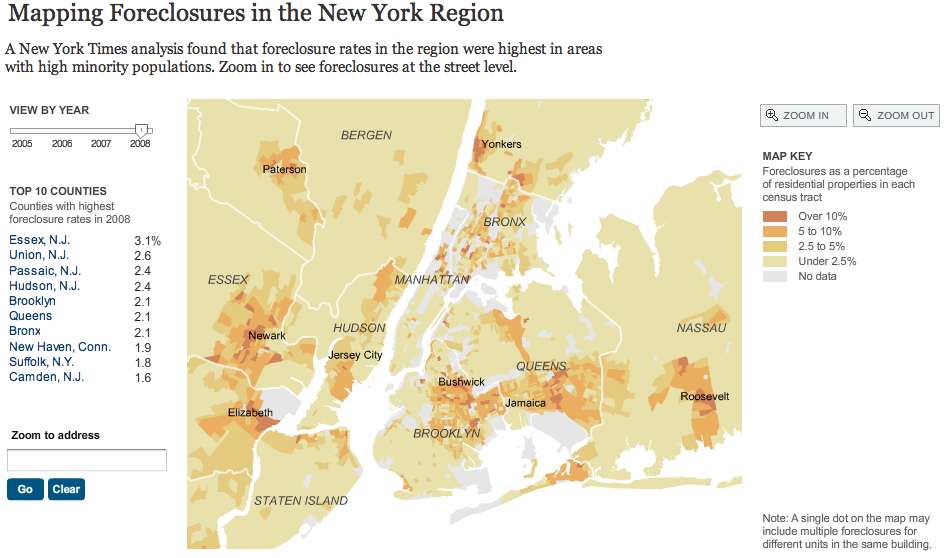
foreclosures-ny
Chart courtesy of NYT

>

Source:
Long Island Foreclosures Rise, With No End in Sight
DERRICK HENRY and JANET ROBERTS
NYT, May 13, 2009

http://www.nytimes.com/2009/05/17/nyregion/long-island/17mortli.html

Foreclosure Crisis in Westchester Crosses Economic Boundaries
JOSEPH BERGER and JANET ROBERTS
NYT May 13, 2009

http://www.nytimes.com/2009/05/17/nyregion/westchester/17mortwe.html

Connecticut Foreclosure Crisis Appears to Be Worsening
CHRISTINE HAUGHNEY and JANET ROBERTS
NYT, May 15, 2009

http://www.nytimes.com/2009/05/17/nyregion/connecticut/17forect.html

In New Jersey, Dreams of a Better Life Dashed by Foreclosure Crisis
KAREEM FAHIM and JANET ROBERTS
NYT, May 14, 2009

http://www.nytimes.com/2009/05/17/nyregion/new-jersey/17mortnj.html

Minorities Affected Most as New York Foreclosures Rise
MICHAEL POWELL and JANET ROBERTS
NYT, May 15, 2009

http://www.nytimes.com/2009/05/16/nyregion/16foreclose.html?ref=connecticut

See Also:
American Dream Threatened
Slide Show

http://www.nytimes.com/slideshow/2009/05/17/nyregion/17mort_index.html

Treasury Offers Incentives for Mortgage Modifications
Dawn Kopecki
Bloomberg, May 14 2009

http://www.bloomberg.com/apps/news?pid=20603037&sid=aW1qiy.dU4fc&

Comments

Please use the comments to demonstrate your own ignorance, unfamiliarity with empirical data, ability to repeat discredited memes, and lack of respect for scientific knowledge. Also, be sure to create straw men and argue against things I have neither said nor even implied. Any irrelevancies you can mention will also be appreciated. Lastly, kindly forgo all civility in your discourse . . . you are, after all, anonymous.

22 Responses to “Foreclosures Are Rising All Over NY Region”

  1. Mannwich Says:

    I have talked to some friends recently in the tri-state area, many of whom aren’t making any money, and are blowing through their savings (401k’s are next) just to hang on in the coming months until their incomes come back. This is thing is just getting started in the upper-middle to higher end. It’s going to get much uglier in the coming months.

  2. bogwad_seigneur (the smelly one) Says:

    Undoubtedly some are going through tough times. That’s beyond discussion.
    BUT
    Before anyone gets too teary eyed, in the very same publication, you have this:
    http://www.nytimes.com/2009/05/17/magazine/17foreclosure-t.html?_r=1&hpw
    Does that sound/seem appropriately self indulgent? It should….

    As an economics reporter for The New York Times, I have been the paper’s chief eyes and ears on the Federal Reserve for the past six years. I watched Alan Greenspan and his successor, Ben S. Bernanke, at close range. I wrote several early-warning articles in 2004 about the spike in go-go mortgages. Before that, I had a hand in covering the Asian financial crisis of 1997, the Russia meltdown in 1998 and the dot-com collapse in 2000. I know a lot about the curveballs that the economy can throw at us.

    and then we have this gem……

    But in 2004, I joined millions of otherwise-sane Americans in what we now know was a catastrophic binge on overpriced real estate and reckless mortgages. Nobody duped or hypnotized me. Like so many others — borrowers, lenders and the Wall Street dealmakers behind them — I just thought I could beat the odds.

    So, ask yourself the necessary question – did you or you think you could beat the odds too, and are now pissing and moaning wondering why the laws of physics, economics and math didn’t apply to you, when you earnestly and firmly believed that this was the honest-to-God-one-time when the rules were clearly “in error”? Pfffft.
    As a footnote, this author has to be praised for at least being honest. Hopefully he makes enough coin from his elevated self awareness and literary outflow to dig himself out of his personal financial hole. He is luckier than most who suffered similar self delusion.
    What is it with this self delusion which appears so endemic? I’m sorry, I don’t get it

  3. Effective Demand Says:

    Look at the sad sack stories:
    “Eileen Pate, a Greenwich-based lawyer, represents one family who fell into foreclosure after using their home to finance their two children’s Ivy League educations. ”

    “But in 2004 and 2006 they took out additional mortgages to finance car payments and pay off dental bills, ultimately consolidating the debt into a $1,500-a-month adjustable rate loan. ”

    “Andrea Moody, a soft-spoken 45-year-old account manager and single mother of two teenagers, was there to take notes because it has been three months since she made a full $2,600 mortgage payment to Chase Manhattan…She or her parents have owned the three-family house in Mount Vernon for 40 years and regularly kept up with the mortgage payments.” ***Owned for 40 years but has a $2600 payment? Why won’t they just say she refi’d and took money out***

    “Her troubles were exacerbated the following year by a $10,000 adjustable-rate loan that she took against the house for a much-needed repair. ”

    The best quote in the article and one that speaks to why banks should be extremely conservative when underwriting loans for homes instead of the still extremely aggressive underwriting we see on the low end with FHA:
    “Houses are an emotional thing,” Mr. Lester said, adding that many people do not realize they overextended themselves financially. “You’ll have people who have no business in trying to save their house and they’ll be coming in here. It’s an irrational decision.”

    As we saw with the NYT reporter who was well versed financially. Emotions overcame logic. The banks have to be the check and balance when it comes to home financing because it has been proven time and time again that people cannot police themselves with such an intensely emotional decision. They either don’t have the financial sophistication to properly judge the risk OR they do have those skills but the intense emotional pressure overrides them.

    Banks should only be aggressive underwriters with large down payments. It protects all parties involved. Instead the most aggressive underwriting currently is the one with the least down, FHA. And perversely the FHA is coming out with a program to “monetize” the tax credit so buyers can use it as a down payment. It is insanity.

    Here is a blast from the past during the boom, a Century 21 commercial… note all the emotional pressure points applied:
    http://www.youtube.com/watch?v=Ubsd-tWYmZw

    Parents desperately want to be great providers for their kids. Husbands desperately want to be “the man” and provide for their wife. Wifes desperately want that great nesting enviroment. For some there are also the status considerations that they show to themselves and others they have “made it”. Large financial committment, extreme emotional pressure, it was and still is a recipe for disaster unless the banks start saying “No” to the marginal buyers.

  4. Mannwich Says:

    I think self-delusion is the new America’s Pastime, at least over the past few decades anyway. It’s just easier to follow the herd than it is to any thinking for yourself. Heck, everyone else was overextending to get what they want NOW, right? Why not me too?

  5. Mannwich Says:

    I wonder how much of this green shoots nonsense is from people who have extra money left over for spending because they’re no longer paying their mortgages but still living in the home?

  6. Effective Demand Says:

    @Mannwich,

    I’ve wondered the same thing. For my area in So. Cal. Loan Performance had the following info:

    “First American CoreLogic, which has a vast store of data on actual mortgages, reports today that Los Angeles County mortgages delinquent by 90 days or more in March were up to 8.9% of the total — more than double the percentage of March last year”

    8.9% of people with mortgages were 90 days in arrears… That is incredible. Imagine a renter not paying for 90 days? They’d be tossed on their butt. But the homeowners are special because they “own” a “home” .

    So if you get the savings rate showing a slight uptick (as it has been) I’m betting it is because people aren’t paying their bills and saving the money because they have now realized the extent of how screwed they are for taking on massive amounts of debt.

  7. Quiet Sunday Afternoon | petecase.com Says:

    [...] Crisis wsj.com by CONOR DOUGHERTY Fighting for a Last Chance at Lifenytimes.com by AMY HARMON Foreclosures Are Rising All Over NY Regionritholtz.com by BARRY [...]

  8. Gilgamesj Says:

    Totally off topic, just to get the stress out of your system: “Smack Paulson”
    http://etfstocks.typepad.com/markets/2009/05/sunday-relaxation-smack-paulson-.html

  9. mikaeel Says:

    I’ve lived in or around NYC my entire life. I grew up in the Bronx when it was burning. It was finally admitted years later that it was the landlords trying to get out of property they no longer wanted, couldn’t sell, or couldn’t afford. I lived down the block from the busiest fire house in the U.S.

    To me it looks like it’s happening again. I live in the north Bronx now. There have been an obscene amount of fires on commercial property within two blocks of my home in the past year. The fires seemed to burn occupied store fronts that hve vacancies one or two stores down. Stevie Wonder and Ray Charles can both see that this is not a string of coincidences. Other people have told me they notice it too.

    I blame the FED. We have become a society were the bottom line is how much money they can get people to borrow. The banks loved the ridiculous prices of real estate, because they were getting the business. Again a blind man could see that the prices were unobtainable. And with fractional banking and lending practices, how much REAL money are banks losing? I think the whole thing is bull dodo.

  10. Cursive Says:

    Gil 2:35

    Ha! Will be sharing that at work on Monday. Thanks for the link.

  11. Byno Says:

    I live in Tampa, and, assuming home prices kept pace with inflation over the last twenty years, housing has shot past the downside of the trend line by over 20%. The home we rented (we just got here a few weeks ago) – built in 2006 for 350k – was auctioned last year for just over 190, and similar homes in the ‘hood are now asking mid 150′s to mid 160′s. Our place is really nice; 20 minutes from the airport, 30 minutes from downtown, 4 BR, 3BA, 3 car garage, but there was absolutely no way I considered buying here. Why?

    You’d think the selling had crescendo-ed in the 2nd quarter of 2008, as things appeared to be bottoming after a really scary descent over the preceding six months. The second derivative that everyone is talking about appeared to be kicking in, as prices went from falling nearly 4%/month to less than one half of once percent/month. But, and this is crucial, since the 3rd quarter of 08, the decline in housing prices has accelerated with a vengeance, as prices came down 18% between September and February (the most recent month for which there is data).

    Anecdotal-ly, when my family came down with me to look at places to live back in March, the neighborhood we settled on had only seven houses for sale out of approximately 400. Now, that number has tripled, three of the five neighboring homes around us are in foreclosure. Moreover, of the two non-foreclosures, one was just brought out of foreclosure in the last six months. When we came down a few months ago, all of the homes were occupied.

    It’s not Mad Max: there are no homes in disrepair, neighbors mow the lawns of neighboring foreclosures, there is little to denote that a home has been foreclosed on save a nondescript notice on a door or in a window, etc, but there are many, many empty houses that were not empty just a few months ago.

    Even when we actually do reach a bottom, it will take years of leveling off before any ascent can resume. I’m bemused by our landlord: she claims that she’s “in it for the long term.” As a former stockbroker, any time I hear that phrase I immediately move my money in the opposite direction; housing is no different, and it may be a decade before she and other investors even get back to the starting line in nominal terms alone.

  12. thetanman Says:

    There are a lot of people right on the brink. My nephew ran over his sewer cleanout and had to get new blades for his mower. It took him a few minutes to figure out which card wasn’t maxed out. And while he’s building a giant deck on his house, his job is teetering. And he has a 2 year old child. I tried to gently hint to him that he might want to be cautious until we see what the economy is going to do. He just stared out into space, his eyes glassy. I just don’t understand it unless he figures the materials will soon be much more expensive.

  13. wunsacon Says:

    Thanks for sharing the anecdote, Byno.

  14. wunsacon Says:

    >> I blame the FED.

    The fault, dear Brutus? The “people” voted for politicians with an “industry-will-regulate-itself” attitude. (And now few are willing to suffer the consequences of “doing nothing”. I.e., it’s “don’t regulate me on the way up, but please regulate me on the way down”.)

    Who do we blame for that? The voters. (Including me.)

  15. wunsacon Says:

    Incoherent messages like the one @ 2:33 pm are appearing more and more. Looks like comment spam — an attempt to engineer page ranking. My guess…

  16. FromLori Says:

    http://www.businessinsider.com/henry-blodget-housing-bubble-almost-over-but-no-recovery-in-sight-2009-5

    But in terms of the relevance to foreclosures, the question: Does it follow that because a borrower took out a subprime mortgage, they were more likely to default? Or to put it another way, if that borrower had taken out a conventional mortgage, would they not have defaulted?

    This the NYT didn’t try to answer. But when you’re talking about a crisis of foreclosures, and you make a charge like “reverse redlining,” it’s a pretty important, if not the fundamental question.

    http://www.businessinsider.com/subprime-lending-and-minority-foreclosures-whats-the-real-link-2009-5

  17. zyzy Says:

    I find it fascinating to depict the “amount of non-white population” as part of the data points…. What does greed have to do with color of your skin?
    I expected to see – “medium level of income” or other valid facts…
    But race?

    Since the start of the “foreclosure boom”, media made it a norm to cry about evil, race targeting techniques used by mortgage lenders. I see this as nothing else, but a creation of yet another “white sin”.
    Before I get chastised by politically correct crowd, let me clarify that i do understand that every opportunity was explored to sale people on the idea of “yes, you can have a house”. Especially, if we take into account government baked “American dream” propaganda. Still, people were signing papers vulnerably – not under the gun.

    Anyway, let’s quickly examine the correctness of this particular data point.
    How relevant is the “white/non-white” population point? Let’s take a look on Fort Lee, NJ. Non-white ~59% . What can i conclude from this statement? Not too much.
    Let’s take a look at who are these “non-whites”. http://quickfacts.census.gov/qfd/states/34/3424420.html
    White persons, percent, 2000 (a) 62.8%
    Asian persons, percent, 2000 (a) 31.4%
    Persons of Hispanic or Latino origin, percent, 2000 (b) 7.9%
    So who is the problem here? Whites, Hispanics, Asians or maybe those few percentage points of blacks? I see no direct relation between race and foreclosure rate.

    All right, let’s read a bit further:
    Language other than English spoken at home, pct age 5+, 2000 55.0%
    High school graduates, percent of persons age 25+, 2000 89.5%

    THATS IT! We nailed it!!
    Foreclosures were targeted @ those who speak 1+ language and have at least high school diploma.

    Or maybe not?
    Oh! Foreclosures are an evil plan to destroy the Great American Society by white high school graduates who, for conspiracy purposes only, speak some freaky language @ home.

    And this is the “analyses” that gets pumped into our society. This makes me sad …

  18. JoWriter Says:

    @ Byno – when your landlady says she’s ‘in it for the long term,’ she may mean that she has owned that rental free and clear for many years, or at least has an old mortgage w/small payments. If so, she can afford to wait for the market to go back up before she even considers selling, as long as she can rent it for insurance + taxes + maintenance costs.

  19. bdg123 Says:

    At least 50% drop in Manhattan real estate prices dead ahead. Likely much more than that on very high end real estate.

  20. bill_from_chicago Says:

    Anyone care to guess where the S&P will be come this Friday afternoon?

  21. leftback Says:

    “At least 50% drop in Manhattan real estate prices dead ahead”

    Sweet. Bonfire of the Vanities, part deux.

  22. Just Another Manic Monday | syntech finance blog Says:

    [...] it will be “Yes they can” or “No, they are deluded” remains to be seen. Barry Rhitholtz did a nice, neg&#97&#116&#105ve overview of the NYTimes article so I won’t go into it here an&#100&#32&#116he map below is really horrific but an optimist [...]

77 queries. 0.368 seconds.