Video-o-rama: Higher bond yields raise caution

Email this post Print this post
By Barry Ritholtz - May 29th, 2009, 3:22PM

Video-o-rama: Higher bond yields raise caution

While investors’ attention was focused on global government bond yields marching higher, the holiday-shortened week produced a surprisingly small number of video clips.

Some quality footage was nevertheless produced, featuring the likes of David Rosenberg, now in his new role as chief economist and strategist of Gluskin Sheff, Mohamed El-Erian, Barry Ritholtz, Puru Saxena and Mario Gabelli.

And then there is “out of the box” analyst Marc Faber arguing that the US economy will enter “hyperinflation” approaching the levels in Zimbabwe. “I am 100% sure that the US will go into hyperinflation,” Faber said in an interview with Bloomberg. “The problem with government debt growing so much is that when the time comes and the Fed should increase interest rates, they will be very reluctant to do so and so inflation will start to accelerate.”

The selection kicks off with a humorous take by Emmy Award winner Hoofy and Boo on “How not to save Detroit”, and concludes with a clip featuring Twitter co-founders Biz Stone and Evan Williams explaining how they plan to attain their goal of generating revenue by the end of the year. (By the way, you can follow me on Twitter by clicking here.)

Hoofy & Boo (Minyanville): How not to save Detroit
“Chrysler is in dire straits and hoping that Fiat will save the company. Join Hoofy and Boo as they watch two turkeys combine in an ill-conceived effort to make an eagle.”

Source: Hoofy & Boo, Minyanville, May 2009.

Financial Times: GM’s future
“Spencer Jakab says once General Motors emerges from almost certain bankruptcy, it may be in surprisingly good shape.”

29-mei-1

Source: Spencer Jakab, Financial Times, May 26, 2009.

Fox Business: End of recession? Not so fast
“David Rosenberg, chief economist at Gluskin Sheff & Associates, gives his take on the end of the market downturn.”

29-mei-2

Source:Fox Business, May 26, 2009.

CNBC: Outlook from the Bond King – Mohamed El-Erian
“Current perspectives on the future of the economy, with Mohamed El-Erian, Pimco CEO/co-CIO.”

Source: CNBC, May 27, 2009.

Bloomberg: Wachovia’s Vitner says consumers seeing better economy
“Mark Vitner, managing director at Wachovia Corp., talks with Bloomberg’s Erik Schatzker about data showing that confidence among US consumers jumped this month to the highest level since September. The Conference Board’s sentiment index surged to 54.9, higher than forecast and the biggest gain since April 2003, the New York-based research group said today.”

29-mei-3

Source: Bloomberg, May 26, 2009.

Read the rest of this entry »

Confidence Game

Email this post Print this post
By Barry Ritholtz - May 29th, 2009, 2:34PM

I find that most of the day-to-day market action is simply noise. The moves up and down are for myriad reasons, but hardly what is ascribed to them.

Take for instance the recent bounce on “better than expected” confidence numbers. Markets took off on the number earlier this week, rallying 200 points. Why?

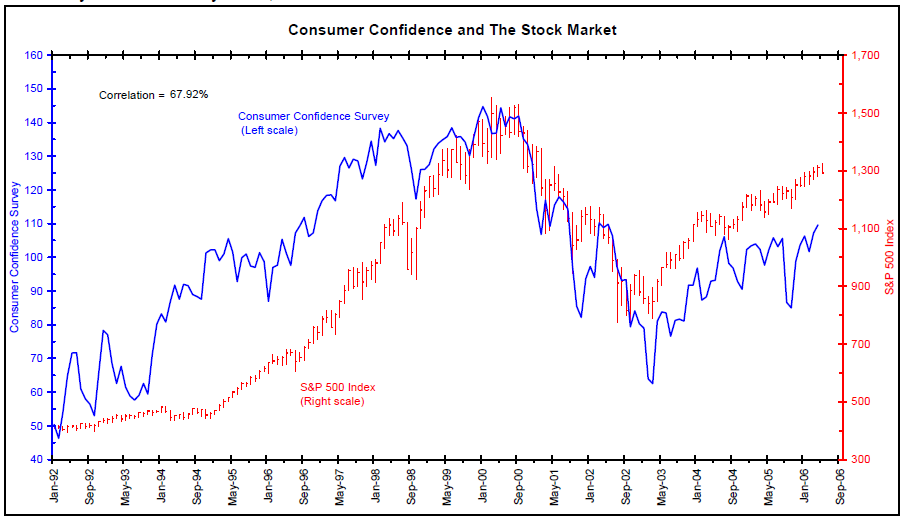
History teaches us that Confidence does not forecast future economic activity; rather, it is closely correlated to recent stock market gains or losses. Markets go up, and people feel better; markets go down and people feel worse.

One of the ironic things about the data is how conclusive it is that sentiment is a contrarian indicator. Mark Hulbert looked at consumer confidence data (via the Conference Board’s index) to its beginning — 1977.  He then looked at how markets did over the ensuing periods. His conclusion?

“The biggest monthly jumps in the consumer confidence index were, on average, followed by sub-par returns. Conversely, big drops in the index were typically followed by above-average returns.

The starkest patterns in the data, however, were between monthly changes in the consumer confidence index and how the stock market had performed in prior months. When the stock market is going up, their confidence rises too — and vice versa. So, given the stock market’s impressive rally over the last couple of months, it was entirely to be expected that consumer confidence would rise smartly.

In other words, focusing on consumer confidence tells us more about how the stock market has performed in recent weeks than it does about the future.”

That makes perfect sense to me.

Howard Simons of Bianco Research pointed out sentiment tracks past — and not future — activity. He notes the absurdity of believing future activity follows sentiment changes:

“For this to be otherwise, we would need to believe consumer sentiment and expectations were truly leading indicators and completely independent variables, with the reductio ad absurdum being the U.S. economy was based in large measure on mood swings.

>

Consumer Confidence and S&P500

conf-spx

Chart via Bianco Research, May 2006

>

Even more amusing:  Consider the big Homebuilder‘s bounce on Tuesday — they were one of the strongest performers that day. But if you looked at the part of the sentiment survey about houses, it was the most negative aspect of the survey: The outlook for home purchases over the next 6 months fell — not surprising, given the recent activity in the housing market — falling sales and prices.

Since that’s the case, why did the Homebuilders rally?

>

Sources:
Consumer confidence is a contrarian indicator
Mark Hulbert
MarketWatch, May 27, 2009

http://www.marketwatch.com/story/a-contrarian-take-on-the-consumer-confidence-data

Sentiment Is Not An Independent Variable
Howard L. Simons
Bianco Research, May 27, 2009

http://www.arborresearch.com/biancoresearch-files/SubscriberArea/commentaryarchive/pdffiles/com20v35.pdf

NPR Marketplace on Bailout Nation

Email this post Print this post
By Barry Ritholtz - May 29th, 2009, 1:00PM

>

I did a fun interview with NPR’s Marketplace on Bailout Nation.

>

Embedded MP3

Audio clip: Adobe Flash Player (version 9 or above) is required to play this audio clip. Download the latest version here. You also need to have JavaScript enabled in your browser.

:

http://download.publicradio.org/podcast/marketplace/pm/2009/05/27/marketplace_cast1_20090527_64.mp3

Read the rest of this entry »

Inside Look – Executive Pay at Financial Companies

Email this post Print this post
By Barry Ritholtz - May 29th, 2009, 12:23PM

An In-Depth Look at “The Finance 50″; Further Analysis and Discussion with Columbia University Professor John Coffee (Bloomberg News)

Weak US Recovery?

Email this post Print this post
By Barry Ritholtz - May 29th, 2009, 11:57AM

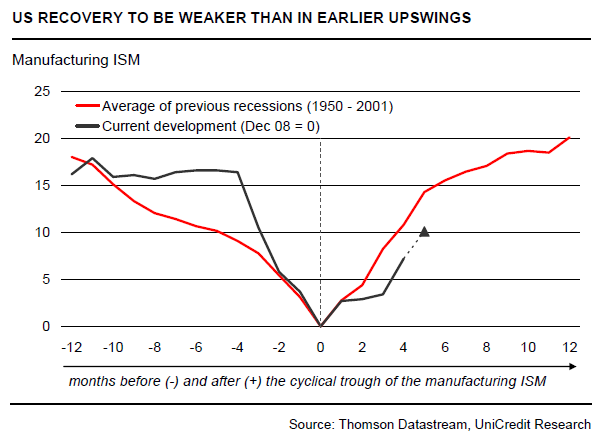
In light of today’s revised GDP data, let’s go to Unigroup CAIB to see what the likely course of the US recovery will look like. The conclusion they draw: The recovery will not be as strong as is already priced into the market . . .

>

us-recovery

U of Michigan Confidence

Email this post Print this post
By Peter Boockvar - May 29th, 2009, 10:34AM

With the week beginning with a much better than expected May Conference
Board consumer confidence # led by the future expectations component,
followed by Wednesday’s 2 point drop in the weekly ABC poll, today’s
final May U of Michigan confidence # was a touch better than expected at
68.7 and up from the preliminary reading of 67.9 and up from 65.1 in
April. It’s at the highest level since Sept ’08 but the breakdown
between current conditions and the outlook was mixed and somewhat
similar to the Conference Board # in that the ‘outlook’ felt better than
‘today’ did. While both components rose from the preliminary reading of
a few weeks ago, final current conditions fell from April BUT the
outlook rose to the highest level since Oct ’07.

Dow 10,000, Revisited: Kedrosky Sees Stocks “Considerably Higher” by Year-End

Email this post Print this post
By Barry Ritholtz - May 29th, 2009, 9:34AM

>

Source:
Dow 10,000, Revisited: Paul Kedrosky Sees Stocks “Considerably Higher” by Year-End
Aaron Task
Yahoo Tech Ticker May 28, 2009 06:48pm

http://finance.yahoo.com/tech-ticker/article/255817/Dow-10000-Revisited-Paul-Kedrosky-Sees-Stocks-%22Considerably-Higher%22-by-Year-End

Ben Frankenstein and his hunchbacks

Email this post Print this post
By Peter Boockvar - May 29th, 2009, 8:48AM

In response to the sharp selloff in US Treasuries and MBS over the past
week two weeks, Ben Frankenstein and his hunch back assistants, I mean
Ben Bernanke and the Fed, are doing some PR to tell the world that their
grand experiment of asset purchases is not going awry but is a
reflection of the success of their actions as the economy slowly
recovers. They said they are not trying to set a specific level of rates
but that is pure semantics as they truly are trying to set rates and
that’s lower. The most important mandate of the Fed is price stability
and whether its quantitative easing or the belief that the worst is
over, the Fed is on the cusp of losing the confidence of the market in
this respect as the $ index is breaking down below the key 80 level and
gold is just $30 from an all time record high. We may not see yet the
whites of inflation’s eyes and some still talk about deflation but gold
near $1000 says a lot about the market’s belief on this.

Q1 GDP revision

Email this post Print this post
By Peter Boockvar - May 29th, 2009, 8:43AM

Q1 GDP was revised to a decline of 5.7%, an improvement from the initial
reading of -6.1% but a touch weaker than the forecast of -5.5%. A
downward revision to personal consumption to 1.5% from 2% was offset by
a slightly less than expected drop in gross private investment, exports
and a less of a drag from inventories. The government spending drop was
also revised slightly higher. Real final sales, which takes out the
influence of inventories, was left unchanged at -3.4%. With the economy
2/3 done with Q2 and the market looking towards an expected improvement
in 2nd half GDP, this revision should be looked at as old news.

The Big Picture Conference ~ June 3rd

Email this post Print this post
By Marion Maneker - May 29th, 2009, 8:30AM

June 3rd is rapidly approaching and we’re trying to fill the last few seats at the conference. Doug Kass will be joining us to talk about his view of the markets. Nassim Taleb will give his vision of a more robust capitalism. Rep. Alan Grayson is still trying to make it so he can discuss his views on reforming the financial system and engage Nassim and Barry (though his participation is dependent on the legislative schedule.) And, of course, Barry is going to run the panel discussion on the media.

The latest iteration of the conference schedule is up on the registration site. Please register if you want to join us on Wednesday.

44 queries. 1.024 seconds.