Tracking the Global Recession
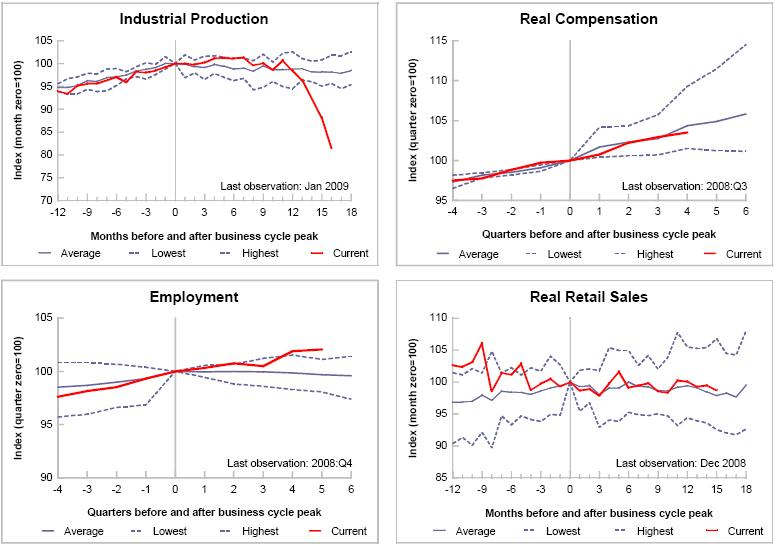
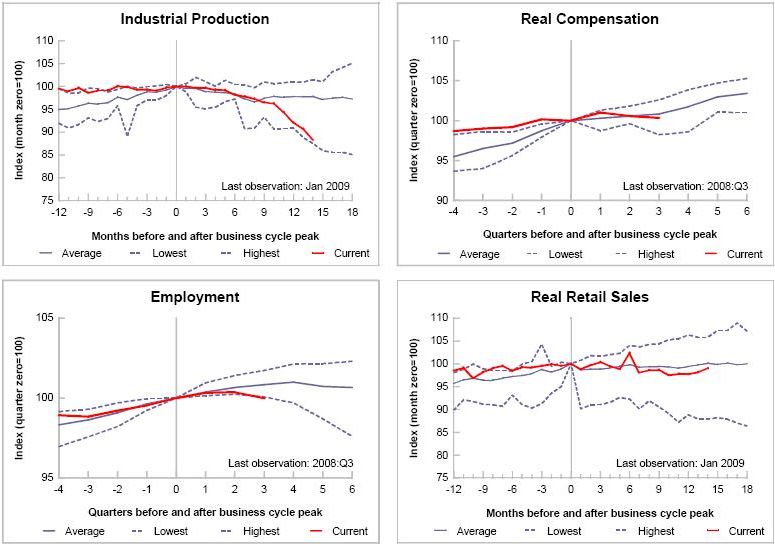
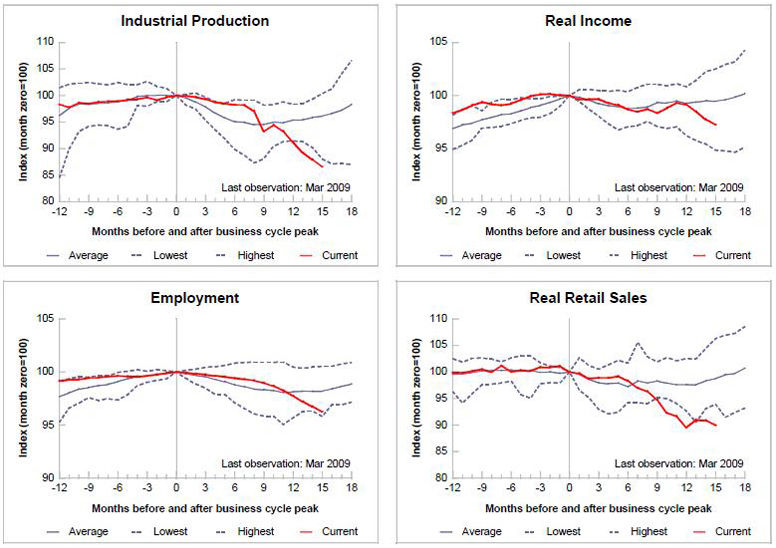
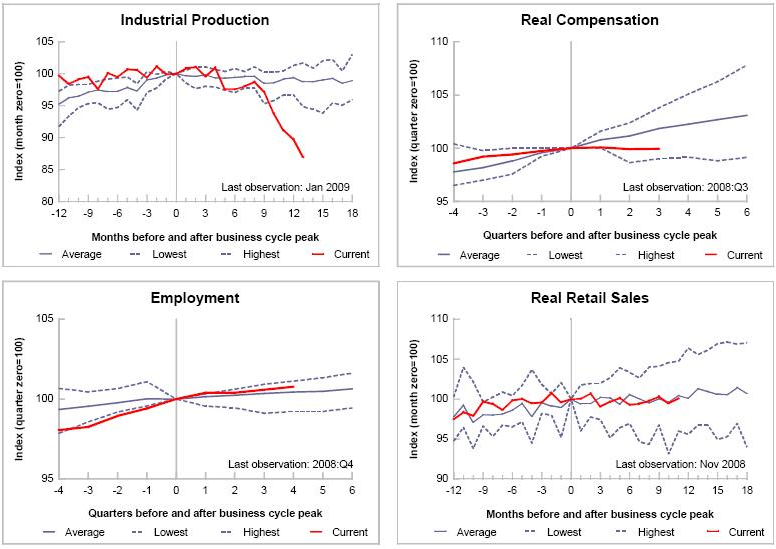
Great set of charts from the St. Louis Fed: Tracking the Global Recession
>
>
(I would have like to see Japan or Korea in the mix . . . )
Great set of charts from the St. Louis Fed: Tracking the Global Recession
>
>
(I would have like to see Japan or Korea in the mix . . . )

May 2nd, 2009 at 1:11 pm
For 4 of the last 5 months sales have dropped faster than inventories…and the sales yesterday were down another .9%. This isn’t a poll or a feeling, this is hard data about the need for future production.
http://briefing.com/Investor/Public/Calendars/EconomicReleases/facord.htm
Just take a second with this over your coffee this morning
(Or Franklin 411, over your Captain Crunch….)
May 2nd, 2009 at 1:21 pm
I think that I am reading these charts wrong – with the exception of the Industrial Production charts, the European powers actually look to be in better shape than the U.S., so far. Haven’t all of the pundits been talking about how the U.S. was “less bad” than Europe?
BR: Yes, having charts for Japan would be very nice. I’d also like to see China, Taiwan, and Singapore.
May 2nd, 2009 at 1:32 pm
nice to see retail sales holding up in the rest of the world. Those are the Joe six packs right? So is US retail consumption just coming back to the pack now?
May 2nd, 2009 at 1:34 pm
Can you spell worldwide printing and devaluating?
May 2nd, 2009 at 1:47 pm
Those industrial production graphs look like my fishing rod the last time I went bass fishing.
May 2nd, 2009 at 1:49 pm
BR: Yes, having charts for Japan would be very nice. I’d also like to see China, Taiwan, and Singapore.
————-
This gives a pretty good idea:
http://www.economist.com/markets/indicators/displaystory.cfm?story_id=13576449
May 2nd, 2009 at 1:52 pm
does it appear that retail sales and income charts seem to be correlated? as the income chart shows declines the retail sales show even more drastic ones? and since we are only at the beginning of a major down turn in income you would expect that retails sales will fall even faster
May 2nd, 2009 at 2:02 pm
That’s why I think inflation will imported into the US. Norice how industrial production has tanked but real income is stble outside the US.
Their trading partner is not buying but they are still getting their paychecks! It’s going to get worse with printing.
The US government might be putting its freshly printed dollars into the financials to prop them up but foreign governement are distributing them at large.
Here in Canada, you should see how much money is being injected right into the economy left, right and centre. In Montreal 0ver 100M to renovate arenas. Highway construction galore. Billions into renovating schools and retraining. In the last few weeks, our local weeklies have been announcing all kinds of new funding for all types of projects.
For me it could not be clearer that we are headed toward huge inflation.
And if I believed in conspiracy theories I’d say that the US leaders want this inflation to come from outside the US so they can blame it on foreigners!
May 2nd, 2009 at 2:31 pm
@Bruce:
I eat oatmeal, not cereal.
These are great charts proving that the US led the world into decline, and the US is leading the world to recovery. In contrast, the Europeans refused to acknowledge that growth was the concern rather than inflation, and they have further to fall. They’re going to get a bit of that old time religion, before all is said and done!
May 2nd, 2009 at 2:38 pm
http://www.bloomberg.com/apps/news?pid=20601110&sid=aEqjv7jiauoc
Treasury Yields Reach Five-Month High as Fed Stands Pat
“That’s been a little bit of a disappointment,” said David Brownlee, head of fixed income at Sentinel Asset Management in Montpelier, Vermont, which manages $18 billion. “The market’s under pressure. The Treasury’s issuing more than the Fed’s ever going to buy.”
Er, let me translate that for you young pups…”The Fed realizes they are never going to be able to backstop the treasury, so they’ve decided to quit..”
“The central bank has bought $76.767 billion of Treasuries since its first purchase on March 25.”
….Now with rising rates, instead of holding on to these puppies, they should sell…but they are way too smart for that..
May 2nd, 2009 at 2:43 pm
Rising rates in a debatable “recovery”…
Priceless…
Weren’t we just a few weeks ago talking about keeping rates down, ESPECIALLY for the benefits of mortgage rates…
Maybe Timmy should put on scuba gear and see if the USS Ship of State is still answering the rudder..and check to see if someone has nodded off at the wheel..
May 2nd, 2009 at 2:49 pm
Bruce in Tn-
sell to whom? that’s the question- and if no-one is buying the Fed will have to be the buyer of last resort- QE²
May 2nd, 2009 at 2:49 pm
franklin411: “These are great charts proving that the US led the world into decline, and the US is leading the world to recovery.”
That’s what it looks like… if you turn the charts upside-down.
The only thing that I really see in the charts is that the European social safety nets are preventing or at least softening demand-destruction in Europe (for now). The only way the Europeans are going to “get a bit of that old time religion” is if the United States economy crumbles or continues to be anemic (which you spend entire days denying).
May 2nd, 2009 at 2:54 pm
What stands out is how run of the mill the current situation is despite all the sky is falling yapping.
May 2nd, 2009 at 2:58 pm
What stands out is how run of the mill the current situation is despite all the sky is falling yapping.
————-
Are we looking at the same charts?
May 2nd, 2009 at 3:02 pm
The only way the Europeans are going to “get a bit of that old time religion” is if the United States economy crumbles or continues to be anemic (which you spend entire days denying).
———–
Don’t waste your time. He’s optimistic because he’s the lucky one to get a 40$ revenue increase because his employer is cutting costs and can’t afford to hire like it used to.
May 2nd, 2009 at 3:02 pm
There is not one thing about this situation that is “run of the mill”. It just seems that way in the land of make believe. In the eye of the storm. The lull will pass soon enough. Spring is a natural time for people to feel hopeful. Summer’s a natural time for people to feel hot, sweaty, and cranky. Better get your air conditioners ready. Gonna be a long, hot cranky one.
May 2nd, 2009 at 3:34 pm
@Patrick
Agreed. It’s bad, but the sun will rise tomorrow. You wouldn’t know it from these comments though!
May 2nd, 2009 at 3:37 pm
Mannwich:
This should pull you through the dog days (wait for the music, and never mind the video)
http://www.youtube.com/watch?v=Ru-IlVWpWNU
May 2nd, 2009 at 3:48 pm
Stay tuned for continued pain ( perhaps stagflation ) in America albeit the happy face USA mainstream media shills and Obama’s stellar economic team ( whose #1 priority is bailing out banking oligarchs ) will do their best to try and gloss over this with alot of lipstick !
China has ‘canceled US credit card’: lawmaker”
http://bit.ly/PQdmP
Treasury Department data shows that investors in China have sharply curtailed their purchases of bonds in January and February. Representative Mark Kirk, a member of the House Appropriations Committee and co-chair of a group of lawmakers promoting relations with Beijing, said China had “very legitimate” concerns about its investments. “It would appear, quietly and with deference and politeness, that China has canceled America’s credit card,” Kirk told the Committee of 100, a Chinese-American group. “I’m not sure too many people on Capitol Hill realize that this is now happening,” he said.
May 2nd, 2009 at 3:50 pm
Kirk was alarmed at how much debt was being bought by the US Federal Reserve due to absence of foreign investors. “There will come a time where the lack of Chinese participation may have a significant impact,” Kirk said.
May 2nd, 2009 at 3:55 pm
km4:
it’d help if they put the lip stick on the front of the pig.
May 2nd, 2009 at 3:56 pm
Nice one
May 2nd, 2009 at 4:10 pm
Soros Says Gain in U.S. Stocks Is ‘Bear-Market Rally’
(Update2) April 7, 2009
http://bit.ly/KrY8s
Key excerpts:
Views on Obama
Soros gave a mostly positive review of the President Barack Obama’s administration. “He’s done very well in every area, except in dealing with the recapitalization of the banks and the restructuring of the mortgage market.
Soros said the U.S. housing market hasn’t bottomed, even as transactions in states such as California have increased.
‘Zombie’ Banks
Soros said the banking system is “seriously under water” with banks on “life support.”
“They are weighed down by a lot of bad assets, which are still declining in value,” he said in the interview in his New York office. “The amount is difficult to estimate, but I think it’s in the region of maybe a trillion-and-a-half dollars.”
Soros said the change to fair-value accounting rules will keep troubled banks in business, stalling a U.S. recovery.
“This is part of the muddling-through scenario where we are going to keep zombie banks alive,” Soros said. “It’s going to sap the energies of the economy.”
Bank Nationalization
The “bugaboo of nationalizing banks,” which the Obama administration wants to avoid, means “we are nationalizing only one side of the balance sheet,” Soros said. “We gradually take over the deficits on the balance sheet. But we aren’t actually going to benefit from the banks recovering.”
May 2nd, 2009 at 4:15 pm
From the previous thread,
Mannwich Says:
“@KJ: I would argue that most (at least many) of the jobs that have gone away, and will continue to go away in the coming months, aren’t coming back. How in the world then does the economy come back again (and not just limp along) without a marked improvement in the job situation? We need to make big structural changes and even if we do (which I don’t see happening yet), these changes won’t happen overnight. They’re going to take years, maybe decades to reach a point where our economy is a truly healthy one.”
In 1982 the unemployment rate hit something like 11.5%, I think it was; yet the economy recovered. I think recovery begins with those who still have jobs and with corporations making capital expenditures for future growth. That then turns GDP around and eventually new jobs are created. It must be that way; if the economy could never improve as long as jobs are decreasing, then we would never have gotten out of any previous recession. Net job creation is not going to happen unless the economy is improving (GDP increasing).
I agree that the economy is going take many years to fully recover, and it is likely that it will never be structurally as strong as it once was — one could argue, as many have, that it was not as strong as it appeared in the last 15 years or so: it was false economy dependent on cheap money and easy credit enabled consumption rather than wealth creating production and savings.
But I am mostly concerned with investing, not predicting GDP, and that makes the whole analysis much more difficult as the economy and equities don’t always move together. The market bottomed in early 1933, but the economy was bad until WW2 started. So perhaps we have already bottomed in equities even though the economy may stay lousy for another 12 months or longer.
pmorrisonfl Says:
“ … Five years ago, I knew numbers of friends who were buying multiple houses/condos on 100% credit.
Others were taking out HELOCs to buy their Hummers and HDTV’s.
Now the same friends aren’t making new deals and are trying to get out of old ones.
Multiply that by millions of people, and I suspect that increased liquidity does not necessarily mean increased demand, at least not by consumers. Where’s your evidence that your assertion is so?
Can you tell me how massive infusions of liquidity will not improve the economy?
Can you tell me how they will? I don’t see how a massive increase of borrowable funds helps a population that can’t and won’t borrow more. Perhaps I am missing something.”
My evidence is just that it has always been so. The Fed’s lowering of interest rates in response to every recession since WW2 has always increased demand and ended the recession. Also, Ben and many others have concluded that the reason the GD was so severe was that monetary policies were too restrictive (raising taxes to balance the budget, not providing sufficient liquidity to loosen credit, etc) turned a nasty recession into a depression.
Further, when the economy gets too hot and inflation rises, what does the Fed do? It takes the punch bowl away by raising interest rates thus reducing liquidity. Money fuels demand and growth, and that is why I always believed they went off the gold standard to begin with – to allow the creation of more money. This is the essence of Ben’s thesis: depressions can always be avoided by printing copious amounts of money and spreading it around to people. The real question is how much liquidity is enough, the proof of that is in the pudding, and that is what we are all debating now: is the pudding getting better or is it just a chimera?
May 2nd, 2009 at 4:25 pm
Well, the MSM didn’t think very much (that is doubly true) about the moves China has made lately…
To reiterate:
Disparaging remarks about the USD being the world currency
Bilateral trade agreements with multiple countries, like Argentina, using the yuan as the trading vehicle
Noted uptick in the buying of gold bullion
Buying materials companies with excess dollars already accumulated
Announcing distrust of the US T-bills as a store of wealth
…remember these and others? Any wonder the fed, with apparently the rest of the world now on a T-bill “water diet” is having problems keeping rates down?
May 2nd, 2009 at 4:37 pm
Further, when the economy gets too hot and inflation rises, what does the Fed do? It takes the punch bowl away by raising interest rates thus reducing liquidity. Money fuels demand and growth, and that is why I always believed they went off the gold standard to begin with – to allow the creation of more money
—————–
The last time the punch bowl was taken away, wasn’t the savings rate around 10% and debt/income 50%?
Imagine the impact of a few percentage rate increases on millions of households.
May 2nd, 2009 at 5:53 pm
Gonna eat and go to a movie, but I thought ALL of you could use a laugh:
http://www.foxbusiness.com/story/markets/upcoming-1074119596/
“One of the “green shoots” is that the advance Gross Domestic Product report for the first quarter showed the economy contracted at a 6.1% annualized rate, not the 5.0% contraction expected, but also not much different than the 6.3% decline in the fourth quarter. So while the economy didn’t improve, it didn’t get worse.”
PLEASE, whoever employs this journalist…never allow him to write another economic article…
….The economy got worse…period..the decline was 6.1%…forget the second derivative, forget on and off, forget black/white…
THE ECONOMY SHRANK BY 6.1% ! The number 0 would mean the economy didn’t get worse…
…Sheeesh…..MSM
May 2nd, 2009 at 5:56 pm
Bruce,
is your brother w/ UNIC, by any chance?
I’ll say this again, ORCL got a steal on JAVA..
May 2nd, 2009 at 8:43 pm
@Bruce. Thanks for the link.
I am really getting tired of BO and his propaganda sites touting his job creation. That is so much BS.
It should be really easy to track job creation from the stimulus plan. But they won’t because it would spoil their BS propaganda party.
They should/better know who’s getting checks from the stimulus plan. All they have to do is institute a monthly job increasereport, or salary increase report from companies/agencies that get the checks. And if they sub it out, pass it on.
The checks are not going to wind up in all that many pockets.
May 2nd, 2009 at 8:54 pm
” danm Says:
May 2nd, 2009 at 2:58 pm
What stands out is how run of the mill the current situation is despite all the sky is falling yapping.
————-
Are we looking at the same charts?
and this…
” Mannwich Says:
May 2nd, 2009 at 3:02 pm
There is not one thing about this situation that is “run of the mill”. It just seems that way in the land of make believe. In the eye of the storm. The lull will pass soon enough. Spring is a natural time for people to feel hopeful. Summer’s a natural time for people to feel hot, sweaty, and cranky. Better get your air conditioners ready. Gonna be a long, hot cranky one.
Excuse me folks but I’m leaving my opinion at the door and simply looking at the charts at the link provided. The charts show a recession that is run of the mill to date. Only the Industrial production chart is an outlier. However that makes perfect sense in the land of the screaming panics about how the world is ending and free markets and capitalism suck. Companies have slammed on the breaks to control inventory.
But thankfully there is an arbiter in this hot air environment–the market. If the town criers with their political agendas are right we should take out the March lows.
May 2nd, 2009 at 9:36 pm
Oh oh…
http://bluelori.blogspot.com/2009/05/china-cancels-us-credit-card.html
May 2nd, 2009 at 9:37 pm
“Are we looking at the same charts?”
I am wondering about the same thing. I think we are, it’s just that many didn’t notice the date when the red lines end. Most of them end in 2008. All of them that end in 2009 are way below the average and in some cases way below the lowest (I wonder how that is possible — I guess it’s really “lowest before this one”). So much about run of the mill.
Those wondering about the better looking graphs from Europe should also consider this; the US is the only country with all charts up-to-date.
May 2nd, 2009 at 9:56 pm
KH said: “The market bottomed in early 1933, but the economy was bad until WW2 started. So perhaps we have already bottomed in equities even though the economy may stay lousy for another 12 months or longer.”
But look at where the market bottomed. Approx. 89% down from the peak. It could hardly go down any further.
Look at what happened in ‘01-’02. The market bottomed well after GDP went positive.
I wouldn’t hang my hat on that one.
Regarding “liquidity injections” by the Fed. Do you guys realize just how big the debt contraction is going to be by the time it’s all said and done? We were HUGELY overleveraged and that’s now unraveling. The Fed’s actions are like pissing on a bonfire right now (OK, maybe a garden hose). Look at their own comments. They’re still very worried about their ability to fend off deflation.
And as others have pointed out, we’ve gone to that well too many times already (cutting rates, easy money). It’s not going to work in our current environment the way it did in the past. Heck, it barely worked in ‘02. Remember the deflation worries then? The only reason it did is because the housing market was primed to suck in that easy money and create a bubble that was exacerbated by the terribly reckless lending and the derivative markets that further levered things up.
That dog won’t hunt this time.
May 2nd, 2009 at 10:00 pm
And regarding the Treasury market and rising yields. I don’t think that trend will continue. Once the reality of the broken economy sets in again and the market droops (or drops), the flight to safety trade will be on again. I’m with David Rosenberg on that one. Eventually there will be pressure on rates again, but deflation is still the dominant force.
May 2nd, 2009 at 11:18 pm
If cutting rates is to work we need someone to borrow. I don’t see anyone with borrowing capacity in the US. Foreigners could start to borrow but then you need to force them to invest in the US or else you have Japan’s carry trade. If you see who has the borrowing capacity that is the next bubble.
And raising rates later? That would destroy the value of the assets on the banks books. Just like Japan we will not be able to raise rates. Unless people truly think taking away mark to market solved the banks problems.
So we know the gov’t will try to keep rates low. That means the increase in government debt will simply be taking money from investors that would otherwise be investing in the US economy. Therefore growth in the future will be slower than normal. Therefore PE ratios in the market must decline to account for that.
May 2nd, 2009 at 11:33 pm
FromLori Says:
“Oh oh…”
IMO, that’s why Ben decided to buy Ts now instead of last Fall and Winter when he initially threatened to do so.
…..
Onlooker from Troy Says:
“…
But look at where the market bottomed. Approx. 89% down from the peak. It could hardly go down any further.
Look at what happened in ‘01-’02. The market bottomed well after GDP went positive.
I wouldn’t hang my hat on that one.”
Yes, but the economy had deteriorated much more than it has so far this time, so it is logical that the market fell much further.
“During the Depression, unemployment was 25% and wages (for those who still had jobs) fell 42%. Total U.S. economic output fell from $103 to $55 billion and world trade plummeted 65% as measured in dollars.
The Depression was aggravated by poor monetary policy. Instead of pumping money into the economy, and increasing the money supply, the Federal Reserve allowed the money supply to fall 30%.”
http://useconomy.about.com/od/grossdomesticproduct/f/Depression.htm
Regarding “liquidity injections” by the Fed. Do you guys realize just how big the debt contraction is going to be by the time it’s all said and done? We were HUGELY overleveraged and that’s now unraveling. The Fed’s actions are like pissing on a bonfire right now (OK, maybe a garden hose). Look at their own comments. They’re still very worried about their ability to fend off deflation. …”
No I don’t realize it; I have little conception of the amount of damage done or how irreversible it might be. All I know is never before in my lifetime have Fed rates been cut to 0.25%, and hundreds of billions of dollars been pushed out the door so fast, even to the point of actually printing money through the purchase of Ts by the Fed.
The amount of stimulus / liquidity being injected is massive compared to that resulting from simply lowering interest rates by 3 or 4 points as was done in past recessions. Perhaps they are pushing on a string, but at some point, when the string is completely compressed, the hand doing the pushing has to meet the object being pushed directly.
How much liquidity will it take to reverse course? Nobody knows for sure, I suspect. We must wait for the data to tell us, and that, of course, will be after the fact, and most likely after the bottom in the market, the ’02 bottom notwithstanding.
I began sniffing a double dip a couple months ago, and the smell is getting stronger as the weeks pass.
May 2nd, 2009 at 11:56 pm
Here’s an interesting tidbit. Anecdotal yes, but indicative I think.
http://www.businessinsider.com/henry-blodget-about-that-gdp-inventory-decline-2009-5
May 3rd, 2009 at 12:10 am
KJ,
I didn’t mean to imply that we’d be seeing 89% down in the market, just that your point that the market bottomed well before the economy was well needs to take into account how far the market went down. And you could still be correct in your general point. We could see a bottom in the market this fall in the 500s, or something like that, for instance, and the market will have bottomed well before the economy is well. The point is that it just doesn’t mean that much.
This economy is tremendously damaged by the amount of leverage we built it on and the consequent unwinding we’re going through. Undoubtedly the Fed is helping to mitigate the fall, but that doesn’t mean that it’s going to create something that looks like a typical cyclical downturn.
IMO the market is reacting as if it is. I’ve seen plenty of investment commentary saying as much. They’re betting on the fact that the steep drop will yield a sharp recovery as the demand comes back off the back of the deep inventory drop. That’s incomplete and shallow analysis, IMO. Yes we may see a blip caused by the inventory cycle, but it will be transitory as the reality of the bigger structural problems takes hold. The market right now is reflecting that thinking after a technical bounce off of deeply oversold conditions. It’s a blind leap hoping there’s something solid to land on.
May 3rd, 2009 at 12:54 am
When I look at these charts, I see massive movements in the national/global economies, stretching out in time and (almost certainly) in magnitude. Unfortunately, that makes it difficult (if not impossible) to make any good guesses about small deviations like our current bear market rally.
I expect that nearly all the Japanese analysts never dreamed that the Nikkei would have taken the path that it has since 1990.
When you are in unique circumstances, wildly different from anything that has ever been experienced before (example: when was the last time that the Fed was printing $300B to buy Treasury debt?), trying to project from past experience is a fool’s game. And you know what happens to fools and their money …
May 3rd, 2009 at 2:08 am
The question coming to my mind is, WHOSE business cycle peak is used as the reference in all diagrams (those of the respective countries vs. US business cycle for all diagrams). It is often said that economy cycles hit Europe 18 months after the US.
Either way: A few notes for you guys who wonder how this can be.
1) Understand that US media try to distract you from how bad the situation in the US really is. a) Compare the total loans of Central European banks to Eastern Europe with the GDPs of European countries. b) Figure at what point of their macro business cycle Eastern Europe is and what the mentality of the people is. Whoever comes to the conclusion that Eastern Europe compares to the US subprime mortgage calamity: I’d love to debate your points.
2) Understand that e.g. Germany differs significantly from the US. a) Germany provides a means for companies to have heir employees work part time during recessions while the government compensates a significant amount of the resulting lower wages for quite some time. b) Even in the poorest regions of Germany, the average household has access to (non-retirement) savings of more than US$ 20,000 and credit cards don’t really exist in Germany (the so called credit cards Germans have are really debit cards; they have to pay all they spent at the end of the month or the card will be blocked, period). c) Germany is an exporting country, not an importing country, and a significant amount of the government’s debt is owned by its citizens (and its own banks, of course). d) More than 99% of Germans have access to health care and social security mechanisms (beyond the one mentioned above) which are much more powerful (and cheaper) than in the US.
3) Most Euopean, and in particular EU, countries still have an economy where banking and service are far less significant to the GDP than in the US and Great Britain, and the wages are more balanced on average. This implies that for each laid-off banker, fewer other (“service”) jobs are at risk (simply because there’s less “service” he paid for) and it also means the economy is more focused on industry and/or farming than on financial and non-financial services. And again, looking at Germany: Yes, they largely depend on exports, but guess which country is their most important traing partner (by volume)? Another European country.
4) Yes, European governments have to deal with “off-balance sheet” (funds) debt, too (including future pension issues), but these liabilities differ by oder of magnitude from the situaion in the US, which were at around 320% of US GDP in 2006 if you assume US$ 42 billion.
5) Yes, the German cntral bank is sort of run privately, too, but it feeds back its revenues to the government. (Question remains, how do they calculate their revenues, but hey…)
Looks like while we all thought we were involved in a process of globalisation and the Internet significantly contributed to the global flow of information, the detailed knowledge and intuition regarding how to judge certain information from around the world still provides potential for improvement. I see both European and US media significantly misjudge information from each other, just because they don’t have the time to research the underlying fundamentals. Not sure it’s always propaganda though it sure looks like it from time to time.
Having said that… keep up the excellent work. After all, the fact that I can post a comment to your article indeed gives power to the people. (Limited, though, because one resource is limited in particular, and always will be: Time.)
May 3rd, 2009 at 7:41 am
The current Depression talk is also pretty run of the mill….
http://www.calculatedriskblog.com/2009/05/shiller-on-depression-scares.html
May 3rd, 2009 at 6:37 pm
[...] BP: Tracking the Global Recession [...]
May 3rd, 2009 at 6:37 pm
[...] BP: Tracking the Global Recession [...]