WSJ Stress Test Graphics
A few good interactive graphics from the WSJ:
>
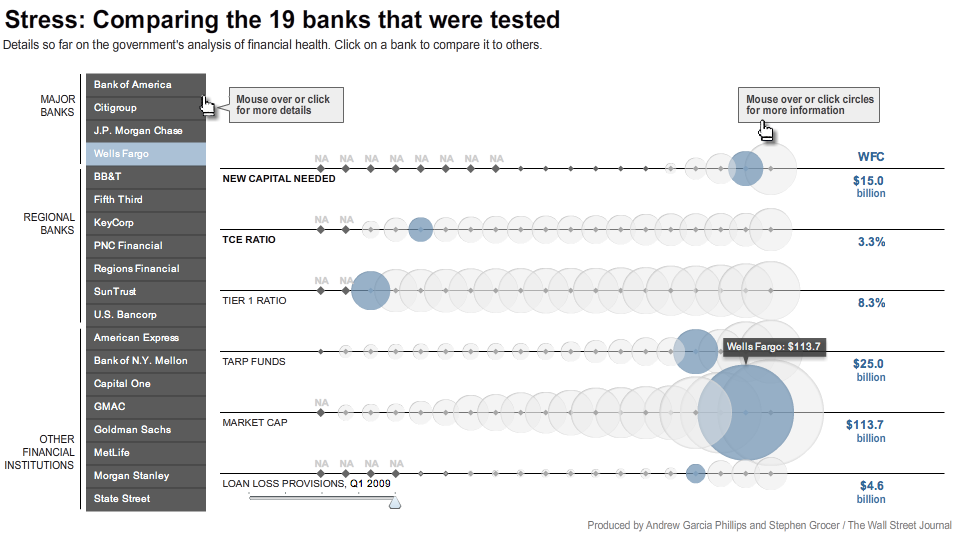
Stress Test: Compare Banks Tested
>
>
Source:
Banks Won Concessions on Tests
Fed Cut Billions Off Some Initial Capital-Shortfall Estimates; Tempers Flare at Wells
DAVID ENRICH, DAN FITZPATRICK and MARSHALL ECKBLAD
WSJ, May 9, 2009
http://online.wsj.com/article/SB124182311010302297.html :



May 9th, 2009 at 6:04 pm
You got to wonder why they even bothered if all the banks “need” is a lousy $75B more. Don’t they still have $350B to play with? This was all a grand illusion for the world’s purpose, to instill confidence back into the minds of the masses. In other words, these guys are just f**kin’ with our heads… And I for one, am getting tired of it.
May 9th, 2009 at 6:15 pm
Just got around to watching Ariana Huffington interview Elizabeth Warren on CNCB (when they finally got Joe Kernal to stop interrupting).
They referred to Bernanke & Geithner’s lack of transparency in responding to the Stress Test as “Don’t Ask, Don’t Smell”.
May 9th, 2009 at 7:43 pm
http://www.bloombergnews.com/apps/news?pid=20601068&sid=apuGP0Cp.XrI&refer=economy
I wish they would call on Warren for this gig.
~~~
BR: This is a badlink — what article were you referencing?
May 9th, 2009 at 8:41 pm
the QOTD:
“Practical men … are usually the slaves of some defunct economist.” —John Maynard Keynes
while this topic, is, seemingly, Finance-related, it shows, in stark detail, a prime example of our Poli-Sci-Fi “Economy in motion.
and, for the Poli-Sci part, we owe a Debt to the author of yon’ QOTD, JMK, his ownself.
as an aside, people forget/never learned that JMK was noted, by those who knew him, for a marked sense of humor. Too bad, for us, we mistook him for an Economist..
See John Maynard Keynes
May 9th, 2009 at 9:18 pm
http://www.alaron.com/energy_report.aspx
excellent analysis by phyl flyn,
seems like the FED magic is starting to work, getting the comodity complex moving,
time to be bullish !!
May 9th, 2009 at 9:18 pm
Headed out the door but thought this was good: Institutional Risk Analyst
“Mortgage Duration Risk: The Banks are no Longer the Problem”
“Next comes dealing with the dysfunction in the non-bank market for securitization and financing, the real battle to save the US economy from a truly dreadful year-end 2009 and beyond.”
~~~
BR: Note: Chris publishes here regularly
This was in the Think Tank last week:
Mortgage Duration Risk: The Banks Are No Longer the Problem
May 9th, 2009 at 10:37 pm
The stress tests are nothing more than an exercise in mass-delusion. It should be obvious to anyone with half a brain that anything other than a happy result would have caused a panic. This refusal to honestly confront a worse-case scenario is keeping with the complete lack of integrity in all of our bloated, rotting, dysfunctional institutions. See you at SPX 150.
May 9th, 2009 at 11:26 pm
I have a question about your “blog”. At what point does your blog cease to be a commentary ‘on’ the news, and just start being a copyright violating re-print of the news?
This copy-paste of WSJ graphics isn’t exactly an impressive piece of blogger-insight, Barry. It’s pretty much just stealing someone else’s intellectual property. (And from a site that charges for access).
My question is: How do you define blogging, Barry — and what service exactly are you performing when you just reprint someone else’s work with zero criticism, commentary or analysis?
May 9th, 2009 at 11:44 pm
check it out. Dick Durbin video interview : banks own the place.
http://www.pbs.org/moyers/journal/05082009/watch.html
May 10th, 2009 at 12:33 am
Hey popo:
Do you own the copyright to these charts? Are you aware that there is, in fact, a copyright infringement? Do you know, for a fact, that the charts are stolen? Are you aware of any arrangements BR might have with the WSJ, or did you just come in here and start libeling him? BR did provide criticism – he said the charts were good. He said where he got them. Why don’t you just shut the fuck up and mind your own goddamned business?
Does that answer your question?
Ya’ freekin’ dickweed.
May 10th, 2009 at 4:19 am
You guys are perplexed by the market rally and all this talk of a turnaround. Its all about the short squeeze in credit. Bearish bets are being unwound which is throwing off waves of liquidity. Doug Noland calls it the government finance bubble. Its basically the dynamics of the crash running in reverse as many financial charts are the ones from the crash turned upside down. You will soon see the numbers improve dramatically as this liquidity floods the economy. The bump in the economy is a given, the only question is it sustainable? Most likely not, as the economy will need ever greater amounts of credit, and one day the short squeeze in credit will end. Then things will get complicated. The Japanese had numerous false dawns and we have a doozy in progress.
May 10th, 2009 at 8:20 am
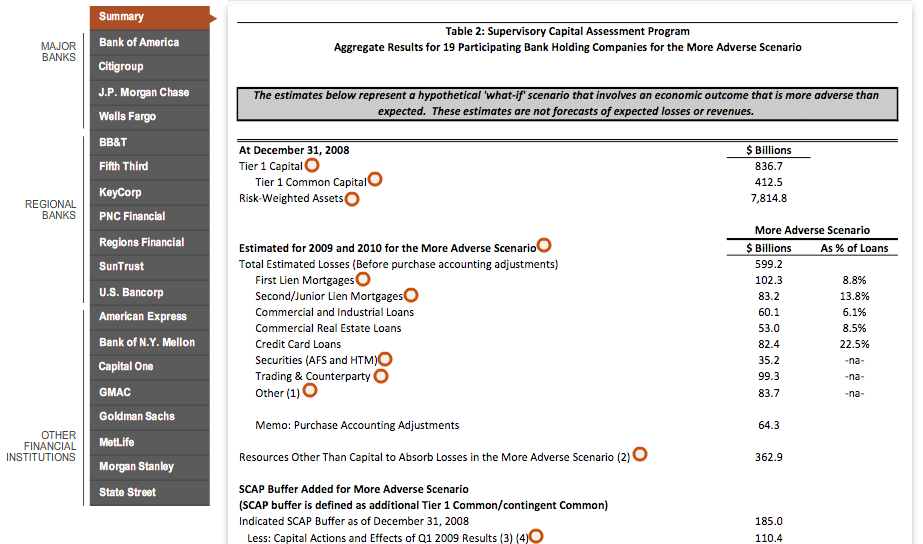
Regarding the “stress” test, look @ Table 2: 1) Memo: Purchase Accounting Adjustments $64.3 billion and, 2) Resources other Than Capital to Absorb Losses $362.9 billion.
Is the implicit assumption for the Fed to maintain a 0% fed funds rate & maintain the $trillions in lending programs? Are the SIVs & Toxic assets all good??????
May 10th, 2009 at 11:18 am
I can’t find anyone on the planet (excepting a certain cadre of long-side cheerleaders) who think the stress tests were anything but a joke.
So, if they were nothing but sound and fury, how come Mr. Market liked them so well?
Being an Occam’s Razor guy, I can’t give a lot of credibility to the theory it’s a jam-job perpetuated by Government Sachs.
May 10th, 2009 at 5:00 pm
Marcus,
I’m an intellectual property lawyer, and you’re clueless.
Have a nice day.
Popo99
May 11th, 2009 at 12:47 am
Well, I opened an account with TCF bank yesterday (a Saturday mind you,) and I am also pleased to notice TCF bank is not on the chart. Fifth Thirds bank is. I will soon be closing my accounts with them.
That’s about all I can do about that chart. There may be other customers acting likewise. I would like to think that some banks might still out-compete the zombie banks.
May 11th, 2009 at 8:15 am
The WSJ article that these charts were attached to points out that the banks got substantial reductions in their capital shortfalls, CITI and BAC alone would have needed about another $50B. Fed & Treasury as investors in these banks are inherently conflicted. This stress test was a confidence building exercise to bring in as much private investment as possible
http://online.wsj.com/article/SB124182311010302297.html#articleTabs%3Darticle
May 11th, 2009 at 8:22 am
The gift of eternal life for GMAC
http://seekingalpha.com/article/136890-gmac-biggest-stress-test-loser-but-leads-a-charmed-life
The US will cover the bulk of the GMAC 13B shortfall
May 11th, 2009 at 10:39 am
The stress in this test is absurdly low, but I guess they didn’t feel ready to see any of them fall at this time. Particularly for the “to big to fail” size banks the requirements should be a lot more stringent. Smaller banks who presumably will not take down “the system” if they fail should be allowed a higher level of risk. But the bigger the bank the more capital and security should back it.
May 11th, 2009 at 12:23 pm
Washington has indeed fixed the solvency problems of the large zombie banks — not with additional capital or stress tests, as many of us seem to think. Rather, the banks have been stabilized by turning them into GSEs via FDIC guarantees on their debt. Those banks which can end their dependence on federal guarantees will be the visible winners in the post stress test market, and valuations and spreads will reflect this divergence between zombies and viable private banks.
Seen from this perspective, Chrysler, General Motors (NYSE:GM) and the large banks are GSEs rather than private companies, parestatales as they know them in Mexico. To talk about a rally in the equity of large US financials seems truly ridiculous, at least to us, especially true when you look at how the public sector subsidies being applied to the banks have distorted their financial statements.
Maybe by the end of next year, when we know which banks can or cannot shed the need for government subsidies, then we can talk about investible equity in these GSEs. To that point, turning Bank of America (NYES:BAC), Wells Fargo (NYSE:WFC) and Citigroup (NYSE:C) into GSEs was just the first battle, Vol. II of the Lord of the Rings, to use another cinematic metaphor. Next comes dealing with the dysfunction in the non-bank market for securitization and financing, the real battle to save the US economy from a truly dreadful year-end 2009 and beyond.
Read the whole thing >
And of course, that worked out so well the first time. What coul dgo wrong this time around?
http://www.businessinsider.com/we-are-all-fannie-and-freddie-now-2009-5