
Can the Fed Execute a Perfect Landing ?

Email this post Print this post
By Barry Ritholtz - June 7th, 2009, 9:27PM

Cool chart in tomorrow’s WSJ on various scenario outcomes that could impact the economy, markets, etc.

Nassim Taleb described this at our conference last week as trying to land a plane in heavy fog on a runway with mountains on one side, and the ocean on the other. If the Fed is perfect, it avoids double dip recession, deflation or runaway inflation. Taleb is not betting on any specific outcome — neither hyper-inflation or deflation — but rather, that the macro-economists at the Central Bank simply won’t get it perfect.

In other words, what are the odds that the Fed nails the dismount . . . ?

>
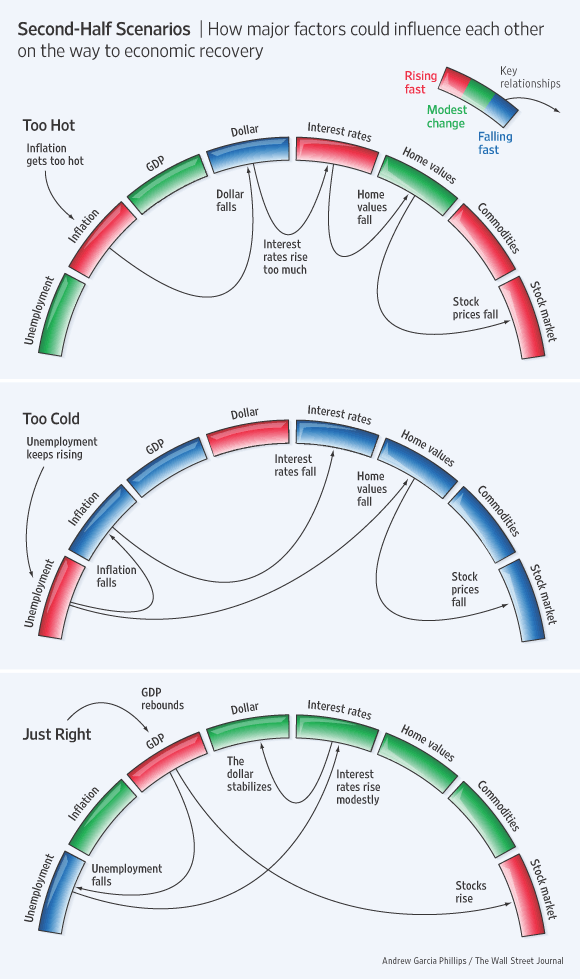
recove_ns_20090607193751

>

Source:
Land Mines Pockmark Road to Recovery
MARK GONGLOFF
WSJ, June 8, 2009

http://online.wsj.com/article/SB124442326661992487.html

31 Responses to “Can the Fed Execute a Perfect Landing ?”

  1. Mannwich Says:

    Viva la Goldlilocks! How long before Larry trots out that saying again?

  2. Steve Barry Says:

    There was a bird strike…it was the Black Swan.

  3. cvienne Says:

    “Nassim Taleb described this at our conference last week as trying to land a plane in heavy fog on a runway with mountains on one side, and the ocean on the other.”

    The major problem with the Fed was that they decided to put the damn airplane in the air in the first place…So if they’re faced with this sort of landing scenario, well, I bet someone is sitting there wishing that they’d stayed on the tarmac to begin with…

    Happy Landings!

  4. rootless_cosmopolitan Says:

    What is Barry talking about? Why the emphasis on “the Fed”? Where does the Fed appear in the graphics? I don’t see it. Could someone explain, please?

    rc

  5. DM RTA Says:

    With the exception of gas prices heating up again in the short term, is there anyone seeing anything to suggest that overheating in the short to medium term is really likely?

    In the past few days I’ve heard about half price lake house rentals, cars $6000+ off sticker, 2fer coupons for local restaurants, and small seasonal businesses not seeing many summer pre-bookings. What’s being stimulated?

  6. Pat G. Says:

    “In other words, what are the odds that the Fed nails the dismount . . . ?”

    A better question is; how many times has the FED gotten it right in the past? History tells us; not very often. Sorry, gotta take the historical odds here. And since they’re in unchartered waters, this landing will prove to be their greatest challenge due to its complexity.

  7. Swampfox Says:

    Perfect landing? Isn’t that the Fatal Conceit.

    In regards to someone asking how we record high p/e (in a downturn) while simultaneously at a record high debt/gdp can end well … I’ve come to the belief that asset deflation is in, in a way:

    Everything the middle class needs will be going up in cost, while everything they don’t need will be plummeting.

  8. super_trooper Says:

    Sounds easier than Kai Tak airport. Let us first take a moment and be happy that Greenspan isn’t piloting this Airbus 330. Who said flying was cheap? I have faith in Bernanke, as been noted here before, Bernanke knows what to do when you’re in/on your way into a depression. So far…….. so good……….. he’s avoided a depression and we’re on our way out of the statistical recession. In his academic mind it’s all set on autopilot.

  9. Swampfox Says:

    Correction: “how record high”

  10. VennData Says:

    So the Fed doesn’t do it perfectly, then they re-adjust and/or talk it the other way etc. With all of the policy tools they have, they can keep tweaking and refining. The airplane-landing analogy, like all analogies, misses the mark in some respect. The Fed can buy and sell bonds to their heart’s content. The Fed’s understanding is improving over time.

    The other thing the conventional wisdom has wrong is that you don’t need the housing market to turn around for the economy to start growing. With the growth in saving and then investment, the economy will do fine with a weakened house-price market. The reason is, housing isn’t an investment, so missing it is like missing any consumable. It’s better to redirect that capital to a productive return-generating investment, not a housing.

  11. Calvin Jones and the 13th Apostle Says:

    In other words, what are the odds that the Fed nails the dismount . . . ?

    I’ll take the bet against the Fed. What has Bernanke ever gotten right? Remember when he said the housing problem was contained?

  12. Swampfox Says:

    Wah? Here’s the problem for the Fed, the monetarists, the socialists, the Keynesians, and nearly everyone else the ivory tower econ world: human nature doesn’t follow a math equation. I don’t care if x=((b)(a+c)/y)(z). Human nature doesn’t follow that pattern. Good luck with the tweaks here and there.

  13. alfred e Says:

    No. They will not get it right. They have not got it right. Welcome to Bananastan. Simon Johnson is right of course.

    They are betting on hope and positive spin to juice consumption. Ooops.

    Sooner or later the banking day of reckoning has to happen.

    And as someone said above. The middle and lower classes will continue to get milked for all they’ve got.

    Seems perfectly reasonable to me after what we’ve observed recently that “Speculators” can drive certain prices as artificially high as they like.

    Just remember to moo.

  14. Cursive Says:

    “Can the Fed Execute a Perfect Landing?”

    Did Adam and Eve f^ck up the Garden of Eden?

  15. rootless_cosmopolitan Says:

    The underlying assumption of the question is already flawed. The assumption is that the Fed could “get it right” at least in theory applying the right tools and policies. That the Fed were able to be in control of capitalist world economy – this is the system with which we are dealing here – is equally a myth like the myth of “rational” or “efficient” markets or what is good for the American elites is good for everyone.

    rc

  16. newcreature Says:

    I read somewhere recently that the biggest challenge with, to use this analogy, the Fed landing the plane perfectly is that the key gauges they are monitoring are reactionary. In other words, when they see they need to cut power and drop the flaps, we have already passed the runway and are headed for the drink.

    This is certainly an interesting discussion. Hopefully someone can give some more detail on the scenarios above, the Fed’s likely reaction if they turn bad and the consequences if they are wrong.

    Mike
    <

  17. thetanman Says:

    Japan Air Lines Boeing 747 crash was gruesome, but the finale flight pattern was a fascinating study in chaos. For hours the plane followed a roughly sinusoidal flight path. Then, for no apparent reason, it dipped like it had dozens of times, but instead of turning back up, it plunged. Literally it fell out of the sky. That’s what happened to the economy in 1930. Things deteriorated so fast, that everyone was stunned. If you believe that 1929 is an analogue of today, then expect things not to roll over, but plunge. Personally I am skeptical.

  18. Swampfox Says:

    @venndata

    As for housing, how old are you? Do you really think the massive wave of retiring boomers is going to sell their houses to the next generation at today’s prices (let alone 2006 prices)? Less than 20% of this year’s college grads have jobs lined up right now, which is down from 50% in 2007 having jobs lined up by graduation. The next generation is already in debt up to their eyeballs coming out of school compared to previous generations with little hope of employment and little hope of living a better life than their parents since they’ll be footing the bill for all of the unfunded liabilities.

  19. Paul Jones Says:

    Inflation is the debtor’s salvation and the populist’s friend.

    America is a nation of debtors and a quasi-democracy.

    No attempt will be made to “nail the landing”.

    We will inflate.

  20. aitrader Says:

    Continuing Taleb’s airline analogy I’d say the pilot missed storm clouds completely and flew directly into them – denying they were there until it was nearly too late. When the plane iced up and nearly fell out of the sky he finally began running through emergency procedures. At this juncture the plane is still flying, barely, but only the most highly liquored or medicated passengers have even scant confidence in his ability to land the plane safely.

    If he does land safely I’d chalk it up to pure luck. Sure, it could happen, but it isn’t likely given the pilot’s performance to date. A more likely outcome is a semi-controlled crash with loss of life somewhat less than all passengers and crew. In other words a disaster but not one of epic proportions.

    One the other hand there is the distinct possibility that another unforeseen emergency could pop up. Black swans, at least according to Mandelbrot, tend to cluster. Call it an engine flame out, radar failure, hail, geese, etc etc. How will a pilot that couldn’t foresee or handle the first issue deal with multiple problems in a constrained time frame?

    I’d say a complete crack-up is certainly within the range of reasonal possibility. I’d certainly not bet against it.

  21. Mannwich Says:

    Things looking green shooty in the airline industry? Is this better than expected?

    http://www.bloomberg.com/apps/news?pid=20601087&sid=aQSs9CGd9Auc

  22. Can the Fed Execute a Perfect Landing? Says:

    [...] Courtesy of The Big Picture [...]

  23. Marcus Aurelius Says:

    For a dead cat, every “landing” is perfect. It’s impossible fore something to crash incorrectly. Perfect 10, every time.

  24. Moss Says:

    The problem is relying on the Fed to land. Once on the ground we should revoke the flying license.
    Since abolishing the Fed and other Central bankers is not realistic within our political confines something must be done so that this institution can no longer manipulate money via interest rates and reserve requirements. I am not sure what but something. This boom, bust BS is no way to run an airline.

  25. Entrepreneur Says:

    “Can the Fed Execute a Perfect Landing?”

    - No.

  26. » Economic News Odds and Ends 8 June 2009 Redfish Emerging Markets.com: Helping Good Investors Make Better Decisions Says:

    [...] Can the Fed Execute a Perfect Landing? – The Big Picture [...]

  27. constantnormal Says:

    Seems to me that the diagrams are missing an important element — the intervention/manipulation of the markets (stocks, bonds, commodities, dollar) by various “interested parties”.

    With trading activity as low as it is, you don’t need murky conspiracy theories to see movement of the markets.

    PIMCO and GS are just as capable of tilting the table in their favor as is the Treasury or the Fed, and do so on a daily basis. The “normal” end-of-day upward spike is proof enough of that.

    I don’t think that this sort of activity alters the outcome, but it does change the timeline.

    So in addition to attempting to land the jet in heavy fog, with mountains on one side and the ocean on the other, we have the added burden of gremlins on the wings, monkeying around with the control surfaces.

    Oh — and the pilot is on his first flight in this type of aircraft.

    Oh flight attendant! More booze and snacks please, I have my credit card ready.

  28. leftback Says:

    Housing prices will continue to supply in the absence of Zimbabwe style printing. Supply and demand.
    The debt mountain cannot be levitated indefinitely, the interventions will only delay the collapse.

    As mentioned above, a semi-controlled crash, where a few people walk away intact.

  29. leftback Says:

    continue to decline…

  30. leftback Says:

    “Black swans, at least according to Mandelbrot, tend to cluster”

    Not even necessary. The issue that people forget that time is eternal and that p(squared) is therefore > 0.
    In addition, if the black swans are not truly independent, then there may be a higher probability of clusters.
    Obviously, subprime, Alt-A, CRE are not independent black swans.

  31. Lord Says:

    Shouldn’t Too Hot have Stocks rise red; Stocks fall red is a contradiction.